They called it “The Sevepenny nightmare.”
Some works of art achieve immortality for their quality, some for being stepping stones in the way for something greater, some for being spectacularly bad, and some… for being too much. Too violent, too sexual, too dangerous. Inevitably, as these works become part of the general milieu of culture, we forget that people ever treated them as such. When it came out, Ulysses was a controversy magnet; check out Kevin Birmingham’s The Most Dangerous Book for the un-lurid details. It was feared that it would corrupt any adults who opened its covers. Today, it’s just another one of these big classics that people pray their kids would read instead of playing some violent video game1.
Yesterday’s controversy is today’s normal. If you try to sell today’s audience yesterday’s video nasties, they can probably tell you there’s worse stuff on prime-time television. Which isn’t to say none of these works has any value beyond blood and titillation, but we tend to remember the blood and titillation. Case in point: Action, the comics. No, not Action Comics. Action was a 1970s British comics anthology; most anthologies of that time had a single theme (war, sport, romance, horror), and Action’s theme was violence. It would have crime stories, military stories, spy stories… all kinds of stories as long as the creators promised to turn the ‘blood’ dial up to 11.
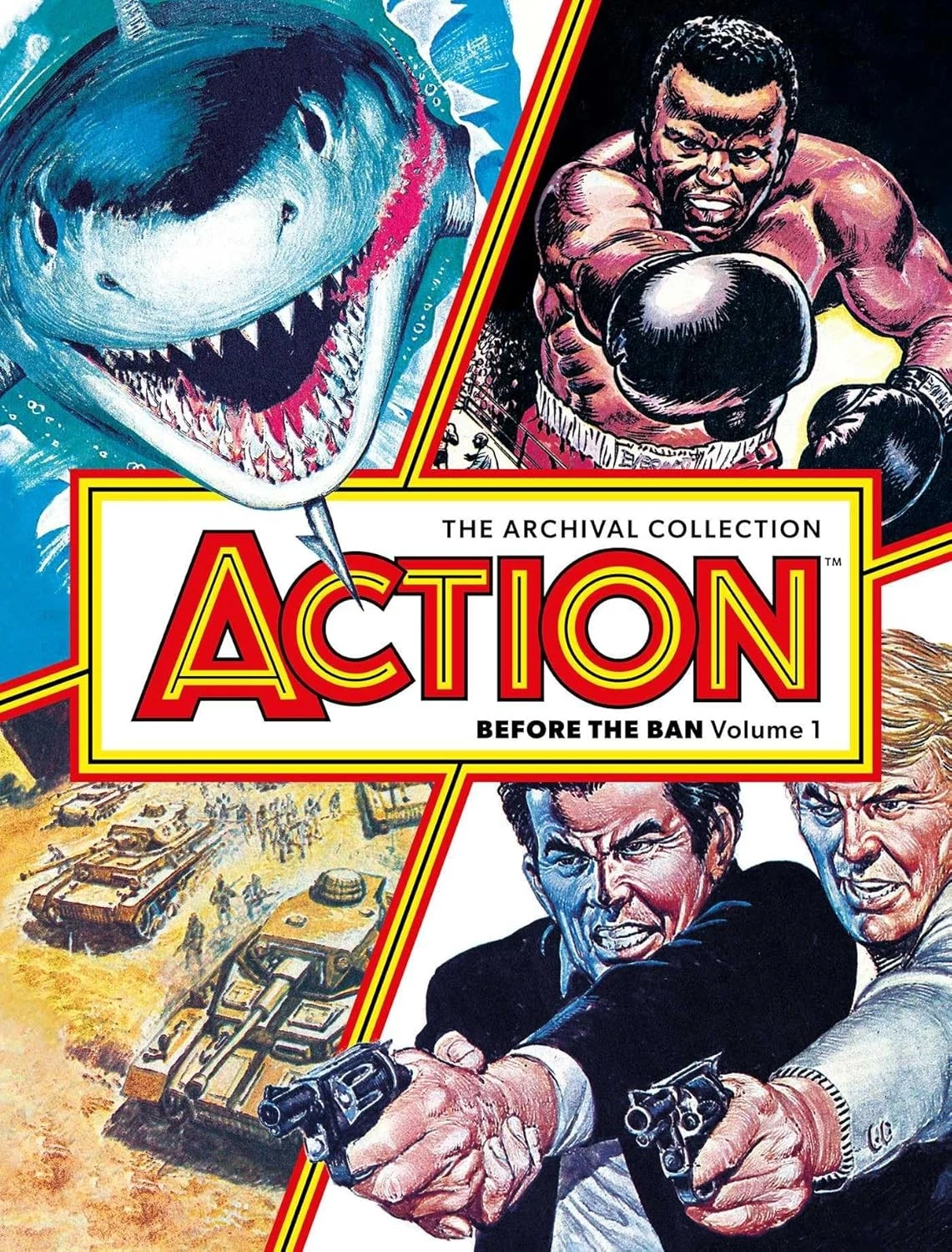
For quite a long time, this work existed only in limited forms; either you went bin-diving in the United Kingdom or waited for the occasional and limited-scope reissue. The long-out-of-print Action: The Story of a Violent Comics contained a decent chunk of strips – but that was pretty much it for the longest time. Well, you need to wait no more. Rebellion (which also owns The Library of British Comics) is bringing it back in a series of hardcovers. The first of which contains issues #1-12, and I do mean the full issues – including letters and the wonderfully ridiculous editorials2.
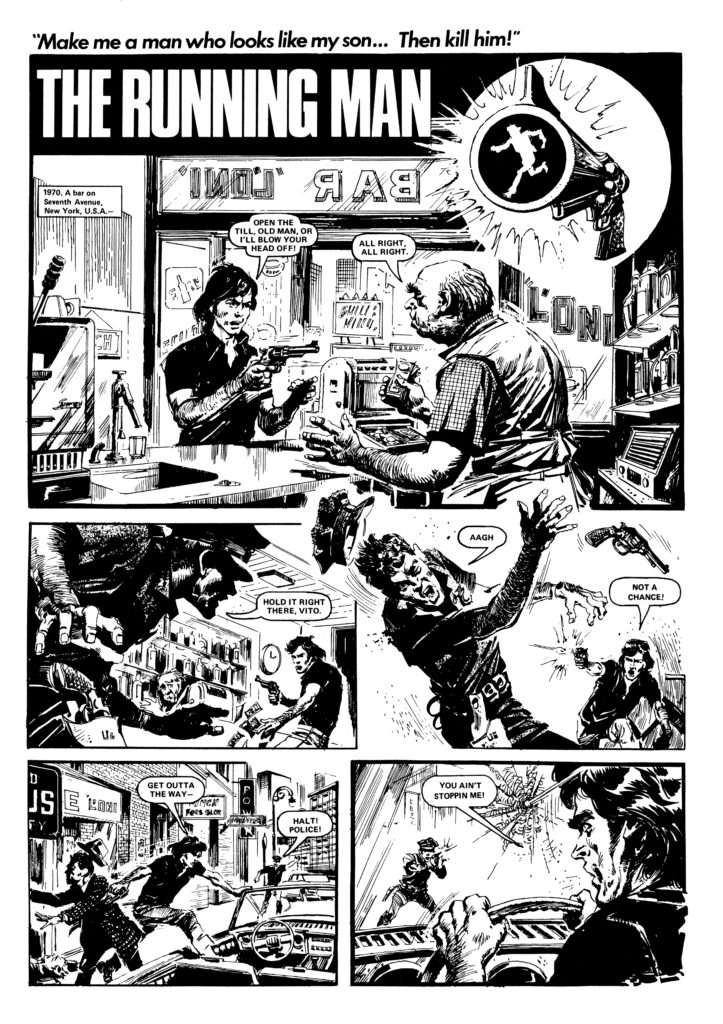
Historically, the short-lived Action is significant for two reasons: First, it helped to set the stage for the more successful 2000 AD3; second, it broke the glass ceiling for violence. Most mainstream British comics from the 1970s were pretty tame compared to their American counterparts. Even stuff that stood out on the British shelves, like the truly excellent Charley’s War, was more due to emotional pain rather than on-page viscera. heck, they were tame compared to American comics from the 1950s. Action was trying to up the ante. The Pat Mills / Ramon Sola penned Hook Jaw, a Jaws rip-off, was the most notable example – a bunch of greedy humans popped on the page to be torn apart by the titular shark. This strip usually got one color-spread each issue, and it was guaranteed that the dominant color would be red. Likewise, a Fugitive copy4 called The Running Man had one story in a ski resort ending with the villain flying inside a massive snow blower and emerging outside in black and white chunks. It’s pretty great.
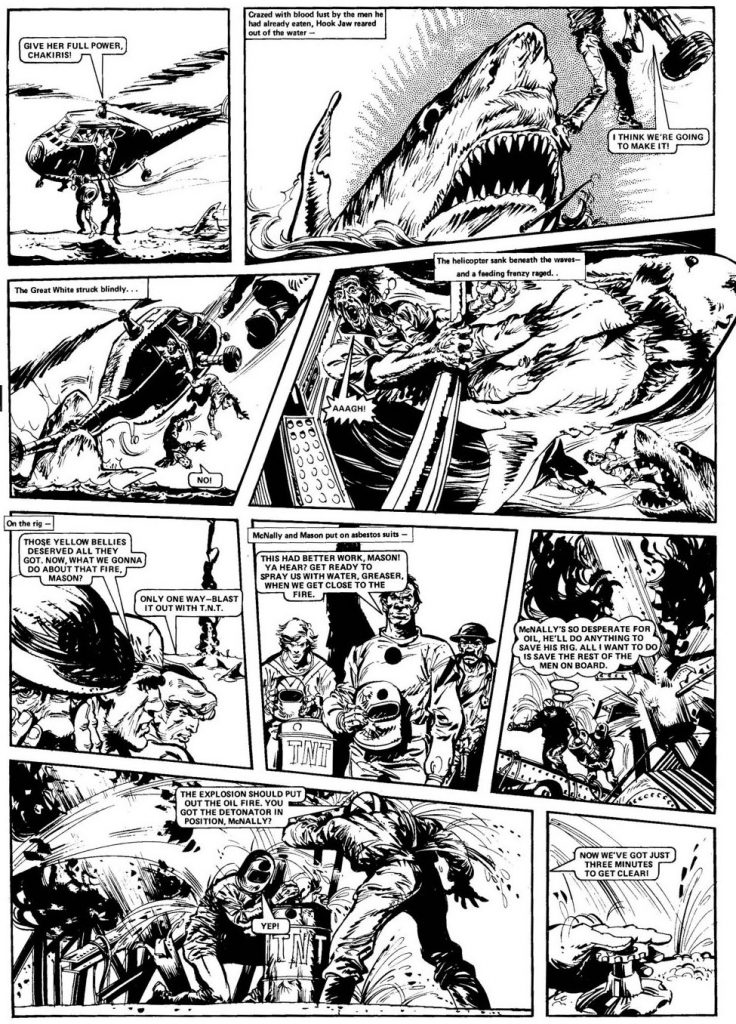
Yet there is more to Action than bloodshed bolted on top of generic British stories. Hook Jaw, for example, has that genuine Mills’ misanthropy – the reader cheers for the shark, as ninety-nine percent of the humans in the story are filthy industrialists who will sell their mother for a dollar. It’s a story about greed, capitalism run amok, and environmental destruction – all told in three-page chunks (and with a lot of human chunks). The John Wagner-scripted Blackjack, a boxing strip with a great hook (our hero is slowly losing his sight and must reach the championship before going completely blind), had a genuine desperation built into it. Every strip brought the hero closer to the inevitable end of his career. Even as he won one battle after another, the end was just around the corner.
Likewise, the frantic Running Man with a British hero framed for murder in the USA and ending up on the run from both police and the people who framed him, a Hitchcockian story of alienation told with the explosive energy of a 1970s exploitation movie. Like many British comics of the period it ends as unintended commentary on the USA which becomes a commentary on the UK: in painting a picture of America as a sprawling land of endless violent encounters, everyone is armed and every spot is a protentional death trap, the creators paint a picture of a panicked former Empire looking with eyes wide open at is replacement: ‘This is the new global hegemon?!’ they seem to ask.
At its best, Action feels topical for the 1970s in a way that still resonates today. Sport’s Not for Losers, terrible title aside, feels like something that could be revived today as a sports manga: Though its class-politics probably mean little for readers outside of Britain, there’s something in the story of a ne’er-do-well teen who discovers that he has a genuine talent for sport – that he has absolutely no desire to develop. The tension with his brother, a person of genuine will who is simply physically unable to perform after an injury, makes for endless variations on the formula.
At its worst, Action sacrifices good ideas for formula performance: The Coffin Sub is the story of a WWII submarine captain who survives while his whole crew dies. When the sub is brought back to duty, he finds himself commanding a new crew and struggling with a new sort of fatalism that (ironically enough) allows him to survive one impossible mission after another. It’s a good idea, a great idea even, but this is where the rigid structure of British comics hit it like a brick. At three-to-four-page installments, there simply isn’t any room to develop the psychology of the character; he’s like a robot repeating the same basic notion in each strip, surrounded by cyphers. The other WWII strip in this collection is both better and worse.
Better, because Hellman of Hammer Force is focused on the more visually exciting world of tank warfare, allowing for a story that is always on the move. Worse, because instead of turning up the ante in terms of gore, the creators decided to shock their audience (or, more likely, their managers) by focusing the strip on a German officer. These days, a World War II story with a German lead isn’t such a rare thing – there’s a whole sub-section of Garth Ennis’ oeuvre dedicated to such stories – but back in the day, this wasn’t done. Some of the people working on the comics fought in the war, certainly almost everyone working on this had a living memory of it. This was daring in idea but not in performance. Speaking of being topical in a bad way: Hellman of Hammer Force buys directly into the Myth of the clean Wehrmacht, with Hellman making sure they fight the war ‘honorably’ as well as telling the readers that he isn’t a Nazi over and over again.
Gerry Finley-Day, creator of a dozen war stories before and after, simply reverses the kind of story he did before. Hellman is just a generic ‘fatherly officer’ character that simply happens to put on the uniforms of the Panzerwaffe. While I sometimes find Ennis’ German war stories annoying when their message becomes a generic ‘dignity of the soldier, if not the war,’ he really can’t seem to stop and thank everyone for their service, his tales are at least willing to reckon with the horrors of war. The point of them is that people can only consider themselves ‘honorable’ as long as they are blind, and that they will make themselves willfully blind. In Hellman, war is as clean as the Wehrmacht, aside from some nasty Gestapo men whose worst sin appears to be personal dislike of the protagonist; no attempt at increasing the action can cover how misguided the whole affair is.
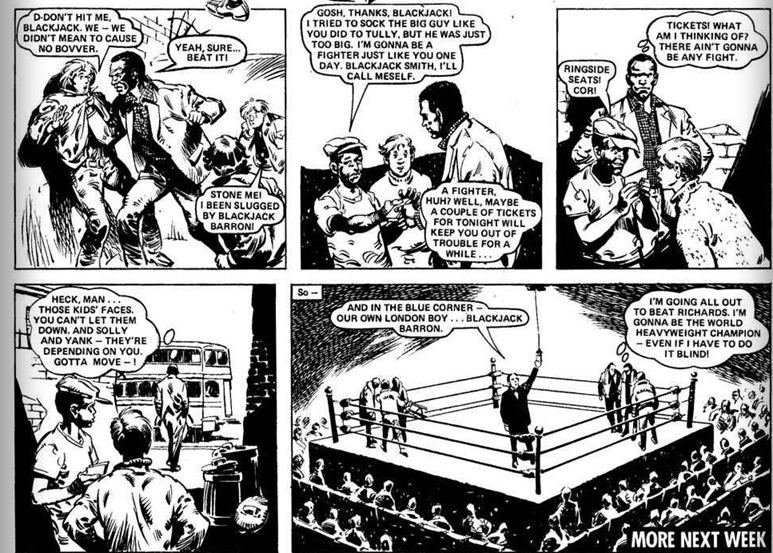
As a whole, Action cannot seem to quite fully escape the pull of its own history. All that black-and-white blood cannot quite wash away the formula. This wasn’t comics punk, a bunch of young ruffians kicking at the system; this was a group of professionals with established history, trying to be controversial without being too controversial. They ended up failing at that – with one cover featuring a prone man mistaken for an officer, apparently the result of a coloring error. The comics was publicly attacked and forced to tone down its content, basically the same story with comic panic in America played in miniature. Even when creating something genuinely daring, they did it by mistake.
If Action is ‘too much’ of something, it is too much of its time. There are bright (red) spots, and for the historically curious, it is a vital missing link in the timeline of British comics, but the whole thing mostly reminds me that the same people would do better with slightly similar material just one year later. Maybe it was the distance of science fiction, allowing them to portray ridiculous action outside the bounds of reality, maybe it was the format (allowing for more pages per story), maybe it was a matter of experience – having been publicly burned once, Mills and Co. learned how to toe the line without overstepping it. I believe it’s because 2000 AD wasn’t created with the intent of shocking its audience; it was made to tell stories, some of which ended up being shocking, but in a manner that feels organic to the story rather than throwing a coat of red paint over the back and white art. Sometimes the system needs a good shock, sometimes. There is a reason 2000 AD is still being published in 2026, while Action is another (sevenpenny) nightmare in history.
SOLRAD is made possible by the generous donations of readers like you. Support our Patreon campaign, or make a tax-deductible donation to our publisher, Fieldmouse Press, today.
- I am showing my age here, I don’t think I’ve seen ‘violent video games are corrupting are youths’ headline in the wild for over a decade now. ↩︎
- British anthologies loved their mascots and silly prizes; in a move that probably won’t pass muster today, Action had ‘Money Man’ who would have a preplanned appearance in certain cities, who would give away money to the first few readers who spotted him. Yep, encouraging children to walk to some strange man in the street and ask for money, sounds legit. ↩︎
- Pat Mills, one of the main creative forces on Action, was the first editor and one of the leading writers of 2000 AD. Other names that jumped ship with him – John Wagner, Gerry Finley-Day, Massimo Belardinelli and many more ↩︎
- Many, though not all, strips were causally borrowed from popular films and TV shows – some of which didn’t even come out in the UK as the magazine went into publication. A trend Pat Mills carried with pride – 2000 AD was launched as a science fiction magazine on the back of the first Star Wars film, even though it had yet to come out. Whatever you say about Mills, he was good at spotting a trend forming. ↩︎
Leave a Reply