In his short story “The Flash,” Italo Calvino writes about a moment of violent, jarring recognition: that nothing in the human world quite makes sense, and that its collectively-agreed-upon concepts are all entirely arbitrary. This recognition occurs in the middle of the crowded street, and the narrator simply cannot explain himself, cannot explain the gravity of his realization. And so, where Calvino’s narrator sees arbitrary chaos, the crowd sees perfect cohesion:“‘So?’ people asked, ‘what do you mean? Everything’s in its place. All is as it should be. Everything is a result of something else. Everything fits in with everything else. We can’t see anything absurd or wrong!’”1
Soon, the narrator settles back into conformity. Everything makes sense to him again. This torments him, as for a moment he had managed to see, by way of elimination, another way of existing, but he remains comforted; someday, he hopes, he might find “that other knowledge, found and lost in an instant.”
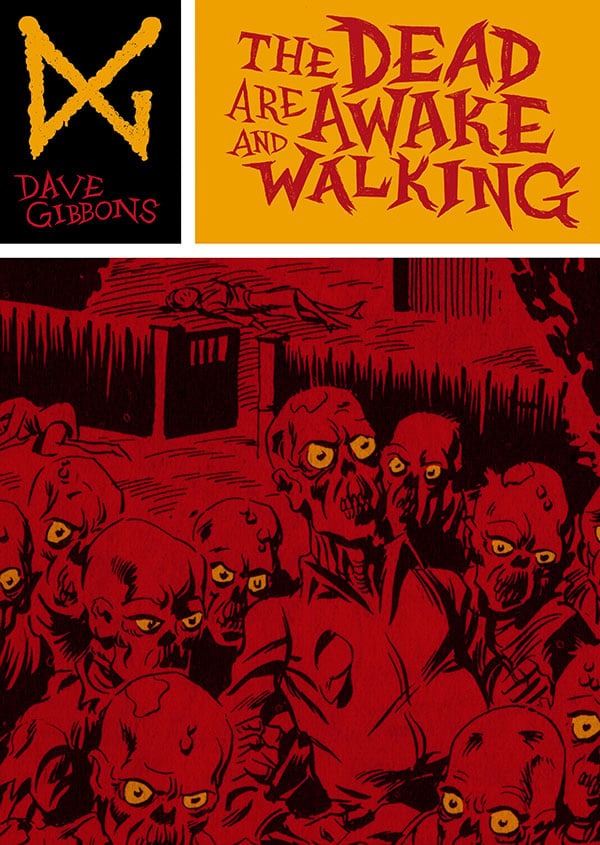
Enter: the dead. In 1971, as part of its Pocket Chiller Library series of horror comics, the British publisher Fleetway released The Dead are Awake and Walking. Last November, the London-based archival outfit Dark and Golden, operated by Tom Oldham (of Breakdown Press and Gosh! Comics) and Douglas Noble (of Strip for Me and A Pocket Chiller), released a new edition of The Dead are Awake and Walking, the first reprint since its original release. In the new Dark and Golden edition, a crucial detail is added: its artist — one Dave Gibbons, in his professional debut — was credited. (The writer remains unknown.)
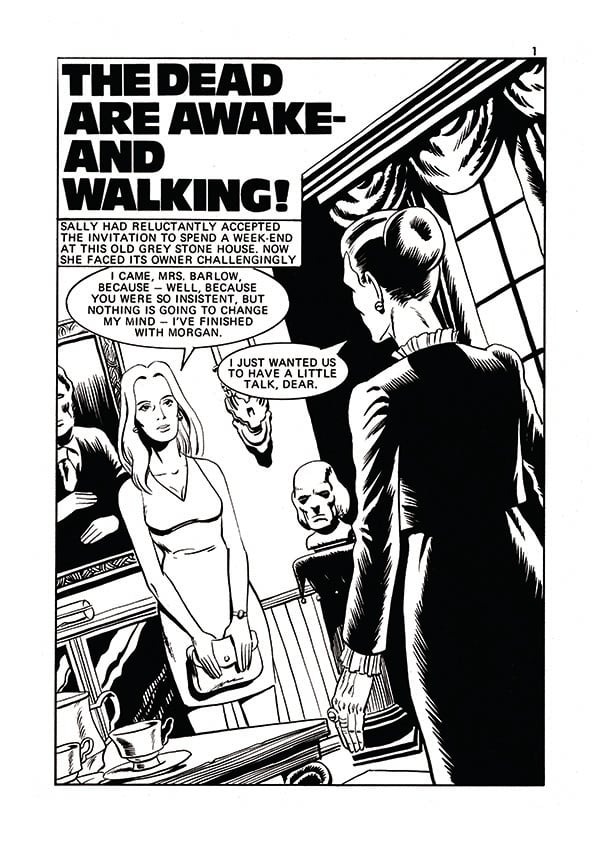
At the center of the story is Sally, a young woman who has broken up with her boyfriend, Morgan. In an ostensible last-ditch attempt to convince her to take him back, Sally is summoned to speak with Morgan’s mother. It is soon revealed that Morgan committed suicide following their breakup, and that his mother intends to put the family’s interest in the occult to good use by bringing him back to life. What ensues is, in essence, a prolonged chase: Morgan’s mother brings more than just her son back to life, and Sally must flee the flock of shambling corpses.
To understand the significance of The Dead are Awake and Walking and its artistic context, a brief lesson in British comics history.
Fleetway’s Pocket Chiller Library (from which Dark and Golden co-founder Noble has borrowed the title for his own curated line of horror mini-comics) was part of a whole slew of pocket-sized titles (see also the war-stories venue War Picture Library, or publisher D.C. Thomson’s sci-fi series Starblazer) that served as a somewhat more mature alternative to anthology magazines, offering up one long comic story rather than a rotation of shorts and serials delivered weekly in two-page increments. In light of the diminutive format, pages were relatively airy — no more than two or three panels per page, compared to the magazine average of eight or nine. In both British anthology magazines of the era and long-form series like Pocket Chiller Library, installments were typically produced in a factory-like method to ensure continuous shelf-presence; the comics were commissioned piecemeal by an intermediary agent, with no direct collaboration or communication between the writer and the artist, and the creators went uncredited in the final publication.
In a recent interview with Mike Molcher, John Wagner — co-founder of 2000AD, co-creator of Judge Dredd, and writer of some of, to my money, the finest comics, certainly the finest genre comics, of all time — said, “Some people have a vocation as a writer and I don’t. It’s just something that I can do and I enjoy doing, but I never felt that I needed to be one. […] I don’t have this burning desire in me to be a writer. […] I just wanted to earn a living.” It’s a surprising comment from someone who’s been writing for upwards of fifty years, made even more surprising simply by the man’s stature, but at the same time I can readily understand him. Historically, in the decades-strong push-and-pull between comics-as-indulgent-artistic-expression and comics-as-populist-entertainment, the British scene has generally fallen on the side of the latter; indeed, 2000AD can easily be said to be the local lineage’s first ‘real’ rebellious streak, and that was a commercially-driven endeavor first and foremost. Efforts closer to the American underground, motivated by the desire to assert adulthood by force, were mostly pushed to the sidelines; even when they did find some lasting success and interest, in the ‘mature’ boom of the late ‘80s and early ‘90s, those titles — Deadline, Revolver, Crisis, Toxic! — were spearheaded by many of the same creators that appeared in 2000AD itself, and thus constituted more or less the venting of a repressed urge, designed not to rebel so much as to supplement.
Tempting though it may be to analyze the art-versus-entertainment dichotomy on purely aesthetic terms, the issue is first and foremost one of labor — self-individuation versus deference to the publication’s constraints. It may well be argued that the no-credit convention (eventually broken by 2000AD’s ‘credit cards’), was the material reality that dictated much of Brit-comics’ aesthetic sensibilities, and not the other way around, as the cohesion of the overall publication was prioritized far over the individual authorial voice, and stylistic uniformity reigned supreme. It was from this starting point that certain conventions — rigid panel counts, dry dialogue supplemented with largely-unnecessary captions, blank characters not driving the plot but driven by it — emerged, essentially eliminating the prospect of both individual style and thematic engagement.
When I describe The Dead are Awake and Walking as Gibbons’ “professional debut,” “professional” should be taken to mean ‘formally commissioned and paid for’ — a worthwhile distinction given Dark and Golden’s previous release Early Gigs, featuring Gibbons’ contributions to underground fanzines and anthologies from around the same time. This, then, is the lens through which The Dead are Awake and Walking — original edition and reprint — should be viewed: not the absolute first work of a now-lauded cartoonist, but rather the first time he was to grapple with the commercial system around him.
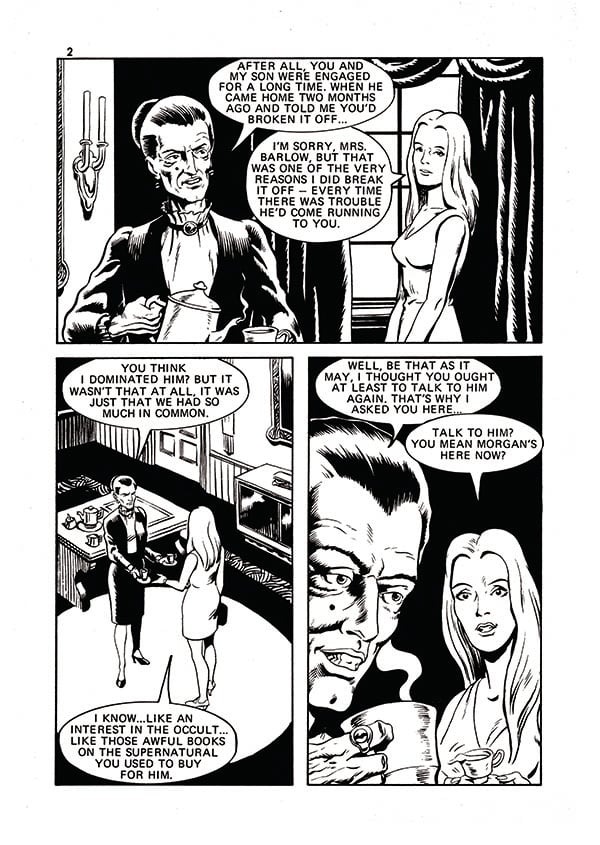
Although the contents of Early Gigs are clearly the work of a young artist, Gibbons’ stylistic thumbprint is still clearly visible, through the influence of the first generation of Kurtzman-era Mad — the balance between comically-exaggerated features and solid physicality. In The Dead are Awake and Walking, by contrast, Gibbons essentially disappears into a far stiffer affect; his penchant for textural detail gives way to an unrecognizably smooth style, which manages to feel both dated and, somehow, ahead of its time, evoking the ‘tamer’ artists of the second and third generations of 2000AD (Steve Yeowell, in particular, comes to mind).
I’ve already written in the past about that aforementioned stiffness of pre-2000AD Brit-comics, though my tendency has been to focus on the magazine side, where the sheer rigor of the format, with its density and its lifeless prose, left little room for individual attitude; each panel, each caption, had to move the plot forward, at a pace so fixed that its characters did not resemble people so much as metronomes. Longform series like Pocket Chiller Library typically suffered from the inverse problem — though they were afforded roughly six times as much narrative space2, their characters and tonal sensibilities remained largely unchanged. Stories thus felt protracted past the point of reason, bogged down by shallow, broad-strokes characterization and incorrigibly mannered storytelling.
On its face, The Dead are Awake and Walking is no different. Its premise, a foundation of pursuit-and-escape, is effective in theory, but in truth its settings are too dull and unvaried, and its characters too dull and undeveloped beyond their broad categories (‘victim,’ ‘assailant,’ and ‘set dressing’), to hold one’s interest; there is not a single word or image that does not feed directly into the progression of the plot, resulting in a flavorless, bare-bones utility, completely stripped of symbolism.
And yet — somehow — I find myself compelled. Let us look at the structure of the story. At first, Sally tries to escape, and when she makes it to safety, nobody believes her but her boyfriend John, who shares the same interest in black magic and cares about that more than he does about Sally. When her boyfriend dies because of that same black magic, she tries to escape; when she makes it to safety, nobody believes her, and she is placed in a psychiatric ward. When she is sent home, with a nurse to care for her, she manipulates the nurse in an attempt to bring both her now-dead boyfriends back to life; Sally dies, while the nurse, Jill, survives — but nobody believes what she saw. For a repetitive structure, it’s a surprisingly effective one: more than reanimated corpses, the real horror is a weaponized disbelief that slowly ripples outwards; Sally goes from victim twice over to perpetrator, freeing herself from the curse of incredulity by passing it onto someone else.
In this respect, formal stiffness manages, against all odds, to heighten the helpless tone through a process of mimesis. The narration, dry and explicative, robs the reader of the ability to experience the story for themselves; the mechanical lettering, applied artlessly as the final step in the production process for easy translation and localization, is tinny and unemphatic. Compounded with the characters’ over-acting, the result is not merely lifeless; it is a mockery of life. What comes to mind is Mary Bronstein’s If I Had Legs I’d Kick You: that dogged sensation that you are not in control of your own story, and that life is just a nightmare with no option of waking.
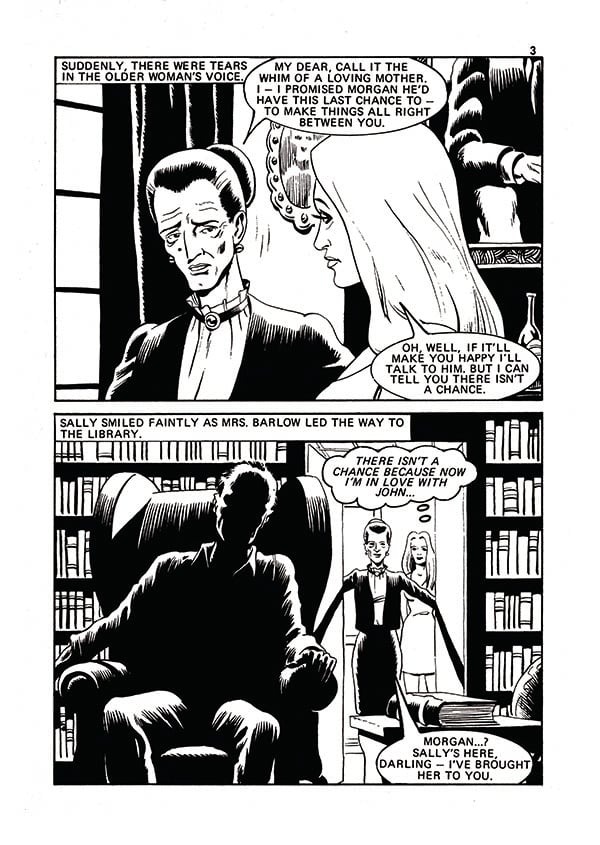
A fellow SOLRAD critic, who liked this book far less than I did, tells me that “we, as critics, tend to look for justifications even when these justifications are self-evidently unintentional.” He is, of course, correct. I do not mean to argue that The Dead are Awake and Walking is in any way designed to be a sharp work of meta-commentary. Gibbons, in his introduction, recalls the script as “64 pages mixing reanimated corpses and young women in their nightwear,” and indeed there is little in the comic itself to elevate it beyond this recollection; it operates entirely within the predetermined set of rules, with no hint of subversion or even of intent, to be read and soon forgotten. But, to the credit of the creative team, they have stumbled onto the one premise that works within, and perfectly complements, the format.
For Dave Gibbons’ published debut, he drew a comic that works entirely in spite of itself. The Dead are Awake and Walking sees, for an instant, that other knowledge, and even if that knowledge should, in an instant, be lost — well, at least it saw something.
SOLRAD is made possible by the generous donations of readers like you. Support our Patreon campaign, or make a tax-deductible donation to our publisher, Fieldmouse Press, today.
Leave a Reply