
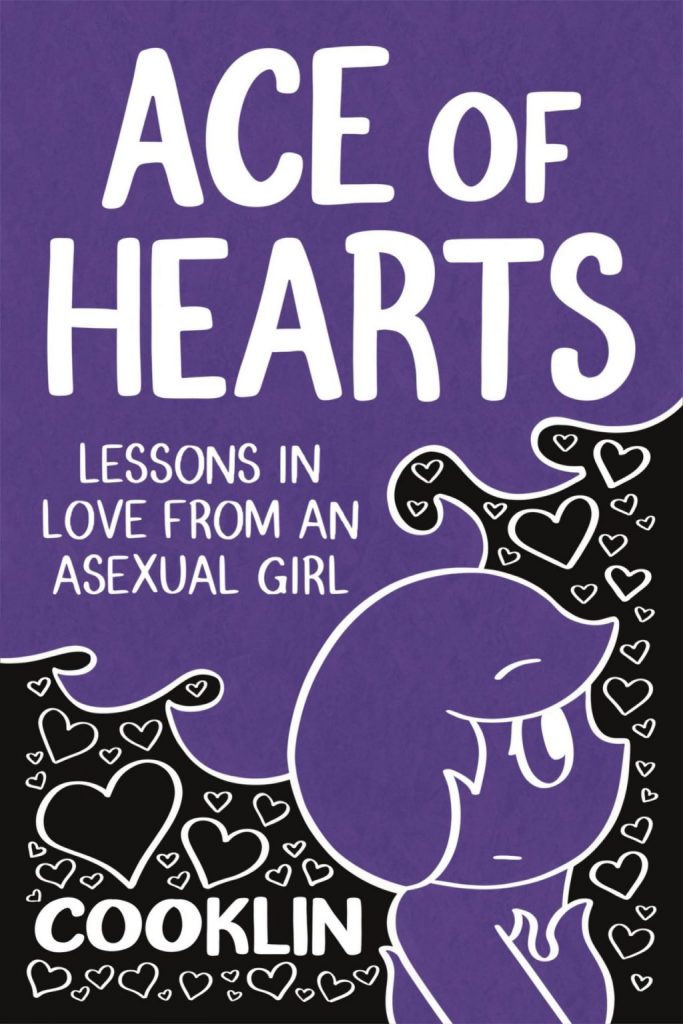
If Cooklin’s debut graphic memoir from Street Noise Press, Ace of Hearts: Lessons In Love From An Asexual Girl were to be represented by a single album, it would be the smash hit GUTS by Olivia Rodrigo. Both works of art have a purple, black, and white aesthetic, a definitively feminist, punk attitude, and a powerful dedication to capturing the ups and downs of romantic relationships, coming of age, and heartbreak with a fearlessness that takes guts to put into the world. The bold, spunky, youthful cartooning and beautiful writing pack an emotional, relatable punch. A lyrical guiding voice brings us into the inner world of Cooklin’s younger self, while she shows us, panel by panel, how she navigated growing up before she discovered the language to define herself as asexual in a society that believes sex is a requirement for being human. This is a cathartic, necessary exploration of self-discovery and identity, one that should sit on shelves beside Maia Kobabe’s Genderqueer and Alice Oseman’s YA novel Loveless.
Though recently coming out narratives populate LGBTQ+ bookshelves everywhere, chronicles of asexuality remain far less common in the publishing industry, and many readers still searching for their own identities may not know what asexuality is. As queer books are being banned and our rights continue to be threatened, we need stories like Ace of Hearts to challenge harmful stereotypes and misconceptions about queer identities and reaffirm our shared humanity.
The book is divided into seven titled sections, each one providing a window into a different lesson learned by the narrator. The iconic, simple style and limited color palette makes for easy reading. I flew through these pages at a rapid pace on my first read through, the sentences smooth as butter. I suspect equal time went into the writing and the art, because in the best comics the two operate as equal forces.

Love is Embarrassing, which coincidentally happens to be the title of an Olivia Rodrigo song, or perhaps a subtle nod, begins in Cooklin’s childhood in Appalachian Ohio, “a very insular place.” Everybody appears to live private lives, lost in their own worlds, stuck in a perpetual gap between people despite their apparent geographic closeness, so Cooklin, who we learn feels like an outsider, naturally gravitates toward books and popular culture as a form of escape. A rulebook. Harry Potter and Hannah Montana offer literary guides to how to fit in and fall in love and grow up. These early interests are telling since they point toward later questions throughout her own book. How do we learn who we are? What false stories do we internalize about love from the world around us and the media we consume? After she eventually finds herself in a trio of friends much like Harry, Ron, and Hermione, the last box to check off her list of societal expectations is a love interest, a quest that then follows her into adulthood.
She soon develops a crush on Stephen, a participant of theatre who steals her heart and gives her a new definition for love: “The desire to know. . . .And to be deeply known. The selfish yearning . . . The selfish yielding.” It’s telling that her earliest concept of romance does not involve touch or sexual intimacy, but an innate need to form a connection, a push and pull caught somewhere between desire and friendship. To have someone understand who you are and see you beyond the masks you wear for others, someone who makes the world feel somehow more full when they’re next to you, who sparks a feeling of abundance, and “an empty ache when it quietly leaves.” The protagonist’s early yearning for love to be a healing force also fulfills the same sort of desire some possess for religion, a hint at what’s to come later on.
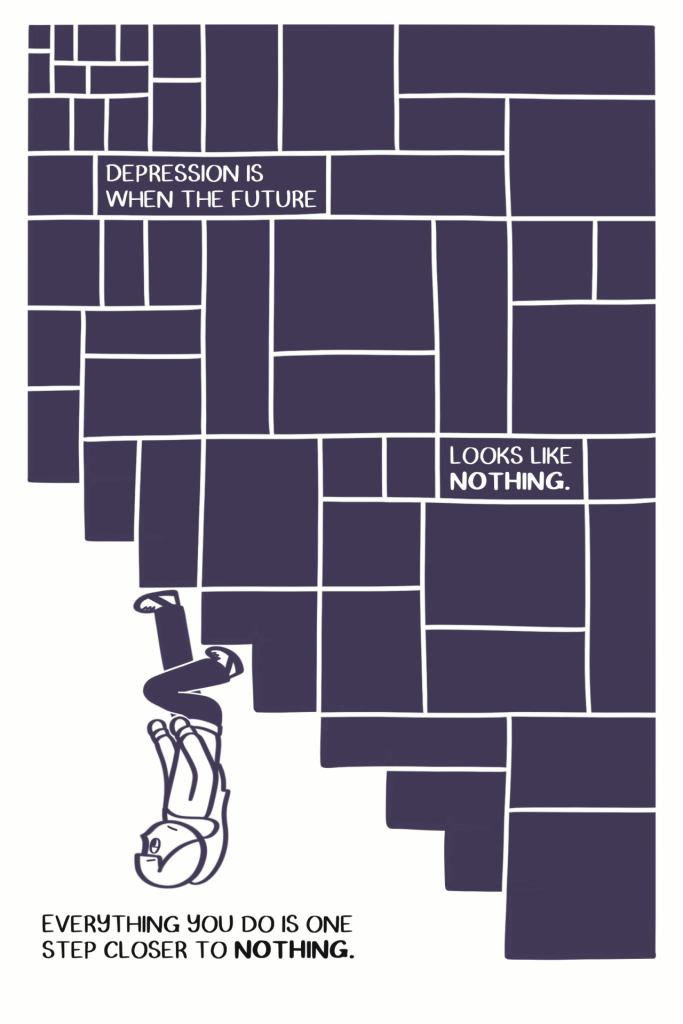
The second part of the narrative, Love is Transactional, explores Caitlin’s move to New Concord, Ohio. Like the fantastical heroes of her youth, she, too, goes on a journey out of the familiar comforts of her childhood and into the scary unknown, though instead of magic, her unique call to adventure in school begins with a call to find God, her battles more internal than external. Though raised by a Catholic mother and Presbyterian father, Cooklin had been content without faith being a part of her life, a state her peers viewed as “sitting happily on the road to eternal damnation,” which is exactly why they try to coax her into the waters of salvation. Others, like her new friend Lucy, insist she needs to be saved from eternal damnation and constantly try to proselytize their faith during sleepovers and casual hangouts. Her admiration for Stephen and newfound friendships led her to give in to peer pressure and accept Jesus Christ as her Lord and Savior. This catapults the start of the transactional love the title implies. Even for platonic love, friendship remains conditional upon a shared identity, religious belief system, a predetermined set of values. For romantic love, there are different conditions. No kissing or sex before marriage. No impure thoughts. No showing too much skin or breaking the code of conduct expected of women and men. The protagonist gravitates toward the structure provided by the church, yet struggles to reconcile the acceptance and validation the space provides with the sacrifices the place requires her to make. Normal gets a new definition within the boundaries set by the church. Cooklin uses inventive layouts to explore the intersection of mental health and faith, particularly in the scene in which she shows us what it feels like to have depression and opts for a splash page rather than the traditional panels she had been using before, visually revealing how the condition turns her life upside down and disrupts the order and structure of everyday life. God’s love is presented as “a model for the way we ought to love one another.” Perhaps fueled by a desire to receive the same love, the narrator accepts Jesus Christ as her lord and savior. She has a tumultuous relationship with a man named Patrick, who goes from a charming suitor to an abusive partner quickly. This leads the reader into the next fragment, titled Love Is Not Real.
In part four of Ace of Hearts, Cooklin enters art school in a new environment away from the evangelical bubble she had been in. Here, on campus, sex isn’t taboo but a topic talked about openly by a sex therapist who lectures them on safety and consent. I would have liked to see a bit more about how the culture at art school in Winston Salem differed from the social life back in Concord. She’s given the language to capture her past experiences with Patrick: sexual assault. Her long distance boyfriend grows more possessive the farther apart she gets from him, and tries to tether her through manipulative tactics disguised as concern. Cooklin questions her relationship to sex and redefines love as “the desire not just to be known, but to be seen.”
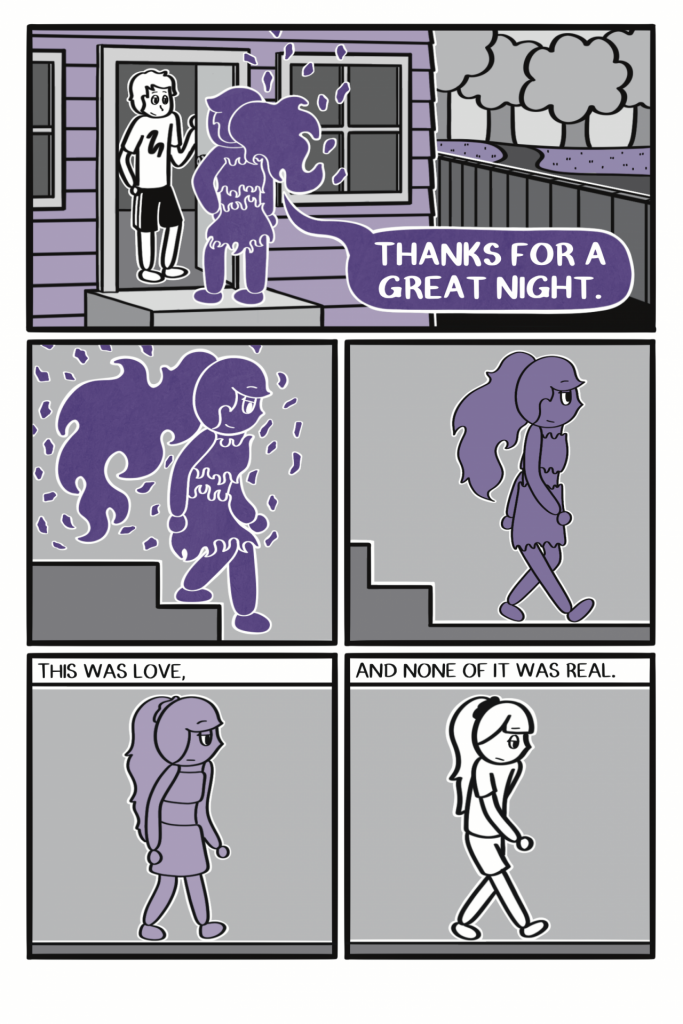
In part five, Love is Obsession, Cooklin plays with her color palette in scenes where sex is a part of the conversation by dimming the purple into a gray. In other areas, however, gray also seems to represent freedom and liberation, while the pages darken to heavier shades and eventually black in scenes where Cooklin questions her agency and willingness to participate in society’s definition of what love is. After she has sex, her avatar is drawn purple and falling to pieces, perhaps a representation of how the protagonist doesn’t feel whole. She seems corporeal. On the last page of the section, backgrounds fade to gray. Cooklin walks down the stairs of the page, purple and then white, the caption telling us “This was love. . . And none of it was real.”
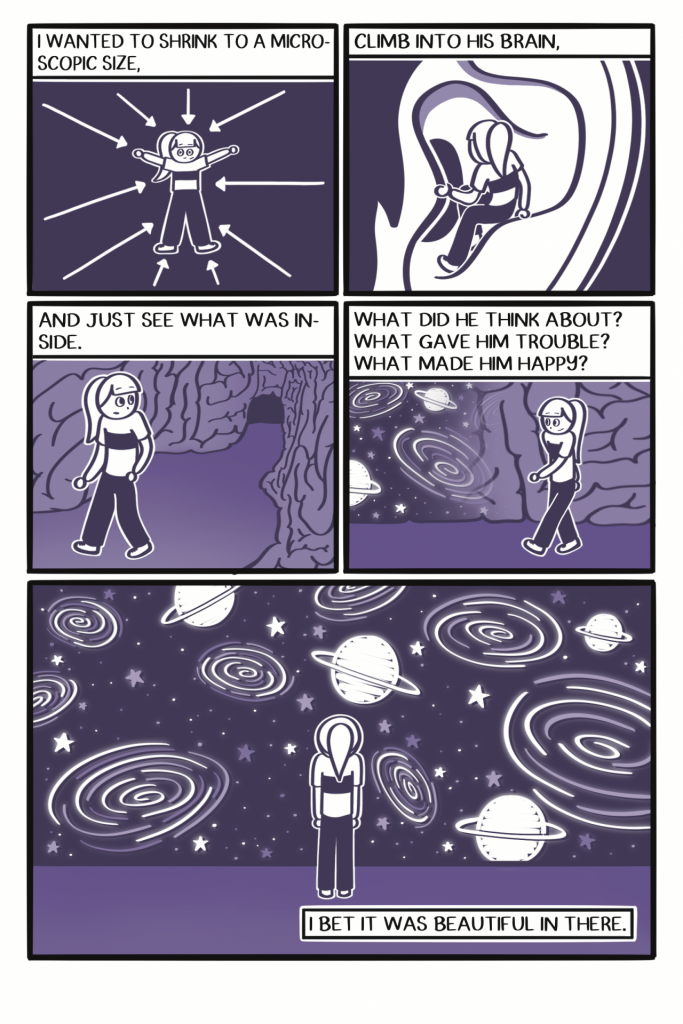
In Love is Strange, Cooklin navigates the realization that she is asexual, meaning she can still experience love but does not desire any sexual intimacy from others. She provides interiority by showing us a glimpse into her search history and her diary, where she writes “I don’t think I understand sex. Like at all. I don’t understand why everyone is so obsessed with it.” By discovering her identity, she accepts herself as she is and embraces love as a possibility for herself on her own terms. There’s a beautiful single panel drawing of her and her lover surrounded by a gray scale outer space that perfectly encapsulates the feeling of being isolated from others due to how she feels while being super connected to the one she does feel love for.
Love is For Everybody ends on a cathartic, heartwarming note. Cooklin defines her own idea of love as “giving someone your undivided attention so that you can learn every part of them.” This beautifully constructed and simply drawn graphic memoir debut will tug at your heartstrings and deserves to be in the hands of readers who need their definition of love expanded and their understanding of asexuality deepened by the author’s authentic lived experiences. Somewhere out there, a kid or adult needs to be told that love is for them, too.
SOLRAD is made possible by the generous donations of readers like you. Support our Patreon campaign, or make a tax-deductible donation to our publisher, Fieldmouse Press, today.
Leave a Reply