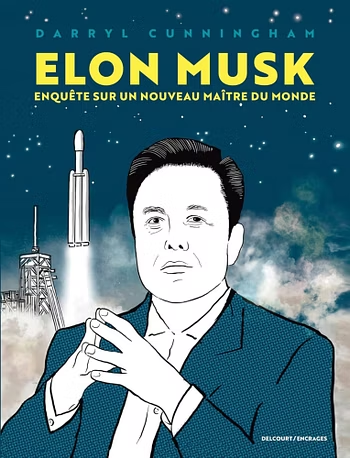
Whatever else may be said about it, Darryl Cunningham’s latest work shows an admirable degree of persistence. Originally published in French as Elon Musk: Investigation into a New Master of the World, the comic struggled for a year to find a possible English publisher over what Cunningham alleged was “concern over possible legal consequences.” He blamed “a climate of fear” for publishers’ lack of bravery. Oddly, Cunningham’s Putin’s Russia: The Rise of a Dictator encountered no such cowardice, even though its subject has allegedly murdered his overseas critics, something Musk has yet to attempt. It was up to Seven Stories Press to prove that the land of the free and home of the brave had not again become the “land of the belly-crawler and the home of the fearful” that I.F. Stone wrote about in the 1950s.
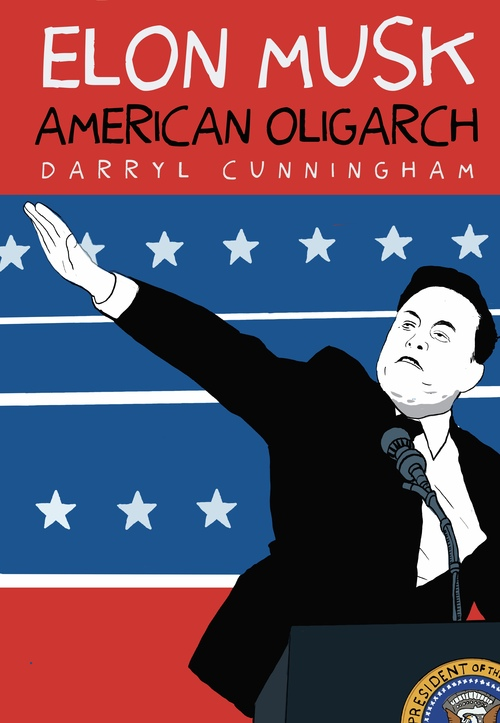
The year between editions has made a great deal of difference for the current book. Now titled Elon Musk: American Oligarch and sporting a studied cover of Musk’s apparent Nazi salute, it has a new chapter on Musk’s involvement in the 2024 Presidential election. Almost a spin-off from his previous Billionaires: The Lives of the Rich and the Powerful, Cunningham’s biography proceeds chronologically from Musk’s maternal grandfather Joshua Norman Haldeman’s embrace of the anti-democratic Technocracy movement to Musk’s modern disdain for popular sovereignty.
As a participant in last year’s Tesla Takedown protests, I did not come to this book without an opinion of its subject. I felt like I had a grasp of his history and worldview, and was interested to see if there were any surprises in store. One unrealized hope was for Cunningham to provide some insight into the Musk fanboys I encountered; the kind of people who drove around in Cybertrucks alternating homophobic slurs with yelps of “Elon is daddy.” What possesses them to waste their time this way? Cunningham is of no help. Perhaps it’s beyond the realm of a cartoonist to weigh in, and a psychologist is necessary, although I would have appreciated an attempt.
On the psychological front, Musk emerges as self-absorbed, lacking in basic empathy. When one of his children died of SIDS, he deplored his then-wife’s natural expressions of grief as “emotionally manipulative.” Whether this lack of empathy provided Musk with a leg up in business is an open question, although if it did, it would be logical.
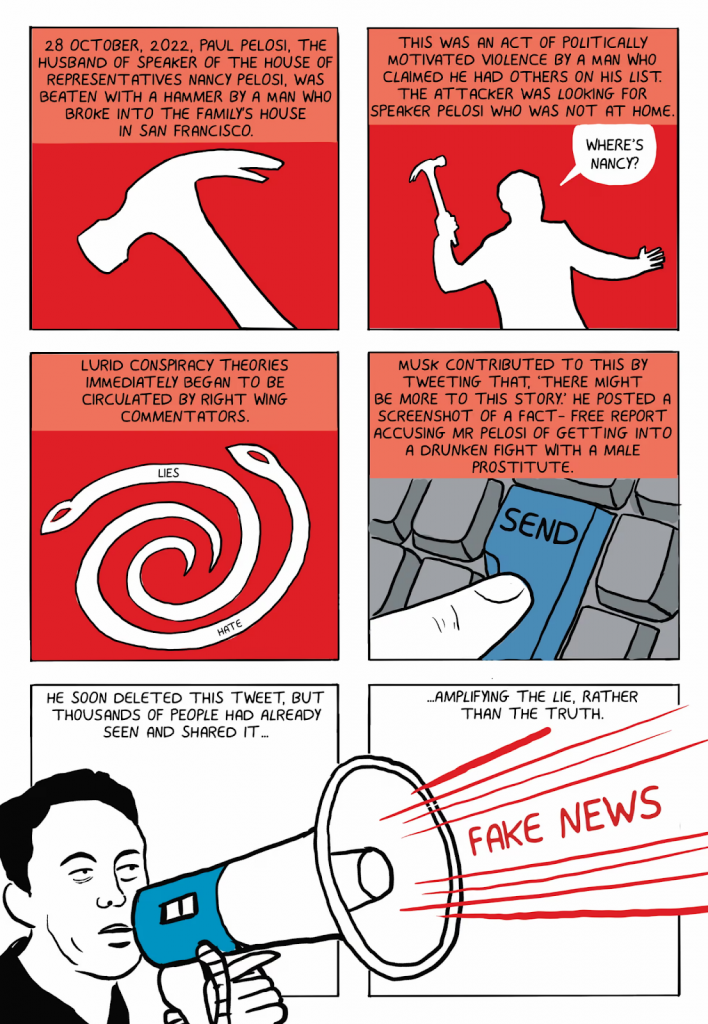
To Publishers Weekly, Cunningham described his process as laying out “the facts brick by brick, like in a court building the evidence.” Indeed, there is a generous bibliography at the end of the book lest anyone find Musk’s comic book antics too unbelievable. This makes the publishers that turned down the cartoonist look even more spineless. After all, if the material was already published without being the subject of libel and defamation suits, making a comic out of it should have been no big deal. The trouble with Cunningham’s bricks (and bricks generally) is that they are uniform and often uninteresting to look at.
Cunningham’s approach to nonfiction comics is frustrating. He tackles important issues, but without a sense of urgency. His style is flat. Most pages follow the same six-panel layout, locking the reader into an expected routine whenever they turn the page. Panels always have text at the top, art at the bottom. At times, there’s so much text it’s reminiscent of an EC panel that made the poor artist cram the art into the bottom half. There’s no shading on any of Cunningham’s illustrations, giving everything an equal weight. He’s aiming for a revolutionary pamphlet and ending up at a PBS documentary. Call it American Monsters.
On occasion, some levity breaks through. In drawing Turkey’s president Erdogan, Cunningham shows Twitter’s bird letting loose some guano on the autocrat’s head. The battle between Peter Thiel’s Paypal and Musk’s X (not the Twitter rebrand or an adult website, but a way to send money over the internet) is visualized as an Over the Top arm wrestling match. Santa Claus appears to shower Musk’s companies with public money, including a $278 million award from NASA, a $1.6 billion contract to haul cargo to the International Space Station, and a $465 million loan to Tesla. It’s an effective dismantling of the myth of the self-made capitalist who disdains government assistance until he needs it.
In one instance, Cunningham misses an opportunity to strengthen his case. In discussing Musk’s grandfather Haldeman’s involvement in Canadian politics, Cunningham mentions that Haldeman was vice president and provincial secretary of the Saskatchewan branch of the Social Credit Party. Cunningham describes the SoCreds as “a minor political party that promoted ideas of monetary reform.” He later reveals that Haldeman was “a pro-apartheid conspiracy theorist who blamed many of the world’s problems on Jewish financiers” and wrote a pamphlet expounding on those beliefs.
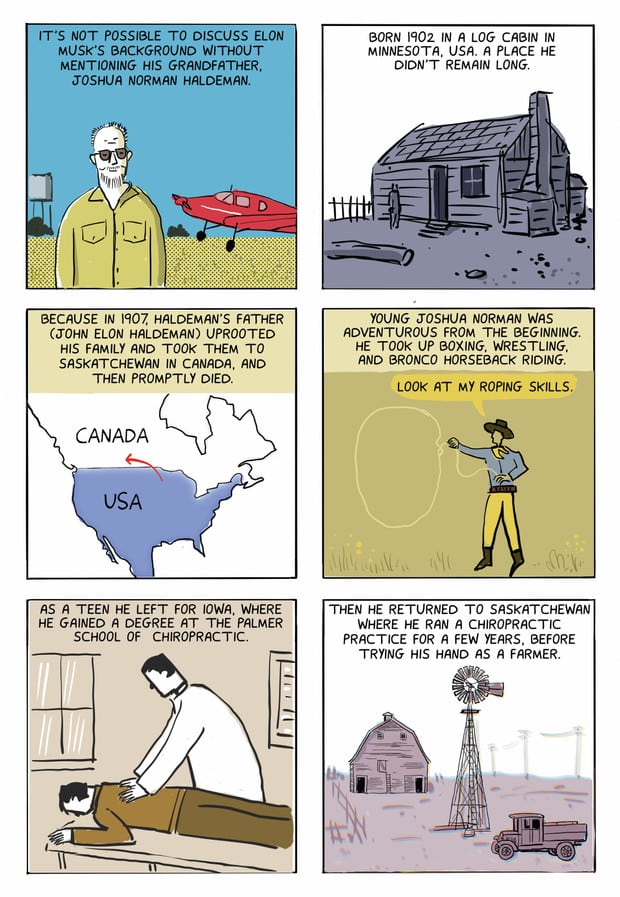
These two incidents are not as unrelated as Cunningham makes them seem. Relevant to the case Cunningham is trying to make — that Haldeman and Musk have a similar political outlook — is that the Social Credit Party broadcast antisemitic conspiracy theories. The Social Credit newspaper asked readers to “look at the names of the key personalities in the Great Conspiracy against humanity… They are almost exclusively Jews racially…” MP John Blackmore distributed the antisemitic forgery The Protocols of the Elders of Zion from his office. “If you tell the truth about Jews,” he asked reporters, “are you anti-Semitic?”
When mentioning Musk’s estranged daughter Vivian Wilson, Cunningham makes a truly unfortunate decision. Even though it’s entirely unnecessary to do so, he deadnames Wilson, a transgender woman. This adds nothing to the book and should’ve been dropped either by Cunningham or stopped by the editor.
American Oligarch captures the various faces of Elon Musk: the science fiction-addled libertarian, the carnival huckster, and the selfish child who grew old without growing up. It also provides more proof that, yes, Virginia, there is a ruling class, even if Cunningham’s title uses the ugly sounding “oligarch” rather than my preferred sobriquet, “robber baron”. But as a rallying cry to do something about them, it falls short of “Solidarity Forever” or “We Shall Overcome.” That’s a shame. As Cunningham’s final splash page shows, Elon Musk’s future is one frightening destination. We’re on a runaway train there, and someone needs to pull the emergency brake.
SOLRAD is made possible by the generous donations of readers like you. Support our Patreon campaign, or make a tax-deductible donation to our publisher, Fieldmouse Press, today.
Leave a Reply