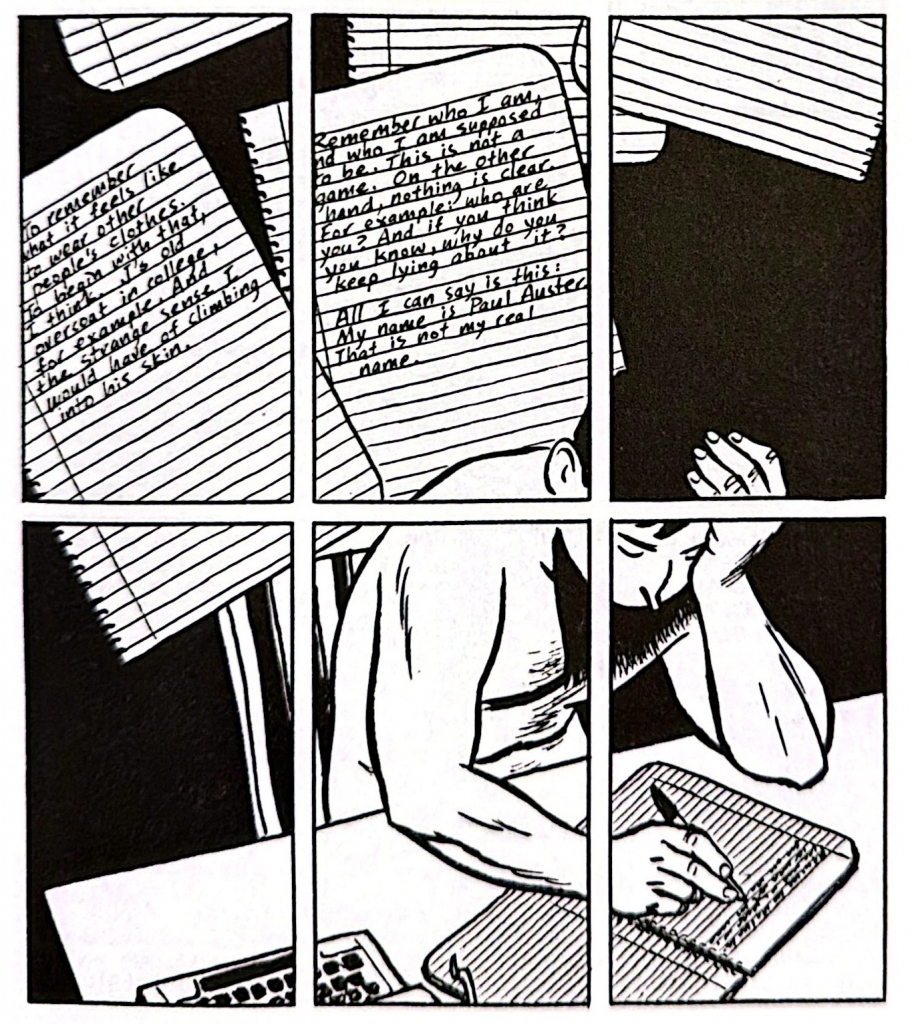
From the very beginning of the graphic novel adaptation of Paul Auster’s City of Glass, the identity of the protagonist is blurred. He is only called Quinn when he is introduced, and it is made known immediately that he no longer writes under his real name, now only releasing mystery novels under the name William Wilson. He has “stopped thinking of himself as real,” and he only exists in the world as Max Work, the detective in William Wilson’s work (Fig. 1). From before the story has even begun, he is a man cleaved in three -– and this only complicates further as he takes on the name Paul Auster. This is a narrative where the characters are purposely blended together and muddied, and the artwork of Paul Karasik and David Mazzucchelli further distorts the reader’s ideas of who is who.
The core characters of the story, and those whose identities are blurred, are Daniel Quinn, Paul Auster, and Peter Stillman Sr. The thread that connects all of these men, despite their enigmatic existences, is their shared identity as writers. Quinn is a writer at his core. Even at his lowest, he cannot separate himself from his writing; it’s all he knows. Paul Auster is the name of the very author of the original City of Glass novel, as well as a writer studying the story of Don Quixote within the narrative. Stillman is a fraudulent professor who has invented stories and characters to support his claims about the new world. These characters, and the ways that their identities intersect with others in the story, enforce the idea that the salient theme of City of Glass is the blurring between fiction and reality that permeates the life of a writer.
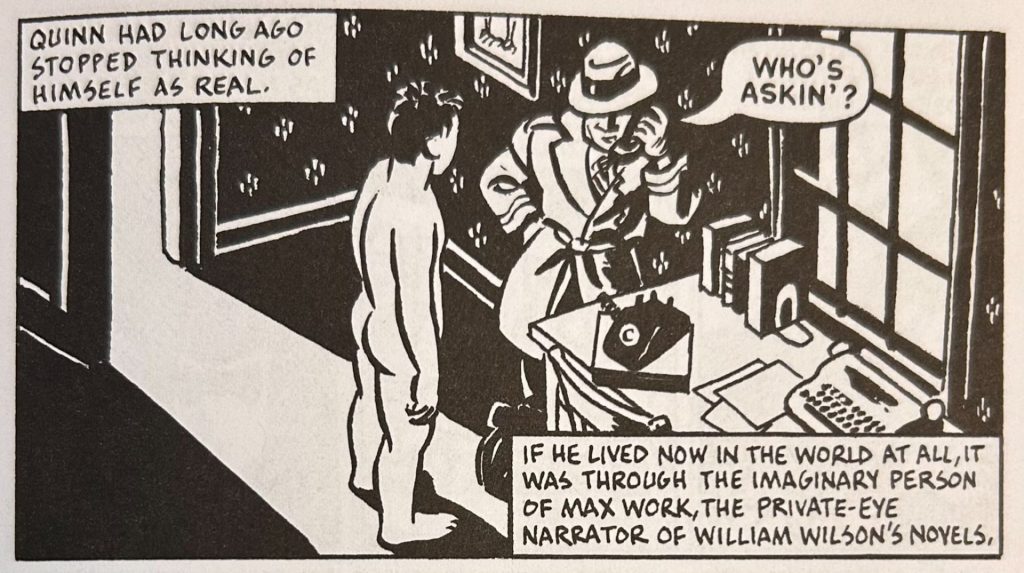
As Quinn begins his work as the detective Paul Auster, Karasik and Mazzucchelli occasionally depict Quinn as Max Work in order to show just how disconnected Quinn is from himself. His first appearance even has Max Work standing separate from Quinn, acting out the delusional adventure of “Paul Auster” as Daniel Quinn just watches on (Fig. 1). On the subsequent page, Max tucks him into bed, putting to sleep what may have been left of the real Quinn, as he takes over. He’s a shell of a man after losing his wife and son, and this identity is the only thing that can fill that void. Quinn continues to pose as his idea of Paul Auster, documenting everything as he goes in a journal he buys especially for the case, trying to keep himself grounded. Childlike drawings are often interspersed between panels during Quinn’s quest for knowledge, acting as a visual representation of the inklings of his former self that peek through the cracks of his current “identity,” as thoughts of his dead son threaten to come to the surface.
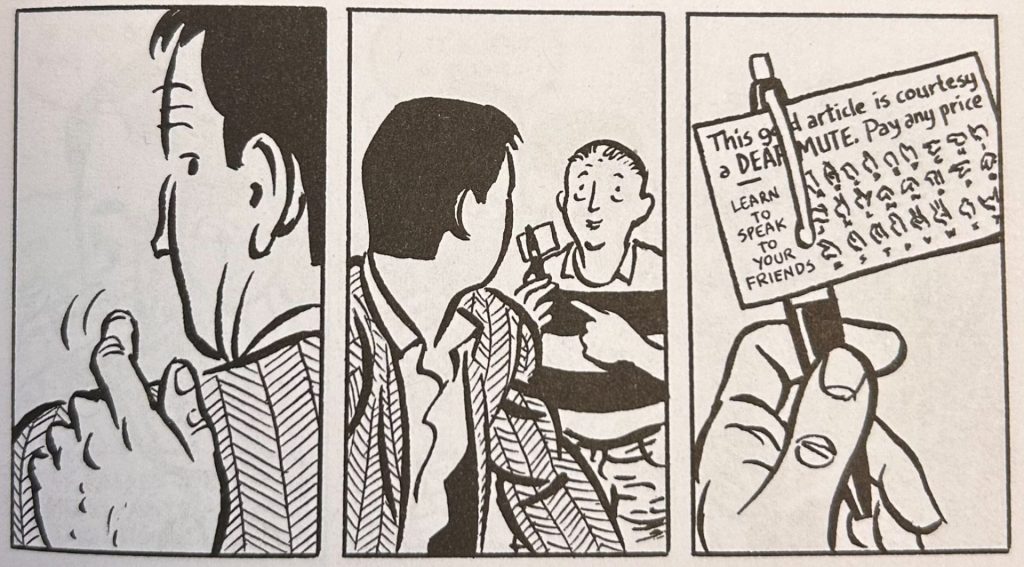
Quinn’s quest is to seek out Peter Stillman, a man who wanted to discover the language spoken by Adam and Eve, a language that would match objects to their words perfectly. Quinn’s identity as a writer would naturally draw him to a case like this. Notably, Quinn has an exchange with a deaf and mute man in Grand Central before he finds Stillman, from whom he buys a pen attached to a card illustrating the alphabet in sign language (Fig. 2). This moment stands out. It’s a scene with no dialogue, Karasik and Mazzucchelli leaving only the wordless interaction, and the detail that he does, in fact, go on to use the pen over the white one he was previously shown using when he writes about the case. The themes of language and communication in City of Glass are extremely prominent; this exchange with a man who can’t communicate with spoken language contrasts with Stillman’s quest in creating a language with a perfect word for everything. As a writer, language is something inexorably tied to Quinn’s life on a deeper level than most. As argued by Julia Wuggenig in her extensive thesis comparing the City of Glass novel and comic, “language as a tool for writing and representation of a narrative is a way for Quinn to compensate for the loss of his security. Through language, he can invent his ideal reality in his narrative” (Wuggenig 64). His very existence revolves around communication without outwardly speaking, just like the man whose pen he will go on to tell his tale with.
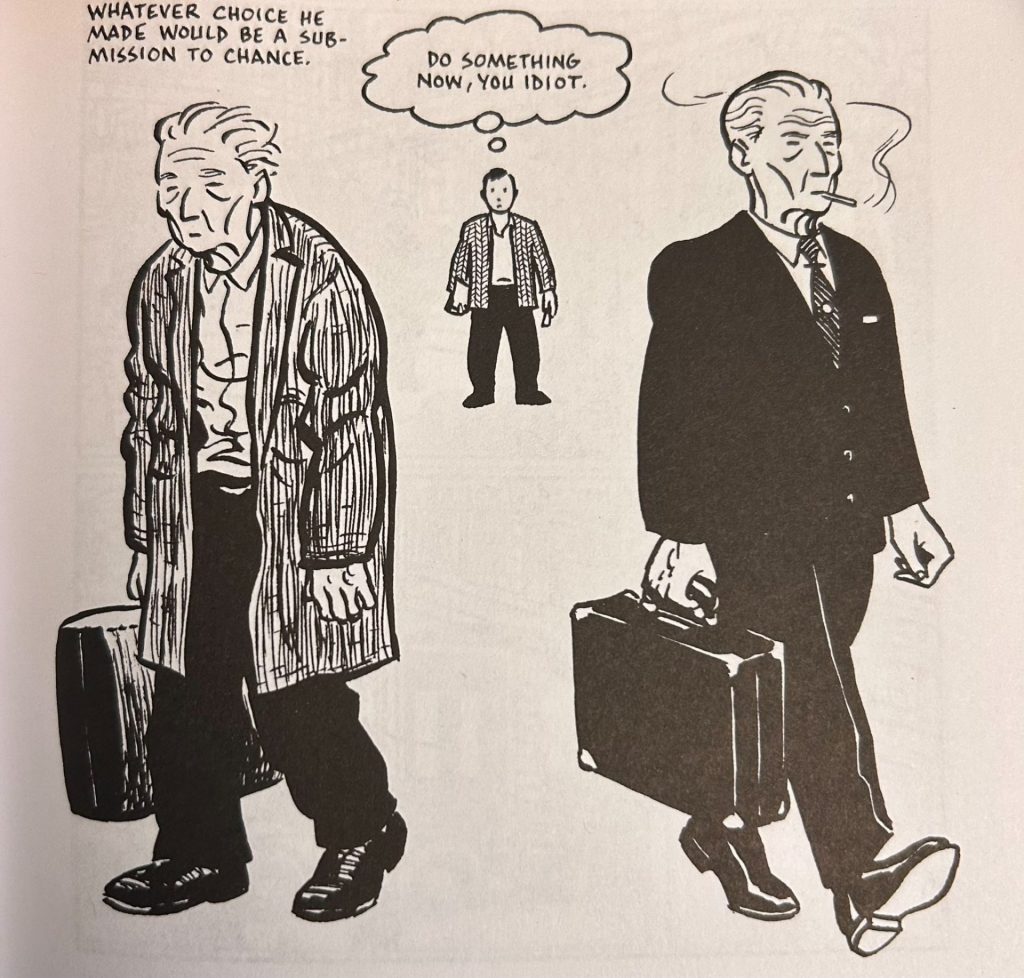
When Daniel Quinn finds Peter Stillman Sr., the man seems to immediately split in two, “like two twins cleaving together” (Karasik and Mazzucchelli 38). This idea of two twins, good and evil, “cleaving together,” is first brought up as Quinn is studying Stillman’s book, in which he examines Milton’s Paradise Lost. Twins are an ongoing subtle motif in City of Glass, depicted most prominently as the two Stillmans appear, and Quinn must quickly decide which one he will follow (Fig. 3). It is not explained whether or not this is truly the same man, seemingly split in two, or if it was a mere coincidence and these are simply two men who look similar. Karasik and Mazzucchelli have blurred Stillman’s identity, and it is made unknown who Peter Stillman truly is: a man who stands proud and refined after the horrible things he’s done, or a simple slouching old man. Quinn must make that choice and decide Stillman’s identity for himself, either decision leading him down a different path in his own life.
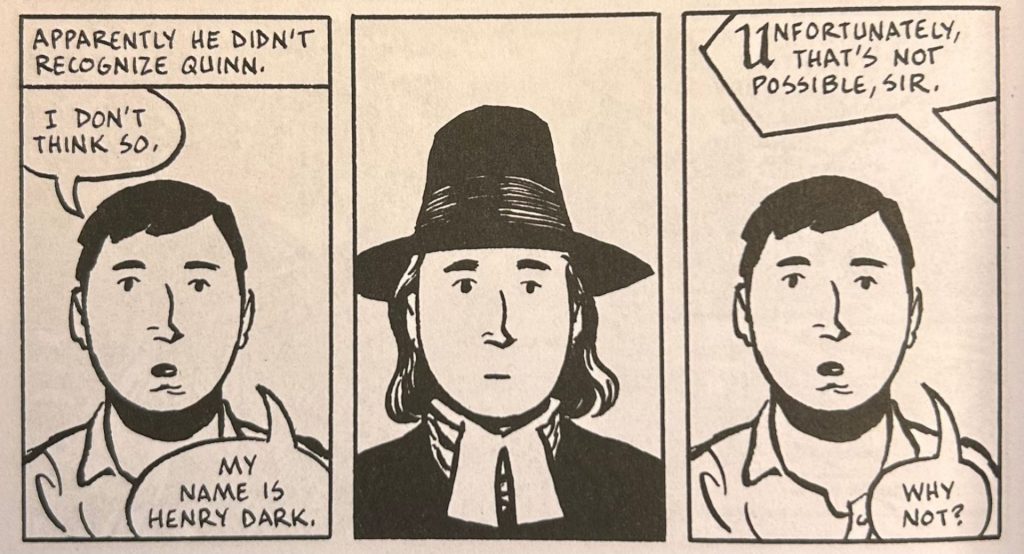
Quinn takes on three different identities when he approaches Stillman to speak with him: Daniel Quinn, Henry Dark, and Peter Stillman Jr. It is through these interactions that Stillman displays his belief in the importance of a name in relation to one’s identity. He refuses to speak to someone who does not first share their name, and when Quinn does share a name, Stillman takes the time to parse its significance. He believes that there is one perfect descriptor for everything, and when met with someone named “Henry Dark”, he remarks that it is “not possible,” thinking only of the Henry Dark that he invented. Karasik and Mazzucchelli depict this change in how Quinn presents his identity with three moment to moment panels, all without any change in layout, just depicting Quinn as wearing the clothes of Henry Dark in the middle panel (Fig. 4). Like the depiction of Quinn as Max Work throughout the graphic novel, this panel is meant to visually represent Quinn’s shift in identity as he plays the role of the fictional Dark.
This belief that Stillman holds about names and identity is a key aspect of his character. For Stillman, the fall of man meant the fall of language (Karaskik and Mazzucchelli 39). As Wuggenig points out, Stillman’s belief is that language after the fall depends on the relationship between “signifiers” and that “there have to exist dualistic oppositions such as light/dark to create meaning.” Therefore, “Stillman senior’s ideal language would have been a language without signifiers” (Wuggenig 63). Stillman refuses to view identity by how things relate to each other, but rather by how the things relate to themselves. By his logic, there exists only one identity for everything, standing in stark contrast to Daniel Quinn, who has gone by many names. However, in order to support his ideas, Stillman went as far as creating Henry Dark and using him as evidence in his thesis, blending reality with fiction just as Quinn has.
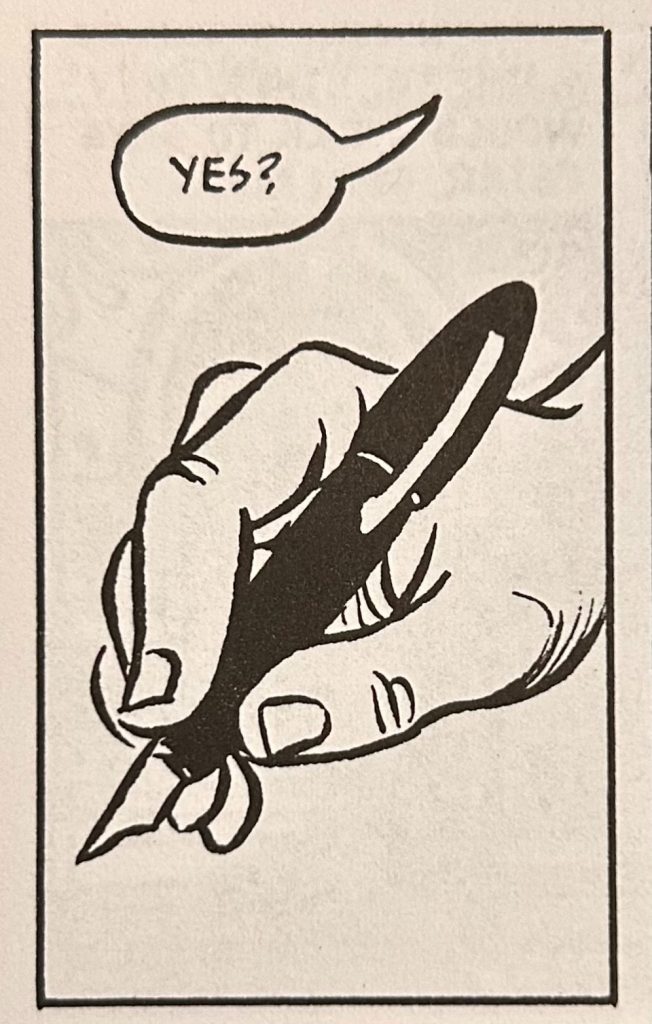
As Quinn loses track of Stillman, he finally seeks out the real Paul Auster. After tying his own identity to his, he hopes to find the true detective who can solve his dilemma, but he is met with a pen (Fig. 5). Auster is the man whose name he has appropriated up to this point in the story, and, as it turns out, he is simply a writer just like himself. Auster is writing an essay about the authorship of Don Quixote when Quinn meets him, and it is this intertextual relationship between City of Glass and Don Quixote that adds yet another layer to Quinn’s identity. Of course, Daniel Quinn and Don Quixote share initials, but, as pointed out by Wuggenig, the protagonists of both City of Glass and Don Quixote “try to make sense of the world by the use of literature through producing or consuming it. Through literature, they can develop a double identity which allows them to escape from the real world” (Wuggenig 37). Both protagonists suffer from identity crises, yet escape through reading or writing.
Karasik and Mazzucchelli have drawn Paul Auster in a more detailed art style than other characters in the comic, to resemble the real-life author Paul Auster, and to stand in contrast to the simplified Quinn. He acts as a foil to Quinn, possessing the family and happiness that he once had. Auster’s young son resembles the son that Quinn lost, playing with a yo-yo just as Quinn’s son is in the picture shown of him at the beginning of the graphic novel. Karasik and Mazzucchelli have once again blurred the lines between characters, the two boys being so similar that we are led to question whether or not Quinn is just seeing the boy as his own son due to the grief constantly threatening to pour out of him. Quinn shares a first name with the boy. His son shares a first name with Peter Stillman Jr., who he resembles a great deal, and who Quinn first took on this quest in order to protect. Names and identities intersect in such a way that we are reminded of Stillman’s quest to find the ideal name for everything and wonder if this would save Daniel Quinn from the madness he succumbs to.
After Quinn fails to track down any of the Stillmans and his case falls apart as he discovers from Auster that Stillman Sr. has killed himself, he descends further into the shell of his former self. He has no home, no money; he has nothing, and yet still he writes. He writes until he no longer can, thinking back on his own identity and those of others. He took the name William Wilson from the New York Mets player he mentions throughout the story, Mookie Wilson. He thinks about the woman who now lives in his apartment, and whether or not she’s the same woman he encountered before reading one of his books. Karasik and Mazzucchelli depict the panels falling away as Quinn loses his grip on reality. There is no life for Daniel Quinn to return to, no mysteries left for William Wilson to tell, and no case left for Max Work to solve. All he can do is write about anything that comes to mind, until there is nothing else left of him but his written words.
Work Cited
Auster, Paul, et al. City of Glass. Picador, 2004.
Wuggenig, Julia. Intertexts in City of Glass as a way to represent ambiguity and fragmentation of meaning in human language-a comparison between the novel and the graphic novel. Diss. Masterarbeit, Stuttgart, Universität Stuttgart, 2019
SOLRAD is made possible by the generous donations of readers like you. Support our Patreon campaign, or make a tax-deductible donation to our publisher, Fieldmouse Press, today.
Leave a Reply