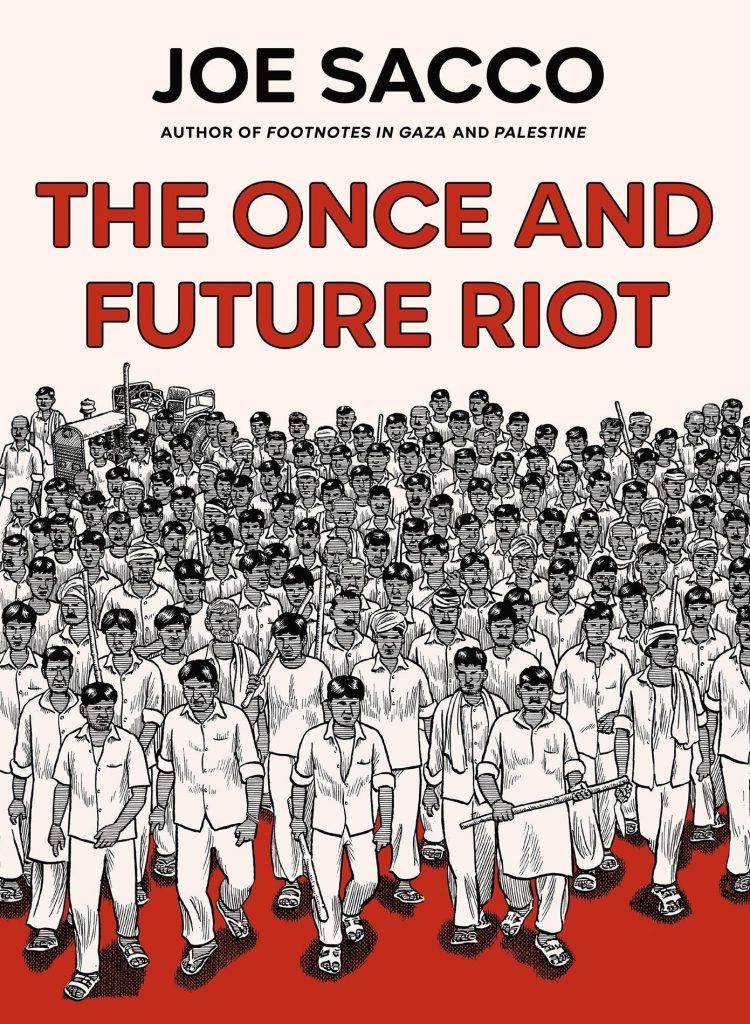
Joe Sacco warns us, in the first few pages of The Once and Future Riot, exactly what kind of epistemological swamp we’re wading into. Like many of Sacco’s previous comics, this is a work of journalism and history; it’s an attempt to excavate the precise circumstances of a 2013 outbreak of sectarian violence that pit Hindu Jats against Muslims in the Muzaffarnagar district of Uttar Pradesh in northern India. But Sacco and his reporting partner, a local journalist named Piyush Kumar, aren’t just looking for the truth. They’re also searching for all the bullshit that has glommed onto the truth in the years since. To use the book’s more poetic phrasing, Sacco and Piyush are hoping to find “the fiction, the myth, the imposter” that has displaced the actual riot. And what they find is a tangle of lies, omissions, and selective misremembering that Sacco calls “The Great Untruth.”
Before we get to the lies, a bit of truthful context may be useful: The roots of the Muzaffarnagar riot that Sacco investigates are entwined with the cataclysmic violence of India’s independence. In 1947, Great Britain partitioned its colonial territory on the Indian subcontinent into India and Pakistan, causing a mass displacement of Hindus and Muslims alike. “Upwards of 12 million people were chased from their homes or fled one way or the other to avoid being part of a minority population, and hundreds of thousands—perhaps as many as one million—died in the ensuing bloodshed,” Sacco writes. While modern India is, to some extent, a secular democratic society, Muslim citizens have become the target of xenophobic members of the Hindu far-right, a movement known as Hindutva. Sacco describes a series of violent episodes orchestrated by members of both religious groups since 1992 — though as Sacco points out in the closing section of the book, it’s the extreme Hindu nationalists who have capitalized on this violence in recent years, using racist conspiracy theories about “love Jihad” to enact repressive legislation targeting Muslims.
Sacco walks us through this history quickly but ably, relying on the compressive power of the comics page to convey a vast amount of national trauma and upheaval in a very short span. I did find myself wishing that he would spend a bit more time dwelling on the origins of India’s sectarian violence, but The Once and Future Riot is a book that often moves at a rapid pace (at least by Sacco’s standards; it’s only half the length of his most recent journalistic book, Paying the Land). The opening sections in particular are a dizzying exercise in framing and reframing the Muzaffarnagar riot, adding layers of testimony from both Hindus and Muslims that complicate the deceptively simple description of “sectarian violence.” The inciting incident, as Sacco tells it, involved a petty conflict between two Jat cousins and a young Muslim that escalated to violence. But understanding how and why an interpersonal dispute could spark a communal conflagration that left dozens dead and over 50,000 displaced requires mountains of context.
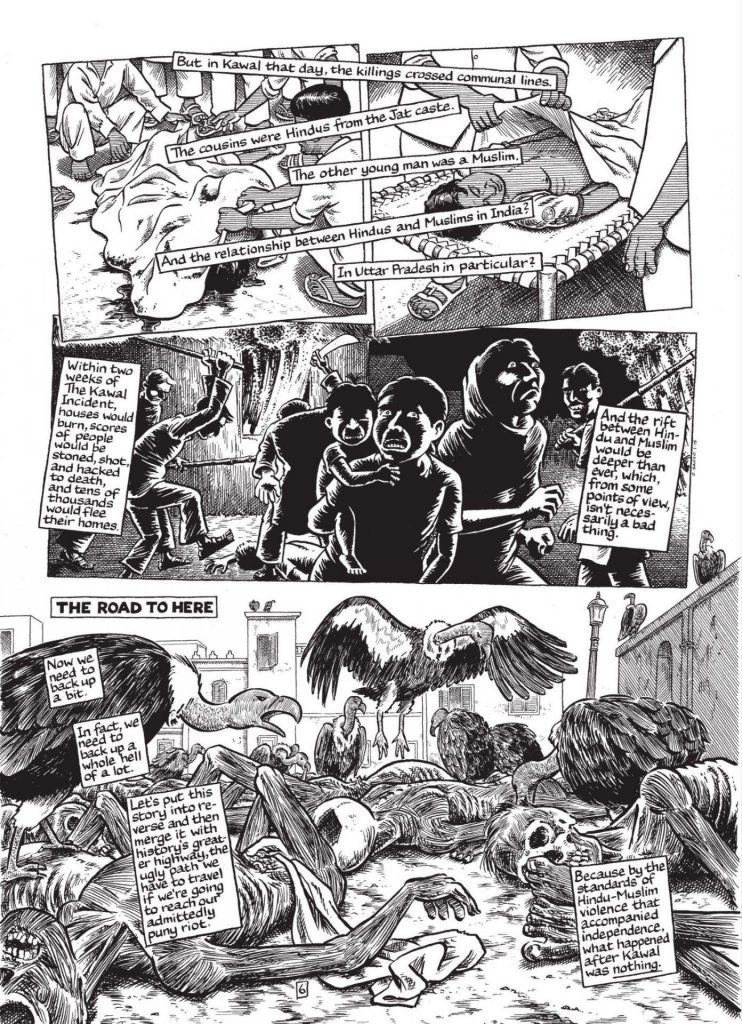
For example: Sacco allows his Jat interviewees to voice their grievances about the political bureaucracy in the state of Uttar Pradesh, which they claim is more sympathetic to the needs of Muslims. But immediately after their complaints, Sacco confronts us with the reality of the Muslims who were driven from their homes during the riot: Impoverished, “wretched souls” who were, even before their violent removal, economically dispossessed agricultural workers on land owned primarily by Jats. And lest we think this is actually a story about a class binary, Sacco also reveals to us that there are Muslim communities in the state who have economic power and might be described as middle-class and cosmopolitan.
Sacco’s work has always rejected the standards of mainstream journalism and mass media, and his relentless focus on the riot’s specific context feels like an antidote to lazy both sides-ism and the pabulum of traditional, “objective” reporting. One could easily imagine a journalist who, when confronted with a riot in which Hindus and Muslims were both killed, simply throws up their hands and retreats into a “both sides have points” or “both sides did violence” narrative mode. Sacco, by contrast, illustrates just how difficult it can be to actually understand the “sides” of a conflict — especially when you realize that every side is telling you a self-serving version of the truth.
Sacco listens with skepticism when a Muslim community leader, who has been accused of leading an assault that killed multiple Jats, claims women and children were responsible for throwing stones. “Nobody died in the village,” the man says, implausibly. On the other hand, perhaps the most outrageous bullshit that Sacco and Piyush are asked to swallow comes from a lawyer for Jats, who shows them a hospital record from the riot’s inciting incident and lies about what it says. Sacco is able to verify, by looking at the actual record the man is showing them, that what he’s saying is untrue. But the lawyer persists in the fiction, pairing it with a conspiracy theory about how the Muslim boy who was killed by the Jat cousins was actually killed by his uncle — and moreover that this supposed familicide was a false flag operation aimed at framing the Jats.
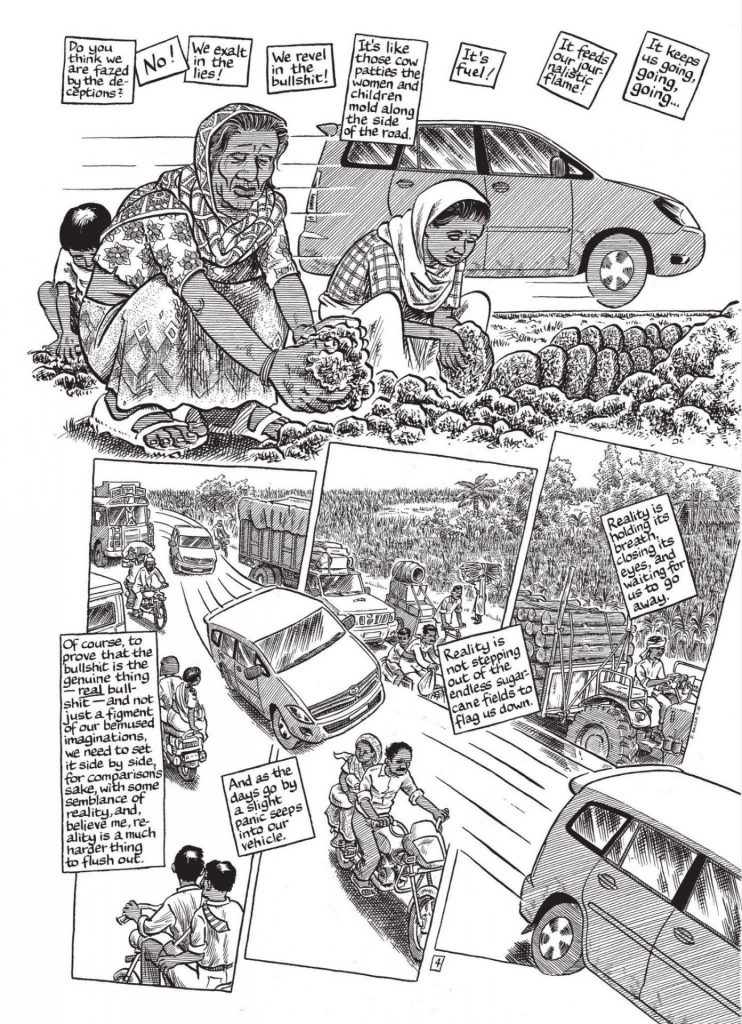
The Once and Future Riot is only partly an attempt to unravel and correct these lies. Yes, Sacco does plenty of fact-checking. For all his sardonic comments about how he and Piyush “revel in the bullshit” — and it wouldn’t be Sacco without a little self-deprecating satire — he is obviously committed to getting as close as humanly possible to describing the reality of what happened. But reconciling contradictory testimonies into a cohesive story is not his ultimate concern. Smoothing over the gaps and ignoring the inconsistencies in what his subjects say would undermine his broader goals. Indeed, the foil to Sacco’s “Great Untruth” is the “One True Story,” a phrase he uses to describe the self-serving pronouncements of the political figures who have, in the aftermath of the Muzaffarnagar riots, warped history for their own ends. It’s a way of nodding to the fundamental irony of the situation: The lies people have told about the violence are, in a sense, just as important and powerful as the truth. It’s the lies — not the truth — that shape the political reality of modern India, as current Prime Minister Narendra Modi used the riots and the resultant upswing in anti-Muslim sentiment to catapult his Hindutva political party, the BJP, into power in 2014.
I want to be careful here: The Once and Future Riot is not some nihilistic post-truth diatribe that declares reality unknowable or unimportant. Sacco still believes in the processes of journalism, as flawed as they are; he dedicates the book to “the hardworking rural journalists of India” and praises the work of multiple local reporters in the acknowledgements, including his guide Piyush. But Sacco doesn’t want you to forget that they — and he — are constantly being gaslit about the circumstances of the riot. The book puts its readers in the same uncomfortable position as the journalists: Like Sacco, you can never be completely sure who is telling the truth and whether it’s the whole truth. It’s an artistic strategy that forces readers to question whether the violent scenes that Sacco illustrates are, in fact, distortions of memory.
As writer Robert Rubsam points out in a review for The Atlantic, Sacco has done this kind of thing before, most notably in Footnotes in Gaza, where Sacco illustrates conflicting testimony from Palestinians whose recollections about violence inflicted upon them by Israeli soldiers differ in a few key details. “The reader experiences these memories, and then questions them, and then at last sees the author’s process as he labors to tell the most honest-possible version of the truth,” Rubsam writes. This capacity to render multiple witness perspectives on the page — to show us the way survivors’ memories can be fragile and unstable and yet still worth listening to — has always been at the core of Sacco’s approach to comics journalism.
Yet despite the methodological similarity, Sacco’s goal in Footnotes strikes me as fundamentally different from his priorities in The Once and Future Riot. In the former, Sacco sorts through conflicting, inconsistent testimony from elderly Palestinians about a massacre in 1956. He gets frustrated when they ramble and mix things up and recounts near the end of the book “how often [he] sighed and mentally rolled [his] eyes because [he] knew more about that day than they did.” But his point is that the emotional reality of what Palestinians experienced at the hands of the IDF is ultimately more important than the veracity of their testimony. The final, chilling sequence of panels is a wordless representation from the perspective of a Palestinian who flees and is caught and beaten by soldiers. Does this visualization show us exactly what happened that day? No, but the images do show us exactly how it felt.
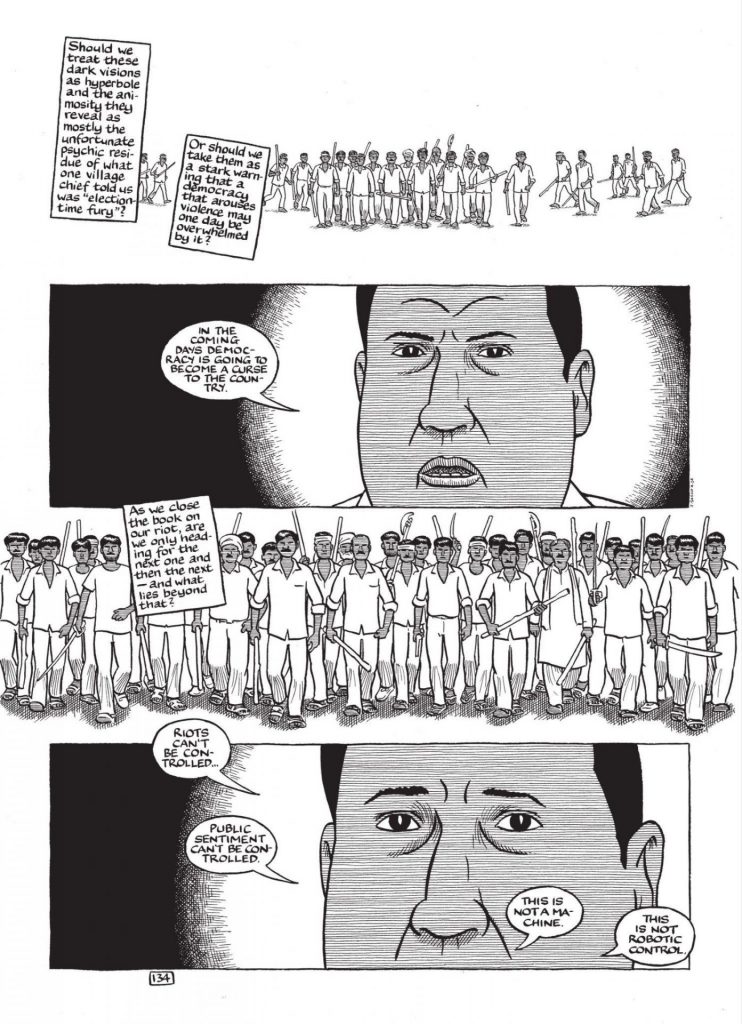
The Once and Future Riot, by contrast, never fully commits to the subjectivity of its characters. Though Sacco provides a sympathetic ear to their stories, Hindus and Muslims both are kept at an emotional distance from the reader. That’s because the “Great Untruth” that was born out of the Muzaffarnagar riot matters, not because of how it makes anyone feel, but because of how it will be used. “[W]ho wins when people kill each other?” Sacco asks. For now, the winners are Modi, the BJP and the broader Hindutva movement. But there is something darker on the horizon. The book’s final sequence confronts us with a gathering mob set against a stark, featureless background. In these images, Sacco’s painstaking context has been stripped away; the specificity of historical events no longer matters; and all that remains is the oncoming promise of overwhelming violence. It is a dispatch from a future where, one imagines, everybody loses in the end.
SOLRAD is made possible by the generous donations of readers like you. Support our Patreon campaign, or make a tax-deductible donation to our publisher, Fieldmouse Press, today.

Leave a Reply