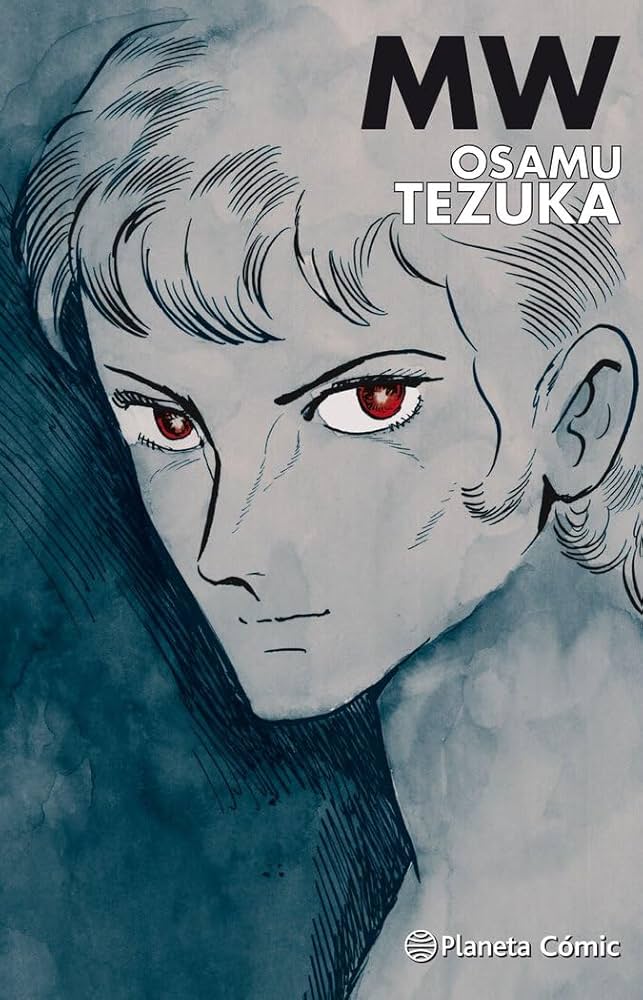
Osamu Tezuka’s MW is a far cry from what most queer readers want to imbibe – at least, for the sake of finding favorable representation of the LGBTQ+ community. The manga’s lurid depiction of homosexuality is grossly indulgent, feeding into the long-standing stereotype of queerness being entwined with villainy. The central character and antihero of the story, Michio Yuki, is an amoral murderer, indiscriminately committing various atrocities over the course of the story. Meanwhile, Yuki’s sexuality and gender expression are key points of his character; he has a sexual relationship with the deuteragonist, Father Garai, a priest he knows from their shared childhood trauma, and he uses his androgyny as a tool for his crimes. MW is undeniably dark, and Yuki is an irredeemable character, but a closer analysis is needed to reach a conclusion on whether Tezuka is truly presenting the whole queer community as degenerate or if he is simply telling a story with villainous characters that happen to be queer. Either way, MW is not the typical progressive queer media that LGBT readers would like to see as representation, but it is still a valuable piece of media that queer audiences can enjoy.
Yuki kills a child not even a full chapter into MW; his first crime of the manga is so extreme that it allows Tezuka to make it known immediately what kind of a person Yuki is. He destroys lives for the sake of it throughout the whole story, killing whom he pleases, often women whom he uses for his schemes. He rapes Garai’s friend and pushes her to have Stockholm Syndrome for him, all because the woman had feelings for Garai. He goes so far as plotting to obtain MW, the gas that he cites as the root of his demented nature, so that he may bring about the extinction of humanity with it.
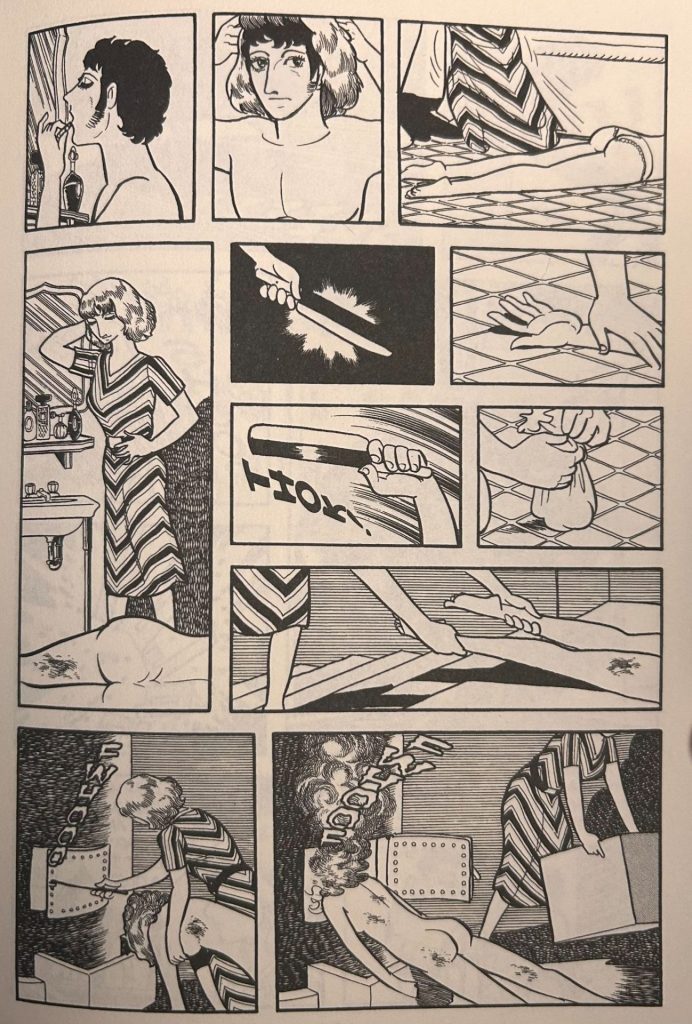
Yuki’s queerness is a weapon. He uses sex as a means to reach his goals, and, while his sexual relationship with Garai exists outside of his schemes, Yuki sleeps with multiple men and women for the sake of reaching his goals. Additionally, due to his feminine features, Yuki is able to seamlessly impersonate the women he has killed, which also allows him to further his goals (Fig. 1). Malia, a writer for Anime Feminist, in their opinion piece “The Transcendent and the Perverse: Sexuality in Apollo’s Song and MW,” argues that “Yuki embodies the homophobic and transphobic stereotype of queer men as dangerous, perverted imitators of women” (Malia). Malia is a queer reader who believes Tezuka is painting queerness as “degenerate.” With Yuki being as nefarious as he is and acting as the most explicitly queer character, it’s difficult for MW’s intersection of “queer” and “degenerate” to be ignored.
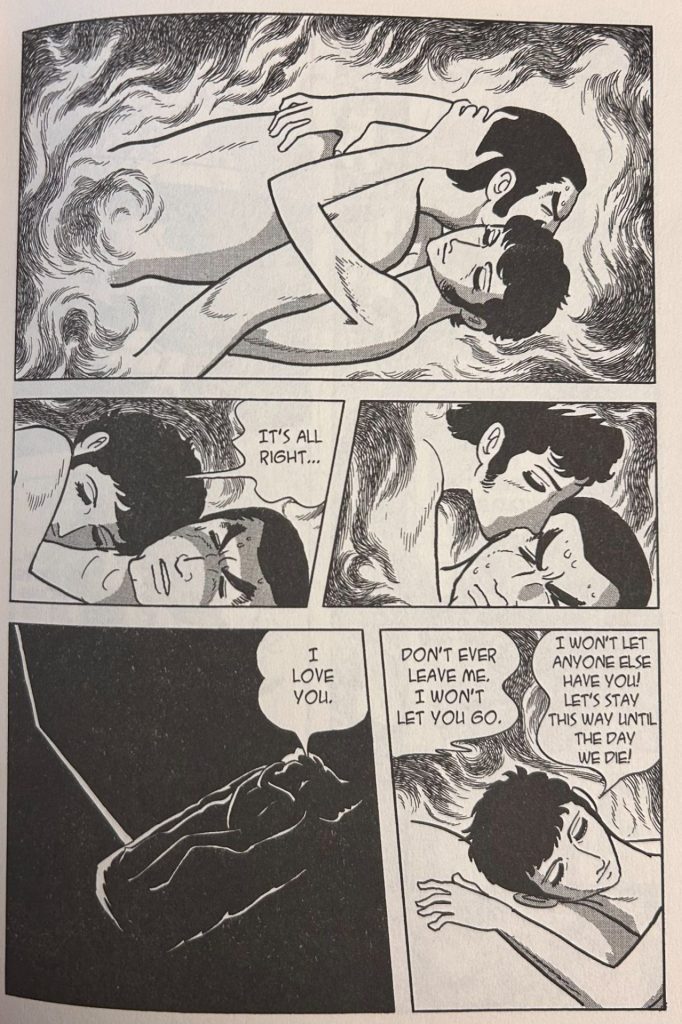
Garai is, of course, also queer, but he fails to balance out the negative representation that Yuki brings. He is opposed to the things Yuki does, but he lets him get away with things he could stop, and even assists him numerous times. His religious guilt consumes him every time he has sex with Yuki, but their shared past and his remorseful love keep him by his side, noting that he can’t cast Yuki away despite his heinous acts because they are “bound by fate” (Tezuka 31). Garai could be seen as a typical repressed gay man in denial about his own desires. He blames Yuki’s ability to pose as a woman for the reason he gives in to sex with him, but Yuki is not dressed as a woman a single time that the two have sex in the story. Tezuka draws Garai constantly embroiled in flames when he has sex with Yuki, representing the guilt that consumes him (Fig. 2). The two seem to genuinely care about each other, as evidenced by Garai’s frantic worry when Yuki collapses on page 318, and Yuki telling Garai he loves him whilst leaving him untouched in his path of murder – but it is all around a tainted relationship. It began in the first place because Garai assaulted Yuki when they first met, when Yuki was a child and Garai a teenager. Malia interprets this backstory as “the tired stereotype of queerness being caused by sexual abuse” (Malia). The relationship being rooted in assault undoubtedly contributes to the negative depiction of a homosexual relationship, but Malia’s interpretation is not fully supported by the text. Yuki only cites the incident as the beginning of his and Garai’s association with one another, not the cause of his attraction to men.
Throughout the narrative, Yuki, as well as some of the other queer characters sprinkled throughout, claim that homosexuality is completely normal and more accepted in other countries. This could be interpreted as being Tezuka’s own view. Chapter 20 involves Yuki attempting to stop Garai from meddling in his schemes
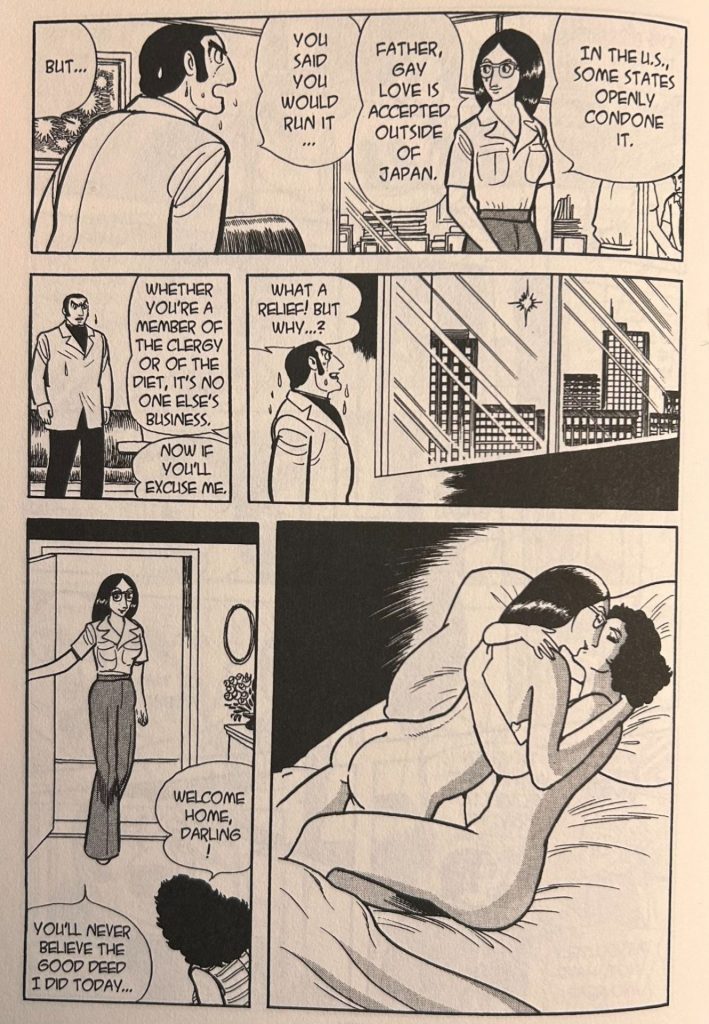
by setting him up to get photographed at a gay club. Yuki’s accomplice threatens to get the image published, and he takes it to the editor of a big newspaper, who turns out to be a queer woman. She states that “gay love is accepted outside of Japan,” and refuses to subject Garai to the prejudice he would face if the image were published (Fig. 3). Her relationship with another woman is framed as wholesome and contrasts with Yuki and Garai’s relationship. The only other queer characters within MW are the men who are at the gay club that Yuki leaves Garai at, and an American general whom Yuki uses for his plot to obtain MW. All these appearances are positive, but so brief that they cannot outweigh the harsh picture of queerness that Yuki creates.
Considering the lack of representation to counter Yuki, it should also be considered whether or not Yuki could still be seen as a likeable queer character despite his crimes. Thomas Brassington, in the article “‘Show
gay people for the often-awful people they are’: Reframing queer monstrosity,” in the journal Queer Studies in
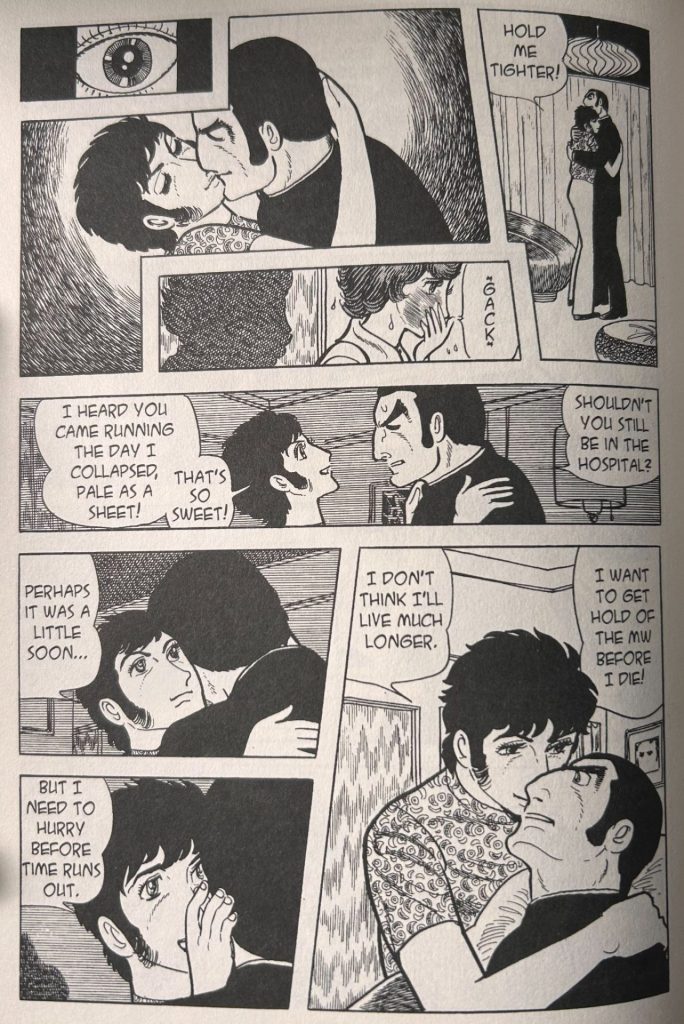
Media and Popular Culture states, “when monstrousness does not provide a vehicle through which queerness becomes legible, queerness becomes expressed in different ways and is put to new work by the psychopath” (Brassington 5). This claim is in reference to the character Villanelle from the show Killing Eve, a queer woman who is a ruthless assassin. Brassington argues that despite Villanelle being a “queer monster,” her queerness is separate from her monstrousness, allowing her queerness to come out through her other prominent traits. This can be related back to MW by considering the aspects that are inherent to Yuki, yet separate from his crimes. It has already been established that Yuki does, in fact, weaponize his queerness, but his relationship with Garai is, for the most part, separate from his overall goals throughout MW. Garai does occasionally help Yuki with his crimes, but Yuki acts completely differently with Garai than he does with everyone else in his life. Everyone else he speaks to witnesses a complete facade, a persona of the perfect man. Tezuka even draws him differently when he’s with Garai. In Figure 4, his eyes sparkle as he sweetly caresses him, while just a few pages prior, he was scowling in Sumiko’s presence; his eyes are narrower and his brows are typically furrowed in the presence of anyone else. Yuki’s femininity becomes less of a weapon and more of a display of tenderness that is only exposed when he is with Garai. Yuki does horrible things, and his relationship with Garai is rooted in abuse, but Tezuka has written their relationship to be sympathetic, and when Yuki actually cries for Garai when he dies in the final chapter, it is genuinely sad to see their story end without the two going down together.
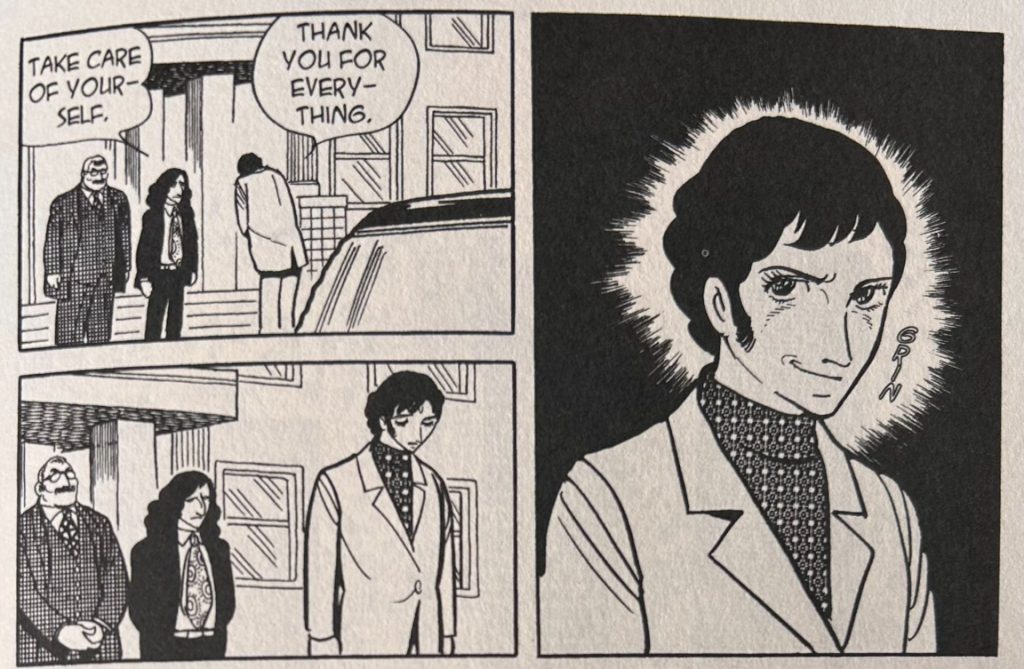
Considering the fact that the line between “monstrousness” and “queerness” is still quite blurred in Yuki’s case, Brassington’s theory does not fully protect Yuki from being a queer monster and Tezuka a perpetuator of longstanding stereotypes. There is a staggering amount of evidence that Tezuka did not write MW with a goal of pleasing queer readers. It is even possible he simply chose to explore the themes for the sake of including varying degrees of shock value. It would be completely fair for a queer reader to pick up MW and pass it off as grisly filth, not worth their time – and yet, this conclusion is not exactly definitive. There is something in the tone that seeps from this ludicrous story that suggests that things are not so black and white. Within MW, there is no outward message that homosexuality should be rebuked. There is not even an outward sense that Tezuka expects readers to fully hate Yuki; after all, he wins in the end. The ending of MW is so ridiculous, campy even, that it is amusing despite the dark circumstances. This is a horrible man who, through means that were laughably avoidable, walks free, and, on the final page, breaks the fourth wall, directly confronting the reader, as if to laugh at us for thinking he’d be stopped (Fig. 5 ).
Yuki is a monster, that much is undeniable, but he is the main character of MW, meaning it is his perspective that readers follow. He is not the first existing main character who is irredeemably evil. There is a separation from reality and fiction that allows people to enjoy a character while recognizing that they are horrible. This is especially true of queer audiences. Laura Westengard, a queer scholar who is a Professor of English at New York City College of Technology, states, “queer audiences often turn to Gothicism to access admittedly problematic representations, and at times queer viewers even identify with the Gothic antagonists, thereby powerfully reframing their meaning” in her piece “Queer Gothic Literature and Culture (Westengard 266). In this case, “Gothic” can refer to modern horror stories as well, which MW would fall under. She refers to the idea of “queer-coding,” which is the notion that certain depictions of queerness are often implicit through certain tropes rather than explicit, and how queer-coded villains were not uncommon in early literature and film in the form of monstrous fiends. If the only “representation” queer audiences have is found in monsters, then it is only natural that audiences will reclaim these monsters for themselves. This linking of monstrosity and queerness is so ingrained in media even today that Tezuka has subscribed to it as well, though he has done it overtly by making Yuki explicitly queer.
When examining MW through this lens, it is ridiculous to make the claim that queer readers will actually relate to Yuki, as they might with more tame queer or queer-coded villains such as some of the villains of the Disney films, but is completely plausible that they could be amused by his blatant villainy that he always gets away with and his somehow flawless impersonation skills. MW is dark, but it is undeniably unrealistic at times; it was a conscious choice of Tezuka’s to discard realism for the sake of Yuki’s victory. Westengard claims that within Gothic literature, “readers enjoy the titillating details of the ‘subversion of order’, or the queering of the status quo, but ultimately the narrative reinforces adherence to norms by the destruction of those situations and creatures that represented divergence” (Westengard 260). This offers an interesting perspective as to why Tezuka would choose not to simply kill off Yuki at the end and allow Garai to enter a heterosexual relationship with Sumiko that would align with his faith. It is unlikely that Tezuka condones Yuki’s crimes, but, through a metaphorical lens, he is condoning the “subversion of order” that Yuki represents, homosexuality and all.
In the form of Michio Yuki, Tezuka has created a character who is horrible in nearly every sense of the word. He is a vile villain who also happens to be queer. His queerness acts as a weapon through which he can make more people suffer, but through his relationship with Garai, that queerness acts as a reprieve from the dark subject matter. Yuki is a monstrous queer, but his grin at the end of MW tells us that that is okay. MW is dirty, but if queer readers were to scrub away all of the filth that clings to the history of queer media, there would not be much left to grasp at. Queer media has evolved since its publication, and the progress that has been made toward more positive queer representation is astounding, especially within the world of comics. MW will never be as beloved by queer audiences as something such as Alice Oseman’s Heartstopper, but why shouldn’t queer fans also get to enjoy their share of vulgar fun – after all, the straight fans get plenty of it.
Works Cited
Brassington, Thomas. “Show gay people for the often-awful people they are’: Reframing queer monstrosity.” Queer Studies in Media & Popular Culture, vol. 7, no. 1-2, 2022, pp. 27-40.
Malia. “The Transcendent and the Perverse: Sexuality in Apollo’s Song and MW.” Anime Feminist, 2019, https://www.animefeminist.com/history-the-transcendent-and-the-perverse-sexuality-in-apollos-song-and-mw/.
Tezuka, Osamu. MW. Translated by Camellia Nieh. Vertical, 2007.
Westengard, Laura. “Queer Gothic Literature and Culture.” Twentieth Century Gothic, 2022, pp. 259-272.
SOLRAD is made possible by the generous donations of readers like you. Support our Patreon campaign, or make a tax-deductible donation to our publisher, Fieldmouse Press, today.


Leave a Reply