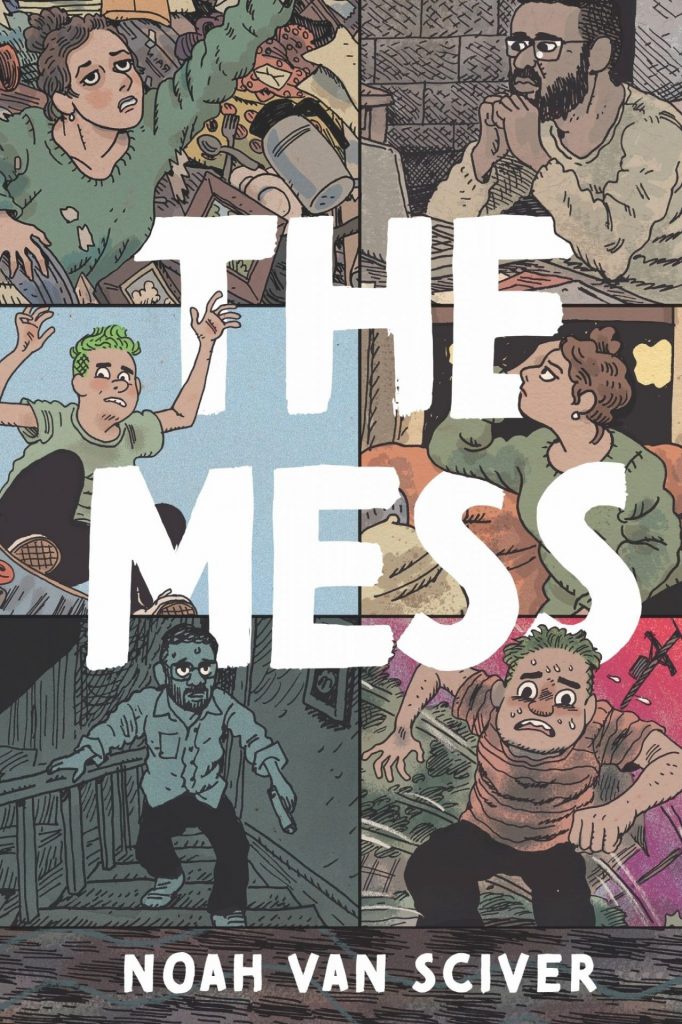
Noah Van Sciver’s new graphic novel, The Mess, is a bit of a stealth story. On a simple level, he creates a skewed and knowing look at the culture of a small New England town in decline. We have intriguing lead characters and a compelling story with subplots that echo significant story elements.
But on a deeper level, Van Sciver creates a microcosm: of broken communications, fractured families, and a dislocated America.
I’m a longtime reader of Van Sciver’s work; in fact, I own a page of original art from his 2012 graphic novel The Hypo and reviewed the book in a jam review with this website’s editor (editor’s note: 2012?? Man, time flies). So when the opportunity came to do an advance review of his next book, to be released September 2026, I jumped at the chance.
I was surprised by what I read. Most of Van Sciver’s books tell the story of a certain sort of man who’s maladjusted and broken in some way. The great reviewer Frank Young described most of Van Sciver’s leads thus: “The hopeless quest for fame and status, by those least able to achieve either, is priority #1 for Noah Van Sciver’s hapless, self-absorbed characters.“
However, The Mess is different. As Noah told me in an interview on June 8, he was challenged by his editor to go outside of his normal patterns:
I just wanted to take a break from doing what I was normally doing to step out of my own comfort zone with my work. Eric Reynolds, the editor of Fantagraphics, I asked him like, well, I don’t really know what to do next. Should I do another Fante Bukowski book or something like that? He said, you could do one of those with your eyes closed. Let’s see you try and do something different. Go in a direction that you’re less comfortable with and see if you can kind of pull that off. So that’s what I was trying to do here. I was like, let’s see if I can just tell a story that I wouldn’t normally tell, something that I would be afraid to put out there. I was afraid to do this book. When I sent the book to Eric, I was like, you don’t have to publish this, man. I don’t even know if it’s very good. I can’t tell. I’m too close to it. So if it’s not good, don’t publish it or whatever. But he liked it, thank God.
As he continued, Noah described how he wanted to “write something that had more concerns about being older, like that was the real struggle or the challenge of this book.”
Which makes sense from a personal standpoint for Noah and from a professional standpoint in his career. No longer the budding young man we met in One Dirty Tree or My Hot Date, Noah is now an adult, with adult responsibilities and growing children. He mentioned during our chat:
Even though I’m a middle-aged man, I feel like I can write stories about guys in their mid-twenties, but to write something that had more concerns about being older or something like that was the real struggle or the challenge of this book. Being a parent and having the responsibility of that, when you don’t have very many options, financially or whatever, and you’re kind of relying on luck or fate or something to try and get you through that. That’s one of the aspects of the book.
As such, he centered this story around a misbegotten trio of leads, all of whom are dealing with death and trauma in their own specific way. And though there is a younger, messed up character in the book, this story shows its own sort of wisdom of age as a reader looks at it.
The Mess takes place in a small New Hampshire town. The lead is Erin Messina, a middle-aged woman who looks her age: with large bags under her eyes and an unathletic body; she looks like who she is: a divorced schoolteacher and single parent. Erin grew up in that town, where she dealt with her mother’s sudden death and her father Frank’s resulting pain. Erin had to leave the stifling town as a teenager due to a traumatic series of fights with her father. Thus the town reminds Erin of her pain and trauma. Frank Messina curated the town’s art museum before his wife’s sudden death caused an emotional decline that led to hoarding behavior. Junk is everywhere – an early scene shows Erin filling the curb with endless bags of trash. The endless clutter becomes a metaphor as Erin and her rebellious teenage son, Jackson, have returned to the house. Not to see old friends or visit old haunts; no, in fact, Erin is on a kind of quest.
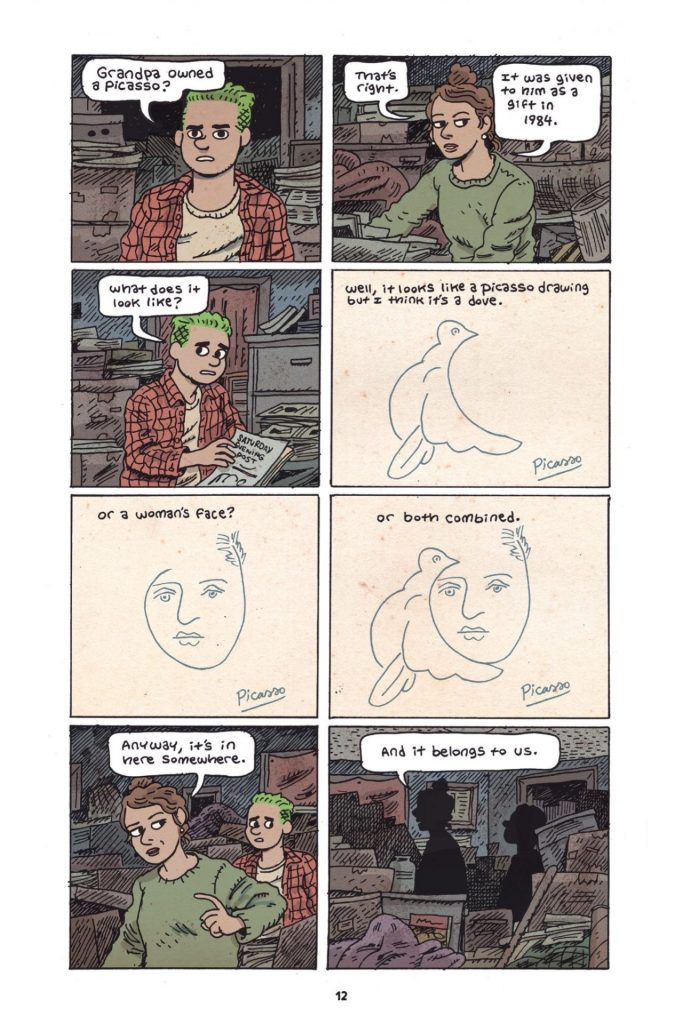
Erin didn’t just return to the town to clean out her father’s house. She is searching for what Van Sciver calls “a lottery ticket.” At one point, Frank apparently was gifted an original drawing by Pablo Picasso. Erin and Jackson need to find the picture, otherwise, as Van Sciver says, “they’re going to be kind of stuck on the economic ladder that they’re on, with all the responsibility and stuff.“ If she can unearth the Picasso drawing from all the chaos, Erin believes she and her son can escape despair, move beyond her precarious financial situation and finally step into a life with more financial security.
In modern America, aren’t we all looking for a winning lottery ticket?
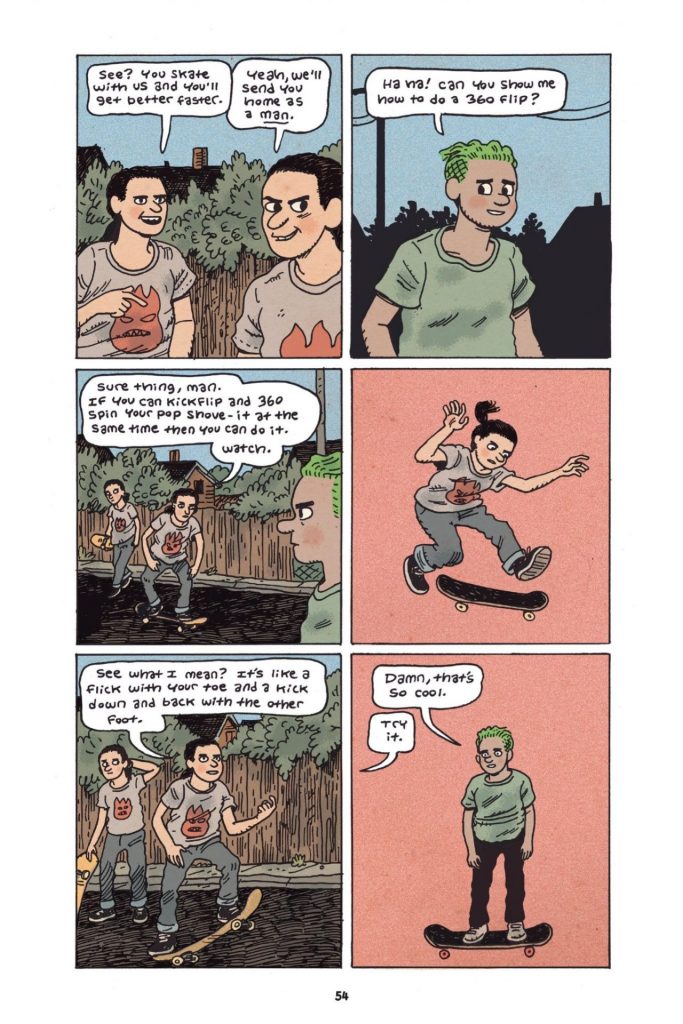
Jackson quickly falls in with a pair of skateboarding twins, free range kids who initiate a naïve Jackson into a broader world than he imagined: shocking freedom, new skateboard tricks and the chance to skateboard in hidden areas of the town, as well a first tantalizing puff of marijuana, but through this relationship, he is also terrifyingly exposed to real violence and a sudden loss of innocence.
Another key character in The Mess lives across the street from Frank’s house. A young, black, gay man named Marcus who is deeply misunderstood by everyone in the community, possibly including himself. Kids throw rocks at his house, spray MURDERER in graffiti on his front door, and gossip about Marcus killing his longtime boyfriend. Marcus carries his own pathetically sad secrets through the book, manifestations of the deep sense of spiritual collapse and malaise that torture him worse than even the graffiti could.
In other words, none of these are “typical” Van Sciver characters whose goals and needs are on the surface. Instead, as he told me, in The Mess, Van Sciver aimed to look deeper into his three key leads. All the main characters in this book pursue their own hopes and aspirations:
Whenever I write now, I’m always thinking, well, what does this person want? I want that to be clear, and the reader should know that, because then, all of a sudden, the reader will be interested. So I wanted to make sure that that’s what it was like, you know, Erin wants the Picasso drawing. Marcus wants to communicate with his dead boyfriend. And Jackson really wants validation from these two boys, these twins. He wants to be cool like them. They’re going to be pro skaters. That’s what he wants. So then that’s just the journey about if each one gets what they want.
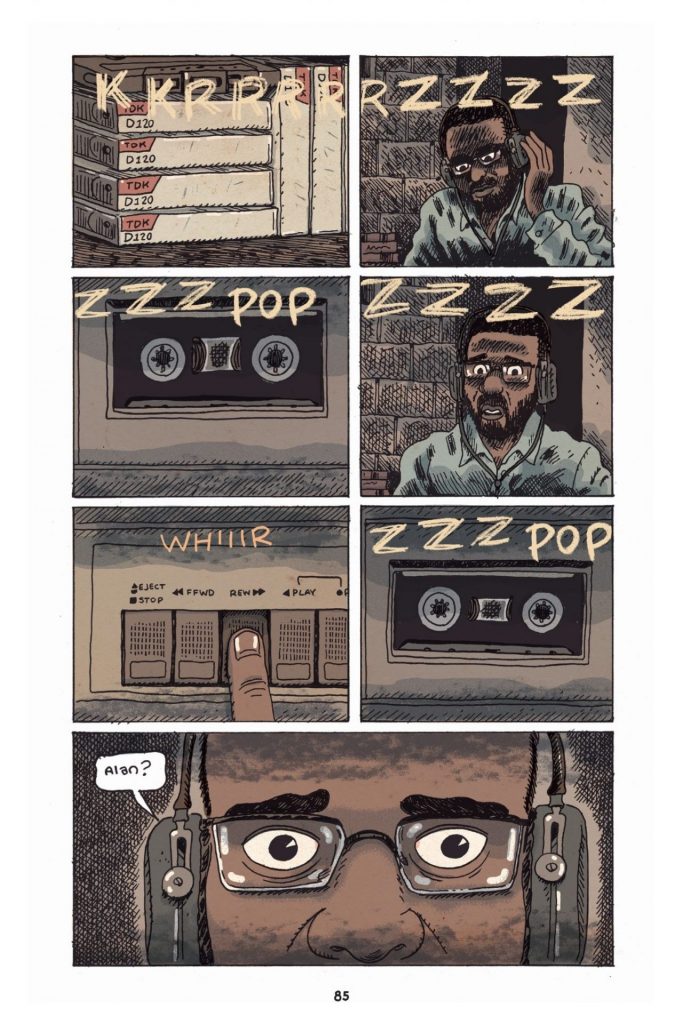
As Van Sciver presents him, Marcus is an especially pitiable character. As a reader, we’re always wrongfooted by him, never sure whether Marcus is actually a nice and well-meaning man or just as broken as Erin. We witness Marcus desperately try to connect with his dead boyfriend through antiquated equipment which was promoted in the 1980s as a way to contact the dead (Van Sciver told me this idea is absolutely based on a real system created by a man named George Meeks, who was once well-known in pseudoscience circles).
Implicit in Marcus’s character is that he’s obviously always felt like an outsider. He’s black and gay, obviously emotionally fragile, and intellectually adventurous. Marcus’s body language, as Van Sciver draws him, gives the sense of how a rough breakup could crush him. It is no wonder, then, that the murder of his live-in boyfriend, Alan, sent Marcus spiraling. Through Van Sciver’s beautifully rendered facial expressions, we always feel like Marcus is trying incredibly hard to communicate with someone, anyone. He struggles hard to break out of the emotional abyss he’s caught inside. But his social ineptitude, combined with the apathy of strangers, leaves Marcus completely isolated. When Van Sciver inserts panels of Alan’s still, deathly face, readers can empathize with the pain Marcus is feeling.
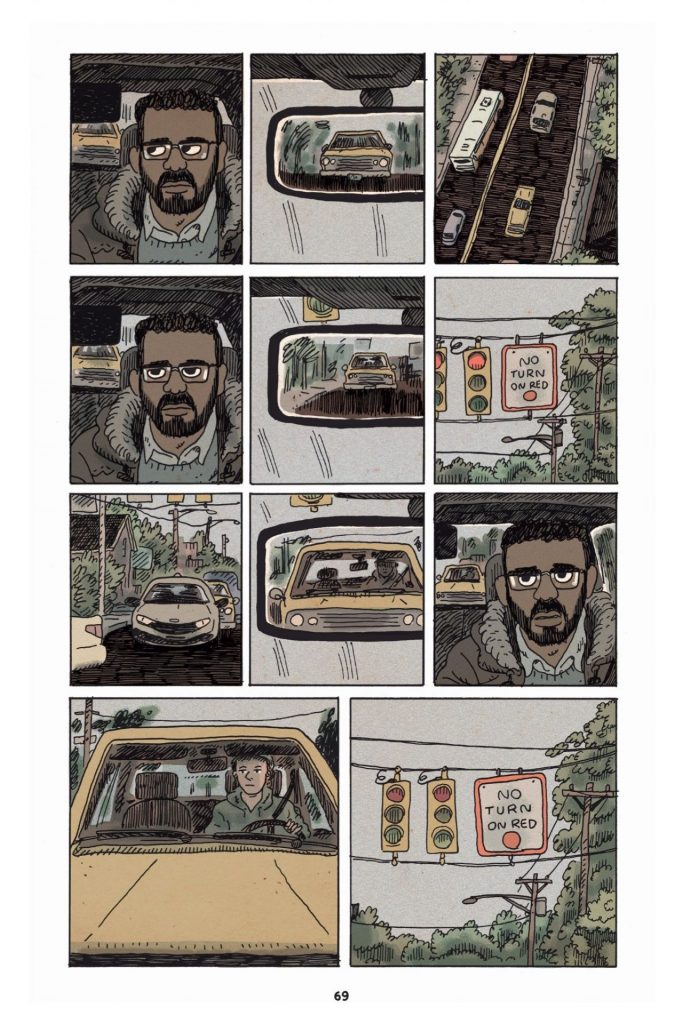
We want to empathize with this man, that is, except for Marcus’s fatal flaw: he always seems to push other people away. Marcus appears to be a truly nice person on a surface level. For example, in a wonderfully told sequence, we witness him give Erin a jump-start when her beater car breaks down on a country road. This happens before she really knows him, so there’s a clever little sequence where he seems to follow her home – only to discover Marcus is, in fact, the mysterious neighbor with MURDERER spray-painted on his house. This sequence is elegant in its construction. At first Marcus’s help feels like small-town kindness. Then the event feels creepy as Erin sees Marcus following her car turn for turn. Finally, the sequence becomes a moment of deep discomfort as both arrived at their homes and start talking. It’s deeply ironic how a moment of kindness results in a deeply uncomfortable experience for both people. In just a trio of pages, Van Sciver eloquently shows readers how Marcus has essentially forgotten how to relate to other people and how Erin has a narrow idea of what she wants from other people.
Marcus is broken by his grief, but then again, all the characters in The Mess are broken by the messes in their lives.
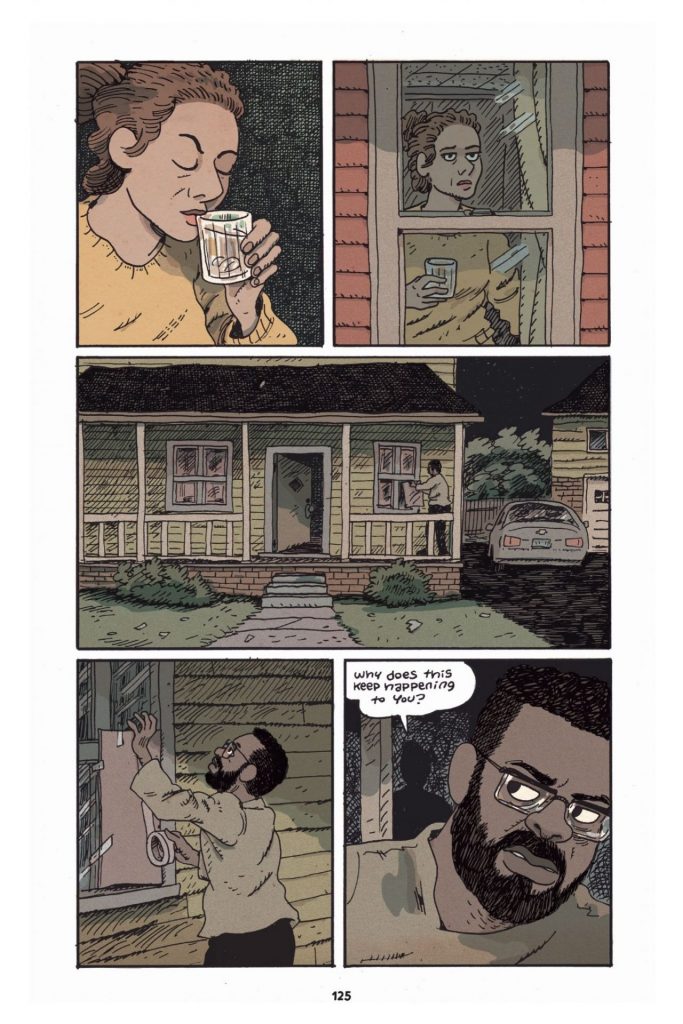
As the book goes on, Van Sciver unfolds the circumstances which brought Erin to the town she left as a teenager giving context to why she seems so broken. Her father’s house holds secrets in the midst of the endless mess.. Why Erin needed to escape, the pain her father was carrying, even a late romance Frank had with a local widower. It’s notable how Erin isn’t curious about her father’s social life, dismissing any thoughts of Frank’s inner life with a shrug. Frank was dead to his daughter long before his physical death.
Thus Van Sciver presents layer after layer of individuals who don’t communicate and a society where connections are always elusive. More than that, The Mess also foregrounds grief as a key theme of the book. From the central macguffin of the book – Frank Messina’s trauma over the sudden death of his wife – to Jackson’s trauma as his friends reveal new sides of themselves, to Marcus’s deep trauma over the loss of his beloved Alan. Van Sciver describes this feeling with eloquence:
It’s grief and how grief manifests itself. What you want to hold on to from somebody who’s passed away, what’s valuable to you. It’s the memory of somebody who’s passed that was dear to you in Erin’s case, it’s just whatever you can scrounge from the end of their life and to help your life financially, help yourself financially. Or in Marcus’s case, it’s like you just want to hold on to that person or the fumes of that person or whatever you can after they’re gone. And he has a lot of guilt about it because he feels like he was partly responsible for the death of his boyfriend. So how does he deal with that guilt and grief?
This approach is a key reason why this book succeeds rather than falling into a set of Van Sciver tropes. One valid criticism of his previous books has been that Van Sciver often spells out a character’s whole life in a few pages. Here, however, he opts for subtlety; as he says, “basically I was like, let me see if I can tell a story where I’m not spelling out everything. I’m kind of hinting at the details of these people’s lives. And then it’s up to the reader to kind of piece it all together. to not overwrite it and things like that.”
This is an intriguing counterpoint to much of Van Sciver’s other work. In books like Junco Jeans, he tells stories from his dysfunctional family and often deprived childhood. Life is tough and broken, but the family always stays together and there’s a sense of connection. The Mess proposes just the opposite. Nobody connects to anyone else. Erin is completely mystified by her dad’s ways. She and Jackson are essentially estranged from each other. Jackson tries to bond with some boys who seem fun, but that relationship has destructive consequences. In fact, those boys also have a broken relationship with their dad – he’s never shown in the book and seems to only be there to be stolen from.
Van Sciver skillfully melds the rot at the heart of this town with the rot at the heart of its residents, delivering a tapestry in his classically ragged cartooning style that emphasizes the threadbare existence of his characters. There are a lot of conversations in The Mess, both spoken and implied, but people rarely actually communicate with each other. Everyone talks past each other, or are using each other, or have their own plans. Rarely does a person actually communicate their real feelings. Never do we feel love without strings attached. Perhaps the center of this book isn’t Erin. Perhaps the center of this book is Marcus, who wants to literally resurrect a relationship with the one person he could truly love.
The Mess delivers a story of a town on the edge – of financial collapse, emotional devastation, and even physical devastation. It feels like a uniquely appropriate book for life in America in 2026. Though there’s no politics articulated in the story, everyone seems crushed under the complicated circumstances of their lives while striving for a quick fix that remains painfully elusive.
The Mess is an exquisitely rich and subtle graphic novel and a true level-up for a cartoonist just emerging into his prime. It’s great to see Noah Van Sciver step outside his comfort zone.
SOLRAD is made possible by the generous donations of readers like you. Support our Patreon campaign, or make a tax-deductible donation to our publisher, Fieldmouse Press, today.
Leave a Reply