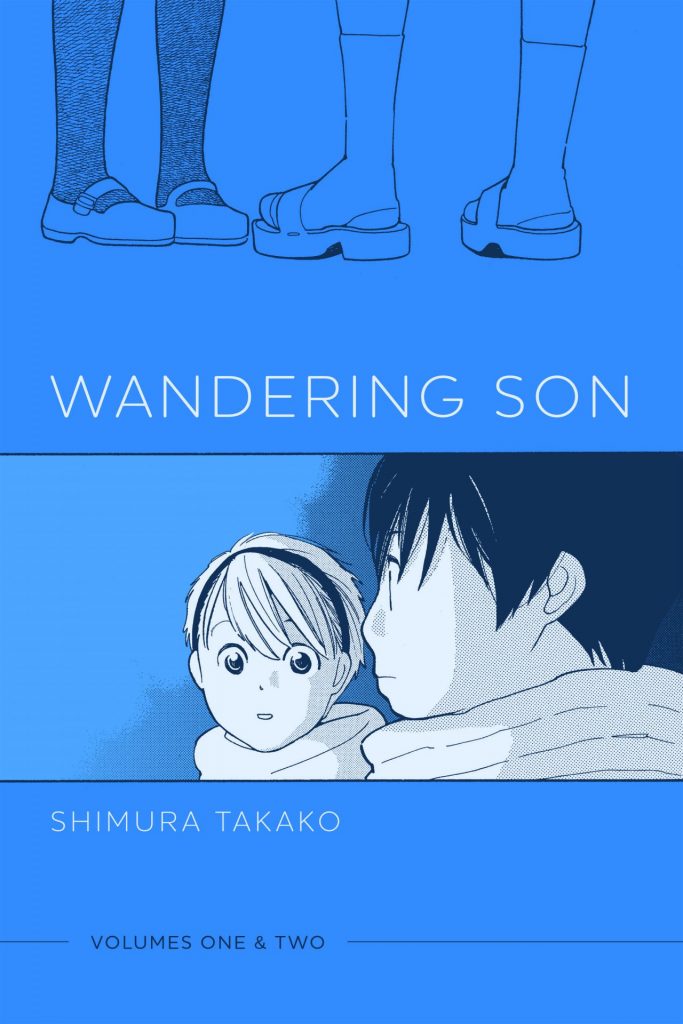
A story about the importance of first accepting yourself before you can authentically present yourself to others, Wandering Son is a manga written and illustrated by Takako Shimura. The series follows two characters at the threshold of puberty who discover that their genders are not in alignment with their sexes. Protagonist Shūichi Nitori was assigned male at birth, and realizes that “he” is actually a transgender girl. Mirroring this characterization is deuteragonist Yoshino Takatsuki, described in the introduction as “a handsome girl,” who was assigned female at birth, and realizes that “she” is actually a transgender boy.
Shimura launched Wandering Son in Comic Beam magazine (published by Enterbrain at the time, now by Kadokawa) in December 2002, where it continued until August 2013; it was also collected into 15 tankōbon by Enterbrain from 2003 to 2011. It then inspired an 11-episode television series by Anime International Company, broadcast on the Fuji Television “noitaminA” programming block in 2011 and streamed simultaneously on Crunchyroll.
The English translation of Wandering Son was published in more-expensive-than-the-average-manga hardcover editions by Fantagraphics from 2011 to 2015. In an instance of life imitating art that would have made Oscar Wilde smile, the series was translated by scholar Rachel Thorn, who herself began to transition between the publication of Volumes 1 and 8. Unfortunately, only those first eight volumes were published before the series was discontinued for lack of sales. Translations are not available in licensed digital editions, and the first four volumes of those hardcovers are long out of print.
Fortunately, Volumes 1 and 2 of this visually charming, historically significant manga will be collected into a single paperback edition by Fantagraphics in September 2026. In anticipation of this reprinting, Wandering Son deserves a retrospective review. While collecting my thoughts on it, I was fortunate enough to be able to speak with the mangaka herself, facilitated by Fantagraphics in the US and Enterbrain in Japan.
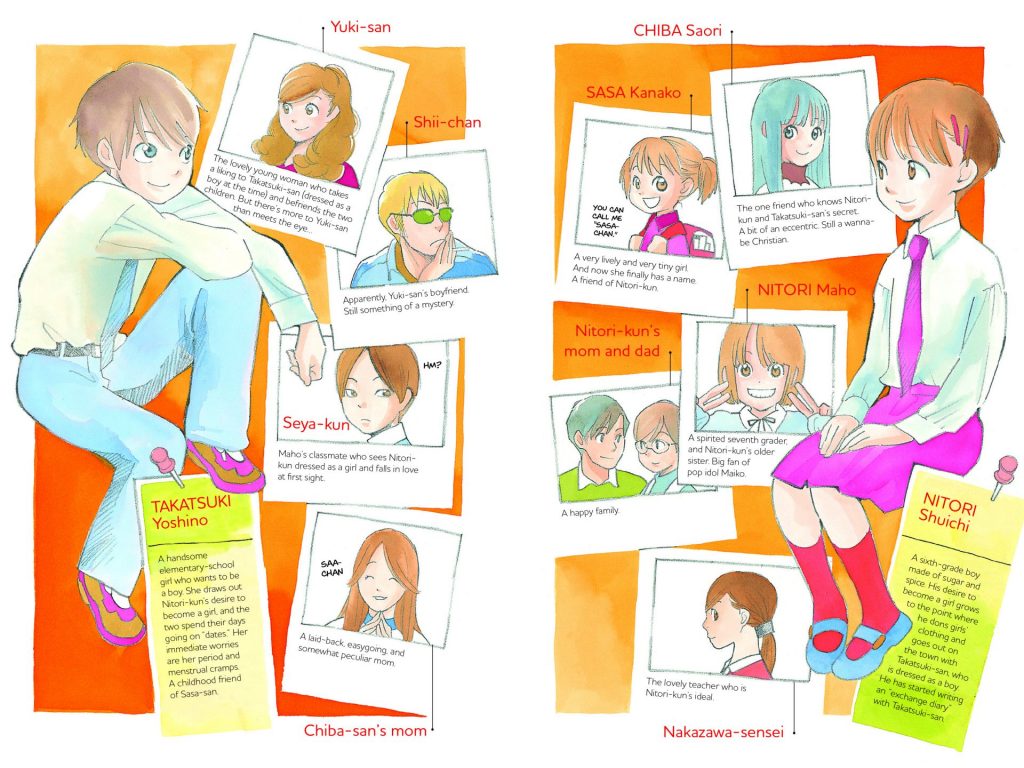
The manga has inspired mixed discourse over the years. Back in 2012, Wandering Son was nominated for a Will Eisner Award in the category Best US Edition of International Material – Asia. The same year, the Young Adult Library Services Association included it on their list of Great Graphic Novels for Teens. But despite having been critically celebrated, the series has incited polarizing opinions among some readers in the Anglosphere, from scholarly articles attempting to apply Judith Butler’s theory of gender performativity to its characterizations, to social media posts equating its fictional depictions of unpleasant situations to real-world violence.
Not every queer experience has a parallel in every culture, so the narrative arcs of Wandering Son might not map exactly to North American experiences. Although the term for “transgender” in Japanese is a loanword from English: “toransujendā” (rendered, as many foreign words are, in the katakana syllabary: トランスジェンダー), being trans in Japan is nonetheless unique to a Japanese social experience. Some of the details that make this manga so memorable are the ones that require a nuanced understanding of cultural contexts.
The meandering path of trans representation
The Act on Special Cases in Handling Gender Status for Persons with Gender Identity Disorder was enacted in 2003 and implemented in 2004, as a way to facilitate legal sex and gender changes in Japan. Initially, there were five conditions: That a person be not younger than 20 years of age; not legally married; have no biological children younger than 20 years of age (lowered to 18 in 2022); have no reproductive function (whether naturally occurring or medically induced); and have genital organs that appear to be of the opposite sex after the change. Before a trans person could have surgery, a psychiatrist would have to diagnose them with Gender Identity Disorder.
In 2023, the Supreme Court of Japan ruled that surgical sterilization is in conflict with Article 13 of the Constitution, which stipulates that all people be respected as individuals. Laws have changed since Wandering Son was first published, but many of the unique challenges of being a trans person have not. With this in mind, the meandering path of trans representation in fiction that leads toward social acceptance should necessarily include Wandering Son as a milestone.
Manga featuring crossdressing and genderplay can be traced all the way back to 1953, when Osamu Tezuka published his shōjo Princess Knight, about a princess forced by circumstance to become a prince. Before Wandering Son, however, trans characters were effectively nonexistent.
Claudine…!, a shōjo by Riyoko Ikeda, was serialized in only two issues of Weekly Margaret magazine in January 1978 before being collected into a single tankōbon later that year. Stop!! Hibari-kun! by Hisashi Eguchi was serialized in Weekly Shōnen Jump from 1981 to 1983, then collected into four tankōbon. The shōnen Ranma ½ by Takahashi Rumiko was serialized for more than eight years, and collected into 38 tankōbon (1987–1996), securing its place as one of the best-selling manga of all time. But in all of these stories, male characters who present as another sex or gender are either crossdressers or, in Ranma ½, seamlessly transsexual because they’re transformed by magic. It wasn’t until 2002 that Wandering Son helped codify a culture of trans and gender nonconforming manga.
As a reader of trans experience myself, I needed to know what initially inspired Shimura to create this story. “I experienced gender dysphoria myself during my adolescence,” she shared. “Looking back now, mine was probably a passing phase, but even after becoming an adult, I struggled with this sense of unease for more than 10 years. I had always wanted to turn my experience into a manga, so this felt like a fulfillment of a long-held dream.”
Shimura approaches the trans experience with empathy and tenderness. I told her that readers regard her as a pioneer in LGBTQ manga, in large part because characters in Wandering Son navigate their gender transitions with a realism that was uncommon in its time. I wondered if she ever imagined that her manga would have this effect, and she replied demurely: “I do not consider myself a pioneer or anything of the sort. But when I think of the readers who deeply cherish this work, I truly feel glad that I created it.”
Out of the closet and onto the stage
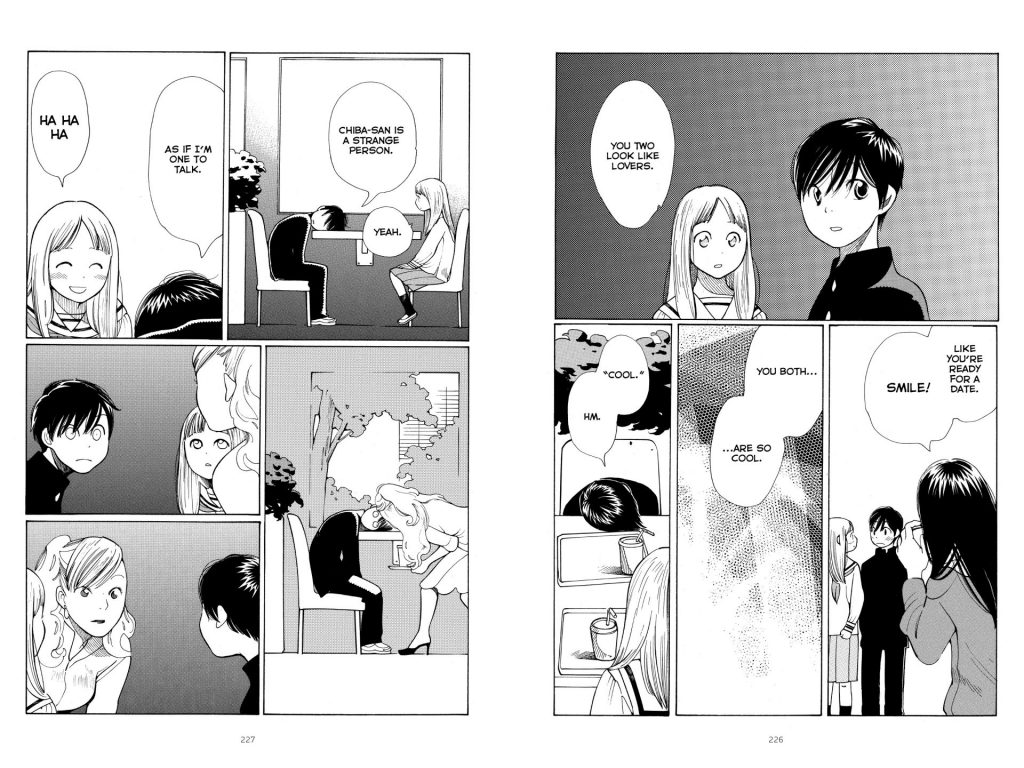
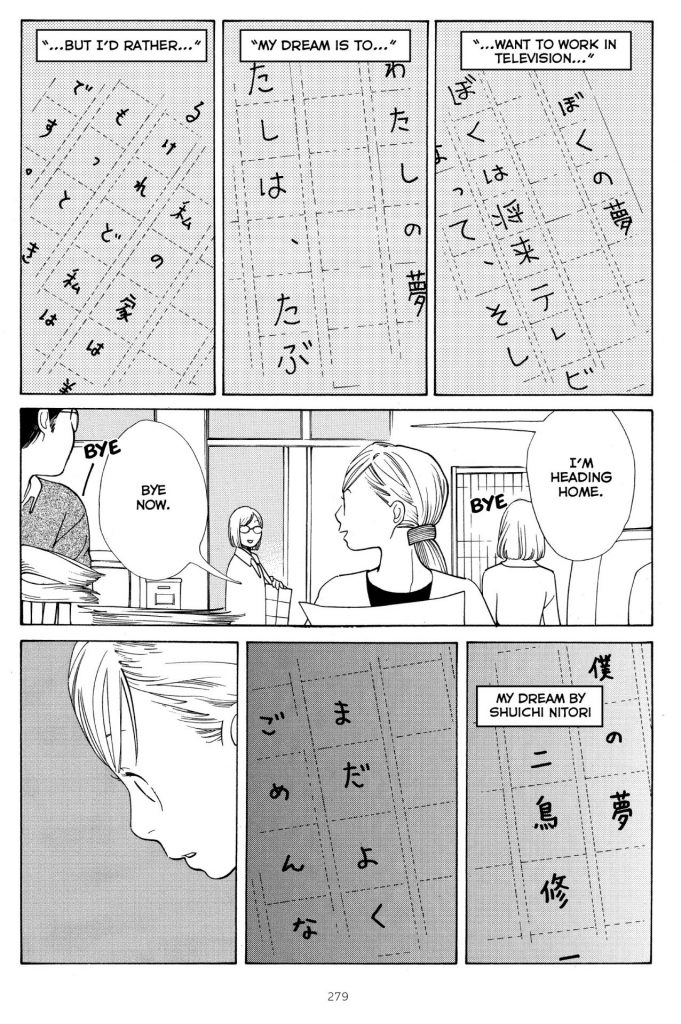
The visualization of Shūichi’s self-discovery relies mostly on depictions of clothing and accessories. Shūichi, wearing a wide headband, is assumed to be a little girl by a man making a delivery to the Nitori family’s home. On the next page, Shūichi’s sister Maho accidentally discovers Shūichi trying on girl’s clothes. But rather than expressing revulsion, she assures Shūichi that the dress looks good on her. Conversely, the visualization of Yoshino’s gender expression is focused on a haircut and styling that transforms Yoshino’s entire character design.
When it comes time to plan a school play, a classmate named Saori suggests that “the girls play the men and boys play the women,” which would allow both Shūichi and Yoshino to dress in ways that are comfortable for them, while also giving them a literal audience. Their other classmates are surprisingly amenable to this creative choice, although some of them seem to enjoy what they see as the absurdity of the idea, because to them, it feels like a “drag show.” Their teacher approves this proposal, and the class performs The Rose of Versailles in the style of the Takarazuka Review (a real-life, all-female musical theatre group in Japan), and refer to it as such.
The Rose of Versailles, a series written and illustrated by Riyoko Ikeda and originally published in 1972, is a historical drama set in France before the French Revolution. Ikeda populated her manga with original characters alongside historical figures, including the Queen of France Marie Antoinette and a fictional commander of the Royal Guard — a woman who had been raised as a man and has (only seemingly) homoromantic experiences throughout “his” narrative arc. Shimura’s direct reference to The Rose of Versailles creates an intertextuality with Ikeda’s manga, and foreshadows the homoromantic elements to be revealed in subsequent volumes of Wandering Son.
In a surprising pivot during the casting scene, Saori suggests that Shūichi play a male character named Oscar because she perceives Shūichi to be a girl already, even though Shūichi has not yet come out to anyone. Saori casts Yoshino as Oscar’s male love interest André. Both Shūichi and Yoshino are unknowingly outed by their classmates. But rather than feeling like an affront to either of them, it feels like an affirmation to both of them.
In the next chapter, Yoshino’s brother discovers that Yoshino has found his old school uniform and tried it on. When he asks Yoshino where he found it, Yoshino answers: “In the closet.” Linguistically, in any language, this might make sense, but especially in English, it can be interpreted as a reference to the concept of being “in the closet,” which Yoshino certainly is at this point in his story. Volume 1 follows Yoshino and Shūichi through a series of decisions about haircuts, fashion, and social engagements where they are increasingly perceived as their true genders.
Throughout these plot points, it reads as important for the mangaka to center trans (and in later volumes, lesbian) characters. “Perhaps it’s because I’ve had transgender and lesbian people close to me in my personal life,” she said. “While the characters in my manga aren’t exactly the same as them, the real people I’ve known have influenced the characters in some way.”
Gender, genre, and gratitude
Wandering Son was originally marketed in Japan as a seinen, the target demographic of which is young men. The page layout, panel compositions, character designs, and dialogue in Wandering Son diverge from popular seinen like Berserk or Vinland Saga, leaving the “gender” of the manga’s visual style open to interpretation, while the narrative itself is more mature in its content than a shōnen or a shōjo. The fluidity of potential readership is affirmed by Fantagraphics, who present it only as a young adult story without any suggestion of gender.
Shimura’s fine line illustration and sparse composition does suggest a kind of utility found in more traditionally “masculine” stories, in contrast to the flowing lines and soft lighting effects that are emblematic of shōjo. The art here serves a distinct narrative purpose: to tell a story of two pre-adolescent people exploring the ways their biological realities are incongruent with their social identities, without excessive stylization or aesthetic flourishes. Shimura’s tidy visual style gives her story space to unfurl.
The pacing of Volume 1 is hesitant, as though the reader is taking small steps alongside the Shūichi and Yoshino as they discover themselves. The pace gently accelerates when Yoshino meets an adult woman revealed to be a fully transitioned (see previous detail about the Act on Special Cases) trans woman named Yuki, who becomes a mentor to him and Shūichi in Volume 2.
The second half of this paperback edition follows Yoshino and Shūichi through the everyday experiences of puberty, alongside the sometimes dangerous experiences of finding their own gender identities, from being called “faggot” by one classmate, to sharing a love for Anne of Green Gables with another. Their journey toward authenticity is fraught yet endearing.
I was curious to know what memory might stand out most on Shimura’s journey of writing and illustrating all 15 volumes of Wandering Son. “In my twenties and thirties, I frequently pulled all-nighters and led a generally unhealthy lifestyle. I can now look back calmly and realize that the disruption to my daily rhythm and diet was taking a toll on both my body and my mind,” she said. “At the time, however, I lacked the perspective to see that because I was too consumed by the feeling that drawing manga was a painful ordeal. Although there must have been plenty of enjoyable moments, what stands out in my memory are the hardships. Perhaps that’s why the day I finished drawing the final chapter remains the most vivid memory — however hazy it may be now — because I recall feeling a profound sense of relief from the bottom of my heart.”
My sense of gratitude for Wandering Son is similarly profound, especially considering it was published at a time when trans characters in manga were some combination of scarce, magical, or tragic. I’m also grateful to my friends (who wish to remain uncredited) for their support translating my questions for Shimura into Japanese as well as her responses back into English.
SOLRAD is made possible by the generous donations of readers like you. Support our Patreon campaign, or make a tax-deductible donation to our publisher, Fieldmouse Press, today.

Leave a Reply