In a 1997 comic titled “A Fresh Start,” a massive disembodied eye — the eye of God, presumably, or something like God anyway — appears before a middle-aged R. Crumb. “Draw, you bastard!” it orders. Crumb’s response: “No, I don’t want to!” He continues: “I don’t like drawing anymore… I’m over the hill… I’m all out of ideas… drained… empty… see? Look how bad my drawing’s gotten!” The eye insists: “You’d better get buzy [sic]… drawing is all you know… you can’t do anything else!” Crumb, pointedly petulant, argues for a while, but it’s a losing battle — after all, he’s the one drawing this whole debate, isn’t he?
Tsuge Yoshiharu is not R. Crumb. Forgive me, reader, for stating the self-evident, but I don’t think I could be blamed too much for it — prior to Drawn and Quarterly’s endeavor to translate his complete works, and even today, the comparison has hounded Tsuge (in an unsurprisingly one-sided fashion). And, sure, it makes a superficial sort of sense — both are hailed as transgressive innovators, without whose taboo-busting their respective scenes would have been unrecognizably different — but the comparison has always rubbed me the wrong way: for one, Tsuge, at his best at least, certainly seemed to have more breadth of interest, and even at his vilest he hewed loftier and more existential than Crumb’s wry detachment and shock-jock antics.
In the second half of the ‘70s, though, Tsuge was having his own “A Fresh Start” moment. On one hand, recent reprint programs resulted in a new (and considerable) revenue stream for Tsuge and his family to live on; on the other hand, between the stresses of family life (it was during this period that Tsuge and his wife Fujiwara Maki’s first and only son was born, and that Fujiwara was diagnosed with, and treated for, cancer) and broader mental illness slowed Tsuge’s creative flow to a drip; he made little work at all, and even less that he was actually proud of. In the man’s own words (from an early ‘90s interview): “I had absolutely no confidence in what I was doing. I felt absolutely defeated, in body and soul. I didn’t have the time or space to even come up with story ideas. None of my ideas went anywhere. Life every day was just miserable.”
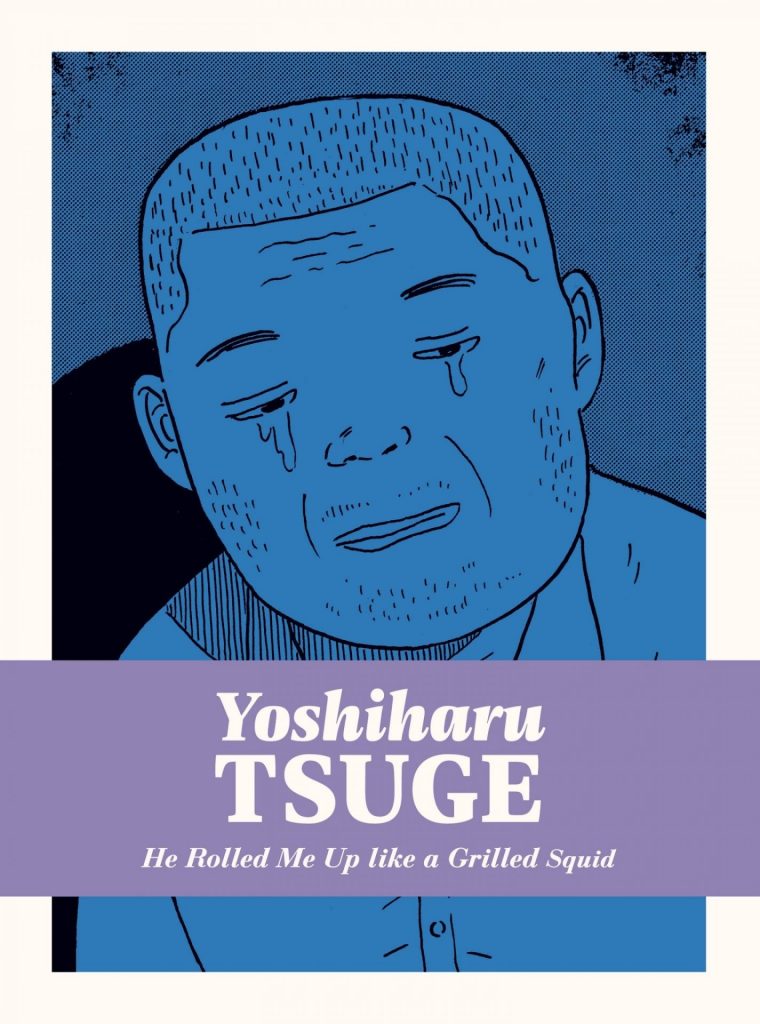
The latest volume of D&Q’s Tsuge library as translated by Ryan Holmberg (the first, incidentally, to be released since Tsuge’s passing in March of this year), He Rolled Me Up like a Grilled Squid, covers this period. Compiling comics published between 1975 and early 1981, the collection further cements, albeit with some exceptions, Tsuge’s trend away from lyrical literary fiction and toward an autofiction of neuroses.
He Rolled Me Up like a Grilled Squid starts with a return to an old reliable genre of Tsuge stories: the rural travel story. In “Plebeian Inn” (1975), Tsuge and a friend of his meet a traveling salesman while on a short getaway. That night, as they drink together, the salesman tells the two protagonists a story about an inn he used to stay at. The proprietors, a married couple, could not conceive a child, and so they asked the salesman to have sex with the wife and impregnate her; when the request proved serious and persistent, he finally acceded. Some time later, he learned that the attempt was successful — the innkeepers now had a small child. This discovery horrified him: not only had he — a married man, with kids of his own — slept with a married woman, now he had fathered another child. Out of shame, he says, he cannot bring himself to visit the inn ever again. Later, convinced that the story was made up whole-cloth, Tsuge and his friend decide to venture to the inn in question, where they learn that the proprietors do in fact have a young girl — but that the child, unbeknownst to the traveling salesman, was adopted, completely unrelated to that would-be father.
While not a ‘bad’ comic on its own, the story is an inauspicious sign for the collection ahead: relative to previous travel stories — the lyricism of “Red Flowers” (1968, included in Red Flowers), say, or the nihilist horror of “Master of the Gensenkan Inn” (1968, included in Nejishiki) — “Plebeian Inn” feels diminished; it has no broader mystery, nothing that extends it past its own confines, what little wisps of theme it offers (the prison of familial obligation, and the persistence of guilt independent of reality) becoming little more than a punchline. Twice in the story, Tsuge and his friend are served alcohol: at first, at the farmhouse the traveling salesman leads them to, they are served fine whiskey, bursting with promise; later, at the couple’s inn, their sake is watered down.
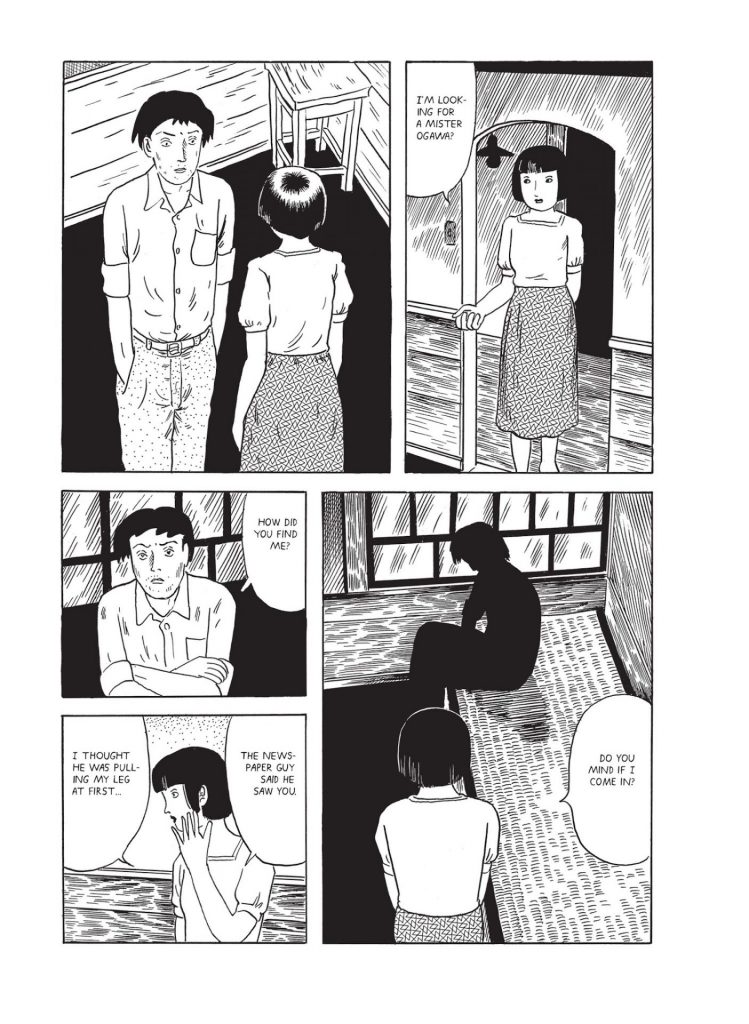
In truth, “Plebeian Inn” was made at a time when Tsuge — an avid traveler, for work and for pleasure — hardly left his home at all. If even travel fails to conjure up feelings of novelty and intrigue, it’s hardly surprising that domesticity should feel even more stifling. In “A Boring Room” (1975), another Tsuge stand-in rents a nearby one-bedroom apartment in secret to seek refuge from family life — not “to live there, per se… but rather to have a place to do nothing.” Before long, his wife hears about the apartment, and, instead of forcing him to pass it up, she actually helps him turn it into “an actual apartment.” Her shocking accommodation does little to help. His escapist fantasy had ended as soon as she walked through the door, no matter what she offered him in exchange, be that kindness or, on one occasion, sex. Though Holmberg, in his supplementary essay at the back of the book, informs readers that “A Boring Room” is a fiction — inspired by a colleague and collaborator of Tsuge’s who rented a similar room for himself — the story is entirely indicative of the totality of Tsuge’s avoidant mindset; even when supported, he is put-upon and beleaguered. “I wish you’d help a little less,” the stand-in tells his wife.1
Among the twelve comics that comprise He Rolled Me Up like a Grilled Squid, “Plebeian Inn” and “A Boring Room” are in a minority position: they are cold, logical, linear — they are stories of the waking world. The majority of stories in the collection (seven against five, to be precise) are direct adaptations of Tsuge’s dreams, a mode of work devised, as Tsuge put it in the same aforementioned interview, as “a lazy shortcut” to cover up for a lack of inspiration. In a way, the pivot is a natural development: like the autofiction stories, the dream-comics are a way of showing where Tsuge is at, mentally, at a given moment — except without any obligation to narrative logic or poetic mechanics.
On one occasion, the escapist mindset of “A Boring Room” finds its fulfillment in the dream-world: in “Life on Cape Komatsu” (1978), the protagonist and his wife are watching a television show about an idyllic peninsula. The protagonist is unfamiliar with the place — “I thought you were good with geography,” his wife teases — but, as the two watch a female diver catch crabs with her bare hands, he becomes increasingly enamored with the carefree lifestyle Cape Komatsu offers. Finally, he decides to “give it a shot” himself, and, as the cartoonist zooms in on the television, we can see his dreaming counterpart wading into the cold water, having bid reality farewell.
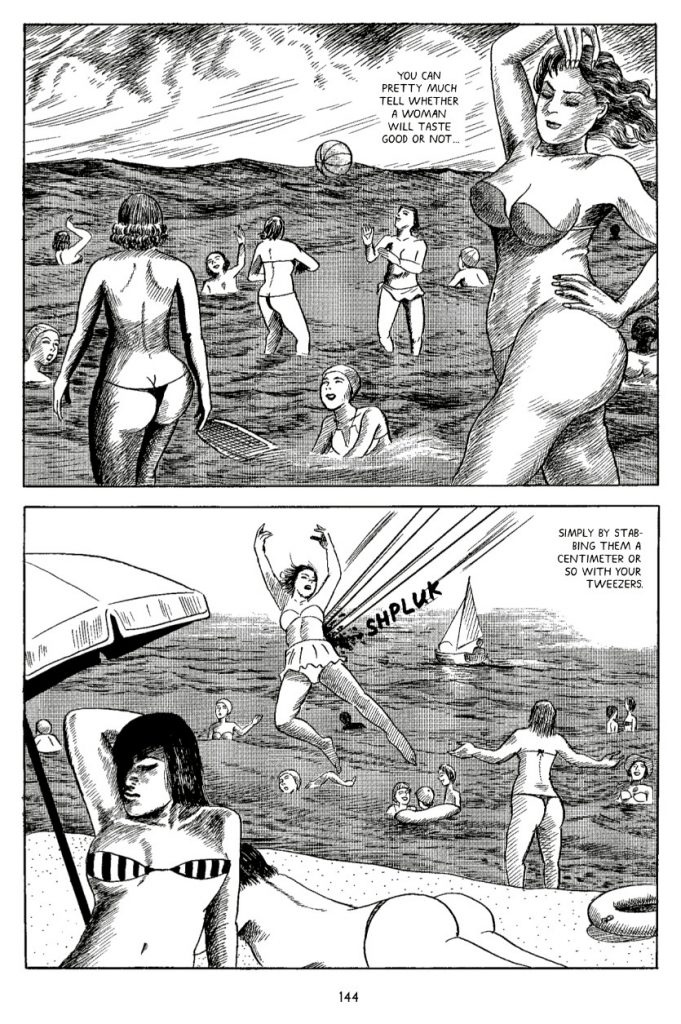
But “Life on Cape Komatsu” is an anomaly; elsewhere, what little reprieve is offered by Tsuge’s dreams is uniformly sullied. In “Yoshibo’s Dream” (1979), for example, Tsuge’s stand-in, Yoshibo, is busy ‘murdering’ women by plucking them out of pornographic magazines with tweezers and swallowing them whole. Suddenly aware that he might be caught and held accountable for his crime, he tries desperately to get rid of the tweezers, running out of his workplace — his brother’s bike shop — and riding around town in search of a place to safely discard them, but, wherever he turns, there are people watching him, foiling him.
“Yoshibo’s Crime” shares its emotional core — isolation brought on by mounting guilt and paranoia — with an earlier Tsuge comic, “A Summer Memory” (1972, included in Nejishiki), in which another Tsuge stand-in finds a woman unconscious in the field after getting hit by a car and rapes her; here, too, the protagonist is preoccupied with the possibility of being caught, constantly blurting out incriminating statements that sound to those around him like complete non sequiturs.
The difference between the two comics is in where Tsuge chooses to end them. In “A Summer Memory,” the investigation into the woman’s hit-and-run is ongoing, and Tsuge’s stand-in is afraid that the police hounds will be able to track his scent; when a dog barks at him on the street, he kicks at the fence to scare it off. Just then, he sees the woman, who “brings back memories.” Guilt, in other words, is all around him, even if he will never be caught. In “Yoshibo’s Crime,” even this last vestige of morality is no cause for concern. Having evidently disposed of his murder weapon, Yoshibo forgets about the debacle entirely; his guilt is material, practical, and easily disposed of, making the moral landscape of the comic feel infinitely worse as the glee of the protagonist becomes the frustration of the storyteller. Rest assured, Tsuge seems to be saying: there is no risk of a lesson being learned.
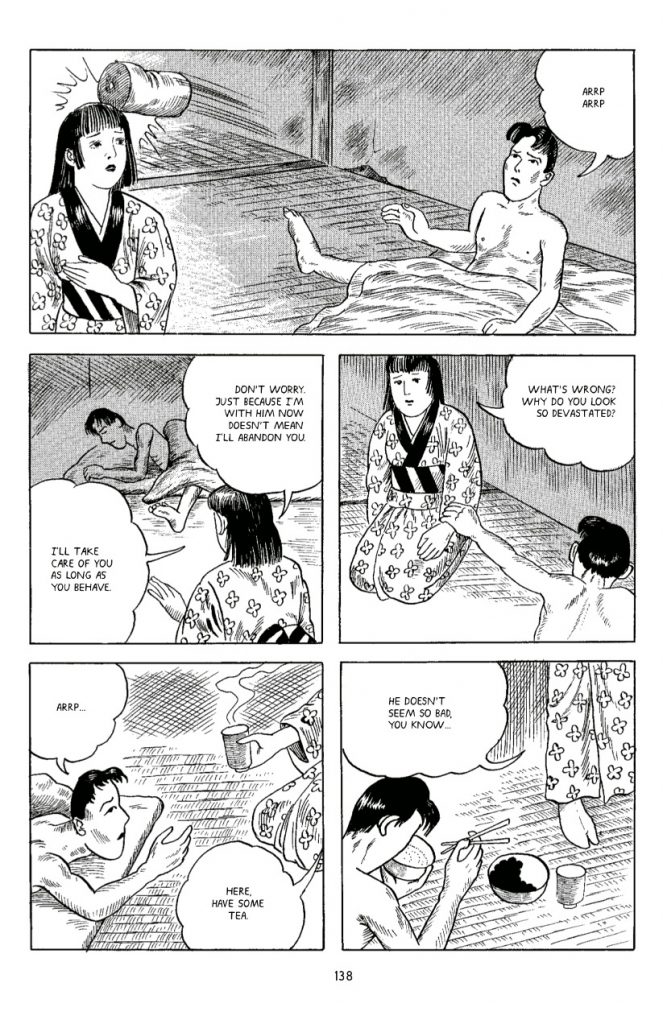
With the collection’s title story (1979), Tsuge’s violent fears reach a fever pitch. A man and his wife are visiting a village where every house has its own hot spring, when, out of nowhere, an older man ambushes the couple and sexually assaults the wife. The husband tries to fight him off, but the older man, a former wrestler, uses his special move, which robs whoever it is used on of their ability to walk or even talk. As the former wrestler takes the wife home, the protagonist follows (by dragging himself helplessly on the ground), and is forced to watch as the new couple have sex — and the wife enjoys it, evidently more than she enjoyed sex with her actual husband. While the wrestler goes out for a while, the wife turns to the protagonist with pity: “What’s wrong?” she asks him. “Why do you look so devastated? Don’t worry. Just because I’m with him now doesn’t mean I’ll abandon you. I’ll take care of you as long as you behave.” (One can’t help but think of Gregor Samsa: a burden on his family, initially tolerated but, the reader knows, probably not for long.) The wrestler, meanwhile, is arrested for rape, but he manages to make his escape — the village’s hot springs are all connected by a shared network. Completely unbothered, he already schemes about “whose woman [he shall] violate next.”
In his supplementary essay, translator Ryan Holmberg aptly notes Tsuge’s influence on the heta-uma wave of cartoonists that came after him, like Ebisu Yoshikazu or Nemoto Takashi; to adapt his dreams into comics, Tsuge simplified his style, his figure work growing simpler and lumpier and his backgrounds more omissive, no longer as devoted to the photorealist MizukiPro sensibility as the ‘waking’ comics were.
Yet “He Rolled Me Up like a Grilled Squid” is not interesting because of Tsuge’s influence on others so much as because of its place on the Tsuge timeline. As Helen Chazan writes in one of the very finest pieces of writings on Tsuge’s work available in English, the comics collected in Nejishiki, spanning the years 1968–1972, funnel Tsuge’s ultimate fear of societal obligation into a fantasy of sexual violence — rape becomes the most potent, unambiguous way to shirk the expectations of society, a forceful declaration: I am not part of you and should not be held to your moral standards. Later on, in The Man without Talent (1985–86), these impulses give way to a psychological mode of self-justification; the whole book is a game of Point/Counterpoint between the protagonist’s endless philosophizing about society’s need for useless layabouts as a supposed means of resistance — and the effects of his own uselessly-laying-about on his wife and child. There is no violence there, not in the physical sense at least; only the encroachment of the world on those unable to face it — and on those forced to clean up, figuratively and literally, after the fact.2
By externalizing the same sexual violence to a third party, Tsuge finds the perfect balance, the shock and upset of the earlier stories coupled with the specific fear of the stories that would come later — familial impotence. The combination of the fast clip of events (hardly any time passes from the moment the wrestler jumps the protagonist’s wife to her statement that she’s “with him now”) with the slippery portrayal of consent (the wrestler’s question, “whose woman shall I violate next,” makes it abundantly clear that he preys specifically on married women as a way of disrupting marriage-as-property, but the protagonist’s wife visibly enjoys the act) push the story into nightmare territory, the key fear being, in essence, cuckoldry: the loss of sexual (and, by extension, marital and psychological) dominance to another man, to the evident delight of the wife. The result is, inevitably, rather revolting: the wife herself has no personhood; the feeling of narratorial horror stems not from her trauma, her being violated, but of her husband who has to watch in powerless horror as the violation of his wife — the emphasis being on his, belonging to him — frees her from her obligations to him.
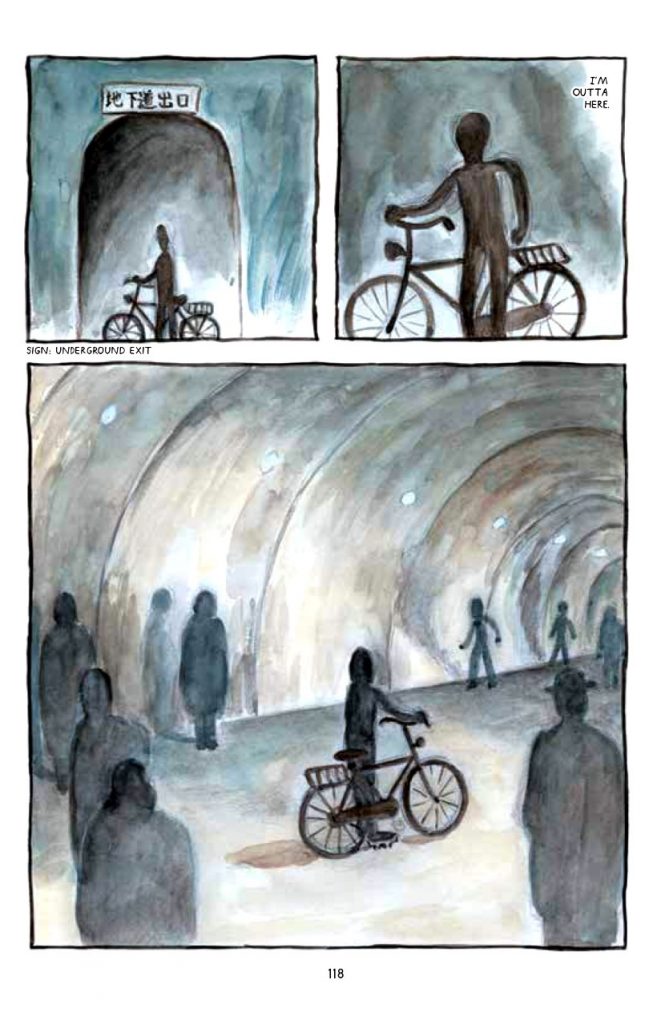
For the most part, Tsuge’s dream-stories are dominated by a shorthanded approach to narrative perspective — all protagonists are tacitly assumed to be Tsuge himself, and the overall ‘state of mind’ is prioritized at the expense of specificity and cause-and-effect mechanics. This is best demonstrated by the collection’s sole color story, “The Swelling Outside” (1979). Here, the protagonist, feeling physically trapped at home (his house is seemingly surrounded by a thick, viscous mass, slowly closing in and breaking the windows and the walls), tries to go outside. At first, he finds the outside surprisingly easy to maneuver, but when he goes to his favorite underground café he finds himself out of step with the upscale clientele. He tries to leave, but suddenly can’t find an exit back to the street. Eventually he does find an exit, a diagonal crawlspace — but as he crawls upwards the space grows increasingly narrow, until he is finally trapped and cannot breathe or move forward any further.
To Tsuge’s credit, “The Swelling Outside” does see him experiment artistically, the typical harsh, sharp inks and heavy screentones now giving way to swatches of watercolor in wintery hues (mostly blue, brown, and gray), fluid landscapes populated by people rendered exclusively in silhouette. But the stylistic departure brings with it a stark change in mode of delivery: the silhouette rendering obviously prioritizes role and mechanical function (the shadowy, indeterminate crowd, the self equally anonymous to the other) over a sense of discrete identity; the lack of dialogue and dominance of narration result in a total interiority, unchallenged by the outside world. That “The Swelling Outside” feels completely ahead of its time — I see a lot more comics like it nowadays, on social media, than I do in anthologies published in the ‘70s or ‘80s — is not at all a compliment: hinging on a self-explanatory metaphor (the outside world literally closing in on the depressed individual) that is granted few additional complications past the first page, the comic so desperately grasps at an emotional ‘relatability’ or recognizability that its very sense of self is eliminated.
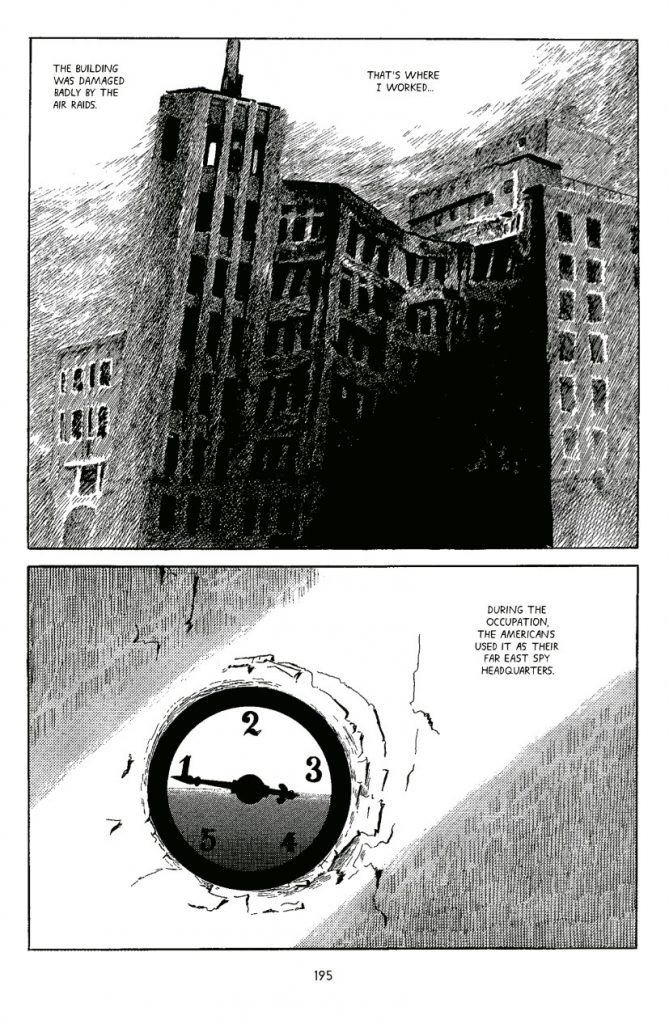
With the increasing focus on autofiction and confessional material, stories that don’t revolve around Tsuge are charged with an added significance, serving as reminders of the man’s early work, back when his imagination allowed him to step outside of himself. In this regard, “Hands in the Window” (1980) is a clear standout. A pair of disembodied hands is discovered on an office windowsill, lying still and perfectly fixed; when the office workers investigate, they find a false tooth hidden under the floorboards. The hands come to life suddenly when a Japanese man in a soldier’s uniform, happening to pass by, immediately recognizes the false tooth as his own, and the hands as those of Gloria, an English spy stationed in Japan in the time after World War II. The man, he tells the office-workers (and, by extension, the readers as well), was recruited as a spy himself, and Gloria was his handler; over time the two developed a mutual affection (Gloria gave the man the false tooth to try on, as they are both missing teeth, and it fit both of them perfectly), but when the Japanese man’s former handler — Sanderson, whom Gloria was assigned to replace — returns to Japan he essentially threatens him to back off. Gloria disappeared soon afterwards, and the man assumed she had gone back to England, but the hands prove otherwise: feeling isolated in a foreign country, she has been waiting for him, in vain.
Of the dream-based comics, “Hands in the Window” feels closest to a traditional story. Tsuge here returns to a theme favored by other Garo cartoonists like his brother Tadao, or Tatsumi Yoshihiro: the collective repression of postwar Japan, its flourishing image propagated at the expense of the downtrodden masses who don’t quite fit that narrative. Through the particular dynamics of tension (the present-day setting versus postwar flashbacks; the ex-army vagabond, permanently unemployed and with nowhere to go, versus the tidy office workers), the surreal elements are given a literary narrative function: Gloria and her former subordinate are both humans robbed of their humanity, Gloria literally (by becoming just a pair of hands) and the Japanese man metaphorically (“Who do you think you are?! Don’t forget who won the war, you lousy Jap!” Sanderson berates the protagonist, physically assaulting him and forcing him to give back Gloria’s false tooth, thus symbolically prohibiting him from pursuing their love).
As a result, the story’s drawing is as rich and as atmospheric as the collection gets, both in environmental work and in character-acting — the shot of the razed building where the spies were stationed is cross-hatched so heavily that it feels oppressive just to look at, while the gestures of the two disembodied hands are pained and dramatic. The cartoonist takes beautiful advantage of the disembodiment in the final sequence: as the ex-soldier says goodbye to Gloria, muttering a sentimental but final farewell, the hands grasp and knock and move around in a frenzy, begging him to stay, but to no avail — the love they want is, quite literally, out of reach.
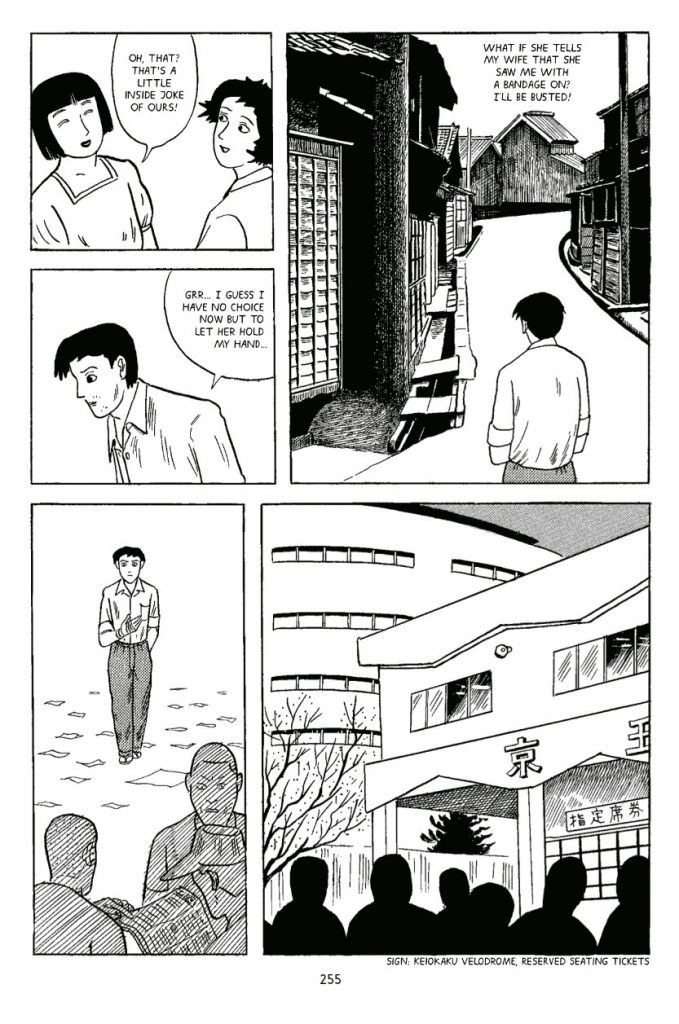
For the final story, “The Day’s Amusement” (1981), Tsuge returns to the waking world. His stand-in, now out of work, settles into the househusband life, cleaning and cooking (that is, when he’s not walking aimlessly around town for hours on end), while his wife gets a job as a betting booth clerk. One day, as she gets back home, his wife gently asks that he express his love for her more overtly; she suggests that he come to the anonymous betting booths, wearing a bandage over his hand so that she can recognize him, and hold her hand for a moment. The next day, he does just as he asked — after he meets with an editor interested in giving him paid work, wears a bandage to lie about the severity of his chronic injury so that he can get out of said paid work, and runs into an acquaintance who he fears would tell his wife that her husband was spotted wearing a bandage over his hand.
Tsuge’s depiction of himself in ”The Day’s Amusement” is a clear precursor to The Man without Talent: having chosen his preferred perspective (No one was interested in commissioning me to draw comics anymore, he narrates as he walks around town, but that was fine by me. Free at last!), he curates reality to fit that narrative, first lying to his wife that the editors of the illustration job he was recently offered have “changed their mind or something” then lying to the editor that he physically can’t draw. To go back to Crumb, this mode of preemptive self-criticism is perhaps where he and Tsuge most clearly overlap: by showing the wrongdoing but focusing on how bad that same act makes him feel, he indicts himself and absolves himself in the same breath. If the wife figures in at all, it is as a figure of pity and sympathy, a poor thing lacking the awareness to stand up for herself. When she comes home that evening, having held her husband’s hand through the wooden screen, she is thrilled, her love for him renewed. The reader, of course, knows better: in the world of Tsuge Yoshiharu, comfort is a dish best served cold.
He Rolled Me Up like a Grilled Squid marks a small but significant step: having passed the midpoint of Tsuge’s output in the previous volume, the readers are now officially closer to the cartoonist’s last work than to the first; the end of Tsuge Yoshiharu, so to speak, is on the horizon. At this stage, his expansiveness — his ability to imagine a world independent of himself — is but a faint memory; now he is withdrawing, crawling into an increasingly narrow space until he is finally trapped. The reader has no choice but to wonder: Will he ever be able to move forward? Will he ever be able to breathe?
- In reality, Tsuge’s regard of his wife was one of festering resentment. In the same essay, Holmberg quotes several passages from Tsuge’s private diaries (not initially written with publication in mind). In one passage, Tsuge complains that when Maki returned from the hospital (she’d gotten a partial hysterectomy and appendectomy following an early-stage cancer diagnosis) she “hasn’t bothered to ask even once about how rough things were for me and [the couple’s son] Shōsuke while she was in the hospital. I don’t think the thought has even crossed her mind. I’m not going to tell her she should be grateful, but her utter lack of sympathy definitely bothers me.” Elsewhere, he complains that Maki puts her energy into exercise rather than housework. ↩︎
- As I have written in the past, The Man without Talent takes on an added depth — for better or worse — when viewed in relation to My Picture Diary by Tsuge’s wife Fujiwara Maki (translated by Ryan Holmberg and published by Drawn and Quarterly in 2023), which discusses roughly the same fraught years in the couple’s marriage, except without the need for psychological–rhetorical mechanisms demonstrated in Tsuge’s version of the events. ↩︎
SOLRAD is made possible by the generous donations of readers like you. Support our Patreon campaign, or make a tax-deductible donation to our publisher, Fieldmouse Press, today.
Leave a Reply