
By the time Red Onion State Prison opened in Pound, Virginia, it had received 3,000 applications for jobs with only 403 guard jobs to go around, plenty from prior coal miners. I grew up Wise County, and both Red Onion and I grew in the shadow of mines and layoffs; our economy was transitioning from an extractive economy to a service economy, with an exception for the prison. It goes without saying some of those miners got jobs and some did not. Where precarity rises, people have a chance of winding up working in prisons, anyway, just not as guards. The links between crime and lack of opportunity do not need to belabored, and prison becomes a way of disciplining people who don’t take to being left behind well.
What is less discussed is the link between the environment and prisons. LaBelle, the small town where SCI-Fayette is located, used to be a place where coal was “cleaned”: washed, graded, sent to power plants. What remained was the ash: dumped in the hills around the town. SCI-Fayette sits surrounded by “about 40 million tons of waste, two coal slurry ponds, and millions of cubic yards of coal combustion waste”. The land where Red Onion stands was once owned by Pittston Coal Company until no longer profitable. Prisons, at least in rural areas, are best understood as a scabrous growth over the wounds we inflict on the earth in chase of extractive profit. What Pat Aulisio’s Coal County Outbreak does is pick at that scab until it bursts.
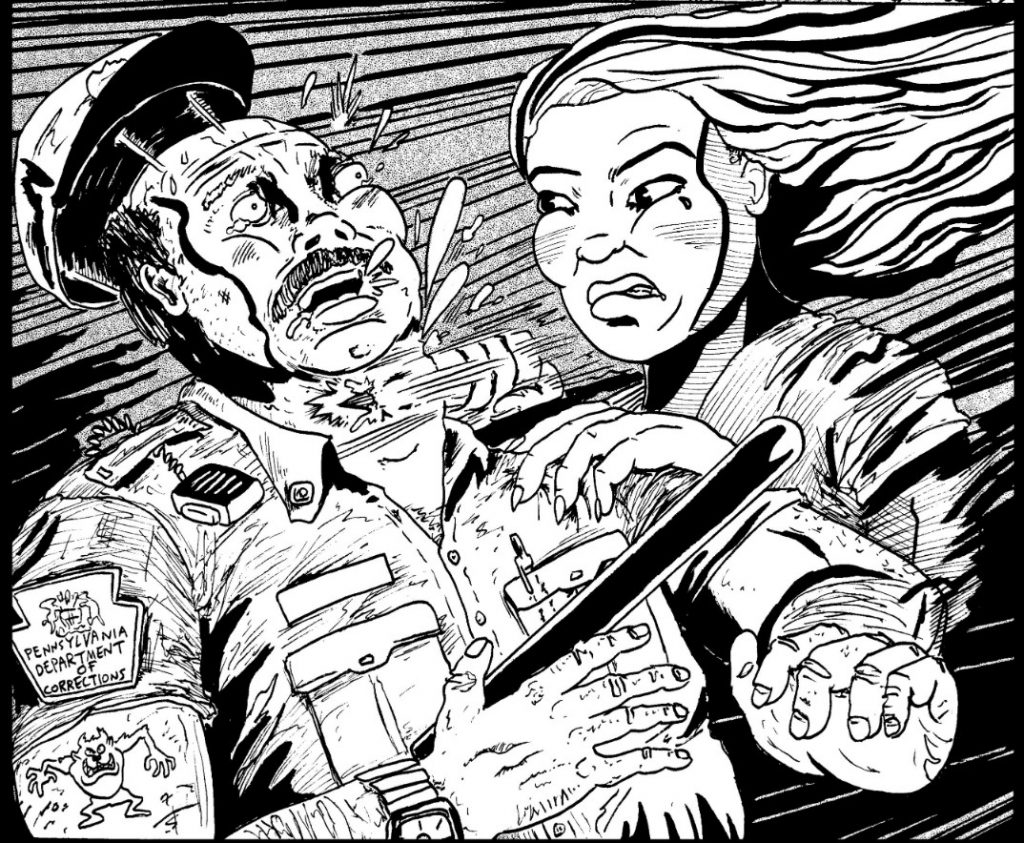
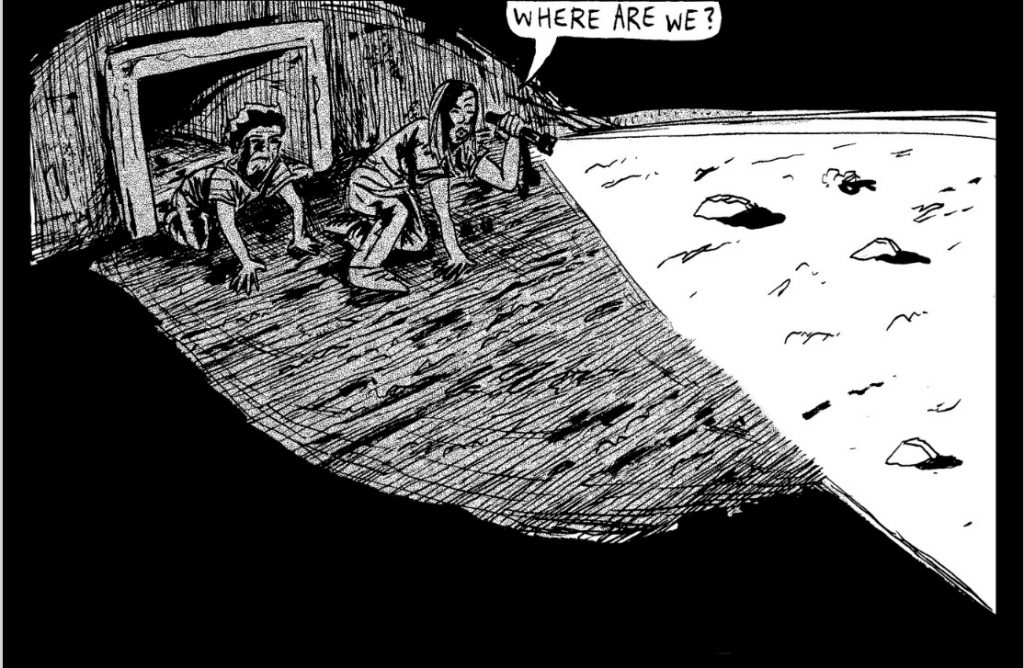
Coal County Outbreak, a single issue comic from Strangers Publishing, builds on the above facts and integrates the location and reality of a prison in a way that goes beyond stock tropes. Often, the horror of prisons in stories is communicated as interpersonal: the horror is not the structure itself, but the people inside the structure. Other works instead supply us with likable prisoners. Coal County’s rejection of both of these easy tropes makes it a work as stark as Aulisio’s black and white inkwork. I Am a Fugitive from Chain Gang or “Jailhouse Rock” or any other number of prisonsploitation films this is not. This is a pitiless horror story not so much because it believes the trio of escapees deserve either the prison or the horror, but because they escape from horror, hope for freedom, and find themselves in unimaginable horror. We don’t know what escapees Naida and Vicky have done (only Vicky’s girlfriend Frankie has her crime revealed), but they act as people in desperate situations do, blindly out of that desperation. Coal County Outbreak opens with Naida stabbing a Coal County prison guard: if she did not, her cellmate Vicky and Frankie would have been caught in their escape and punished. In exchange, she has to come with them.
Without the pure reliance on backstory (which would have run the risk of ignoring that our prison system is cruel to everyone, “deserving” or otherwise), the art communicates the claustrophobia and bleakness of the prison world. The escape through the faulty dryer vents follows a page of crossing lines leading us from one panel to another, with the three escapees crawling on their hands and knees. In Aulisio’s prior work Grid Observer, his grid work communicates a sense of true wildness. The titular Observer may encounter any number of oddities, but those oddities grow from the absurd freedom created by the Grid. Metatextually, it turns the reader into a protagonist as well: both the reader and the main character are “grid observers”, and that freedom means anything can happen. Here, in Coal County Outbreak, the art instead imprisons our characters and us as readers alike: panels grow smaller, more claustrophobic, beginning to feel like cells. As the panels winnow, so does the sense that nothing good will happen.
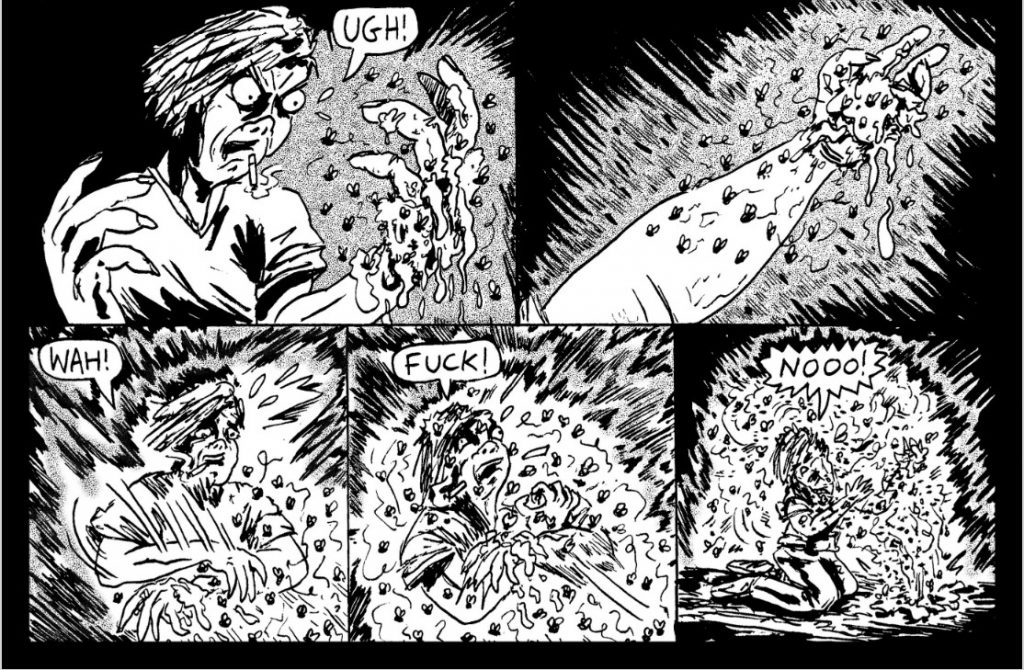
The panels break open as the prisoners fall through a weak part of the vent; they find themselves near the drainage pipe where an underground stream flows. Inside the stream are bugs. Not just any bugs, but flesh-burrowing bugs that crawl under your skin and cause large fleshy blister-bubbles to grow as more crawl through your wounds. In the comic’s most haunting panel, they leave one of the escapees with a bloated, grotesque face almost like a Halloween mask.
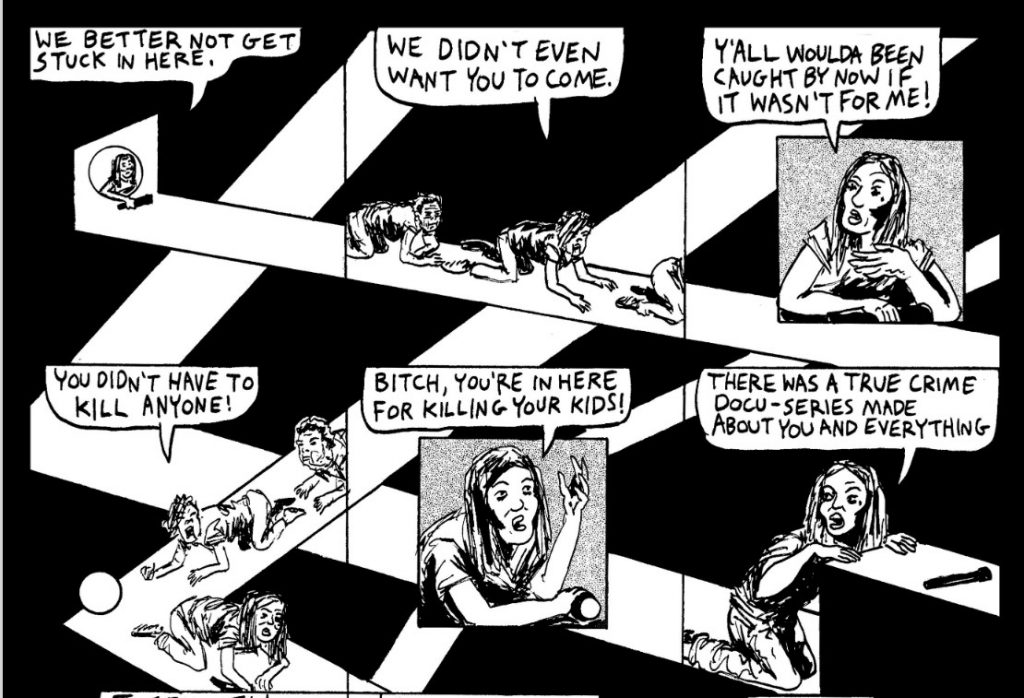
To take a moment to speak about the bugs: it becomes the canniest choice of Aulisio’s. The association we have with flies is that they feed off of waste and use it to lay their eggs. Where we see flies, we see refuse. But what transformed these bugs? Was it the nature of the prison, or is this runoff from the old days of the coal county? The comic doesn’t say, which is to its benefit: either way, they get under our protagonist’s skin and transform them into something like parodies of humans, faces mishappen and skin bubbling. In a way, they become a metaphor for violence: when the first prisoner (the hapless Vicky) is infected by these bugs, the only response is to put her on the wrong side of a stolen flashlight. Violence becomes a leveling field; the bugs are found in a literal “undercurrent” of the prison. Everyone in the strictures of the prison becomes violent, whether it’s an official and sanctioned violence by the guards or the desperate violence of the escapees. Which all begs another question: if someone’s day job is to use state-sanctioned force on the clock, how would they remain untransformed by this violence? Can they even attempt to? Violence is a fact from page one to the end. The only crime we know for certain anyone committed is Frankie’s: she killed her kids and became so infamous that she had a “true crime documentary” made about her.
The most evocative question ever asked in horror comes from a movie poster for The Texas Chain Saw Massacre: who will survive and what will be left of them? Beneath its midnight b-movie presentation was a film about who gets left behind when productive capacities change, when the abattoir no longer needs a person to hit cattle between the eyes with a sledgehammer. The film is unique among slashers for having a material basis – carving up and eating teenagers: the Sawyers lost their jobs, their minds, and then started eating people. The question asked on that poster is not just a question for the cast. Deindustrialization leaves people in the lurch, scraping for survival and hoping to get through in one piece. Texas Chain Saw Massacre, though, came out in 1974. In the coming years, an answer would be provided by incarceration. If you can’t survive the economy, what’s left of you can try to survive in prisons, where that two-part question could be asked again of every person housed in prison walls, from victims of the War on Drugs to people who commit mortal, heinous crimes that we struggle to comprehend. In such cruel and unusual conditions, escape attempts, whether or not we think some prisoners deserve freedom or otherwise, is an inevitability.
The end of Coal County Outbreak leaves one prisoner alive: Frankie. She finds a crack in the earth and crawls through, kicking her remaining and bloodthirsty comrade back down into the earth. But then, she’s caught: Coal County guards stand ready to bring the prisoner back to their cell. But something happens. The bugs that tortured the prisoners now fly forward and attack the guards, no doubt burrowing under the skin. We are left with a chaotic, violent scene of guards trying to avoid the bugs. We see this all in a wide, panoramic view: our prisoner face down on the ground, our guards in fear. What was once an undercurrent has roared to the surface.
One of prison’s more specific ideological functions is to obscure that the law is not a standing and ineffable principle, but a triangulation under a complex number of matrices and political needs that doesn’t think about the individual. But after so many individuals are put through a cruel system that it creates societal problems, that has to be adjusted. Married to a profit model, the prison’s importance only grows greater as its operators and private firm CEOs become more politically important. After all, the problem of crime and punishment is a political question, an extension of the same balancing of priorities the law consists of in the first place. It is a political question firms like The GEO Group and CoreCivic are happy to answer. What prisons also obscure is humanity: that under these calculations you, too, can become illegal if there is enough political will behind it. All one needs to witness is that the defining policy position of the Trump administration is imprisoning immigrants for making the decision that their lives would be better in the United States and not filing paperwork. These ICE facilities (along with data centers, which may very well prove to be an ecological catastrophe akin to coal mining) typify our current existence the way the factory typified the Industrial Age or the shopping mall typified the 80s. They are prisons, and they, more than any other facility, prove that the idea of prisons as rehabilitation is a total canard. How can you rehabilitate the act of going to another country in pursuit of a better life? Why is it a locus for such cruel and unusual punishment? And if the system doesn’t work, why should prisoners believe in a system whose cruelty they experience? What Coal County Outbreak is about is the truth of prisons, but told through a horror story: prisons will create a world where everything becomes Coal County, and we’ll be left to deal with what erupts from the prison.
SOLRAD is made possible by the generous donations of readers like you. Support our Patreon campaign, or make a tax-deductible donation to our publisher, Fieldmouse Press, today.
Leave a Reply