I was thinking of All That Jazz (1979, dir. Bob Fosse).
Partially because there is something, well, jazz-like about the work of the late Kevin O’Neill in this, Silent Pictures, his final creation, a sort of indevotional follow-your-own-rhythm, surrender-to-no-familiar-system that makes one think of someone like John Zorn. But really, it’s because All That Jazz is so obviously, so front-towards-the-enemy, about the artist dying with his final statement, a captain going down with the ship. All That Jazz ends with a ten-minute extravaganza musical number in which “Bye Bye Love” by The Everly Brothers becomes “Bye Bye Life” as our protagonist alternates between the land of imagination (singing, dancing) and real life (tagged and bagged in a hospital), as grand of a statement as an artist could make, raging against the dying of light as it actually dies.
Except Fosse didn’t actually die. He was so sure that he had little time left, he put all of himself into a work that signals its ‘final’ statement, and he was left lost and confused when it became clear he still had a good few years left (eight years and one more movie). I am writing about this because there is something… fascinating about any artist making what seems to be a ‘last will and testament’ in the form of art, and it remains fascinating even if they keep going. The Old Man and the Gun is the final Robert Redford role, even though some stuff filmed earlier came out later, a summation of one man’s public persona as the most charming son-of-a-bitch alive. Miyazaki and The Wind Rises, an old man trying to balance his love of machinery with what that machine actually does. Clint Eastwood and The Unforgiven with its final coda to the western genre that he redefined in his gruff image.
In comics: We have the final Peanuts strip by Charles Schulz (which came out a day before the man passed away), and also… not a lot of works I can recall. It’s a harsh and demanding field in which people often do serialised work right up until they die (too many to name), or get tossed aside the moment their style/brand is no longer popular enough.
Final Words are for people who have enough breathing space to prepare for death. In fact, Kevin O’Neill’s League of Extraordinary Gentlemen: The Tempest has a bleak running gag in each issue, an opening text piece about a real-life comics creator who ends up dead at the drawing board. ‘This field will kill you,’ The Tempest seems to say, ‘run away as fast as you can.’ This bitterness, along with the fact that series writer Alan Moore made his intention to leave comics quite clear, made many (including myself) believe O’Neill was heaving his ‘bye bye love’ to the comics medium as well. Or at least to the comics market.
Not so, it turns out. O’Neill came back for some more short works with Garth Ennis for 2000 AD, but before this new phase of his career took place, the artist learned he had only a few short years to live. Thus, as COVID surged through the world and he was, like many of us, locked at home, he began to look inside and to pour himself onto the page. A rather rare occurrence, despite the length and versatility of his career, O’Neill had done very little solo work (mostly some early comedy work, like Mek Memories, which is near-impossible to find). This was the first time in a long time that we would get to experience pure Kevin O’Neill. Sadly, also the last time.
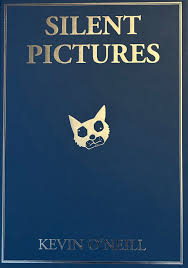
Thus – Silent Pictures; a final work if there ever was one. A pair of silent (if one ignores all the written puns on inmate objects) comedy narratives, released in a hardcover box-set format through the famed London comics shop Gosh, each with a short intro by longtime celebrator Alan Moore.
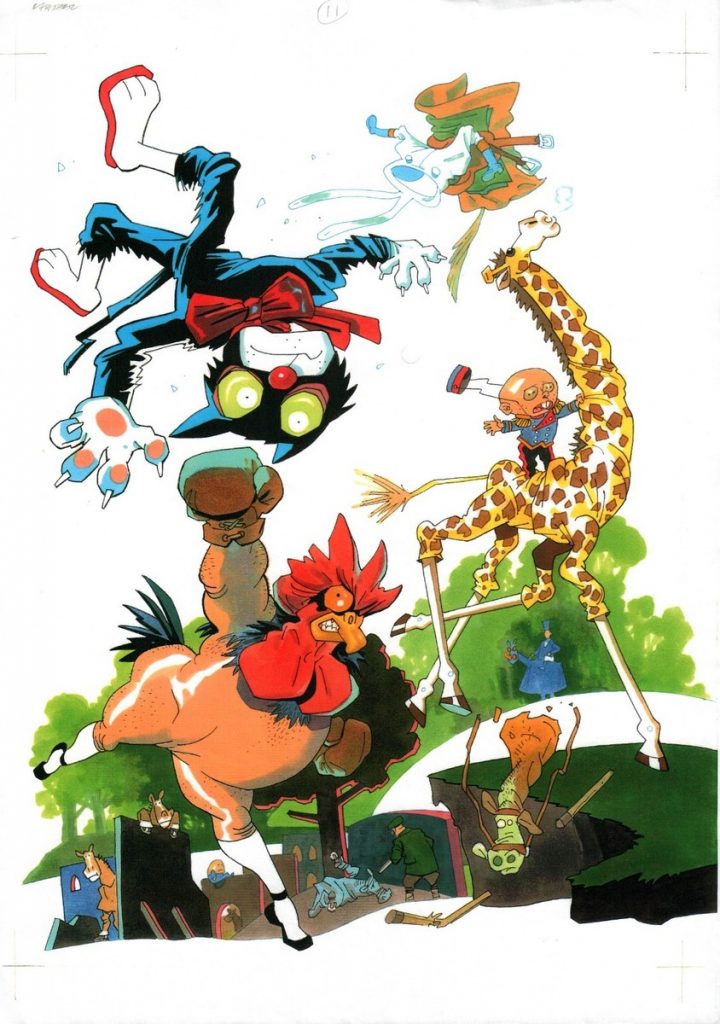
The two works are Featerland, a mock-pantomime tale, and The Balaclava Kid, a western-infused childhood dream reaching back to the artist’s memories of post-war London. These are Kevin O’Neill’s last words in comics. Yet they do not feel like it. If it were not for the introduction by Alan Moore, mostly the one attached to the ‘first’ book Fearterland, one wouldn’t have to know that we are looking at something aiming at grand significance. I almost wished I had kept these introductions to the end, because they impose their own meaning on a work that is joyfully open-ended. The story in both, as much as one can call anything therein a ‘story,’ is gleefully comedic and anarchic. By containing so little meaning, it manages to contain all meaning. I am thinking of something James Joyce apparently said of Ulyssess: “[I]t will keep the professors busy for centuries arguing over what I meant[.]”
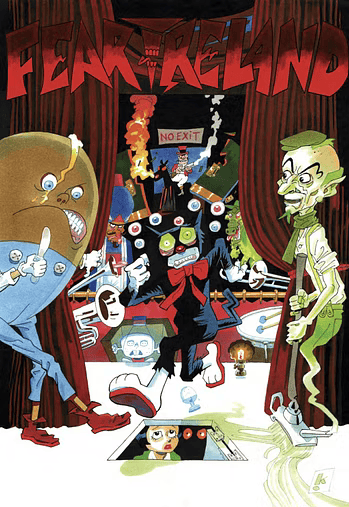
What is notable about these works is what is absent – old age is absent. These works are not about the end of one’s life; rather, they seem to go back to an earlier stage, to the simple joys of childhood in which the false and the real intermingle regularly. Fearterland contains not only recurring figures and tropes from British panto, but it seems, sometimes, to take place on a stage, with characters in the story playing characters within the play, with horses usually portrayed as people in bad horse costumes and our lead figure being drawn as a young-woman-playing-a-young-boy (the principal boy figure). Yet, at the same time, the alligator figure trailing them is an actual humanoid monster, not a person in a costume. There is also a giant Gorilla, which is also a robot (not a robot gorilla, but a robot in a Gorilla costume). The books keep you on your toes – how many levels of fakery are we in at any given time? Everyone is masked, in one way or another, life is endlessly chasing after a truth that could never be found.
There is no attempt to explain things; the general story is simple (our leads steal a certain ruby from an evil caliph figure who sends out various henchmen to track them), but what happens on each page is a showpiece of mayhem, owing more to early Hogan’s Alley than to comics as we came to know them in the early 20th century. Pretty much every page in both volumes is either a full spread or a double spread; division into panels is so rare as to be non-existent. Thus, despite being part of a larger story, each page also operates as a semi-independent work of art, a snapshot of theatre life. One could gaze at them for hours and still not fathom their depth completely.
It is a personal sin that I often read comics far too quickly; like many in this cursed age, I am oft besieged by the sheer amount of stuff to read, view, listen, etc., that I end up giving nothing its due in terms of investment. People will spend hours and days illustrating something that will hold my gaze for seconds or minutes. Silent comics, in particular, are something that I often glide through; yet this was a rare case in which two short stories with almost no text took me longer to go through than full graphic novels – the manner in which each page is constructed almost as an independent unit forces you to confront them as a new piece of art. O’Neill teaches us to read him anew with every page.
To be honest, I found Fearterland more admirable in terms of craft than likeable. I suspect that this is up to me not quite knowing enough about the kind of plays O’Neill is reacting to, yet I can’t help but wonder how this will baffle those who know even less than I. The chaos overwhelms throughout, the playfulness is to the max. O’Neill’s sheer dazzling style as an artist could oft make his work more of a showcase than a story; League of Extraordinary Gentlemen, especially the latter parts, ended up being hugely impressive but emotionally exhausting, it almost made you forget that this is a man who is, at heart, a first-rate comedy artist. He could do so much, and so he tried to do it all, drowning out the heart of the story. Fearterland is not quite at this level of technical showcase, but it errs on the side of craft.
The Balaclava Kid, on the other hand, playing as it does on more familiar (to me) notions of cowboys and action figures (and cowboy action figures), and life in the after-effect of military conflict, hits closer to home. Comics that celebrate childhood nostalgia are plentiful, probably too plentiful, but O’Neill understands how to do it well. The lack of words helps this one, avoiding maudlin or syrupy sentimentality (this isn’t Gant Morrison with endless homilies for the ‘power of comics’). It’s not as madcap as Fearterland, and thus easier to follow, but its simplicity reveals a greater depth of talent: the two big double splash pages near the end, one of which rejoices in utter cartoon zaniness, as if entire Road Runner cartoon exploded into a single image, all disparate elements bumping into to other, is contrasted beautifully with a shot of the ‘real world’ – a bombed-out city in which life must continue, even as the memory of death lurks at every corner. There is no healing salvation in these childhood toys, no magic touch that would make the dream into reality… but that does not mean the dream is not worth holding onto. Its beauty is reason enough.
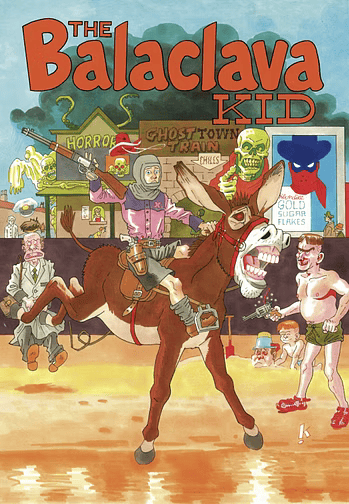
Balaklava Kid also allows itself to take the occasional less-is-more approach, with some pages containing only a single pictorial element. It never becomes ‘simple,’ O’Neill wouldn’t and couldn’t be a master minimalist like Alex Toth, but there is a sense in that book that he found a way to whittle down the chaos of Fearterland into an approach that better represents his intentions. As if, even at that late age, he was still finding his path. To paraphrase something Akira Korsawa said when he was 83 years old – “I’m only now beginning to see the possibility of what cinema could be, and it’s too late.” Sadly, it was too late for Kevin O’Neill, still getting better with each page. Who knows what book three would have been like?
Oh yes, there was meant to be a third book (according to Moore). There were meant to be several things. Because while Silent Pictures is O’Neill’s final work, we can’t quite be sure that it is the work as he would see it. The forward mentions a possibility about the work being originally intended as a ‘talking’ comics (even if most of the planned dialogue was in gibberish language), and the possibility that some pages have been shuffled about (O’Neill’s studio apparently being a chaotic reflection of his art) .“I’m almost certain” writes Moore, about the final form these stories took. Almost. As if we are gazing at the fragments of The Satyricon for the first time, wondering how all of these are coming together. We’ll probably never know, but then again – we don’t have to.
I find that there’s something beautiful about these Silent Pictures, about their lack of explanation, about their open-ended nature, about being a final work, a work of man staring at the end, but doing so with nary a hint of regret and pain. These are works that are joyous (sometimes overtly so) and vibrant (always overtly so). It’s not a good work – after years of working with other people, O’Neill appears overwhelmed with the endless possibilities of making stuff up as he goes along and ends up throwing every idea he had onto the page without any consideration – but it is a great work.
SOLRAD is made possible by the generous donations of readers like you. Support our Patreon campaign, or make a tax-deductible donation to our publisher, Fieldmouse Press, today.
Leave a Reply