This interview stems from a personal interest and a long-standing fascination with political and underground comics from the 1970s and 1990s, and, in particular, with the New York scene in which comics functioned simultaneously as an artistic language, a tool of counterculture, and a form of direct engagement with reality. Within this context, Seth Tobocman’s work has been a constant point of reference for me.
His trajectory across several decades — from the fanzine scene in Cleveland to World War 3 Illustrated and his experience on the Lower East Side — reflects an understanding of comics that is never separated from lived experience, but instead treats it as political and expressive material. It is a way of conceiving drawing as a space of conflict, memory, and resistance, one that has deeply shaped the imaginaries and practices of New York counterculture. Gianluca Costantini (June 2026)
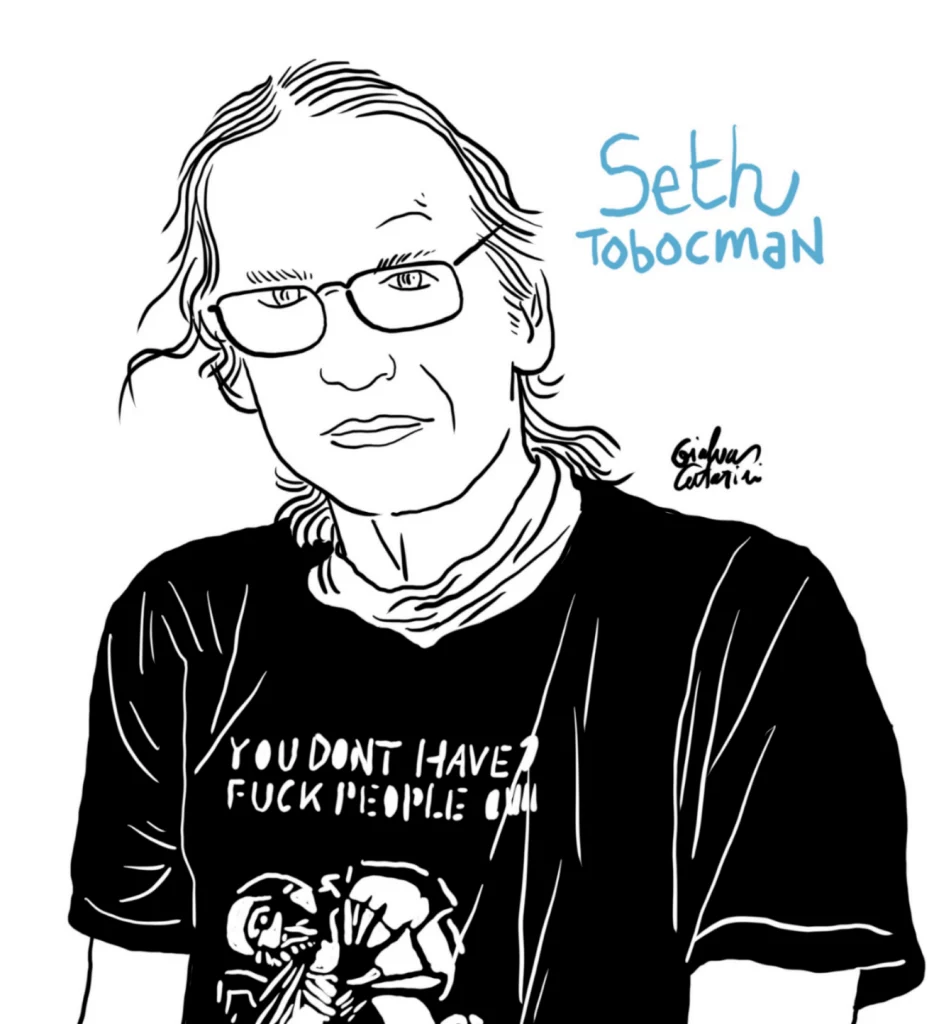
Costantini: You have said that as a child, you were bullied and that Marvel superheroes functioned as a form of psychological survival. Looking at your work today, do you think all your art comes from a need for defense? Has drawing been more a form of revenge, healing, or resistance?
Tobocman: I have been involved with comics for most of my life. Any relationship that lasts that long is sure to change over time. There will be ups and downs, break-ups and reunions. And times when the terms of the relationship have to be renegotiated.
What first attracted me to comics were the bright colors and the bizarre characters. The Marvel superheroes seemed like real people to me and I enjoyed their company more than the company of my peers. Like many comic fans of my generation, I was bullied as a kid and comics provided both escape and fantasies of revenge. It was certainly the case that the fight scenes in superhero comics resembled my daily life more than the portrayals of an idealized childhood that appeared in most children’s literature of that period.
Today my relationship to comics is much different. I’m sixty-eight years old and I am trying to process a lifetime of experience through this thing called comics which used to be thought of as a child’s toy.
Drawing comics is what makes sense out of my life. I can’t imagine myself being a functioning human being without it. Any problem I have, personal or political, I take that to the drawing table and that is where it gets worked out.
Comics were always a way of connecting my own life, my fears, anxieties, and struggles, to something larger than myself, be it a larger imaginary world, a larger aesthetic world, or a political and historical world.
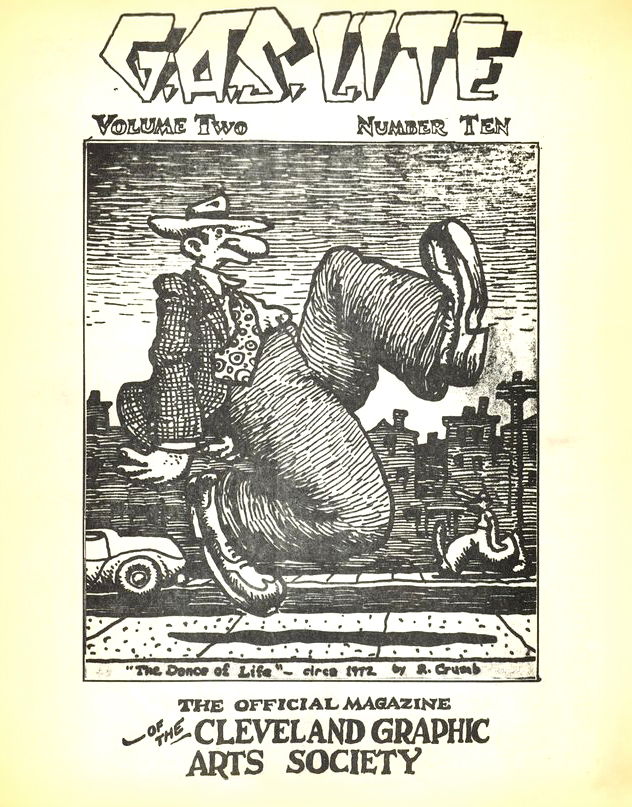
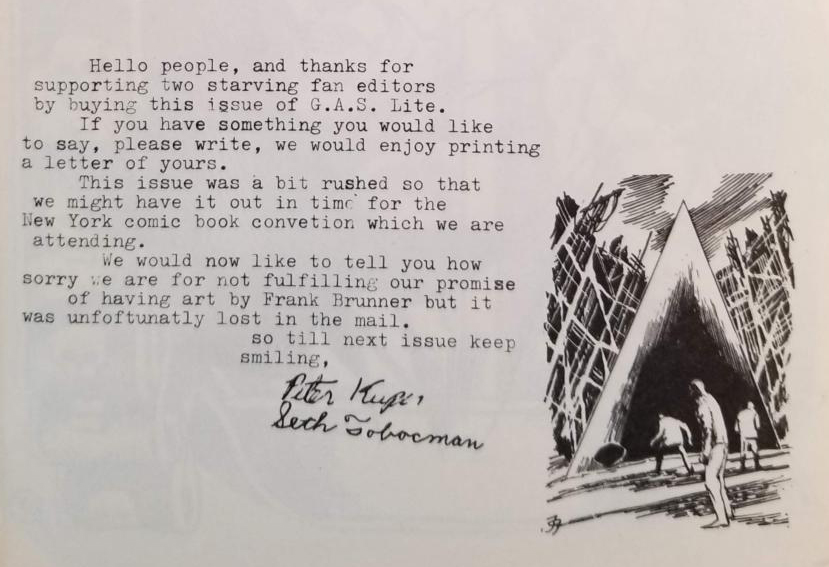
You and Peter Kuper started as teenagers making fanzines in Cleveland, when underground comics were still a tiny subculture. What were you really looking for in those early publications? Was it already a political gesture, or simply a way of not feeling alone?
What could be more political than trying not to feel alone? Comic book fandom was the first counterculture that I would join. I found other people who shared my interests. Most of those people were older than I was but they were quite willing to talk to me as if I was an adult. Comic fandom was very small in those days so I sort of met everyone in just a few years. fans, pros, underground cartoonists, and a lot of people who were just starting out and would later prove to be important figures.
You met figures like Harvey Pekar, Jack Kirby, and Robert Crumb while still very young. Was there a precise moment when you understood that comics could be not only entertainment, but also a tool for social and political truth?
In the 1970s, there were a lot of people in the comics subculture who wanted the medium to evolve. People saying, “We can do better.” Jim Steranko was one, Crumb was one, Trina Robbins was one. Then there’s George Metzger, Guy Callwell, Neal Adams, T. Casey Brennan. You might think of Kirby as a conservative figure, but at the time I met him he had just left Marvel comics and was trying to go in a new direction.
Harvey Pekar was another story. When Peter and I first encountered him, Harvey hadn’t started writing comics. He was just one very depressed guy who lived in our neighborhood, collected swing records and underground comics. But then he hit on this idea of doing realistic comics. A number of other people had already experimented with this. But Harvey was the guy who dedicated his life to writing and self-publishing autobiographical comics. He published one issue of American Splendor every year for decades. At first, people viewed it as an oddity. But this turned out to be important.
There were many other innovators who you don’t hear about much anymore.
Two artists who had a huge effect on me were Jeffery Catherine Jones and Vaughn Bode. I met them at the Detroit Triple Fan Fair, which was one of the first comic book conventions. I entered an amateur art contest there and won the prize for ‘most original’. They were the judges, and they spent a lot of time talking to me, even though I was just a kid. They stressed the idea that comics needed to expand and encompass a wider variety of styles and more diverse subject material. They introduced me to French comics. So I was looking at Drulliet ten years before Heavy Metal got published in the US. Jeff and Vaughn were also fascinating people. Both Jeff and Vaughn liked to draw pictures of beautiful women who happened to look a lot like them. As an 11-year-old I had no word for that, and in 1970, most people had no word for that. So they also introduced me to the idea that comics could be a portal into a transgressive counterculture. They showed me that artists could bend or break the rules of society. I still have my copy of Jeff Jones’ SPASM . I still think it was one of the best comic books ever made. Reading it today, it still holds up.
By the time I was in high school, the Marvel superheroes had stopped feeling real to me. I had read enough comics that I began to recognize that there were formulas and the same stories repeated over and over. And alternative comics, in the 1970s, were few and far between. I drifted away from reading comics for a number of years.
But I returned to comics in my 20s because I found it was the language in which I could best express myself. At that point, I needed to find new ways of making comics that were relevant to my experiences as an adult, political person living in the world.
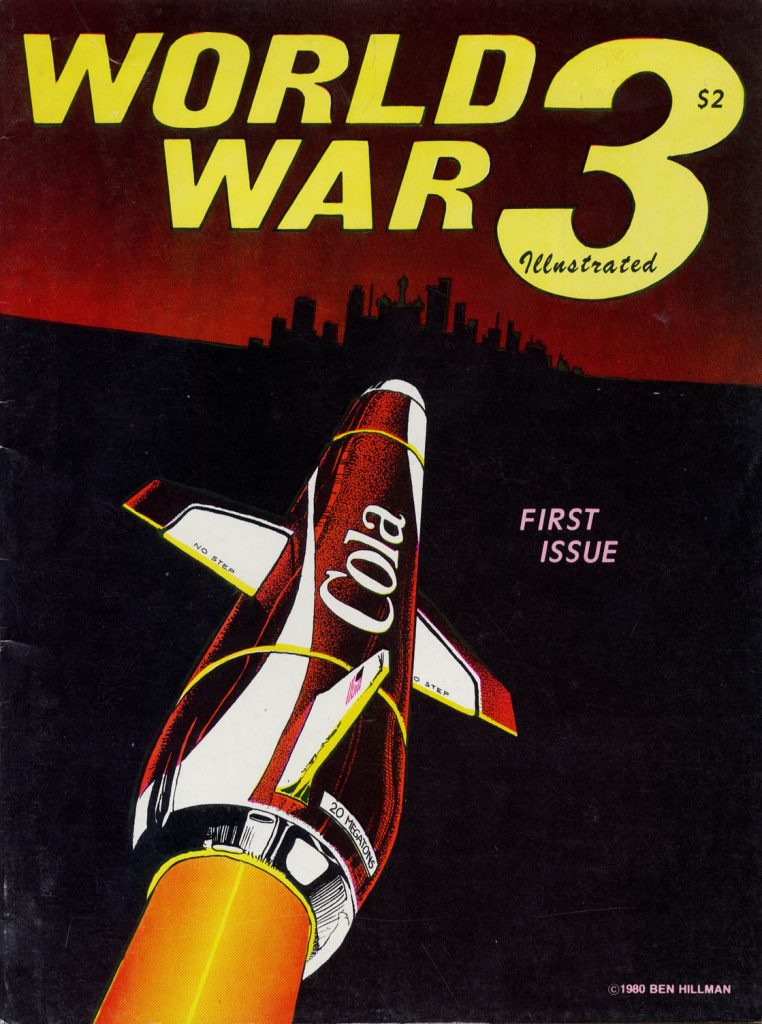
When you and Peter Kuper founded World War 3 Illustrated, Ronald Reagan was coming to power, and nationalist rhetoric was rising around the Iran hostage crisis. Did you feel you were creating something meant to last for decades, or did it feel more like a temporary gesture?
At the time, we had no idea how things would work out. We wanted to believe that WW3 would eventually make enough money for us to pay ourselves and pay the other artists. That never happened. What did happen was that a lot of people were very inspired by the fact that a couple of 20-somethings were taking a stand against Reagan. Let’s remember what the American political scene was like in 1980. The Left had completely collapsed. The Weather Underground were negotiating their own surrender. The Democrats were clueless. The small Communist parties felt like fossils. The New York Punk scene was apolitical and tolerated rock musicians wearing swastikas. The Gay community was just encountering the mystery disease, but people were still afraid to talk about it. So there we were, too naive to know what a difficult project we had initiated. I still meet people who were deeply affected by our work in those years. I think that if there is one important contribution I have made to society, it was that I chose to set out in one direction at exactly the time when the whole society was going the other direction.
In much of your work, there is a constant tension between propaganda and human complexity. You’ve said you didn’t want to lie as an artist. Was there ever a moment when you realized your political stance was preventing you from truly seeing a person or a situation?
Wow! That is a heavy question. Actually, I think it happens all the time. Someone is taking a position which might, objectively and politically, be a bad position, but they have real, human reasons for taking that position. So there is a real danger that one will become arrogant and judgmental. I think I have often been a hard person to work with because I was very sure I was right in situations that were more complicated than I was ready to admit.
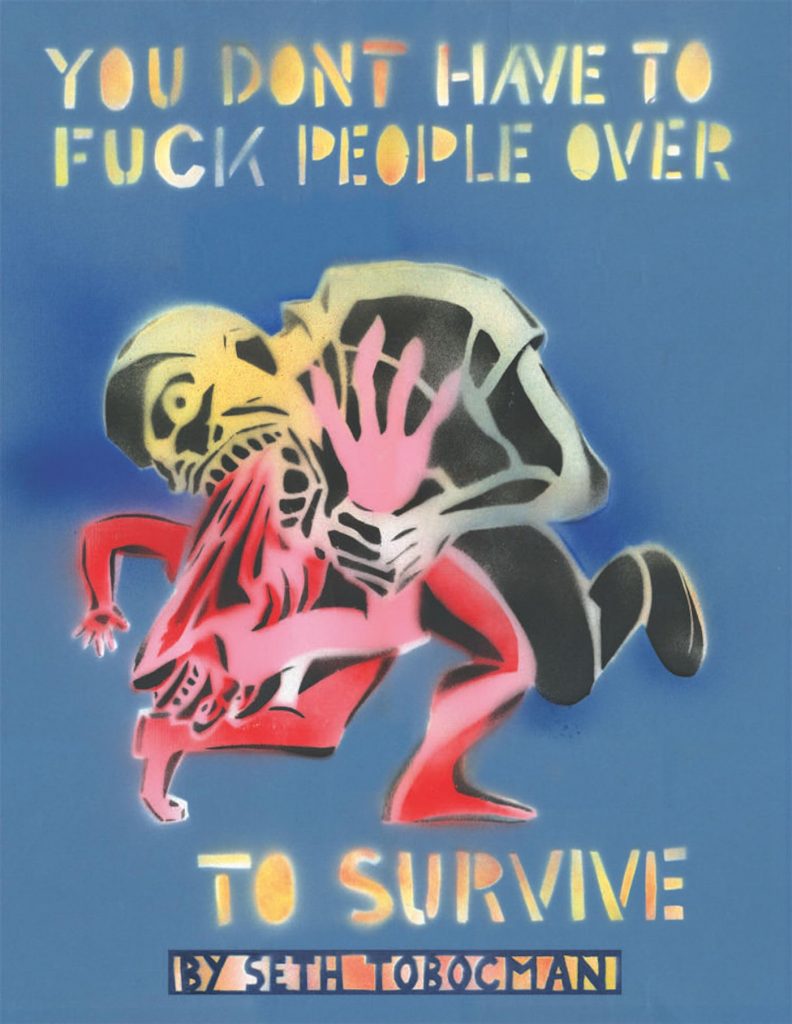
In 1990, you published You Don’t Have to Fuck People Over to Survive (Pressure Drop Press, 1990), a title that today reads almost like a provocation against individualism and the logic of permanent competition. More than thirty years later, do you think that message is still workable? Rereading it today, do you still fully identify with that title?
Provocation is the right word for it. The phrase “You Don’t Have To Fuck People Over To Survive” combines an almost Christian pacifism with foul language. The image it goes with is a picture of ruthless brutality and cannibalism. It’s a deliberate paradox, and that’s why it works. I came up with it at a time when the human interactions between myself and my peers were pretty awful. It is as much an instruction to myself as to anyone else. It is still pretty good advice in my opinion. A lot of people feel they need to be more destructive and competitive than they have to. The society encourages us to think that way. Look at all the wars going on right now.
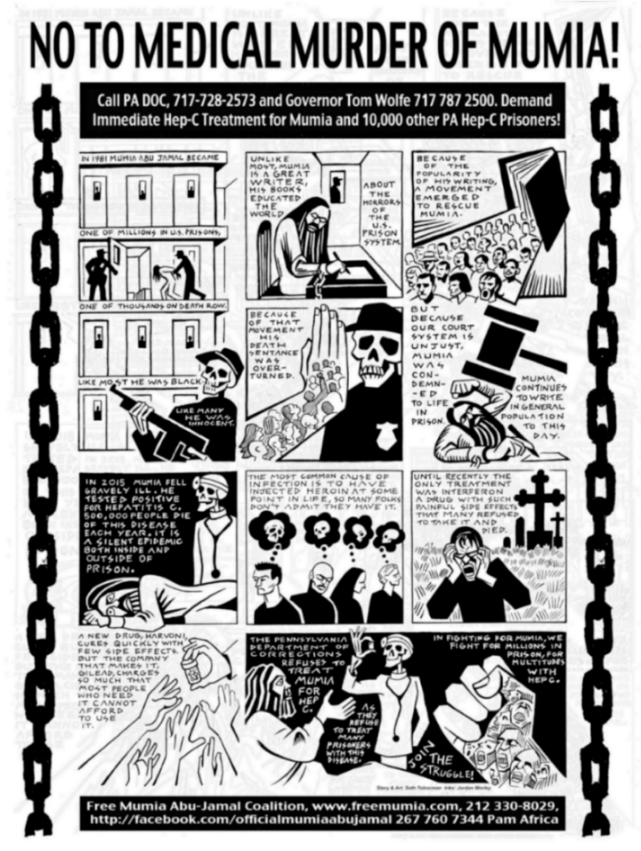
In Freedom of the Press in Black and White: The Story of Mumia Abu-Jamal (S. Chicago ARA-ABC Zine Distro, 1999), you told the story of Mumia Abu-Jamal not only as a legal case, but as the story of a Black journalist being silenced. What interested you most: exposing a specific injustice, or showing how power decides who gets to speak and who does not?
At the time, I saw the story of Mumia as a window into all the things that happened in his lifetime. The 60s, 70s and 80s. The Black Panthers, MOVE, and even the gay movement, because Q.U.I.S.P. (Queers United In Support of Political Prisoners) was a big part of the early Mumia campaign. What came of that was an actual relationship with Mumia, who wrote and drew for our magazine, and with MOVE, who are wonderful people.
You experienced the Lower East Side as a unique human laboratory: poverty, violence, solidarity, art, drugs, and revolt. Today, many radical neighborhoods have become cultural brands through gentrification. Does it hurt to see what happened to the Lower East Side? Do you feel you lost a homeland?
We used to joke about putting barbed wire along 2nd Avenue and declaring Loisaida to be an independent state. Today it feels more like the Lower East Side is just another part of America. So that’s a loss. But on the positive side, a lot of things that were unique to our neighborhood, like open mics, or discussions of police brutality, feminist, queer and gender issues, are now part of American life. So something’s lost and somethings gained.
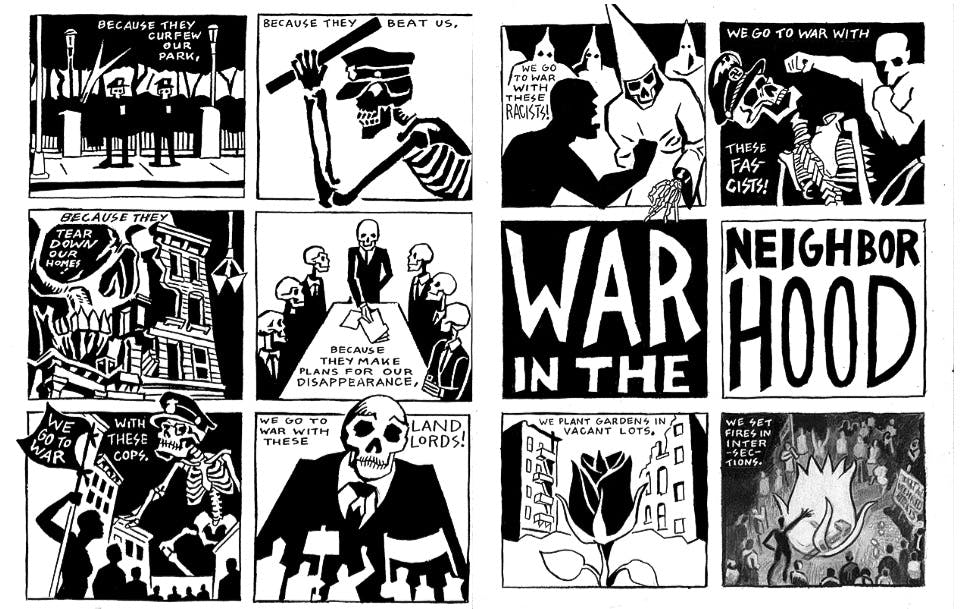
In War in the Neighborhood (Autonomedia, 2000), “war in the neighborhood” shifts conflict from grand geopolitical narratives to everyday urban life. Looking at that work today, do you think the neighborhood is still a central political site of resistance and struggle, or has it been gradually neutralized and turned into a cultural, consumable space?
I think that most real political organizing takes place in a specific place, among specific people, so neighborhood is pretty important.
In War in the Neighborhood, the story is deeply rooted in direct experience and the urban fabric of the Lower East Side. Can you explain how you worked on it? What kind of documentation did you use — testimonies, notes, archival materials, direct observation — and how did these elements become drawing and narrative on the page?
I drew the first pages of War In The Neighborhood in 1989 when I was still an active organizer of the Lower East Side squatters movement. I was not a ‘journalist’ in those days. I did not show up at a demonstration with a sketch pad or camera.
I didn’t really throw myself into work on the book until around 1995, when I had really stepped back from this activity. By that time, most of what happens in the book was already in the rear-view mirror. So when I wanted to draw comics based on my own experience, I had to reconstruct those events. I sketched the neighborhood, many friends sat for portraits, and I also had a lot of friends who were photojournalists and were very generous sharing their pictures. I knew what I needed because I was working from my own memories and personal stories. So I quickly amassed an impressive amount of documentation. But then the illegal nature of these situations, as well as the principles of good storytelling, required I fictionalize these events.
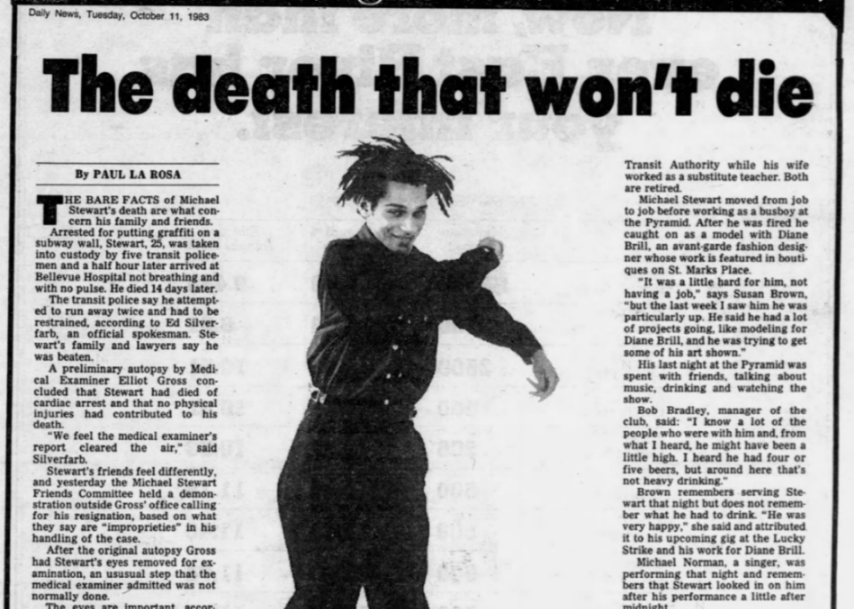
1You have written that many of your contemporaries died young — Michael Stewart, artists, activists, friends — while you survived. How do you live with that kind of survivor’s guilt? And what does it mean to grow old inside a counterculture that imagined a different future but often failed to achieve it?
Back in the 80s and 90s, a lot of people I knew died young because of AIDS. Then, about 20 years ago, a lot of my friends began to die because of hepatitis C, which is the pandemic no one wants to talk about because it is associated with heroin. Now my friends are dying very fast. Even the very healthy ones. I’ve lost four great comrades in the last year. It’s mind-blowing. In my dreams, I often talk to dead people.
As far as what we did or did not achieve, I was more frustrated about that when I was middle-aged. Now that I am a genuine old person, I look at it differently. I am more aware of how many of the things we believed in turned out to be true. How we were all way ahead of our times. We didn’t succeed because people didn’t listen to us. Those people turned out to be wrong.
In your stories, heroes are never pure: contradictory squatters, fragile activists, communities capable of both violence and solidarity. Do you think the American left still fears moral complexity? And can comics be a space where contradictions become fully visible?
I think American society as a whole fears moral complexity. But that goes double on the left because we are always under attack, and we naturally want to protect ourselves. So that makes self-critique very difficult. It’s hard to write about radical movements that are under attack with any nuance. I tried to do this in War In The Neighborhood, and I see that Ben Passmore is also trying to do this in Black Arms To Hold You Up. It’s important work because if we are ever going to take power, we have to know what we’re doing.
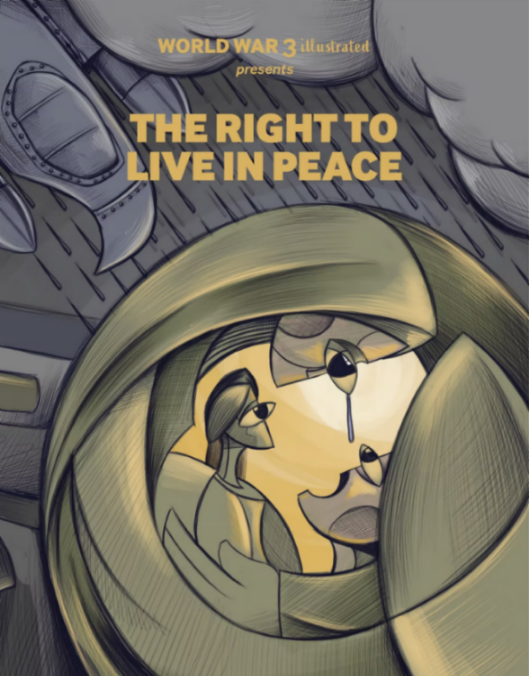
You’ve said that 1970s contemporary art rejected communication, while you wanted to “speak to people.” Today, we are saturated with constant communication through social media. Have we lost something? Does political art still communicate meaningfully, or does it mostly produce noise?
The American Art establishment of the post WW2 era was very hostile to any type of representation. This was part of the Cold War. They were trying to prevent Art from communicating left-wing ideas.
The comic industry in the 1970s was very narrowly focused on producing adventure comics for teenage boys and viewed anything else as unmarketable. They also had to function within the Comics Code.
We had 3 major television networks that all tried to produce only that range of material that everyone would agree with.
In the 70s and 80s, it was hard to find alternative culture, so we really valued it when we found it.
Today, there is a lot of great political art, and many different kinds of comics. I’m particularly impressed with all the cartoonists from the Middle East, and some from Eastern Europe as well. But I think people have become a little jaded because it is so available.
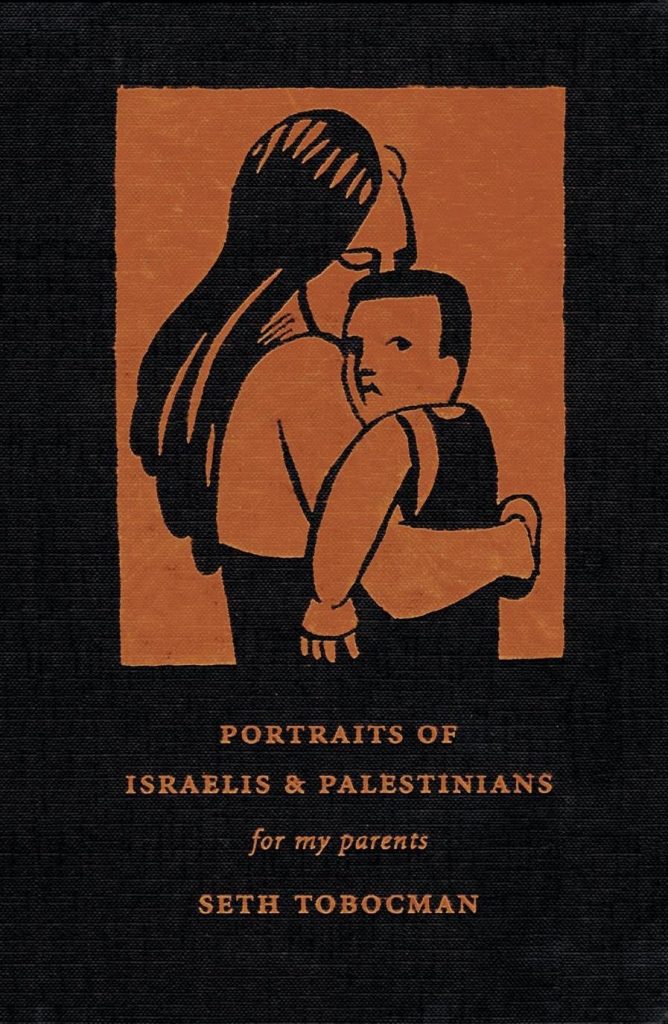
In Portraits of Israelis and Palestinians For My Parents (Soft Skull Press, 2003), you chose portraiture as the central form for depicting people inside an extremely polarized political conflict. How did you construct these portraits methodologically — direct meetings, conversations, observation, mediation between languages and positions — and how did dedicating them “to your parents” influence the way you looked at and drew these people?
The drawings in Portraits were just my sketchbooks from my first visit to Palestine. Drawing portraits is a great way to meet people. They generally like it. With little kids, I would do two drawings, one for me to keep and one to give away to them. I still like the drawings in that book very much, but some of the commentary I wrote is a bit naive and shows that I was just learning about the issue at that time.
15 – In one passage, you describe how radical movements learned to make decisions collectively, arguing late into the night. Today, political relationships are often mediated by algorithms and online outrage. Do you think we’ve lost the physical capacity to be together? Do you miss that assembly-based, street-level dimension?
Call me a Luddite if you want, but I think online discussion has done some real damage to political organizing. People write some very irresponsible things over the email. They type something cranky in the middle of the night in their underwear, and the whole world reads it. When you meet someone in person, you have to deal with how you are making them feel. The conversation is more nuanced and reasonable. Perhaps that is why ‘accountability’ has become a big aspiration. There is so little of it today.
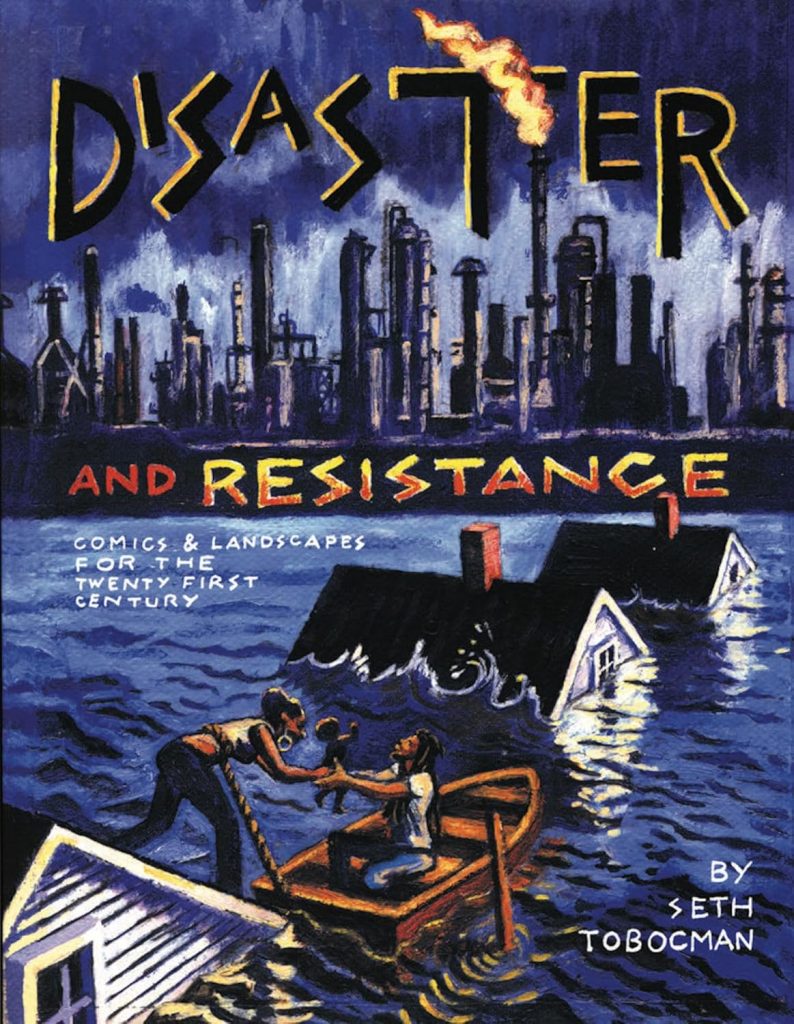
In Disaster and Resistance: Comics and Landscapes for the 21st Century (AK Press, 2008), disaster never appears only as an exceptional event, but also as something that reveals forms of resistance and everyday life. What, on a more personal and non-technical level, drew you repeatedly to the idea of “disaster”?
Life just seemed to be a series of disasters: 9/11, then the war in Iraq, then New Orleans. And it hasn’t stopped. The economic crash, Ukraine, October 7th, the genocide in Gaza. The system seems to be in a constant state of crisis.
World War 3 Illustrated still exists after more than forty years. How has the meaning of the word “radical” changed from 1980 to today? And do you think a magazine like that can still change people’s consciousness in the age of algorithms?
The magazine has always spoken to a small audience of several thousand very sincere people, who are deeply affected by what they read and act on their beliefs. That’s radical. When I meet people who read the magazine, I am always very impressed by them.
In the early issues of World War 3 Illustrated, you were completely outside the market: comic shops didn’t want it, bookstores ignored graphic novels, and distribution mostly happened through punk record stores. Do you miss that time when art, music, and politics felt part of the same underground ecosystem?
Nostalgia was originally understood as a disease of acute homesickness. It’s a complicated emotion.
In the 70s there were a lot of nostalgia movies about the 1930s and 1940s. My dad would often comment sarcastically that his peers were nostalgic for the great depression and the Second World War. But he did enjoy his swing records. Nostalgia for an imagined American past was a big part of Reaganism and is a big part of Trump’s MAGA movement.
Today, there is a lot of nostalgia for the Lower East Side of the 1980s. I’m aware that some of my art can be commodified as 80s nostalgia, which was never the intent.
If other people enjoy 80s nostalgia, it’s fine with me. But that was a pretty difficult period in my life, and I still have nightmares about it.
So if we are going to value something about the 1980s, let’s value the fact that, when confronted with a hostile environment, we found ways of doing what we wanted to do anyway. Maybe that can inspire people to resist the repression that is coming down today.
Looking at your long artistic collaboration with Peter Kuper, what has made such a lasting partnership possible? And were there moments when you nearly took completely different paths, artistically or politically?
Peter and I are very different people. Peter makes friends easily, I tend to be a bit antisocial. Pete is better with the application of materials. My use of materials is a bit messy, but I think my drawing involves more structure. Peter tries to look for a happy ending or at least some comic relief in his writing, while I look for a moral. Peter is very much in the world of illustration and graphic design, and I am more involved in activism. On the editorial board of the magazine, we balance each other out, and I think that has provided space for a wide spectrum of different points of view. What we have in common is progressive politics, a belief in the potential of comics, and a very strong work ethic. I have always been impressed with how much he gets done.
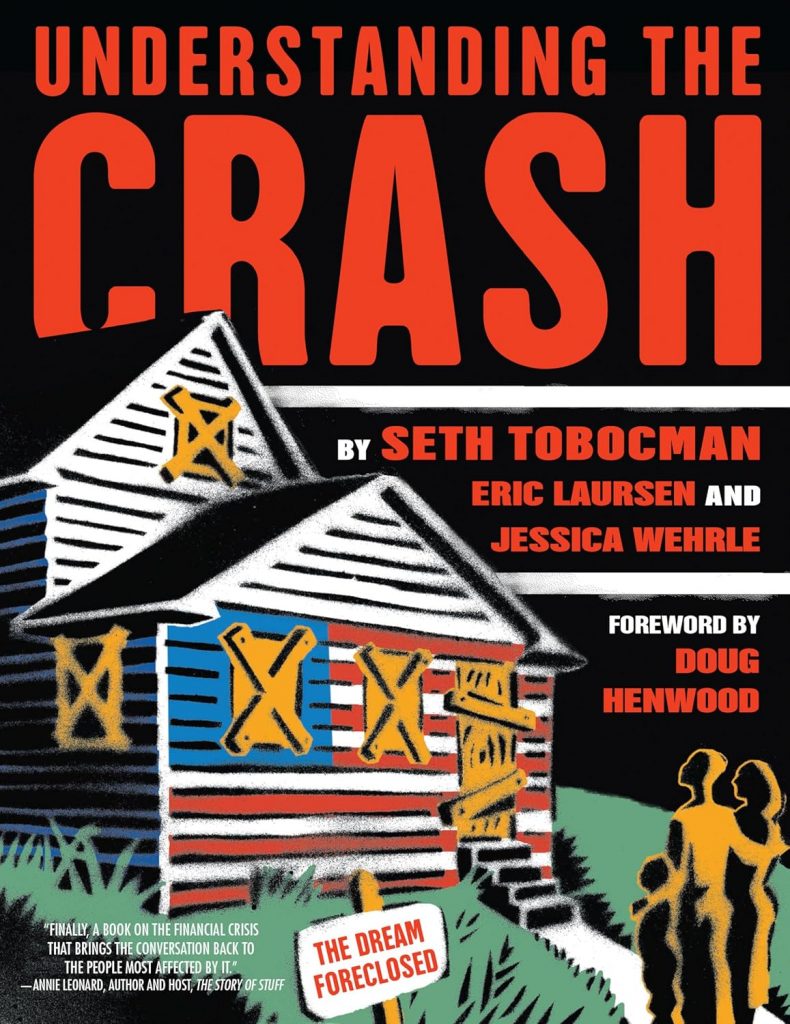
In Understanding the Crash with Eric Larsen and Jessica Wehrle (Soft Skull Press, 2010), the “crash” seems to be more than an economic event: it becomes a way of reading an entire social and political condition. What were you really trying to explore in that book beyond the financial crisis itself? Was it an attempt to understand a system, or also to show how that rupture changed how people perceive their everyday lives?
The most important accomplishments of the American Democratic Party happened in the first years of the FDR administration. Social security, regulation of the banks, the New Deal. But only a few years later, leftists were being forced out of the Democratic Party and the Labor unions in the name of “anti-Communism”. Since then, mainstream American politics has been one long attempt to undo the New Deal reforms. Resulting in the financial crisis of 2008. At the time we created Understanding The Crash, we hoped that the shock of that crisis would cause the country to finally turn around, but as we can see with Trump, the reactionary direction of American politics continues.
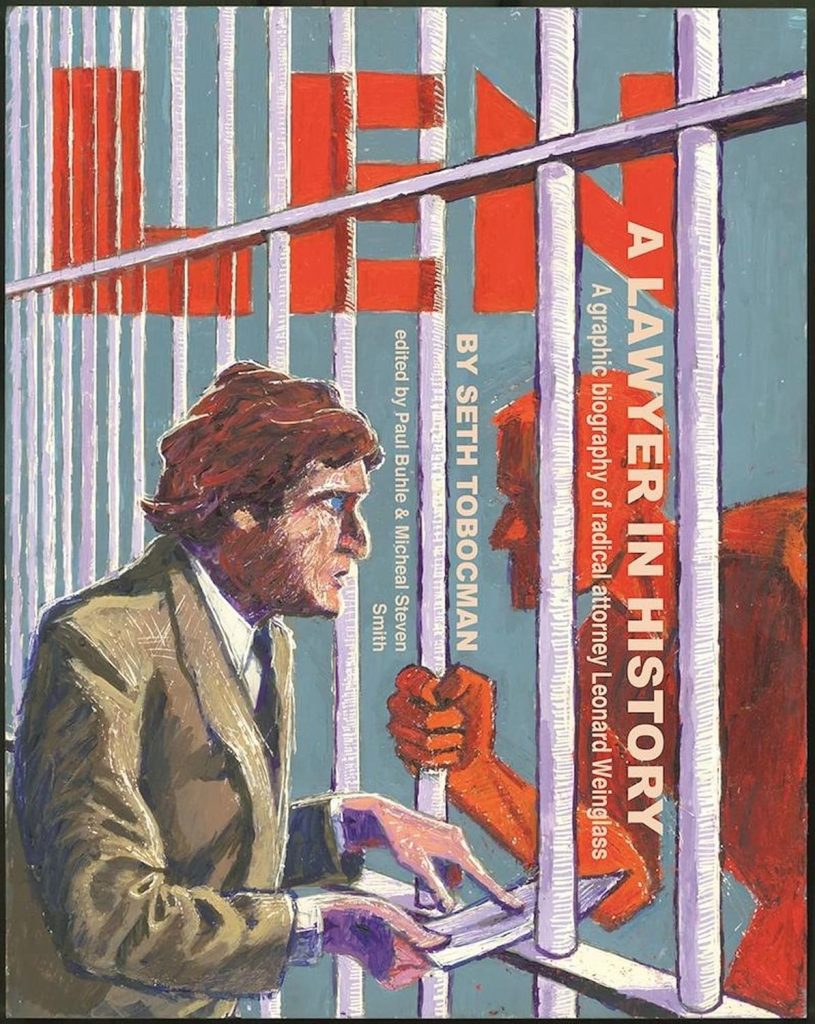
In Len (a Lawyer in History): A Graphic Biography of Radical Attorney Leonard Weinglass (AK Press, 2016), Leonard Weinglass emerges not only as a radical lawyer but as someone who turned legal practice into a continuous form of political engagement. What interested you most in telling his story as a graphic biography: his public role as a defender in political trials, or his personal ethics of law as everyday activism?
Len Wineglass was one of the great unsung heroes of the 1960s. His legal skills are what made it possible for people like Abbie Hoffman and Daniel Ellsberg to be such influential figures instead of just being jailbirds. Lenny’s friends felt that his life should be remembered, and commissioned me to draw a graphic biography. This gave me a chance to write and draw a comic book about the important events of that period. I very much enjoyed writing about Abbie Hoffman, who has always been one of my heroes.
How did the project “Comics as Political Expression” at ABC No Rio come into being, and what does it mean to you? How does this collective space — between zine library, printshop, and DIY practice — shape the way comics are taught and experienced not only as an artistic language, but as a form of political and community action?
I have been teaching people to draw comics at The School of Visual Arts since 2002. I enjoy it a great deal and learn a lot from my students. It is a whole new community that I get to be part of. But what I can do there is limited because most SVA students are hoping to make it in commercial comics, superheroes, manga, or game design. Very few want to do the type of comics I do. That’s understandable. There is more money in mainstream comics. So I have designed an online course on doing political comics that is available through the community arts center ABC No Rio.
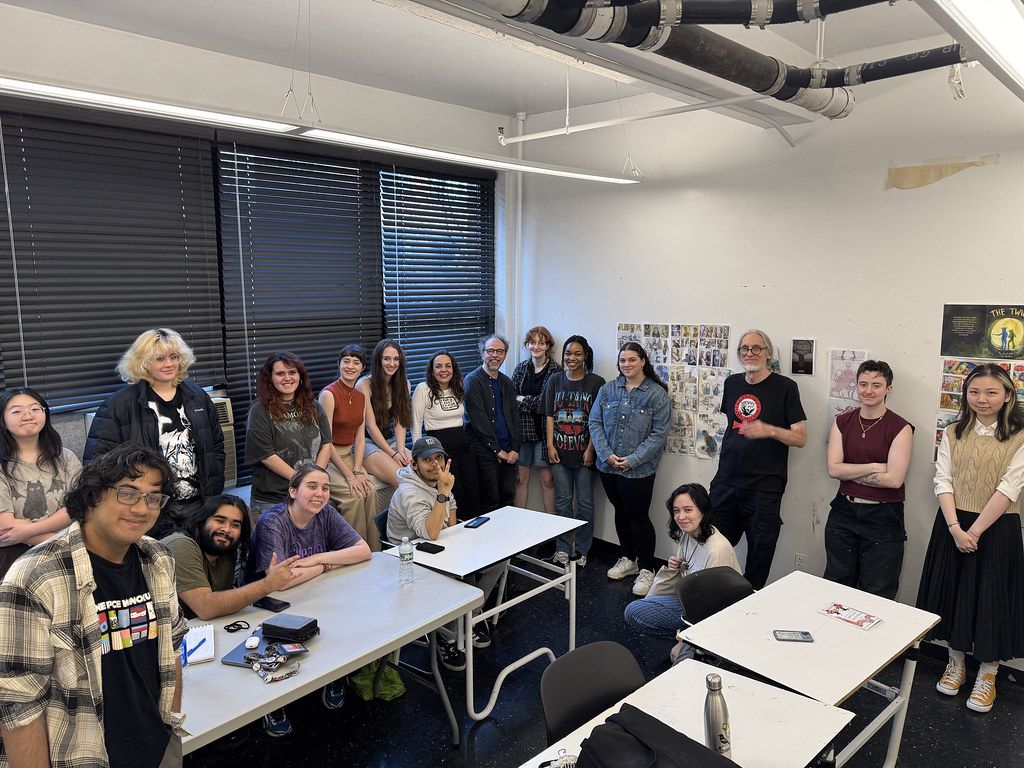
ABC No Rio is an artspace that came into existence when artists squatted an abandoned storefront for an art show in 1980. After the eviction of that show generated negative press coverage for the Koch administration, the city gave the artists another location, ABC No Rio. Over the years, the city has tried to evict them a number of times, and they have fought back. I was part of civil disobedience to defend the space in the 1990s. Today, they have become owners of the building but were forced to renovate it up to building code. So, No Rio has been closed for a number of years during construction. They will reopen to the public in the Fall, and my online course will become an in-person course.
In your live events, where you do not draw but instead narrate and perform your drawings accompanied by a musical group, comics become something hybrid between oral storytelling, performance, and concert. What changes for you in the shift from page to this performative format? How do music and voice reshape the meaning of the drawings and the relationship with the audience?
In the 1970s, I saw Vaughn Bode perform Bode’s Cartoon Concert, in which Vaughn, usually dressed in partial drag, would present a slide show of his comics, performing the voices of the characters. And also, just talking about his life. This left a lasting impression on me, and when War In The Neighborhood came out, I decided to promote that book through live performance. Today I work with a number of talented musicians, who have formed a band, Continuity Of Struggle, to back up my slide show.
What are you working on right now?
I have just finished a 30-page comics interview with Stanley Cohen, the attorney for Hamas. It is pretty controversial material. It will be published this Fall as part of an anthology called Which Genocide Are You On edited by Andy Singer and Mr. Fish.
I am working on a graphic novel inspired by the end-of-life process of my parents. It will probably be called Finding and Losing Mom and Dad. It is not a memoir but a work of fiction inspired by real events. I do not name names; there are some imaginary characters. Death himself makes an appearance, and of course, has all the best lines. It is an attempt to address questions of mortality, but also provides a snapshot of a certain section of the American Jewish community at a certain moment in history. It uses a style from the Creepy, Eerie, and Vampirella horror comics I read as a kid. Graphite and grey wash are used to create photo-realistic representations of supernatural beings. Horror comics are how teenagers deal with those two great mysteries of life, sex and death. Hopefully, we get older, and sex loses its mystery. But we are all children in the face of death. So this is not a memoir but a horror comic for your second childhood.
New York often appears in your work not only as a space of conflict and inequality, but also as a place shaped by a concrete form of beauty — made of people, everyday gestures, and collective resistance. What does the beauty of New York and its inhabitants mean to you? Does it arise despite the city’s social conditions, or precisely through them, as a form of dignity and political presence?
When I first came to New York, I was immediately struck by how busy the streets were. How full of people. One is immediately confronted with all these different people from all over the world. Also, with all the signs and graffiti. So many attempts to communicate. Where I grew up in Cleveland, it was too quiet. You could walk down the street and see no one. And this left way too much space for my mind to produce negative thoughts. So I found I was better off here.
Yes, I love the shape of the buildings and the way light falls into this maze. Yes, I love to draw it.
Today, unfortunately, New York is once again an island of sanity in a country that is going mad.
As I get older, I find walking on pavement hurts my feet, so it’s good to get out to the country and walk on the earth.
But New York is my home, and I will probably live here for the rest of my life.
SOLRAD is made possible by the generous donations of readers like you. Support our Patreon campaign, or make a tax-deductible donation to our publisher, Fieldmouse Press, today.
Leave a Reply