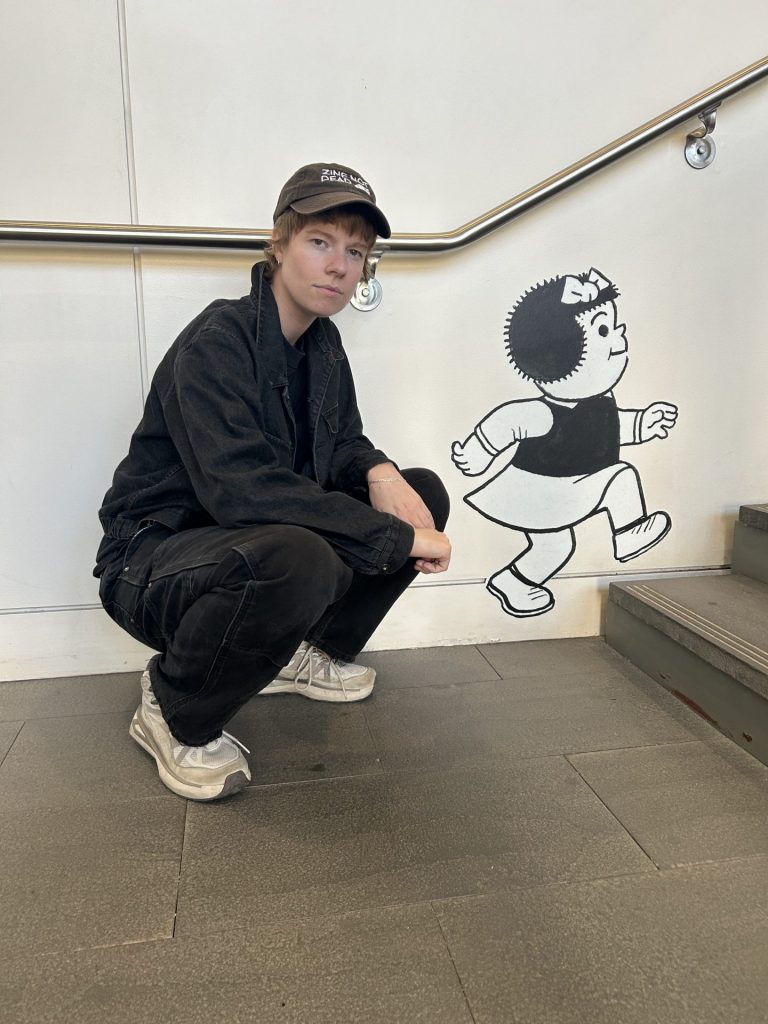
When I first met cartoonist Caroline Cash, she was a bookseller at Quimby’s Bookstore in Chicago. A glint of queer mischief in her eyes made me feel genuinely welcomed into conversations about comics and music and our mutual friends in the global scene. I later learned that she had relocated from Charleston to attend the School of the Art Institute of Chicago.
Cash wrote and illustrated Girl in the World (Silver Sprocket, 2019) in her senior year. After graduation — and while still a bookseller — she started her series PeePee PooPoo, which is published (also by Silver Sprocket) in the hilariously nonsequential order 69, 420, 80085, and most recently 1.
She eventually left Quimby’s to pursue comics full-time. In addition to winning Ignatz, Broken Frontier, and Eisner awards for PeePee PooPoo, her work has also been published in The New Yorker, The Nib, The Chicago Reader, and the Museum of Modern Art online.
2025 was a fructuous year for Cash: In August, Oni Press published her licensed Adventure Time book, The Bubbline College Special; and in September, Andrews McMeel Syndication announced that she would be the new cartoonist for the Nancy comic. Cash had been a guest artist for three weeks in 2024, but as of January 2026, the legendary strip is all hers.
Aria Baci: What were some comics you encountered that shoved you into the metaphorical mosh pit of comics creators? Comics that inspired you to start making your own.
Caroline Cash: I started making comics in college, and the first major influence of them was the Lose comic series by Michael DeForge. From there, I read Dykes to Watch Out For by Alison Bechdel, Black Hole by Charles Burns, and the Frontier anthology series published by Youth in Decline. My favorite issue of that series was the Eleanor Davis comic.
Also, I was really inspired by the work of my peers and mentors, specifically Gabe Howell, Jessica Campbell, Bonnie Guerra, and Dena Springer. Some other big influences from the Chicago comic scene are Chloe Perkis, Anya Davidson, and Nick Dranso, whose work I started reading after I had began drawing comics.
Baci: Ernie Bushmiller inherited the comic strip Fritzi Ritz from its creator Larry Whittington in 1925, and introduced the character Nancy (as the niece of Fritzi Ritz) eight years later in 1933. But it would be 85 years before a woman would write and illustrate Nancy comics. Olivia Jaimes took over the strip in 2018. Did being a woman in a historically male medium ever present any challenges for you?
Cash: Yes.
Baci: On a similar topic, do you think we’ve arrived in a place culturally where we can just be who we are without necessarily announcing our sexual orientation or gender identity in advance? For example, I’m out as a woman of transsexual experience (and I’m more or less bisexual), but I would sometimes love to be able to just acknowledge those identifiers and move on. Does your queerness inform your writing or your cartooning, or is it just another detail of who you are as a person?
Cash: My queerness impacts my work and writing in pretty specific ways. I’m not so interested in linear storytelling, which I think is very queer in and of itself. But more than that, I’m only passionate about making comics that I would like to read, comics that are my taste. And, wouldn’t you know it, I’m way more interested in work that has dykes in it than work that doesn’t.
To your point that we’ve arrived at a place where we can announce our identities, yeah, we can. Shouldn’t have to, but. I believe for all the people out there who would write off reading a story because they assume it’ll be gay because it’s made by a queer person, there are other people out there searching for new, exciting gay work, and are usually quite happy to find queer artists. I care much more about them reading my work than others.
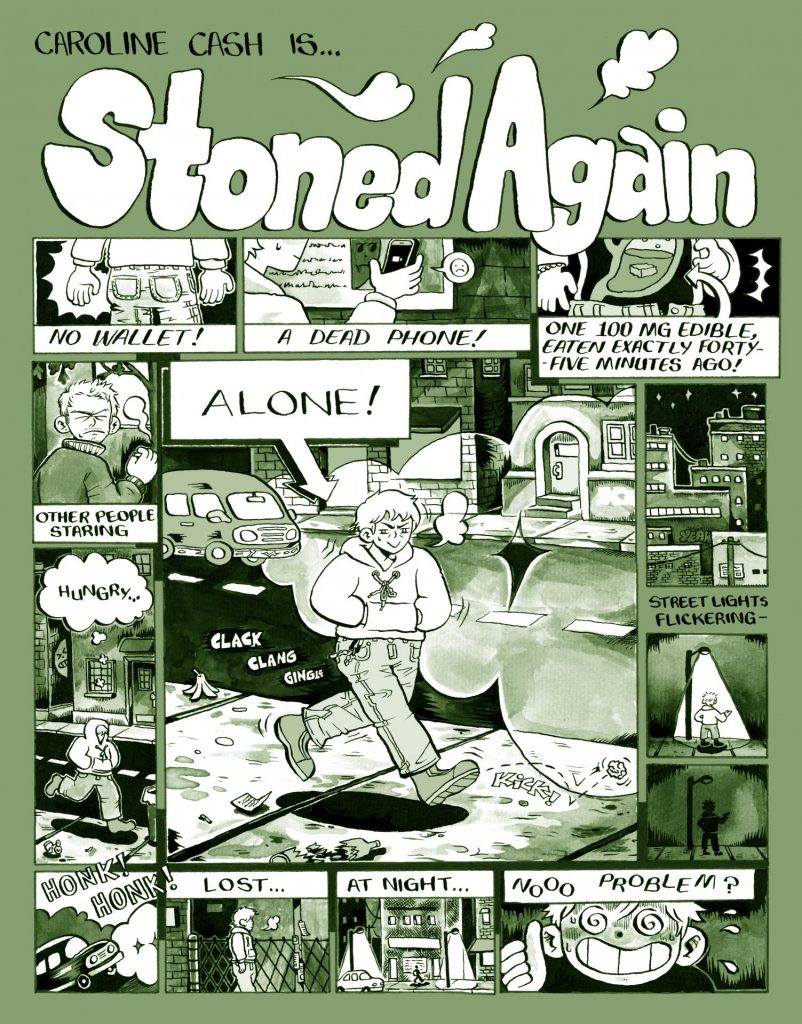
Baci: I’m rummaging through these feelings because it seems like queer people working in comics has been — or soon will be — completely normalized. Does our existence as queer people in comics need to be political? What if we just want to draw cartoons? And what if those cartoons aren’t necessarily tethered to our social identities?
Cash: Our existence is political. Art is political. All art should be made with the awareness of that. However, I’m not going to stop anyone from drawing cartoons about cute frogs who can use magic going about their days.
Baci: Who doesn’t love cute frog cartoons? Back to queerness, something about energy of Girl in the World and PeePee PooPoo reminds me a little of comics by Moa Romanoa (Goblin Girl), or even contemporary prose writers like Kimberly King Parsons (We Were the Universe) or Jean Kyoung Frazier (Pizza Girl). The characters are kind of amoral, but in their authentic messiness, they end up giving us a lovingly accurate account of being queer girlies in the twenty-first century. Have you ever thought of your characters as something like queer slackers? And even though they’re cartoons, how real are their experiences for you?
Cash: After I made Girl in the World (in a bit of a last-year-of-college-and-smoking-too-much-weed vacuum), a bunch of people recommended Goblin Girl. I read it and really enjoyed it! I liked Pizza Girl as well. I’m a bit lazy, and a bit gay, so it makes sense that my characters are too.
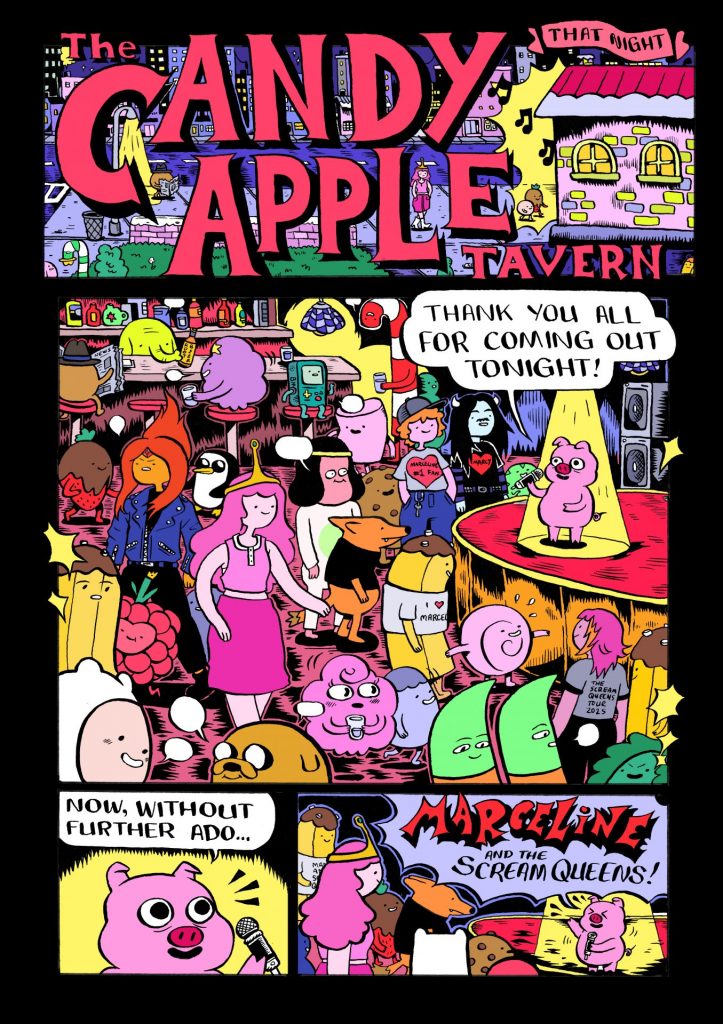
Baci: Aesthetically, do you have any preference for solid black and white or grayscale, over color? Anyone who knows you knows you read a lot of manga.
Cash: Black and white for sure is my ultimate preference, but it’s different project by project. Some are better in color.
Baci: So let’s talk about Nancy. Do you remember your first experience with the comic strip?
Cash: I don’t necessarily remember. I first read it when I was really young, and then started studying it when I was first trying to write gag strips. I was around 19 or 20 years old. I ended up getting my favorite Nancy panel tattooed not long after.
Baci: What attracted you to Nancy as a character? She’s such a sassy grouchy icon!
Cash: Nancy by Bushmiller was an extremely clever comic strip. Most of the gags feel timeless, because of the use of slapstick humor. But it was smart slapstick.
Baci: In an interview from 1949, Bushmiller said that he originally intended Nancy to be an incidental character: “I planned to keep her for about a week and then dump her … But the little dickens was soon stealing the show and Bushmiller, the ingrate, was taking all the bows.” Did you ever imagine that a book titled PeePee PooPoo would find such a dedicated readership, win awards, and eventually open the door for you to step into the role of drawing Nancy?
Cash: Nah, I was just making comics that I cared about. PeePee PooPoo is a comic I care about. The fact that other people care about it too has changed my life.
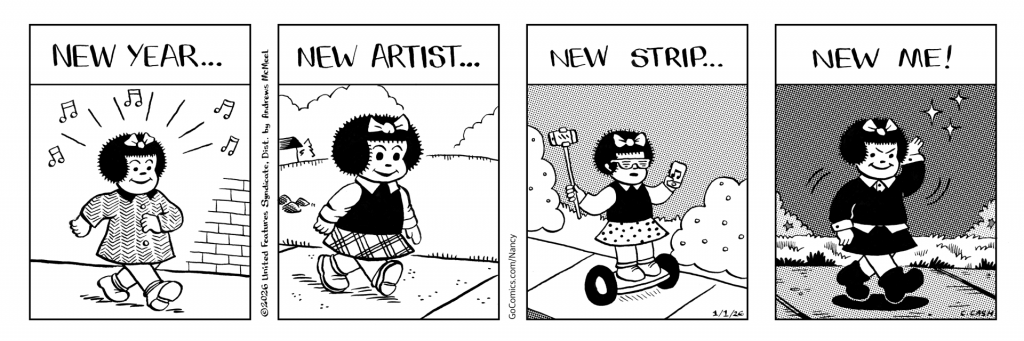
Baci: I love seeing Caroline Cash-style word balloons and letterforms in a long-running newspaper comic. Have you created a font of your handwriting, or are the strips hand lettered?
Cash: Everything’s hand done. If I had packs of halftones, those would be hand-done too. I’m pretty traditional.
Baci: What do you hope will be your legacy — the literal mark you might make — on Nancy?
Cash: It’s my first week, soooooo too early to say! Don’t want to jinx anything. I have some big ideas.
Baci: Will you have time for other projects while she’s being published so often?
Cash: Yes, I certainly hope so! I have a handful of different projects in progress. In a bit, when I’m more used to the Nancy schedule, I’m sure it’ll get easier to work on multiple comics at once. There are a few comics that haven’t been announced yet, but I’ll have a couple comics coming out in 2026. Something big that I’m working on for 2027 is my Debut Graphic Novel, which will be published by Drawn and Quarterly. They’re my favorite publisher, and I’m very happy to be working with them.
Baci: Do you have any insight to share with queer comics artists who are still finding their footing?
Cash: It’s really important for all newer cartoonists to finish their comics. And print them cheaply. Have them be easily readable. Give copies away to your friends. By doing this, you get your work out there, but more importantly, you get into the practice of completing comics and having those comics enter the world. Your friends are your first readers. Then their friends are your second readers. The wider a net your work casts, the more people making comics you will meet. The more queer cartoonists you will meet. The longer you keep at it, the better and easier this goes. Something that really helped me was tabling at zinefests and indie comic fests. It was a great way to meet people obsessed with the same niche interest as me.
SOLRAD is made possible by the generous donations of readers like you. Support our Patreon campaign, or make a tax-deductible donation to our publisher, Fieldmouse Press, today.
Leave a Reply