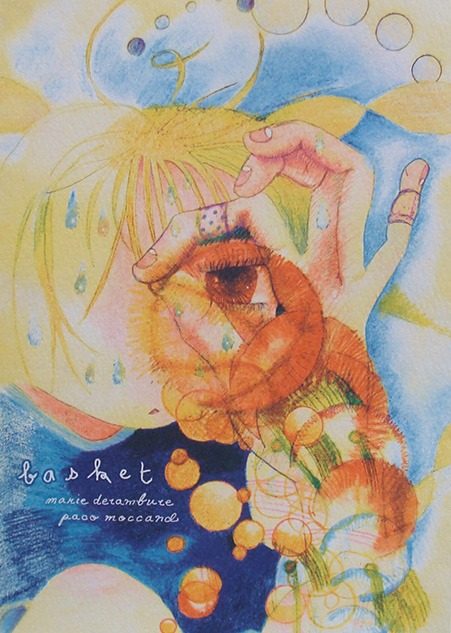
It starts with an intruder. Six members of the Cabestany middle-school basketball team wait for their coach, Elodie, to open the gym so they can start their practice; the seventh player, Ines, decides to simply force her way inside through a back window, prompting another member of the team, Fanny, to follow her. When Fanny hears muffled voices inside the gym, she snoops around and finds the coach already inside — along with a mystery man keeping her company.
As far as opening scenes go, the first chapter of Basket — the graphic novel by artist Marie Derambure and writer Paco Moccand, published last year by Lucky Pocket Press — is an effective one, setting up both the key mystery of the first act (the identity of the mystery man) and the initial dynamic within the team, essentially pitting Ines against the rest of the girls, with Fanny trying to mediate between the two parties.
This latter part, however, is the book’s first trap, and a fatal one at that. A major part of the appeal of the team-sports narrative, I suspect, is in its safety: for the main characters to reach their objective, they have no choice to get along, to set aside their differences and focus on the task at hand; no matter how much interest the reader (or, for that matter, the author) might have in the actual sport, there’s a pernicious allure to the concept, being, such as it is, a crash course in community at large. Note the book’s own marketing copy: “A […] comic about a scrappy middleschool [sic] basketball team and the 7 girls that make it up” — the focus, ostensibly egalitarian, is on the collective.
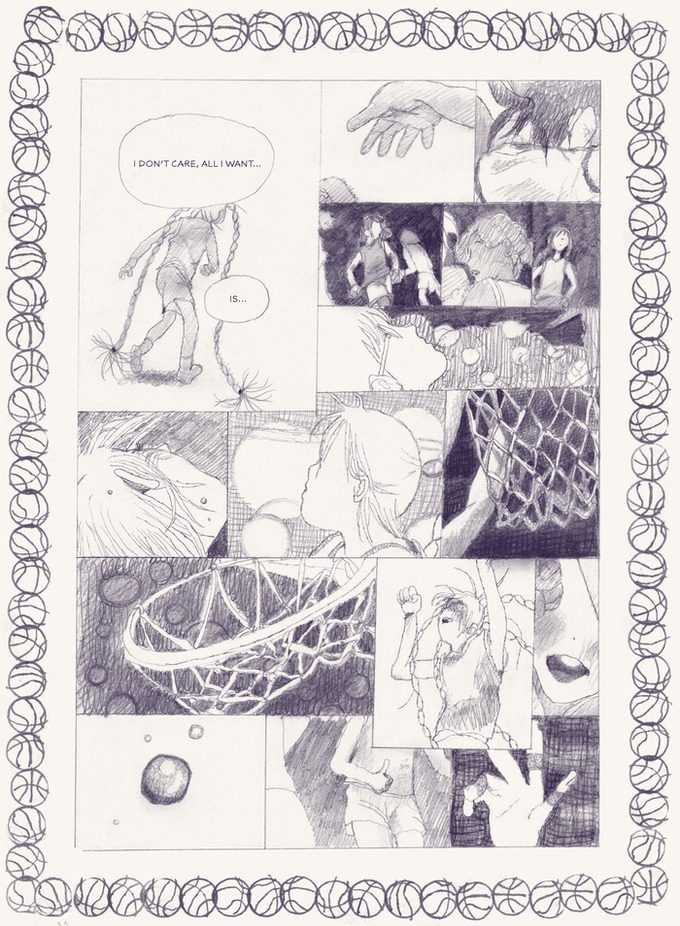
Yet what becomes evident early on is Derambure and Moccand’s reluctance to flesh out the five remaining members of the team outside of Ines and Fanny — though they are given names, in truth they have no personalities to distinguish them, and the only time their presence has any bearing on the plot is when two of them are injured and cannot play (even then, there is little indication that the team is materially impacted — the scene only serves to cement the team’s underdog status in the mind of the reader).1
Inevitably, this lack of detail dulls Ines’ potency as a character. There is, to be sure, an elegance to the way details of her life — or, rather, of the way her life is perceived — are sparingly doled out: in a moment of unexpected intimacy, the first question Fanny asks her is whether she has any friends at all; later, we learn that the rumor around school is that her father is in prison. Most importantly, the recurring motif is that basketball, to her, is a lifeline, her sole focus and ambition: “For you,” she says to Fanny, “it’s just a hobby. But for me, it’s all I have.”
Here, I cannot help but think about a different sports comic: Matsumoto Taiyō’s Ping Pong. I’ve written in the past about my ambivalence toward Matsumoto’s attitude, often too romantic for its own good, but a key element of the cartoonist’s depth stems from his constant reminders that, even outside the characters’ chosen niche field, the broader world still exists, and that they must engage with it, even if this engagement manifests as a withdrawal (that is, an active refusal to engage). Sure, some of Matsumoto’s players stick to ping pong after they’ve graduated high school, but some fall out of it; some of them are exasperated by it, but some of them find work and partners and fulfillment. When Matsumoto is at his best, he recognizes that the chosen field, the calling, does not insulate one from the world at large — it complements that world, leaving the individual to find their personal angle of engagement.
Within Basket, it is Fanny who embodies the potential for this depth. During their sole on-page hangout, after they go and spy on Elodie, Fanny tells Ines that she will be leaving the team at the end of the season: “I was never a big fan of basketball,” she tells Ines; “I just stuck around to hang out with my friends, but with exams coming up and all, I want to do more meaningful stuff.” The whole reason she prodded Ines to hang out with her, with some befuddled reluctance on the latter’s part, is because Fanny wanted them to be friends even after Fanny drops out of the team. This potential, however, is largely squandered, as at no point are the characters presented in their downtime, outside of the basketball setting, nor do they ever talk about their lives — that is to say, the supposed difference between Ines and the rest of the team is stated but never felt, as the creators fail to provide the negative space in which character dimensionality manifests.
Soon enough, it is discovered that the coach’s mystery man is a scout for the rival (and more successful) team, Toulouges, and that, in addition to their affair, Elodie had given him notes about the team’s strategy so that his team, not hers, would win; in exchange, Elodie is promised a job working for Toulouges. It’s Ines who recognizes him, because she herself had been in contact with him in the past — in hopes of defecting to the other team. Elodie and Ines thus form a pact of silence, both of them prioritizing themselves over the team. This pact is short-lived, of course; the rest of the team soon finds out about the would-be betrayal, and Ines is kicked out of the team while Elodie is essentially ghosted. Fanny eventually forgives Ines and gets the rest of the team to welcome her back, while another girl, Zoé, becomes the new coach and is tasked with coming up with a new strategy to regain the team’s competitive edge. On its face, this is an opportunity for Derambure and Moccand to course-correct by spotlighting another member of the team; in practice, Zoé’s dialogue is largely limited to dryly-practical instructions, with little to betray personality.
If there is anything in Basket that can be described as a revelation, it is Derambure’s cartooning. With the exception of two close-up pages which employ what looks like ink washes, Derambure draws exclusively in pencil, which she uses to an impressive degree of versatility, running the gamut between two extremes: lively solidity, with high-fidelity proportions and labored hatching, versus chibi-like reductivism, where the penciling is a lot stiffer and unrendered. The chibi moments have slightly more depth than the initial appearance of mere comic relief; in truth, they are perhaps Derambure’s most effective tonal tool. Consider the following two pages:
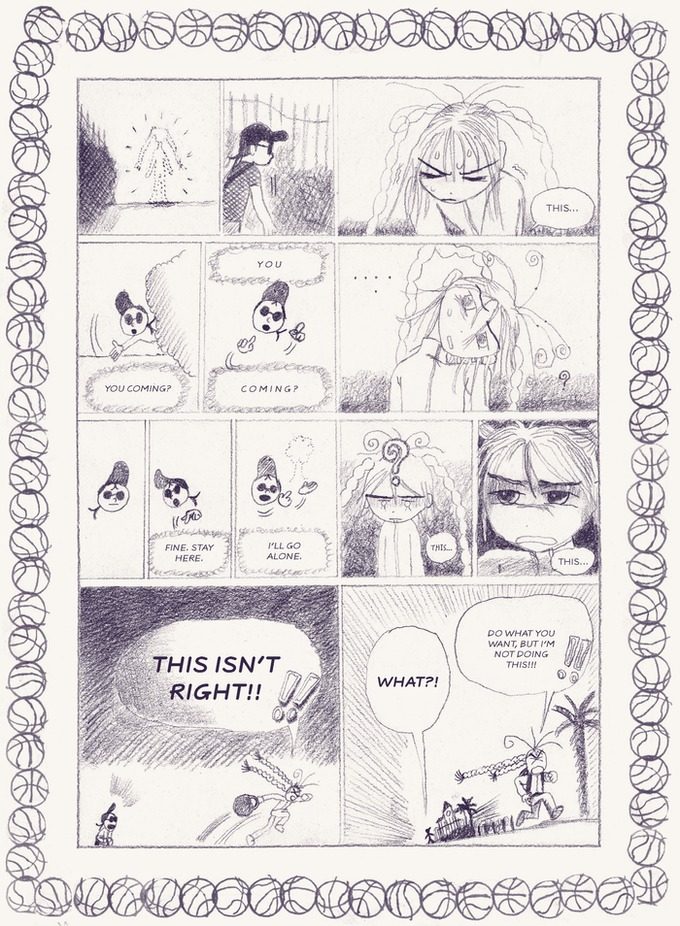
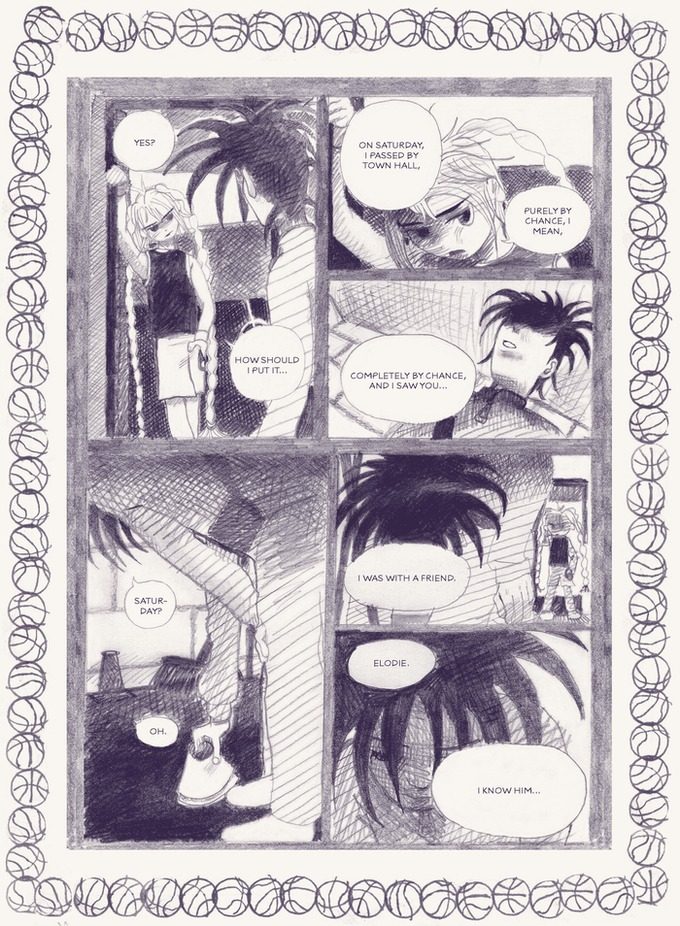
In the first page, Ines and Fanny spy on Elodie; in the second, Ines confronts Elodie about her mysterious liaison’s identity. Throughout the book, the default mode of emotional expression is articulated, rehearsed. In the confrontation page, there is the sense of drama, not just in the sense of interpersonal conflict but also in the sense of theatrical portrayal, of an active and intentional emotional construction: the careful compositions and heavy hatching give the reader the sense that, prior to the actual conversation, Ines ran this moment in her head a thousand times. In the first page, by contrast, the crudeness and immediacy of the drawing perfectly convey a feeling of concurrence — Ines has only just seen who the man is, and doesn’t have the psychological time and composure to construct a ‘mature’ outwardly reaction. In this sense, these momentary visual simplifications serve as an effect of not just levity but also emotional volatility, particularly effective in reminding the reader who these characters are: ultimately, they are still teenagers, play-acting at a maturity they are only beginning to grasp.
In her portrayal of the game itself, Derambure loses herself in the adrenaline of real-time play. Consider, for example, the last two panels of page 23, taking place during a practice session:
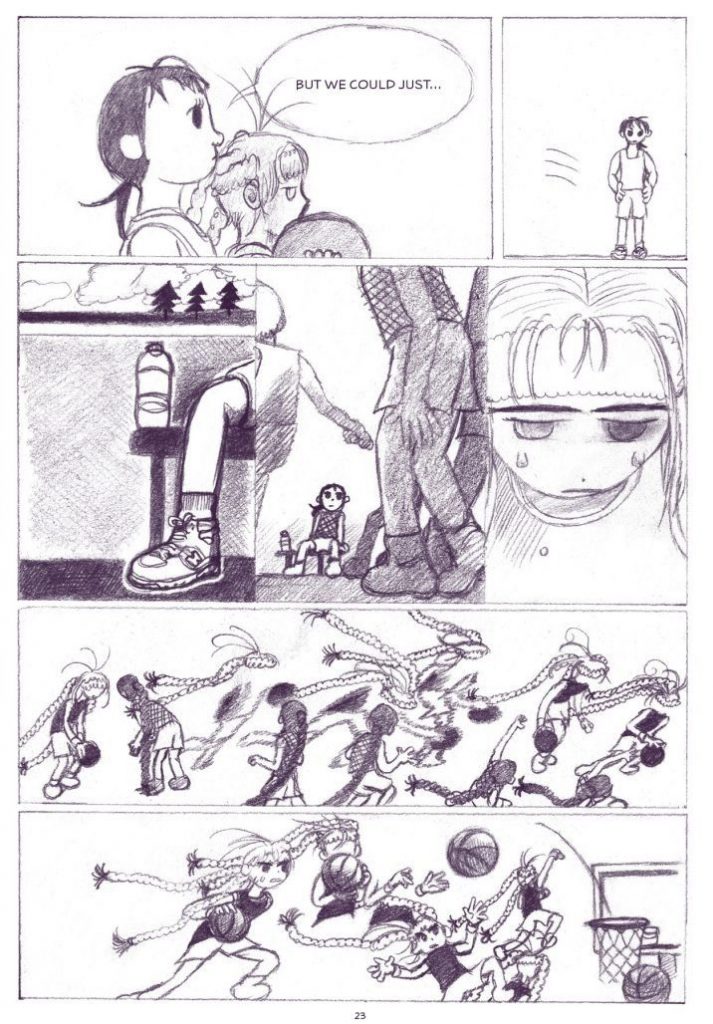
Part of the reason I like these specific panels is their insistence on sequential contiguity. Derambure resists the obvious temptations — either to break these moments down into smaller panels into a semi-montage, or to go the opposite direction and drop away panel borders altogether to create a more fluid image, akin to Connor Willumsen’s Bradley of Him, both being layout choices that appear elsewhere in the book — instead, here, she satisfies herself with just two ‘moments’: first the run along the court, then the jump and shot. There’s almost a quaintness to this choice, an overt sequentiality that harkens back to Muybridge.
At the same time, though, there is a charming collapse of perspective on display: though Ines progresses in a more or less planar fashion, moving from left to right but not upwards or downwards, the other girl, Emma, ‘falls away’ gradually; when Ines jumps to dunk the ball, she gradually shrinks as she advances in the panel. Furthermore, both the background and the floor have ‘dropped’ out of view, creating a non-space where only the crucial elements — girls, ball, basket — exist. Even the girls themselves exist more as pictograms than overt representations: note the way Ines is represented as a floating head of hair, her face omitted. The result is ecstatic — the reader looks at the players from the outside, but experiences the game in an adrenal blur, closer to how the game feels than how it looks.
That the above is a practice session is, in itself, pertinent; see, for the sake of comparison, page 167, from the actual game versus Toulouges:

It’s an intoxicating feeling, which only intensifies as the game continues — the pages don’t progress so much as pulse, and Derambure’s lines grow ever more frenetic and shaky, especially as the team grows more and more physically fatigued.
Here, too, though, the energy and charm feel like they exist less for their own sake and more as a disguise, a shorthand. For the game against Toulouges, Derambure and Moccand make the wise decision of slowing down — the match takes up some fifty pages, a quarter of the length of the book itself. Where the actual progression of it is concerned, however, the creators seem distinctly non-committal; they focus on their protagonists’ intrinsic struggle, being the extreme physical exertion, but it’s noteworthy that, even though the game ends on an extremely tight score, Toulouges (“the top-ranked team in the county,” the characters inform us) are rarely depicted scoring — when the Cabestany girls score it is drawn directly several times, but for Toulouges the comic generally cuts away to the rising numbers on the tickerboard. It’s a clever sleight-of-hand: when ‘our’ team does it, it’s a success; when ‘theirs’ does, it’s a technical matter. Again, that hint of authorial fear: weakness and vulnerability are allowed only when telegraphed at arm’s length.
The Cabestany girls win in the end, of course. It’s Fanny who throws the decisive shot, assisted by an exhausted Ines, seconds before the buzzer. And that’s where Derambure and Moccand leave us: the team is declared the winner, and the girls hug Fanny goodbye, she and Ines each shedding a single tear from afar. It’s a happy ending, to be sure: the girls’ efforts have proved worth it, and their conflicts have been left squarely in the past; Fanny even got her closure, settling the game and dispelling any notions that the team revolves around one star player and no one else.
But something nags at me. That the departure scene is a montage, three loosely-sequenced pages with the dialogue presented as voice-over rather than direct word-balloons, makes it feel like an afterthought, an acknowledgement of finitude that is all too reluctant to take away from the sweetness of the win. That finitude, of course, winds up eclipsing the victory anyway, but the authors refuse to pay it much mind. I find myself wishing (somewhat inappropriately, perhaps, for a critic whose duty is to analyze the work as it exists, not as he would like it to be) that the story continued for even just a single scene — not because I am that engrossed in the story, but because I would like some indication that these characters have some autonomous life in the minds of their authors.

Must learn to be less selfish, coach Elodie’s notebook says of Ines, just shy of halfway through the book (tellingly, Ines is the only player whose data page is shown). And, indeed, Ines’ victory is in learning to step outside of herself, to expand her focus. One suspects her creators would benefit from the same lesson.
- When I was a kid, my father would quiz me on sports trivia sometimes. I know jack about sports, but being inundated with soccer and basketball in the background every weekend has a tendency of sticking around in your mind. And the thing is, even a decade after I first heard these names from him as a bit of trivia, and eight years after his death, the names Jordan, Paxson, Pippen, Cartwright, and Grant still exist, in my mind, as a single complete unit, as a team. In Basket, outside the three girls I remember — the three girls that tie directly into the plot — there are four whose names I do not remember even after reading this book three times. ↩︎
SOLRAD is made possible by the generous donations of readers like you. Support our Patreon campaign, or make a tax-deductible donation to our publisher, Fieldmouse Press, today.
Leave a Reply