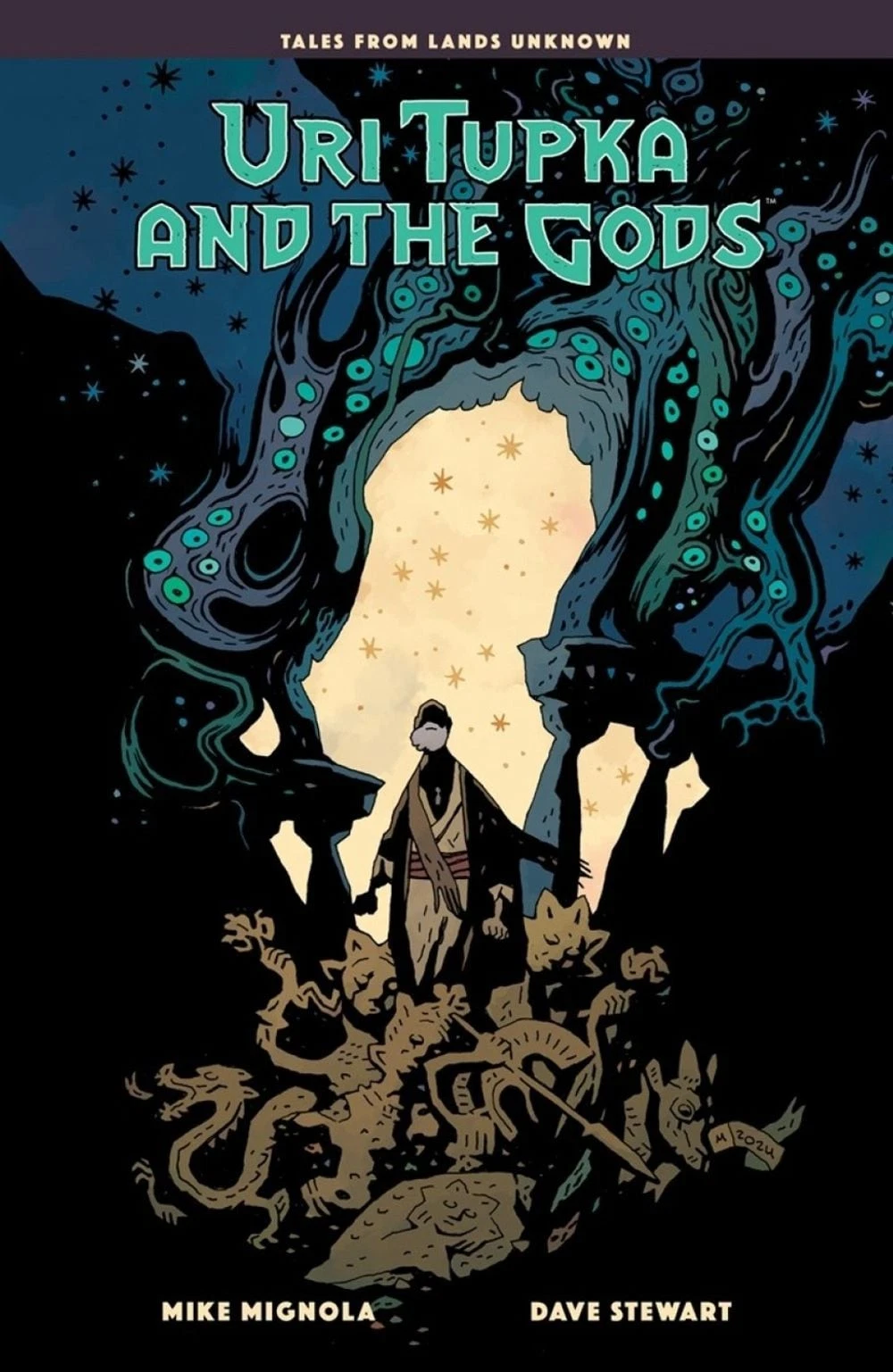
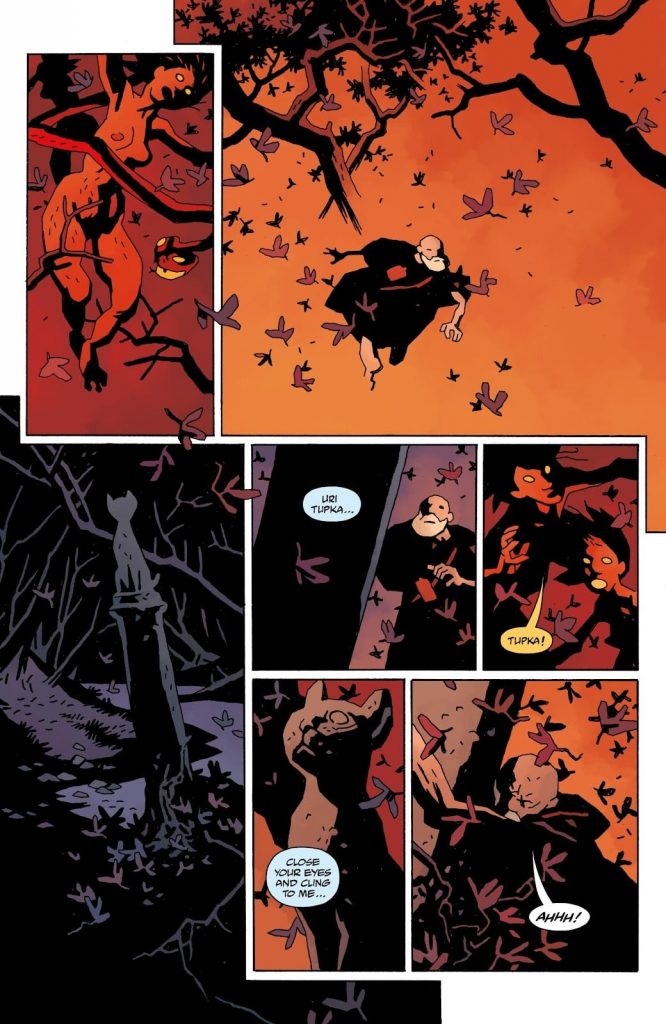
About sixty pages into Uri Tupka and the Gods, it happens: a panel stops me in my tracks. This is not quite the first panel in the book to impress me — Mike Mignola knows how to dazzle, that much isn’t news — but, as soon as my eyes land on this one, I know for what may as well be a fact: this is the most beautiful panel the man has ever drawn.
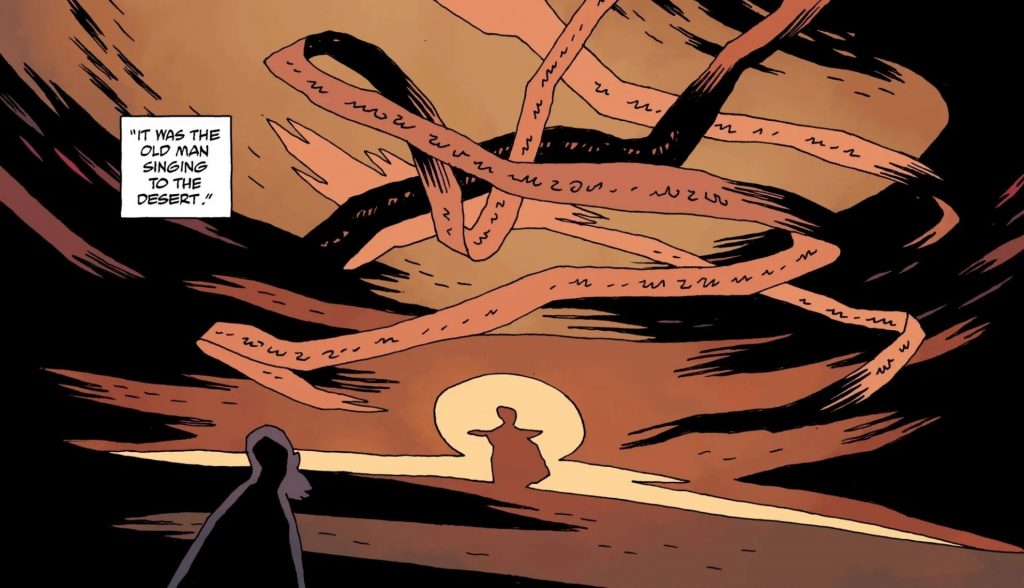
It’s beautiful precisely because of what it is not: it isn’t a fight scene with Kirby crackle, nor a lyrically grim portent — for once, it is a moment of genuine peace. Mignola is a difficult cartoonist to talk about, in the sense that, if he has changed as an artist at all over the course of the twenty-first century, it is more a matter of degree than of sweeping sensibility. His pooling shadows, his blocky shapes: these are all immediately recognizable, and have been for longer than I have been alive. The reader, then, must look for specific moments, specific images where energy still manages to flare out. The above certainly constitutes one such moment. The ribbons of song, energy-becoming-physicality, evoking captioning in medieval painting; the warping swatches of light in those autumnal hues (applied by longtime Mignola colorist Dave Stewart); and the two men, one of them watching solidly from afar as the other melts into the light around him, losing his form in a moment of oneness, of — there’s no way around it — transcendence: this is Mignola at his grandest, stepping, in a very real way, outside of himself.
For some time now, I have been something of a Mike Mignola skeptic, mostly for one reason: having read as many volumes as I have of Hellboy, I never got the feeling that the cartoonist believes in anything beyond the level of “Well, it makes a fun story at least.” To be sure, ‘belief’ is a fickle metric for narrative success, but any discussion of gods and mysticism, of which Hellboy has no shortage, raises, at least in my mind, the question of mythology-qua-narrative versus mythology-qua-frame-of-reference. In the latter sense, Mignola simply never managed to compel me; his is a colorful, rich, entertaining world, but it only exists as long as I hold the given book in my hands.
Imagine my surprise, then, when I saw the following preface and dedication in the opening pages of Mignola’s latest, Uri Tupka and the Gods, recently released from (who else) Dark Horse Comics as the latest installment of Mignola’s Lands Unknown universe:
“All I remember about my first Holy Communion (yes, raised Catholic) is the presents[:] a plastic glow-in-the-dark rosary, a battery-powered robot that made a horrible roaring noise, and a book — Sixty Saints for Boys — where I learned that Saint Nicholas once reassembled and brought back to life some murdered kids he found in a pickle barrel. Whoever gave me those long-ago glorious objects, this one’s for you.”
More than any comic he’s written, this short, almost-offhand dedication feels like a cipher to Mignola’s whole deal: two religious objects, and a children’s toy tucked in between them to bring them to life, to keep the medicine down. Right away, this makes me sit up and listen closely: God, with a capital G now, has entered the room — could it be that, this time, They are here to stay?
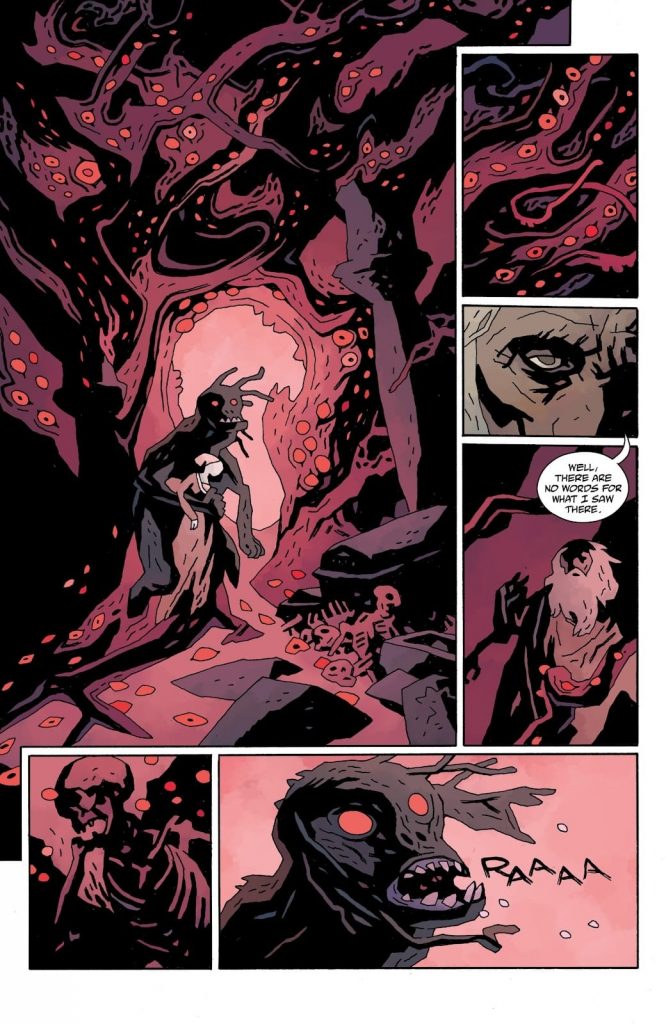
As Mignola himself notes in the supplementary process section, the structure of Uri Tupka and the Gods is a tried-and-true formula for him: a guy sitting in a bar and telling the people around him exactly how he wound up here — wherever here is — over drinks. Here, the storyteller is the titular Uri Tupka, a theologian who has recently made himself a wanted man by accusing the Emperor of sacrilege; having managed to flee for his life (the other two signatories on the scathing letter were not so lucky) a year prior, he has now returned to his hometown under cover of darkness and reconnected with two of his peers to tell them about his journey. The previous Lands Unknown book, Bowling with Corpses and Other Tales, suffered from an inability to carry the weight of its own promise: heralding the arrival of a new ‘shared universe,’ it operated at times as its own lore-book; its stories had little internal drive and little to bind them together. Uri Tupka and the Gods, by contrast, has a degree of narrative urgency that accommodates Mignola’s knack for incidental worldbuilding, as Tupka is forced to move from place to place and come into contact with the locals.
That is precisely where Tupka becomes interesting: less as a character in his own right than as a contrast. The world Mignola builds, you see, is one colored by religion, or, more accurately, by religiosity; when characters assert that the gods are dead, they mean it as a literal articulation of collective trauma rather than in the Nietzschean–Enlightenmentarian sense. As such, theology is not a practice of secularized academia but of the very matter of life itself: Tupka’s faith is his moral compass (his accusation of sacrilege, aimed at the emperor, is grounded in an in-world verse of scripture which dictates that “all men shall be equal to each other […] as all the gods, like leaves of grass, shall be equal to each other”) as well as his means of self-defense (“I don’t believe that,” he says to the ersatz-Cossack who tells him that the gods are dead; later, when the same group of abductors destroy a temple, it is Tupka alone who survives). At no point is this faith compromised or even questioned: when presented with an opportunity for food and shelter at the on cost of signing away his soul to the devil, Tupka, starving and penniless, takes his blade to the book of damned souls and destroys it.
That Tupka is not only morally and theologically upright but persecuted for his uprightness is self-evidently an authorial shortcut, giving the reader something to root for in the absence of more specific character traits — certainly compared to Hellboy, Tupka’s presence is understated, without much in the way of charisma or distinguishing features — but it is also the natural progression of Hellboy’s core nature-versus-nurture conundrum; where Hellboy seeks to break away from his past environment (the Hell that yielded him, the Nazis that summoned him), Tupka seeks to break away from the present. There’s more than a hint of the Ditko mode of storytelling here — if he is ‘special’ or ‘chosen,’ it is only thanks to his unwavering principle; Tupka is the living embodiment of an ideal.
The cartoonist’s approach to worldbuilding here, a fellow critic who has read far more than I informs me, is firmly rooted in Robert E. Howard: between the Greek-sounding names of the sacred books, the overtly Germanic and Slavic regions, and the broad depiction of race (the turban-wearing, elephant-riding desert-dwellers, or the Cossack-looking group that abducts Tupka in the Yulles), the reader can clearly recognize the makings of Mignola’s world, but these makings are in no way obligatory or binding; they offer their own easy departures.
Similarly, Uri Tupka’s religion is not immediately recognizable as any real-world religion; certainly it isn’t Christianity, and, more likely than not, it is improvised on the fly as Mignola sees fit. But, by inserting the question of faith, it distinguishes itself from the in-world mythologies and cartoon cults of Hellboy, where the existence of the gods (and demons, and folklore characters) is incontrovertible. Notably, Tupka does not seek to uphold any sort of orthodoxy: “for all the splendor of that place,” he says of the Great Cathedral constructed by a past emperor, “I didn’t feel [the gods] there either.”
Up until the visit to the Cathedral, Tupka is in a largely reactive position, fleeing first the Emperor’s soldiers, then the bandits, then the devil that wants to claim his soul, but the empty feeling it leaves him with gives him, for the first time in the story, something to search for outside of his own personal safety. He decides to change course and makes for an ancient desert temple (endangering himself once more, and even falling briefly in love, in the process), where he meets a mythical hero sent by the gods to show him precisely what they have been up to: trying to ward off the danger that killed the world that preceded the present one. This, we learn, is why Tupka returned to his town to speak with his fellow theologians: having been chosen by the gods to study “The Unknowable Thing” and help defeat it, he needs to tell them his plan in case it fails.
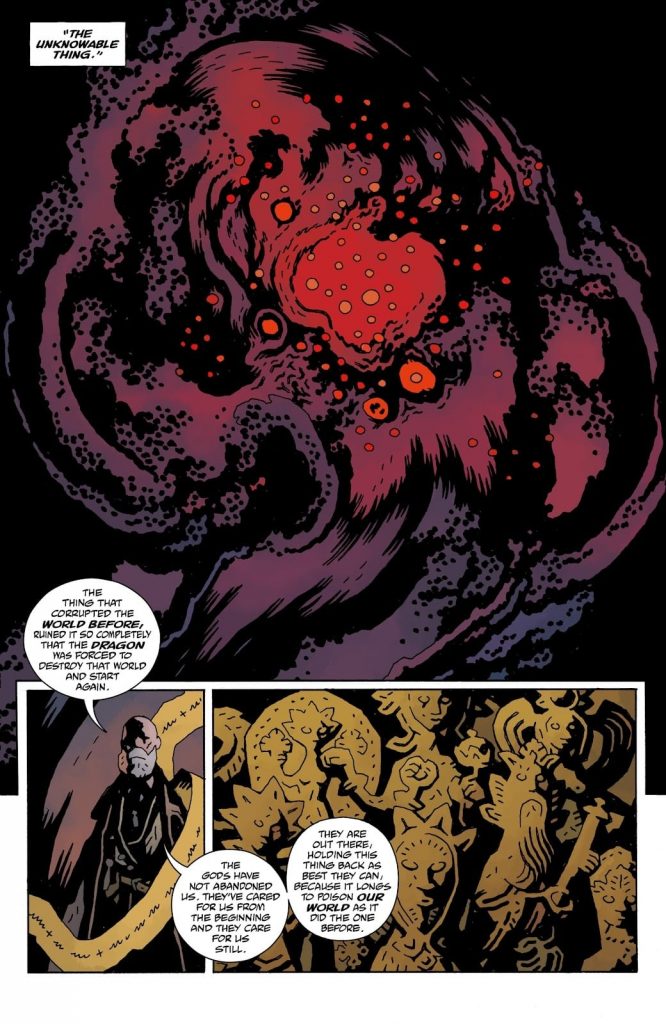
When asked in 2014 about his personal beliefs, Mignola said, “I don’t believe in anything, really. Not on a conscious level. That is the beauty of it. I was raised Catholic. I was taught a bunch of stuff. I find religion fascinating, but at no time does any of that tie my hands.” Yet the bottom line of Uri Tupka and the Gods — that there is still a God to love and protect mankind, because if there weren’t things would be even worse than they already are — feels like a moment of personal reckoning for the cartoonist.
By the time this review is published, the follow-up volume, Uri Tupka and the Devils, will be practically around the corner. In a way, I almost fear that; the first volume ends on such a clear call to action — Uri Tupka, the wanted man, setting off to the one library that might have the sacred text he needs to know what he’s up against — that it’s easy to imagine Mignola sliding back into the realm of pulp. As it stands, though, Uri Tupka and the Gods makes me feel something I practically never feel: a sense of narrative hope, an attachment to the character amidst his grave circumstances. For the first time in who knows how long, decades into their storied careers, Uri Tupka and Mike Mignola are both setting off into lands unknown, in search of something truly bigger than themselves; I, for one, can’t help but hope they find what they’re looking for.
SOLRAD is made possible by the generous donations of readers like you. Support our Patreon campaign, or make a tax-deductible donation to our publisher, Fieldmouse Press, today.

Leave a Reply