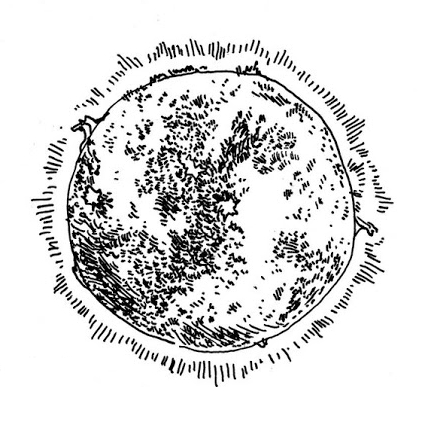
There is a particular kind of silence that belongs to comics.
It is not the silence of nothing happening. It is not blankness, emptiness, or a failure to speak. It is closer to a pause in which the reader becomes aware of their own looking. A figure stands by the sea. A bird crosses a page. A body turns away. A landscape changes slightly from one image to the next. No caption explains the movement. No dialogue tells us what has been lost, remembered, or understood. The page simply waits.
I have always been drawn to that waiting.
In a silent comic, the absence of words does not make the story simpler. Often, it makes the reading more demanding. Without dialogue or captioning, meaning has to be gathered from posture, distance, scale, repetition, framing, rhythm, and the space between images. The reader cannot simply follow language through the page. They have to look, compare, infer, and, sometimes, accept that they do not fully know.
This is what I value most in silent comics: not simply the absence of words, but the presence of care.
Silent comics require care from the maker because every visual decision carries more weight. Gesture, pacing, composition, and sequence have to do the work that language might otherwise perform. But they also require care from the reader. To read a silent comic well is to stay with an image before turning it into explanation.
In a culture that often rewards speed, silent comics offer another tempo.
The page as a place of listening
When I think about comics, I often think less about speech than about listening.
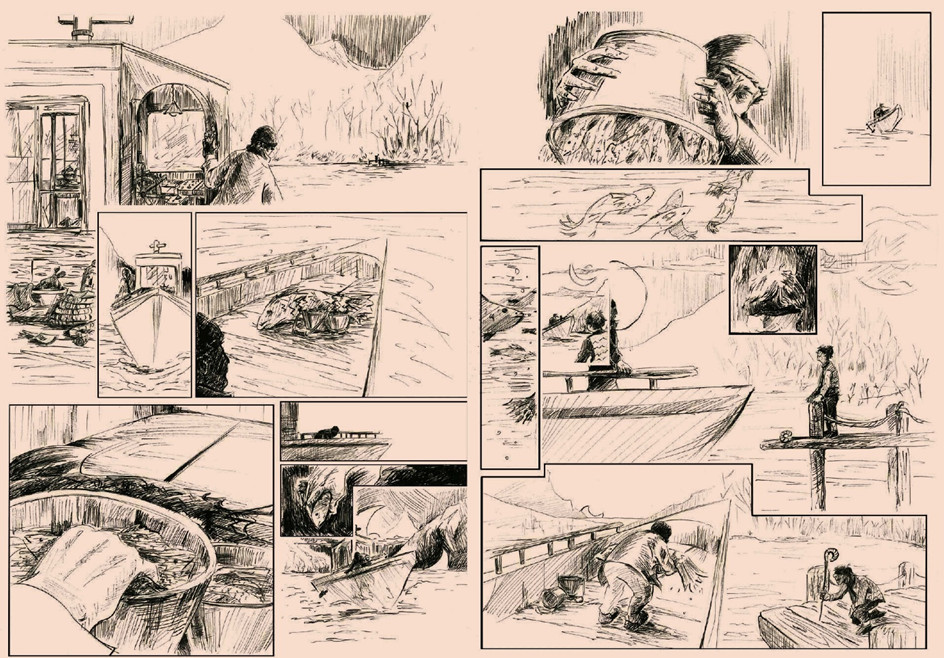
A silent page still has sound in it. Wind, water, footsteps, wings, breath, distance: these may never be written, but the reader senses them. The absence of written sound effects does not remove sound from the page. It transfers the work of hearing to the reader’s imagination.
This is one of the paradoxes of wordless comics. By withholding language, they can make the reader more alert to what cannot be heard directly.
A page might show the sea, a figure, and the sky. Nothing is said. But the image is not mute. The reader may feel the weight of water, the openness of the horizon, the loneliness of a figure placed small within the frame. Another page may repeat a similar composition with a slight change: a different distance, a shifted gesture, a new presence in the sky. The difference between the two pages becomes narrative.
This is why I do not understand wordless storytelling as merely “textless”. Textless suggests that something has been removed. Silent storytelling, for me, is more active than that. It is a way of composing attention.
In prose, a sentence can move the reader quickly through time. In a wordless comic, time often has to be built visually. A repeated frame can slow time down. A sudden change in scale can make a moment feel interrupted. A page without obvious action can become an emotional threshold. The reader is not only following events; they are feeling the duration of the page.
Comics theory often speaks about the gutter, the space between panels, as the place where the reader completes what is not shown. In silent comics, that gap becomes especially important. The reader cannot rely on language to stabilise the sequence. They must infer. They must risk misunderstanding. They must look again.
That gap is where much of the comic happens.
Slowness as care
Slowness is often treated as inefficiency. In creative work, this pressure can be very strong. Artists are asked to produce more, post more, adapt faster, remain visible, and become legible within systems of circulation. The result is a visual culture where speed can begin to feel like value.
But comics remind us that speed is not always the right measure.
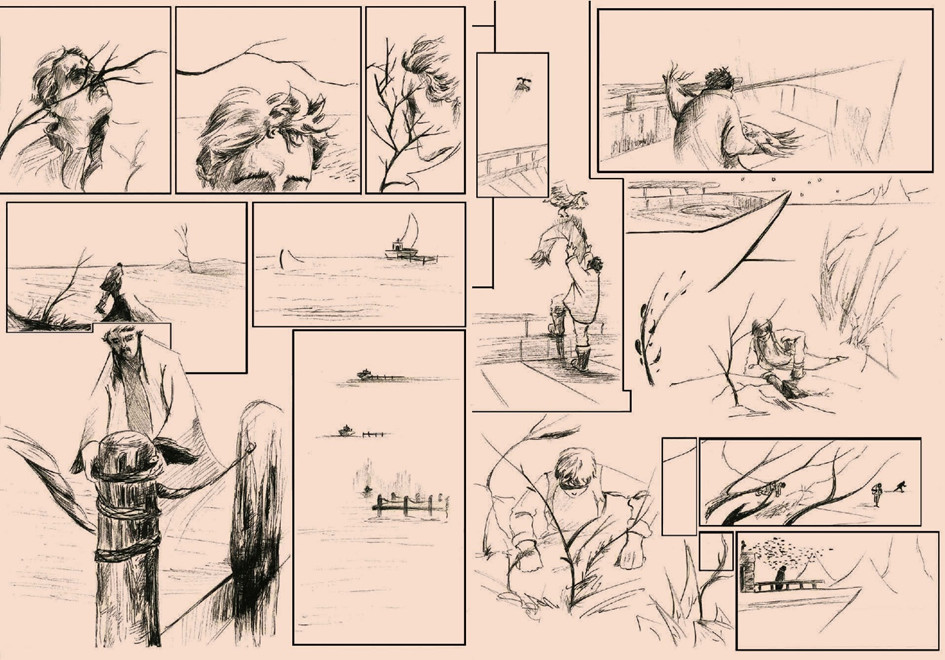
Some images need time. Some sequences need delay. Some feelings cannot be responsibly compressed into instant understanding. A silent comic does not prevent quick reading, but it rewards returning. A panel seen early in a sequence may only become important later. A repeated object may change meaning after several pages. A landscape may begin as setting and become memory, grief, or transformation.
That delayed recognition is one of the pleasures of wordless comics. A reader may not realise that an image has become important until it returns. The recognition happens later, almost physically: I have seen this before. But now it feels different.
This is why I think of slow reading not as a limitation but as a practice of care.
To read slowly is to allow the image not to be exhausted immediately. It is to give time to something that may not reveal itself all at once. It is to accept that looking is not the same as understanding, and that understanding may require patience.
A wordless comic asks something particular from its reader. It asks them not to rush.
This is not always easy. We live in a culture of fast images: scrolling, recognising, reacting, moving on. Many images are designed to be understood immediately because that is how they circulate most efficiently. A wordless comic offers another tempo. It does not refuse communication, but it refuses instant possession. It gives the reader access, but not complete mastery.
Silent comics teach this quietly. They do not lecture the reader about attention. They produce attention through form.
Care against industrial rhythm
The phrase “non-industrial comics” can mean many things: small press publishing, handmade production, independent distribution, experimental form. But I also think it describes a relationship to time.
Industrial rhythm wants repetition, speed, clarity, and output. It wants work that can be produced, packaged, explained, and circulated efficiently. There is nothing inherently wrong with clarity or circulation, but when these become the dominant values, more fragile forms of reading can disappear.
Silent comics resist this by asking for another kind of exchange.
They do not always announce themselves loudly. They may not offer an immediately marketable premise. They may not be easy to summarise. Their value is often located in duration, not spectacle.
A silent page can ask the reader to care about a small gesture. It can make atmosphere into narrative. It can treat a pause as an event. It can make absence visible without turning it into a slogan.
This is not nostalgia for a pure handmade past. Tools, reproduction, distribution, and technology have always shaped comics. The question is not whether comics should be “old” or “new”. The question is what kinds of attention different forms make possible.
Silent comics make possible an attention that is relational rather than extractive. They invite the reader to stay with what is unresolved.
Drawing as searching
When people see a finished comic, they often see the image before they see the labour of sequencing. But in wordless comics, sequencing is where much of the thinking happens.
A silent page cannot rely on a caption to fix a confusing transition. It cannot use dialogue to clarify a character’s emotional state. Every decision has to carry more weight: the size of a panel, the distance between figures, the direction of movement, the balance between action and pause, the repetition of a shape, the placement of white space.
This does not mean that every image must be perfectly clear. In fact, clarity can sometimes be the wrong goal. The question is not always, “Will the reader understand exactly what I mean?” Sometimes the better question is, “Will the reader feel invited to search?”
Drawing becomes a form of searching for me as well.
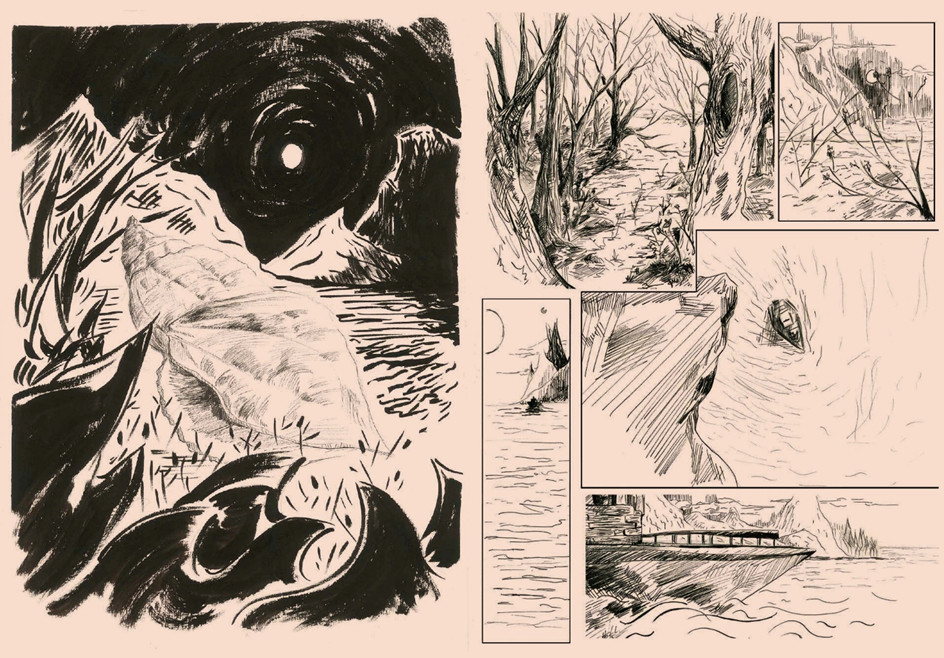
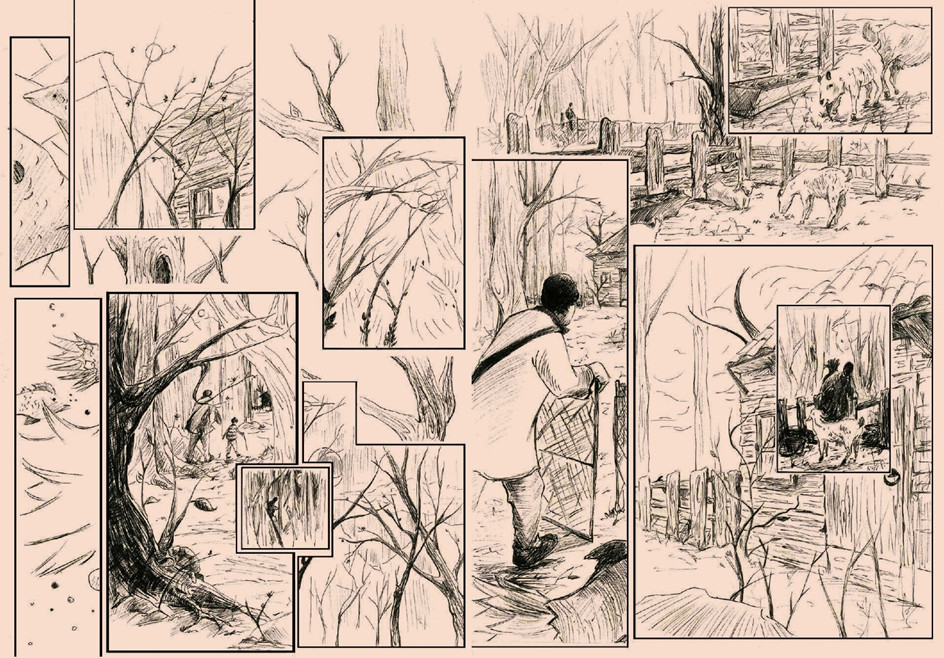
In my own non-verbal storytelling, including my wordless graphic novel Fishes May Come Back, I have often started not with a fully formed meaning, but with an atmosphere, a figure, an animal, or a recurring visual pressure I do not yet understand. Through drawing, arranging, removing, and redrawing, the sequence gradually reveals what it needs. The process is not simply execution. It is discovery.
This is one reason I resist thinking of illustration as only the production of images. Drawing can be a form of thought. It can move toward things that language reaches only later. In a wordless comic, the drawing is not there to decorate a story that already exists elsewhere. The drawing is where the story thinks.
A fish might suggest return, loss, submerged memory, or fragility. A bird might suggest distance, watching, departure, or protection. The sea might be passage, grief, openness, or uncertainty. None of these meanings needs to cancel the others. In a silent comic, an image can hold several possibilities at once.
That multiplicity is important, I think. When an image is over-explained, it can become smaller. It may still communicate, but it loses some of its capacity to remain with the reader. Silence, by contrast, can protect complexity. It gives the reader space to feel before naming.
Much of life is experienced before it is explained. Comics can honour that. A drawing can hold the moment before language arrives or the moment after language has failed. In wordless comics, these moments are not secondary to the story. They are the story.
What silence gives back
Silent comics are sometimes described as universal because they can be read across languages. There is truth in this, but I also think it can be misleading. Images are not simple or universal in any easy sense. They are shaped by culture, memory, experience, and context. A gesture may not mean the same thing to every reader. A symbol may open differently depending on who encounters it.
The strength of silent comics is not that they erase differences. It is that they allow different readers to enter the work without requiring every meaning to be fixed in advance.
The maker offers images. The reader brings memory, culture, emotion, and attention. Meaning happens somewhere between them. It is never entirely controlled by either side.
In contemporary visual culture, there is a strong pressure for images to become instantly readable. They are captioned, tagged, indexed, classified, and described. They circulate through platforms that reward quick recognition. Even outside platforms, we often ask images to explain themselves quickly: What is this? What does it mean? Why should I care?
A wordless comic can gently resist that demand.
Some images need to remain partially open. Some experiences should not be converted too quickly into explanation. Some forms of grief, memory, transformation, and ecological relation require silence, not because they are empty, but because they are too layered to close.
A reader may finish a wordless comic and still not be able to explain exactly what happened. But perhaps they remember the sea. A bird. A hand. A figure at a distance. A feeling of waiting. A sense that something was lost and something else may still return.
That kind of memory matters.
Comics do not always need to explain themselves in order to stay with us. Sometimes they remain because they withheld something. Sometimes they speak most clearly through what they leave unsaid.
A silent comic does not withhold words to create mystery for its own sake. It withholds them because the image, the sequence, and the reader’s attention can sometimes carry forms of meaning that explanation would flatten.
And in that waiting, another kind of reading becomes possible: slower, more careful, less industrial, and more intimate.
SOLRAD is made possible by the generous donations of readers like you. Support our Patreon campaign, or make a tax-deductible donation to our publisher, Fieldmouse Press, today.

Leave a Reply