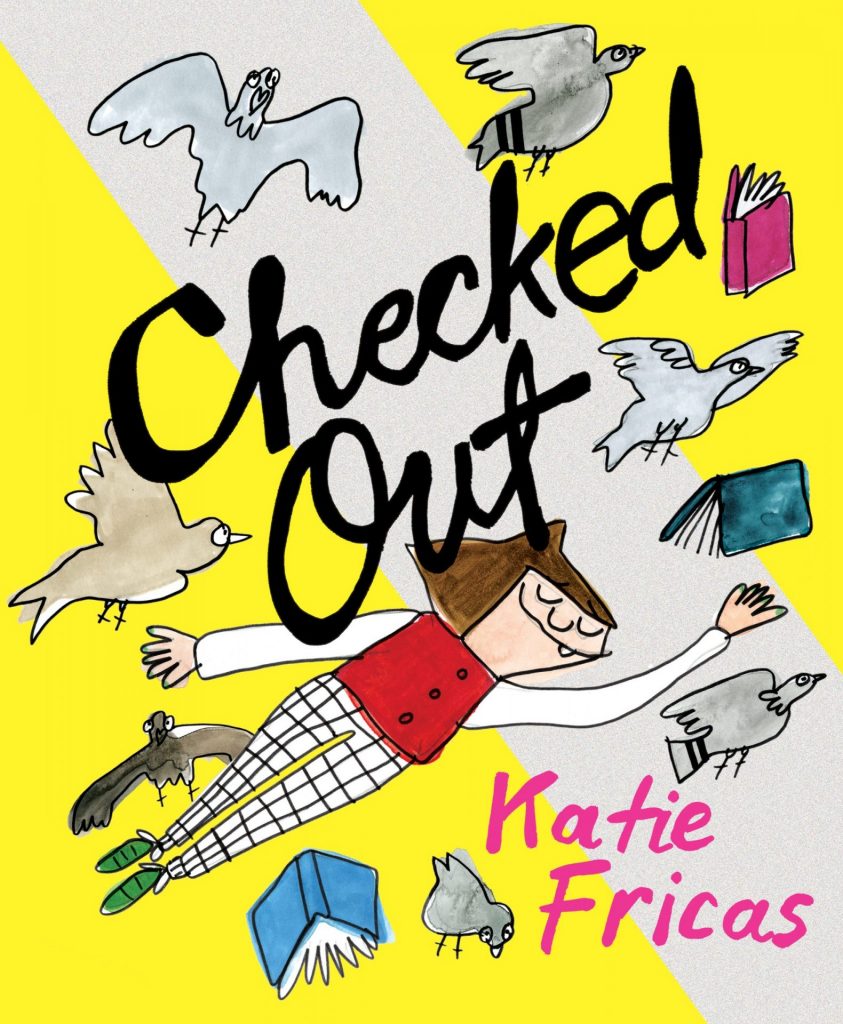
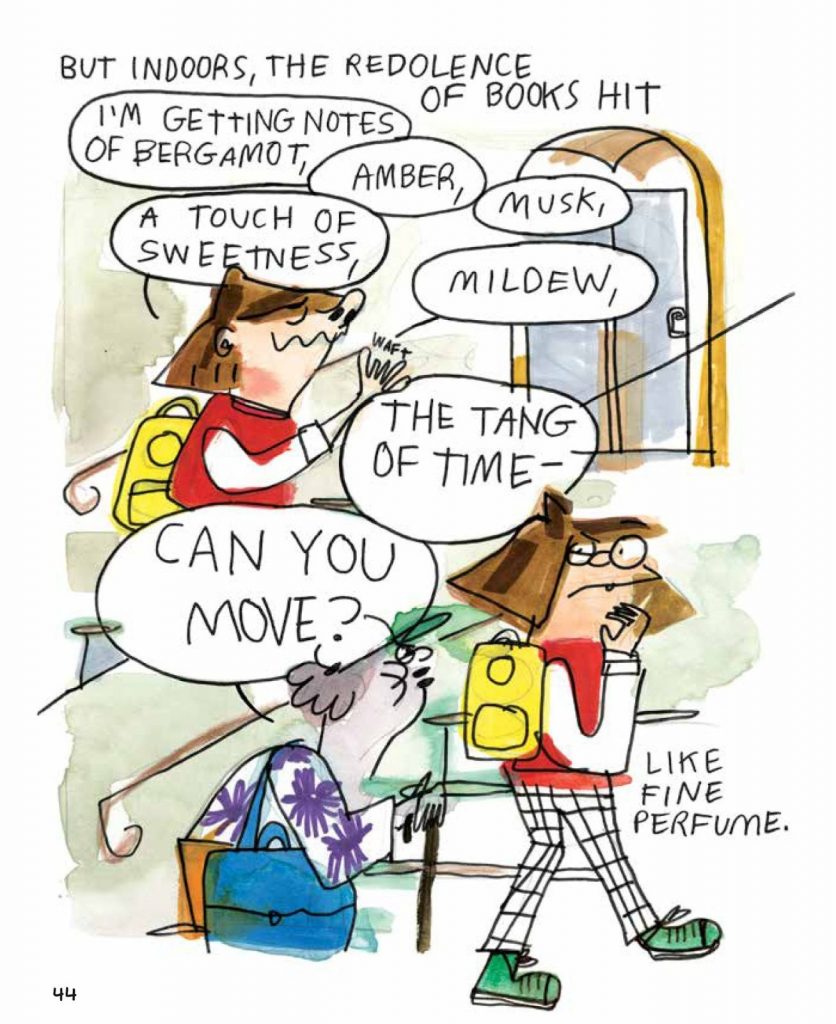
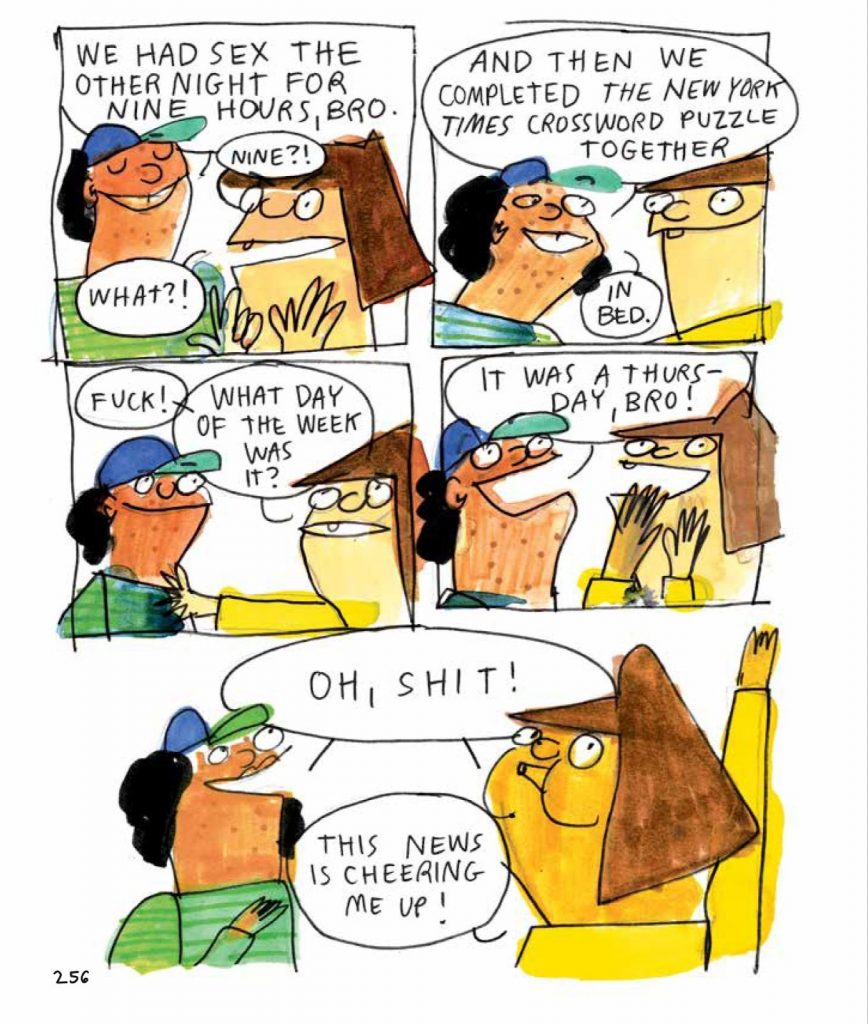
I don’t remember when I first discovered the comics of Katie Fricas, only that I loved her style from the moment I saw the cover of Checked Out, a graphic novel recently published by Drawn and Quarterly. Checked Out follows Lou, a queer cartoonist and library worker, as she tries to make a graphic novel about carrier pigeons in WWI while she also goes on a series of disastrous first dates in New York City. This debut is, hands down, my favorite graphic novel of 2025 (sorry to everyone else). I enjoy how you can see the pencil lines through the watercolors, the quirky shapes of each character, and the Roz Chast-esque depictions of the world around her. Fricas’ writing carries the story into a complete, satisfying arc. She has crafted a kunstlerroman, or artist’s novel, about the joy and struggle of comics of the highest order, the sort of book I look for in a comic book store. Checked Out brings everything I love about alternative comics to the table: great storytelling and unique drawing so expressive and authentic that every page feels so alive. In many ways, I feel Checked Out was written for me, someone who has been described by the library workers at my school as a “library person,” as well as a queer cartoonist working on a graphic novel.
Besides being an author and a library worker, Katie Fricas has published journalism-style essay comics for The Guardian, The New York Times, The LA Review of Books, and more. I was over the moon to get to speak to her (whose website, in her signature handwritten lettering, delightfully declares that she’s a cartoonist, and you’re not) over Zoom for over an hour about the process of making Checked Out, libraries, Jennifer Camper, her cat, and her comics origin story.
Lara Boyle: I love the hand-drawn style of Checked Out and how you could see the pencil lines through it. I was curious what inspired you to do it traditionally drawn as opposed to digital, and how did you find your style?
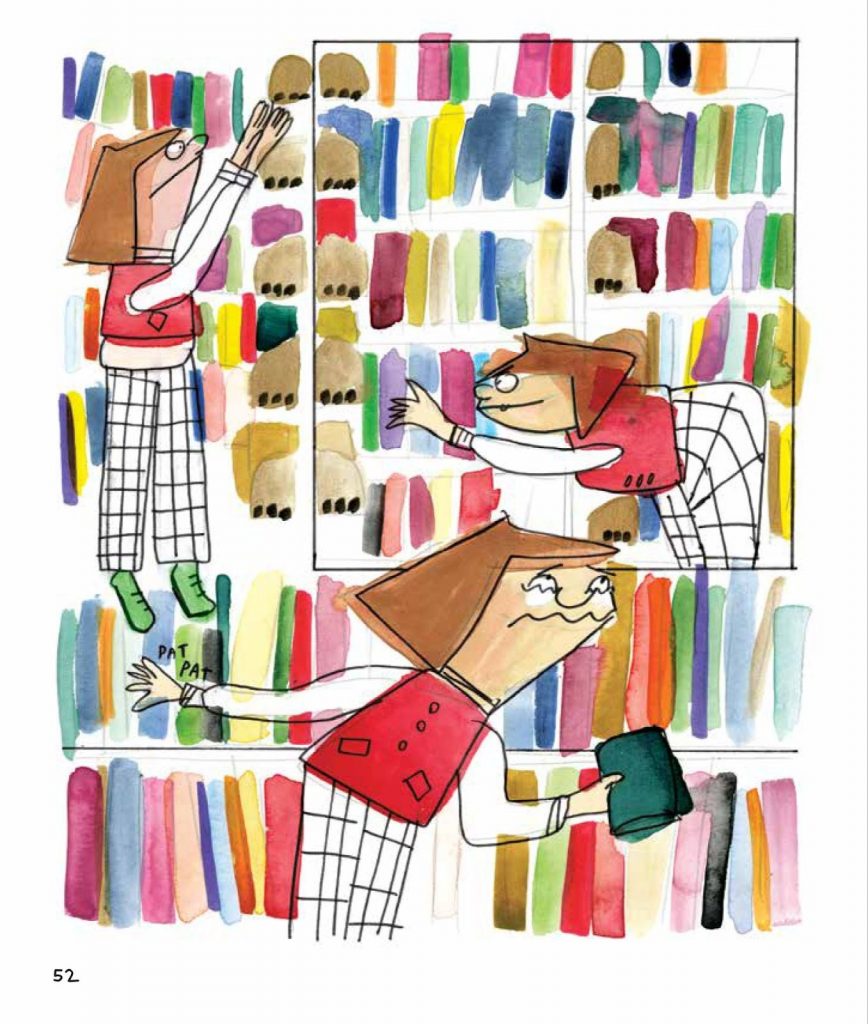
Katie Fricas: Yeah, I don’t work digitally. I try to avoid Photoshop as much as I can. So it was just natural to do it this way. I used to only do things in black and white and then just using micron pens and pencils on paper, but then I took a comics class at the 92nd Street Y maybe ten, twelve years ago, and I started using black ink with like a brush instead of a nib because I can be a little bit messy with just like getting out of my control, and from there I realized I liked painting, so the book is watercolor marker, and flair, like felt tip pens, from like Rite Aid or whatever, but I’m just super impatient so I like that watercolor dries fast and it just moves along with it. I think things really opened up for me once I started using a brush, but there is also marker, it’s copic markers, I have this whole thing here, and that helps keep these more vibrant.
How many pages does it take to get you to the final version?
I would say I drew each page at least five times. So I don’t mind messing up, I kind of leave it, but oftentimes there’s something about the composition, or the way that the drawing looks that I don’t like, and I have to keep starting over until I do, so the book is about 356 pages, but I drew maybe, I feel like I drew 1,500. So I would start just on printer paper and pencil, and I would use a light box and then use a nicer piece of paper over it, and then watercolor on top of that. So even if I only did a page like once, which was rare, it still involved drawing it a few times on the light box and stuff.
Do you keep a sketchbook or have a routine you do when you’re doing a long-form book?
Yeah. I have a sketchbook, and I have diaries, written diaries, all the way back from when I was like eight, so always kept diaries. I have this file cabinet that’s just full of all my journals, and I definitely consulted all of them when it came to writing this book just because I wanted to be a writer before I decided to do cartooning, and I’m pretty obsessed with making sure the writing is flowing and feeling the way I wanted it to. And that was really hard to come up with on the spot, so let me just pull things from stuff I’ve already written. So a lot of the book is, there are a lot of sentences or ideas in it from journals from years and years ago. But I definitely keep a sketchbook daily. I mean part of my problem is I don’t have any discipline so the sketchbook is sort of this play space I also have; I mean, I keep maybe four or five notebooks at a time. I have this sketchbook for drawing stuff that I see and keeping notes; I have a regular written diary, dear diary style; then I have another notebook that’s my business notebook where I keep pitches or lists or ideas or things that I need to remember, and I usually buy another sketchbook during all this stuff just because I have a stationary obsession, so, yes, I am constantly churning through an entire world of notebooks.
Are you particular about which type of sketchbook?
There’s this 5×8 landscape sketchbook. I have this little French notebook with nice smooth paper. I have this big kind of book long notebook from Barnes and Noble. I’m not too particular, but if I want to use watercolor, I have to get sketchbooks that can take watercolor.
Do you remember when you got the first idea for Checked Out and where it started for you?
Well, I worked in a library for fifteen years, and I love a workplace drama, anything that takes place in the service industry. I think I started doing Checked Out as mini episodes for this website Spiral Bound, I don’t think it exists anymore, but it’s a comics website, and I was doing that in 2018. I think I was just pitching a lot at that point. I realized that you can just email people your ideas and do articles and get them places, so I was emailing The New York Times, The Guardian, and all these places, and I was also emailing smaller indie comics outlets and stuff. So I think I just emailed Edith Zimmerman, who is the editor over there, that I wanted to do this comic about working in a library. I was just pulling from things that happened in the library. Also, the library is, you know, undergoing changes; libraries are under attack. I know that a lot of schools have eliminated their school libraries, so it felt sort of more than just being an autobiographical thing. Oh, there’s my cat (It was at this point that we reached my favorite part of Zoom interviewing cartoonists, which is when their pets come into the screen, and Katie Fricas’s cat, Fang, distracted me immediately. My ADHD went totally sidetracked). Well, that’s the classic move that cats do. Yeah, but, um, so I wanted to do something to kind of preserve library culture, just in case it goes away, or it changes drastically. Yeah.
I think you mentioned at one of your events that a lot of the characters were based on real people at the library. How did you know which characters would go in the book? Did you sketch while you were there, or did that kind of happen naturally?
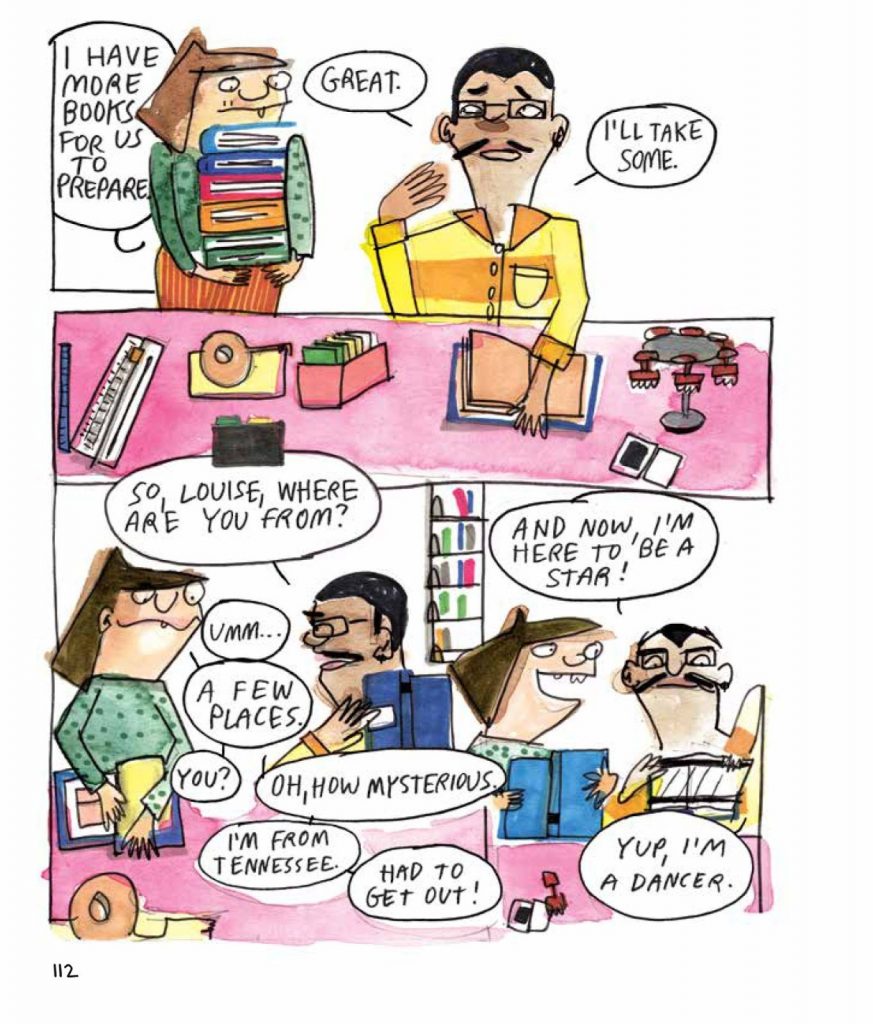
So the library where I work is this boutique-y library on the Upper East Side in New York City, so the clientele are people who live on the Upper East Side, kind of historically the one percent, but there are also a lot of elders who live up there, a lot of old New Yorkers, people who are naturally just full of hilarious things to say. So it was just, I mean, I overheard snippets of conversation and moments from everyday life, so I would definitely always remember when somebody said something hilarious. So I wanted to include a bunch of things that people had said to me over the years. There’s a scene in part two of the book where the main character, Louise, is starting to train at the circulation desk, and she’s starting to meet all of the library regulars. So I included four of the people that made a big impression on me and they’ve all passed away since the book came out or before the book came out, so I thought that was almost a cool tribute, too. And in a way, I didn’t have to worry about hurting anyone’s feelings, even though those particular characters don’t say anything weird. Or I didn’t have to worry about violating anyone’s privacy because they all passed away. There’s one person who always said really hilarious things that I didn’t put in the book. He’s a famous lawyer, he’s kind of well known in New York City and he is still alive, but he’s sort of a formidable guy. He would come into the library in this three-piece pinstriped suit, sometimes he would come in in his pajamas, and he really liked all of us who worked at the circulation desk, and he said that “he liked us all so much that we each get one murder”. So that’s one of my favorite things anyone ever said to me, but I was like, let me not mess with this guy. And so I didn’t put it in.
Did you outline or script the book before?
Yeah. I did. So when I proposed the book, I sent a formal proposal with all of the parts with my agent to a bunch of publishers, and you needed to include an outline, which is terrifying for me because I tend to work by grabbing random things and then collaging them together, but it did help me structure things. I wanted there to be an arc to the story. I wanted the characters to each undergo a change, or I wanted to make sure we knew what happened to each of the characters. I wanted to make sure that New York City was a character in the book, and so that necessitated something. So the outline that I sent ended up looking totally different than the book. I was sort of confusing myself just because there are a number of themes in the book, and I was having trouble braiding them together, so I pitched the book as sort of an episodic semi-memoir, but then it turned into one long narrative with a beginning, middle, and end. Or at least I hope it did. And that was helpful because, otherwise, it could have been just a meandering diary comic, which is fine, I actually love those too, but I wanted this to be, in my mind, I wanted it to loom large as a capital B Book. So I felt, yeah, I needed to get some control over the order and the pacing of things.
So you pitch it. Then how long did you have to make the book, and what was that process like?
Well, I think it’s different with every publisher. Drawn and Quarterly is incredible. They gave me seemingly as much time as I wanted. Some of my other cartoonist friends had like a very much more rigid schedule, and also I pitched the book at like 200 something pages and it went way over that and Drawn and Quarterly did not bat an eye at that. So that was really cool, especially because I’m a first-time author, but it took me five years. When they accepted my proposal and we talked about what it was going to look like to work on the book, I told them that I could finish it in six months, which was totally delusional. I think in my mind, I wanted to finish it in six months because it had been marinating for so long and I can be sort of manic in the way I work that I figured it could be possible. They sort of nodded and smiled like, “oh that would be nice”. At one point, we thought it was going to come out in 2023, but, yeah, it took five years. And it wasn’t five years of constant working on the book. There were chunks of weeks or even months where I didn’t touch it and I was guiltily torturing myself over it. So it’s funny because it’s not like having a traditional job where you just go in and you’re there all day. So a lot of the time, I felt like I was doing it wrong because I wasn’t doing that. I felt like I should be sitting at my desk from dawn to dusk. I did try, once I hit four years on it, and I had already talked about it to everybody, and everybody was like where’s the book? I tried a little more discipline. So I have this little kitchen timer, and I set it for increments of forty-five minutes, and I would make myself sit for the forty-five minutes with a ten-minute break three or four times a day, and it’s funny because working three hours a day is actually enough in some cases. Which also feels weird to say because I’ve always had a day job where I’m definitely not only there for three hours a day, so it was sort of a scatter brain process. Drawn and Quarterly kind of took the proposal when it was still very much in proposal phase, it was not a fleshed out book yet, I know that a lot of times when you’re pitching fiction, you have to have the whole thing done, but it was not the case. So I’m checking with my editor every few months to say Hi! Am I doing okay? And my editor there, Tracy Hurren, would say just keep going, just keep going, and we didn’t start editing it together until about four and a half years into it. So I was just sort of doing it by myself with the help of my friends until it was ready to show them. And part of that was because I was doing it out of order; it was really fragmented, so I didn’t know how to feed it to the editor in a way that would allow her to edit it. She’s like when does this happen? When does that happen? So they did help me sort of understand how to order it, but, yeah, it wasn’t even possible to read it the way that I was doing it until it was done.
What does editing look like for comics?
Well, I actually edit comics myself too, so I would say it’s a combination of the basic literary editing, where you’re looking at the words, you’re talking about the sentence flows, you’re talking about grammar, and continuity and style and all of that stuff, but then you kind of add those same elements to looking at the images. I think, I’ve worked with a lot of editors before where I pitched comics to outlets that don’t edit comics, and a lot of times, people don’t look at the pictures, or I think they feel, since you’ve already drawn and painted the whole page, they don’t want to give you edits because it would mean changing things, but I always have no problem changing the images as needed. I had an editor once at Hyperallergic, which is this art website, and I was doing these illustrated reviews of art shows, and she was really cool. Her name is Jillian Steinhauer, and she’s now doing reviews for The New York Times and stuff, but she was one of the first editors I had that actually paid attention to the pictures, too. So she noticed in one part I had mentioned this dress in an exhibit that had sequins on it, and her note was this dress doesn’t have sequins on it. They do so much. I felt like people hadn’t necessarily paid attention to that. Drawn and Quarterly, they’re complete pros. So they definitely knew about that dance that you achieve between words and pictures. I think it’s sort of dividing your attention between those two elements, but also having an eye for how they flow together. Sometimes I would draw something and it would be confusing, or I would draw something that I had already written, so either I could delete the text or remove the picture, you know, because those are sort of redundant, so there’s all these little things to look out for.
How did you find your style of breaking out of the traditional panel sequence, like I love how loose it is, and how long did that take you to develop?
It took me like thirty seconds to develop it because I can’t use a ruler, it was just not happening, so there was never a period where I was formally trained in doing comics. I basically learned to draw from kids’ books. There’s this artist, Ed Emberly, who does these drawing books for kids. It’s a book on how to draw dragons, and it’s all visual; there are no words on how it’s done. He just draws one thing, and he shows you how to add onto it from there. So I learned a lot from that. I definitely had to lean on other cartoonists and the way that they formatted their pages and did perspective and stuff. And I did a lot of copying. I mean there’s one image in the book where Louise throws a book up in the air and it’s an aerial shot of her in her bedroom with the book kind of up close to the camera, and there’s no way I could’ve figured out how to do that, but I had this Spongebob comic from Free Comic Book Day where he’s in his bedroom and it’s an aerial shot so I just used that and switched my characters into it. So I would say that mimicking had a lot to do with it. I was also doing a lot of nonfiction comics under deadline, and those needed to be completed quickly, so it helped to be really gestural with my lines. For this book, though, I wanted to make sure that even though it’s blocky, it still looked clear. Anywhere that there are actual panels in the book, you can pretty much be sure that I boosted it from someone else in comics. The other thing I did, oh yeah, I forgot about this, I looked through maybe ten of my favorite graphic novels, and I just did a sketch of some of the panel layouts that I liked, and then I had a practice notebook that I called The Checked Out style guide, and it included all of the character sketches, some of the plot, different colors that I wanted to use, and then it included these pages of sketched pencil sketched layouts and so I often consulted that when I needed help.
What are some of your favorite graphic novels that made that list?
Make Me A Woman by Vanessa Davis is one of my favorites. That one also doesn’t have any panels, but the flow to it is still really clear. I love Moomin by Tove Jansson. And I also like how some of her panels would be Moomin’s tale or a paintbrush, so the way that she sort of still used panels but made it whimsical. I thought that was cool. I keep talking about Diane DiMassa, who did Hothead Paison: Homicidal Lesbian Terrorist, which was formative for me. Her style was really scratchy and fueled by rage, and I felt a kinship with that, so I definitely looked to that. I’m trying to look around. Yeah, there are a bunch of people. Also Geneviève Castrée, who was on Drawn and Quarterly, she did a lot of really beautiful art. And her colors were always very striking to me. So that was another person.
Are you a fan of Roz Chast also because your work reminded me of her?
Yeah, absolutely. Oh, thank you. So Roz Chast, I work in the events department at my job, so we have authors come speak. Roz Chast came to the library to speak. I genuinely like to stay behind the scenes, but my coworkers were like, “oh Katie, you’re a cartoonist, would you want to introduce Roz Chast”? I actually did come out from the shadows to introduce Roz Chast and I’m glad I did because somebody in the crowd that night was like, “oh, Katie, we didn’t know you were a cartoonist” and that’s the person who ended up getting me my agent by recommending me to people, so I definitely have a soft spot in my heart for Roz Chast. And her facial expressions are so funny. Facial expressions are a big deal to me. I think formally in comics, you call it acting or whatever, I don’t know, I’ve never taken a formal comics university course or anything, but I do notice some people don’t do facial expressions, and I feel so weird about that. How could you not? It helps drive the story. I had a mirror on my desk, and I just used my own face, so a lot of the ways that the characters look in the book is just my face.
I love the shape that Louise has. I feel like it’s such an iconic shape. You mentioned children’s books as an influence. Does looking at their iconography kind of help inspire you?
Yeah, totally. So I was into The Berenstain Bears and there’s this one storyline in The Berenstain Bears where the brother and sister have to clean their room; it’s a huge mess and they do it, but the drawings are first of the messy room which I just love, the interior landscape, a kitchen, or a faucet or a bedroom, and then they get all these tupperware containers and they label them, and then they show the room clean, and so I was obsessed with those drawings, I loved seeing the room go from messy to clean in drawings. There’s this book called Gregory The Terrible Eater, which is about a goat who eats a bunch of trash, and so there’s piles and piles of garbage in it. So there’s a scene in Checked Out where Louise flushes herself down a toilet, and she’s, like, swimming through the sewer and there’s all this trash around. So I consulted that one because I was like, okay, apple core, tin can, more trash. I definitely looked to Gregory The Terrible Eater. But I think in terms of worldbuilding, children’s illustrators are just so good at that. I mean, I’m dying to break into children’s book illustration, I just don’t know the secret handshake or how to do that. That’s kind of a goal of mine.
Did you also have an obsession with the carrier pigeons or is that purely the fictional part of the book?
I did. So the character Louise in Checked Out is writing her own book, and it’s about this pigeon that saves a battalion of men in World War I, and before I was working on Checked Out, I was actually working on that book. So, for about ten years prior to working on Checked Out, I was researching pigeons and specifically this pigeon from World War I. That didn’t come from a real, genuine love of pigeons, it just kind of popped into my head that maybe I should start. I like to deep dive into random topics, which I think a lot of us do now, especially in the middle of the night when you can’t sleep, so I was just deep diving pigeons one day and this story of this bird that served in the U.S. Army came up. It received a medal from France for this heroic act. My dad was in the military and is a veteran of war, and so I think there was something about looking into military history that was sort of bugling up in this pigeon, and the pigeon was sort of a safe space to rummage around in that. But yeah, I mean, I went to the battlefields in France, I was reading Charles Darwin, who writes a lot about pigeons. I was doing all kinds of research about this, but I couldn’t get past a certain part of the story. I felt like I was drawing the same scene over and over and over again. So I was like, oh, let me make up a backstory for this pigeon that’s totally unique, but then that started to feel sort of disrespectful in a way because the pigeon wasn’t vetted with these troops in World War I and a lot of them were coming from Long Island, and I was like well there’s people who are related to or were in this and I don’t know that I’m being a good historian, so there were a number of factors that caused me to abandon that.
Was that your first attempt at a full-length graphic novel? Or was there one before?
That’s a good question. Um, I guess it was my first attempt. I mean I had been doing comics before that, but they were mostly shortform, nonfiction essay comics, doing some political things, like I went to protest the 2016 Republican National Convention in Cleveland and did a comic about what was going outside of the convention center, and for Hyperallergic I was going to art shows that involved a lot of moving parts, performances or fashion shows at The Met Costume Gala and illustrated reviews of those in a way to preserve the art show you know because when they’re taken down it’s over. I went to this play, Trinkets, which is about queer sex workers in the 90s, and I did a comic about Trinkets, so I was just doing shortform stuff. The thing is, ever since I was a little kid, I wanted to write a book, or I wanted to write a lot of books. I wanted to be a writer, and, so, yeah, I guess Cher Amie was my first attempt at doing a graphic novel, that’s kind of blowing my mind to think about.
What drew you into comics as a medium, since you said you wanted to be a writer, and how did you evolve into making comics?
Well, I went to college in the year 2000, and that was sort of an explosion of underground comics at that time, or a new explosion. Daniel Clowes and all these kinds of people that are considered sort of legendary in the underground comics world were producing their work at that time. So I was exposed through underground comics in the sense that I was never interested in superheroes or anything like that. I didn’t think it would even apply to me to look at comics. I looked at cartoons on TV when I was a kid, but, yeah, I took a trip to San Francisco with my first girlfriend in the early 2000’s and we went to all these used bookstores and we just, there were all these boxes and boxes of comics by women and dykes and stuff from the 70s and 80s, like Lee Marrs who does Pudge, Girl, Blimp, and that’s where I saw Diane DiMassa. I saw work by Jennifer Camper, who is now sort of a mentor to me, and one thing I like about underground comics is that the bar is low in terms of entry; you can just go up to people that you like at conventions and talk to them, and I found such camaraderie in the queer comics community specifically. Jennifer Camper does this conference called Queers & Comics. She’s done three iterations, I don’t know if she’s gonna do another one, but she pulls together all of these queer cartoonists from all over the world and has them do panels for three days talking about all aspects of comics and that was really formative for a lot of us to see that there is this driving queer comics renaissance, so I definitely have to say I didn’t realize that comics were for me until the gays stepped in and showed me that they were.
How did you find a comics community when you were just getting started?
Well, I started going to underground comics conventions. I moved to New York City in 2006. The MoCCA fest was being put on at that time. It was The Museum of Comics and Cartoon Art, that’s what MoCCA stood for. It’s currently put on by a different organization, The Society of Illustrators, but there was a museum called The Museum of Comics and Cartoon Art in SoHo. It was this second-floor little museum. So they would put on the MoCCA fest. I took a class there from Fly, who is this Lower East Side cartoonist and activist in New York City, and she was doing a class on how to make comics. I had just started reading all these queer comics, so I was like, oh let me give this a try. I went to the MoCCA fest a few times as a spectator, um, Jennifer Camper was actually exhibiting at the MoCCA fest. She had actually come out with an anthology called Juicy Mother. Juicy Mother was a collection of comics by queer cartoonists, and I had heard that she was doing a second issue, so I just went up to her and introduced myself and asked her if she was still taking submissions. I think the submissions were closed and she wasn’t, but I just sent her a submission anyway because I’m a Scorpio and a complete fanatic, so I just ignored what she said and she didn’t know me at all but she accepted it. So that really helped to build my confidence. I was also really kind of enmeshed in zine culture from the 90s. Michelle Tea, who is this queer author in San Francisco, was putting on this queer roadshow called Sister Spit and I was kind of tuned into Sister Spit. They’re still going or they were still going until recently. That was sort of this forum in the 90s for me in New York, or not even, in the early 2000s, I was in New York. That was where I heard about a bunch of artists. So I actually submitted a comic to her too because this was in 2007, because she was doing a book called Baby Remember My Name, it was an anthology of new queer girl writing, and she accepted three cartoonists and the rest was all prose, so she took my comic and the other people in there were Nicole Georges and Cristy Road, so I feel like there’s this, there’s a very welcoming kind of feeling to communities because a lot of us are queer, a lot of us have our chosen families, and we’ve had to help each other through all kinds of things, and that definitely extends to our art making.
Do you have a favorite convention that you’ve been to?
Yeah. I would say that Short Run in Seattle is my favorite convention. Short Run is incredible. It’s a one day convention, but they have workshops and fundraising efforts all year. Sorry, I keep mentioning Jennifer Camper, but my sister lived in Seattle for eighteen years, and I was going to stay with her for a little while and Jenn put me in touch with Kelly Froh who is the executive director of Short Run just to be like, hey, you guys should hang out when you’re over there, so Kelly was really supportive. They do a comics residency for anyone who’s not a cis man, that’s called Trailer Blaze, and it takes place at this vintage trailer park where all these airstreams have been kitted out with cute interior designs, and it’s this beautiful romantic location on the Olympic Peninsula in Washington State. So I got invited to go on Trailer Blaze, and I’ve just never experienced a more supportive convention than Short Run.
Speaking of Jennifer Camper, how has she influenced your career, and what drew you to her work?
Well, I mean, Jennifer Camper’s hilarious. And she was working in high contrast black and white, so I definitely think I was kind of mimicking her stuff. She has this book called SubGurlz, and it’s these badass women with spikey hair and switch blades, and they’re having sex, and they’re having fun. Jenn was very much in the mix with Alison Bechdel and Dianne DiMassa and Howard Cruse, who passed away recently, wrote Stuck Rubber Baby, which is this major queer comics text, and he was her mentor. So I just was really a fan of Jenn’s work. And she’s just been a guiding force for me. She would always come over and be like, “I like what you’re doing, but are you using archival materials”? To this day, she’s like, “Is that archival”? And I don’t think that the flair pen is archival. But she would always have these practical concerns for me to think about. She’s also a graphic designer, so she’s always there if I have a PhotoShop question. And she’s my neighbor, so we spend holidays together. We started out just kind of being in the mix with a bunch of queer cartoonists in New York City, and then we became friends. And she’s currently working on a big giant book, and I’m really excited for it. But she has sort of been like my practical anchor through all of this. I remember she came over to see how I was doing on the book once, and my papers were all over the place, it was like this huge wreck, and she was like how are you doing this? What are you doing? Are you feeling your way through the story? I was like Yeah, I guess I am. She’ll sometimes be like I’m doing my comics like you now, she’s very much a planner, which you can see in her comics because they’re very funny and crisp and precise, but I think we’re sort of influencing each other at this point, so that’s really cool.
Do you have a favorite place in New York City to draw?
Well, I like drawing in diners. A lot of them are open 24 hours, so if you just keep your cup of coffee going, you can kind of stay awhile. So I used to draw with a group of friends in diners. Since the pandemic, I haven’t been drawing too much in public. My favorite place to draw in New York City now is to draw in Coney Island. I’m so obsessed with Coney Island, she’s my muse, this amusement park out here. When I was little, my parents would take me to this little amusement park called Whalom in Massachusetts. It’s since been torn down, but it was this rinky-dink amusement park and I’ve always been really interested in folk art or art you can tell people were self-taught in making, like vintage signs, and bright colors, so just anything that looks like an old-timey amusement park, I’m there. I was recently driving across the country, and I saw this sign in Wisconsin that was the Barnum and Bailey Circus Museum, so I think circus imagery, strangely enough, or amusement park imagery, especially because the rides feature hand-painted art and it’s technically kind of bad, but I think it’s amazing. There’s a freakshow in Coney Island which sounds like it could be problematic, and it might be, but they have all these circus paintings on canvas that are hanging outside, and I love it. So Coney Island is definitely my favorite site to draw.
I know you mentioned The Met. Do you have a favorite art museum that you tend to go to?
Oh, that’s cool. Have you ever heard of the Visionary Art Museum? It’s in Baltimore. Or The AVAM. The American Visionary Art Museum. So that’s a museum that’s dedicated to folk art. I loved it when I went there. It’s high kitsch Americana and pink poodle sculpture there. They put on really interesting and good shows. It’s cool that we have a queer gallery, I mean the Leslie-Lohman gallery puts on a lot of cool shows. I saw a Barbara Hammer show there, who is the artist who, I don’t know if you’ve ever seen that postcard that’s like I want a dyke for president, there’s a poem that has that, the poem’s not by her, but she did some imagery for that. And I used to go to the American Folk Art Museum a lot. I haven’t been there in a while. I should go again, but that’s in New York. And I mean, I grew up moving around a lot, and my parents were always taking us sightseeing, so there was a period where I lived right outside of Washington D.C. and I really liked the Smithsonian. They were all free, and there’s an art museum, there was the museum of space or whatever, and I think it’s just The Smithsonian Museum of American Art or something, but really cool. They actually have the body of Cher Amie really stuffed on display there. And so I went to see that. But it’s right next to this, or it used to be right next to this exact replica of Julia Childs’ kitchen, so I really like The Smithsonian.
What advice would you have wanted to hear when you were starting out?
I guess my advice would be, there’s all different subcultures to cartooning. I guess I would say, if you find yourself in the company of a bunch of people who you don’t vibe with, or who are making you feel weird about your art or the way you do it, you should get away from them. There was a period where I was, because I tend not to be around a lot of a faction of these cishet hipster men cartoonists, and there was a period where I found myself in the same circles with them and I was comparing myself to them or feeling like they made more sales than me at conventions, and it was helpful in the sense that it helped me to up my confidence, but there was something that was happening that I felt I wasn’t doing something right. Especially because they were talking about the way things should be done. I think if someone’s saying how something should be done, and it doesn’t resonate with you, run. The other thing is, I don’t think there’s any need to go to a convention or table at a convention that charges a lot of money for the tables. I’ve been to conventions where I’ve literally made zero dollars. Conventions can be great for networking and learning about other people’s art and forming community, but I wouldn’t put too much pressure on yourself for how well monetarily you do at a convention. I think it’s best, if there’s a convention that you want to go to that seems tiny and stuff, but if the table fee is four hundred dollars, skip it.
—————————–
Checked Out is a narrative about an artist and how her life and environment cannot be separated from the story she tells. The protagonist searches for herself in her work and decides that in order to move forward, she has to abandon the past. Though she’s haunted by the untold narrative of the carrier pigeon, Lou understands she must let go of the myth in order to find a truer version of the story and herself. This is a story about how intuition can guide us toward our most authentic selves. And unearthing that deeper truth beneath the surface of another can be a liberating experience, especially if it’s a story the world has tried to silence or suppress. Like New York City, comics have become a harbor for outcasts, the othered, the oppressed. Making a graphic novel can be an isolating task, but finding community helps carry us through the process.
“It’s true–books are ghosts,” Fricas writes in Checked Out. “I feel their presence all around me.” If Checked Out were a ghost, its presence is an utter delight, the sort of friendly spirit who would help you find the perfect library book or make sure you return it on time.
This is a comic you want to be haunted by.
SOLRAD is made possible by the generous donations of readers like you. Support our Patreon campaign, or make a tax-deductible donation to our publisher, Fieldmouse Press, today.
Leave a Reply