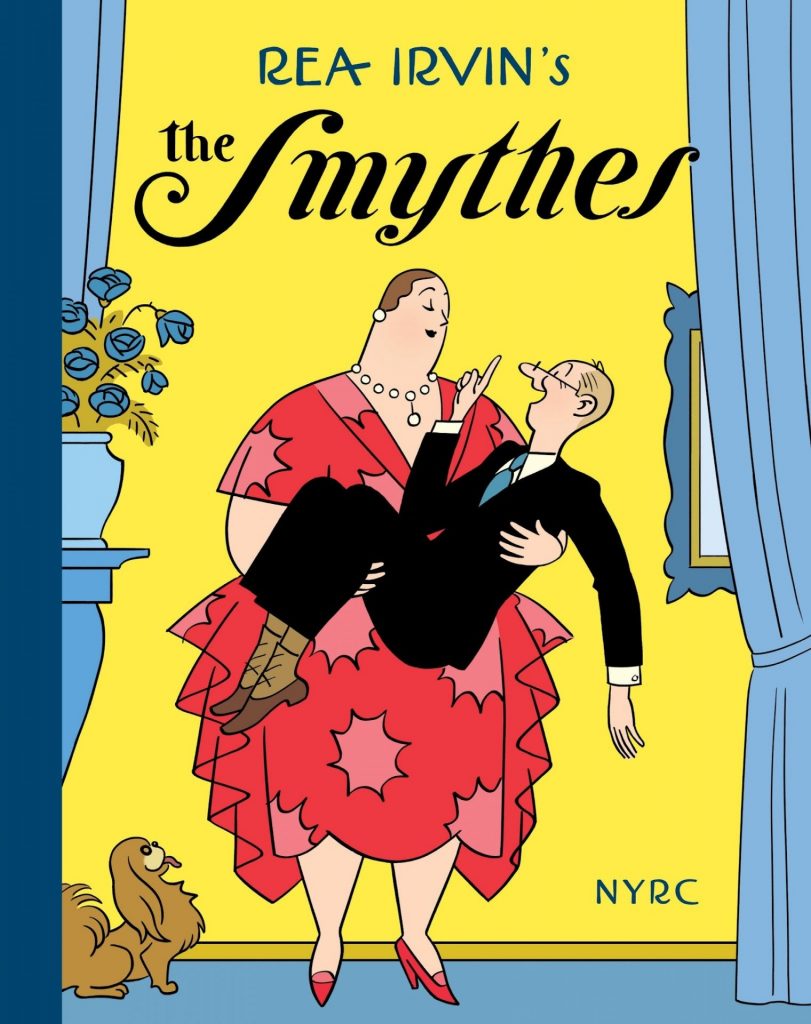
The cover of The Smythes, the first-ever collection of Rea Irvin’s 1930s newspaper strip, published last year by New York Review Comics, offers a mild cognitive dissonance: on the front cover, the two main characters, the married couple John and Margie Smythe, are in a playful but telling position, the lean and nebbishy insurance salesman cradled in the arms of his zaftig wife; on the back, in the living room, their daughter tries to play the piano while her younger brother runs around in a frenzy, sending furniture and papers flying all over. The cover is perfectly reflective of the family’s dynamics (even if it overplays, somewhat, the importance of the kids), but not, purely speaking, of the strip itself: its colors are bright and solid, the lines rendered in rich brush-strokes; open the book, and you’ll find colors that are sun-bleached by comparison, and lines that are thinner and sharper.
For this, there’s an obvious reason: the cover itself was drawn not by Irvin but by R. Kikuo Johnson — who also edited the collection together with Dash Shaw — after Irvin’s style. This melding of past and present, not altogether reminiscent of Seth’s highly-contentious designs of reprints of John Stanley or Doug Wright, is not intended as a misrepresentation, per se, but as a statement: cartoonists serve as their own informal archivists, historians, and scholars; the art-form and its practitioners are their own DNA. Co-editors Johnson and Shaw, then, are the latest link in a chain of tradition: Fantagraphics’ reprints of Nancy used clippings from the private collection of Daniel Clowes; Drawn and Quarterly’s Walt and Skeezix hardcovers drew from the collection of Joe Matt.
In her biographical essay on Irvin, supplementing the book and accompanied by an extensive gallery section, historian Caitlin McGurk quotes an exchange between Irvin and The New Yorker founding editor Harold Ross, wherein Ross said to Irvin, “Does it seem funny to you, Irvin, that two fellows like us, from the west and without a formal education, should be getting out a sophisticated magazine like The New Yorker?” Though Irvin’s life and career had from a young age given him a taste for worldly adventure, at the heart of The Smythes is a sentiment reflective of that question: a sentiment best described as sophisticate impostor syndrome.
As a protagonist, John Smythe can be seen as an inverse of Bringing Up Father’s Jiggs — where McManus’ immigrant-turned-millionaire retained his poor man’s sensibilities and tastes, Smythe is forever in pursuit of the appearance of refinement and forever falling short, often because of a mildly misanthropic conviction that he knows better than everyone around him. As such, it is usually John who serves as the punchline, whether because of his kneejerk hostility or his total lack of self-awareness: in one strip, he insists on serving his guests a new beverage his wife Margie has taken to making, not because it is good but because it is disgusting and he wants to be relieved of his hosting duties; in another, he mocks Margie for wanting to vote for a certain political candidate just because of his handsome looks, and indeed he soon finds his own preferred candidate on the strengths of his platform — said candidate is canvassing on the street, and when John asks him questions the candidate simply turns them around to John, waiting for John to feed him the answers and then complimenting him with couldn’t-have-said-it-better-myself platitudes, perfectly fooling John because both men are equally hollow.
Margie, by contrast, settles into the role of the rich socialite far more naturally, maintaining a multitude of hobbies and compensating for John’s lack of assertiveness: when an employee about to be fired swindles him by offering to buy his insurance office, turning the tables and turning John from the manager into the meek office worker, it is Margie who has to swoop in — becoming the new boss in the process; when a burglar breaks into the Smythe house, it’s Margie who matter-of-factly disarms him while John trembles in fear (and, later, steals her credit from her).
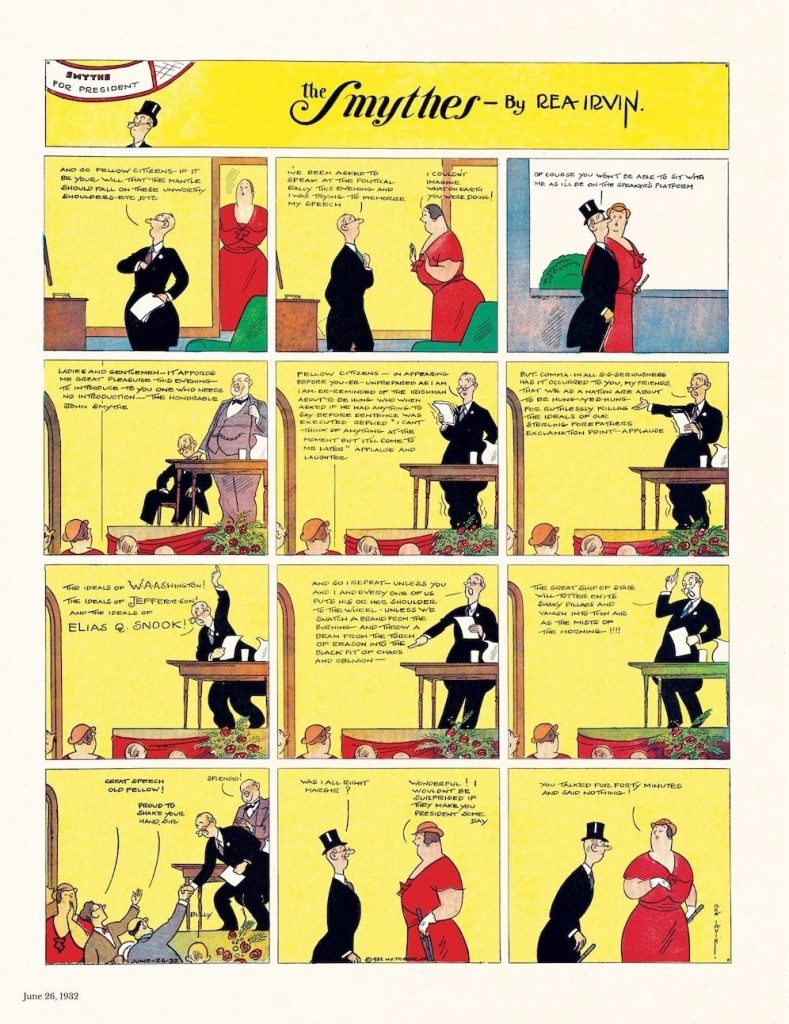
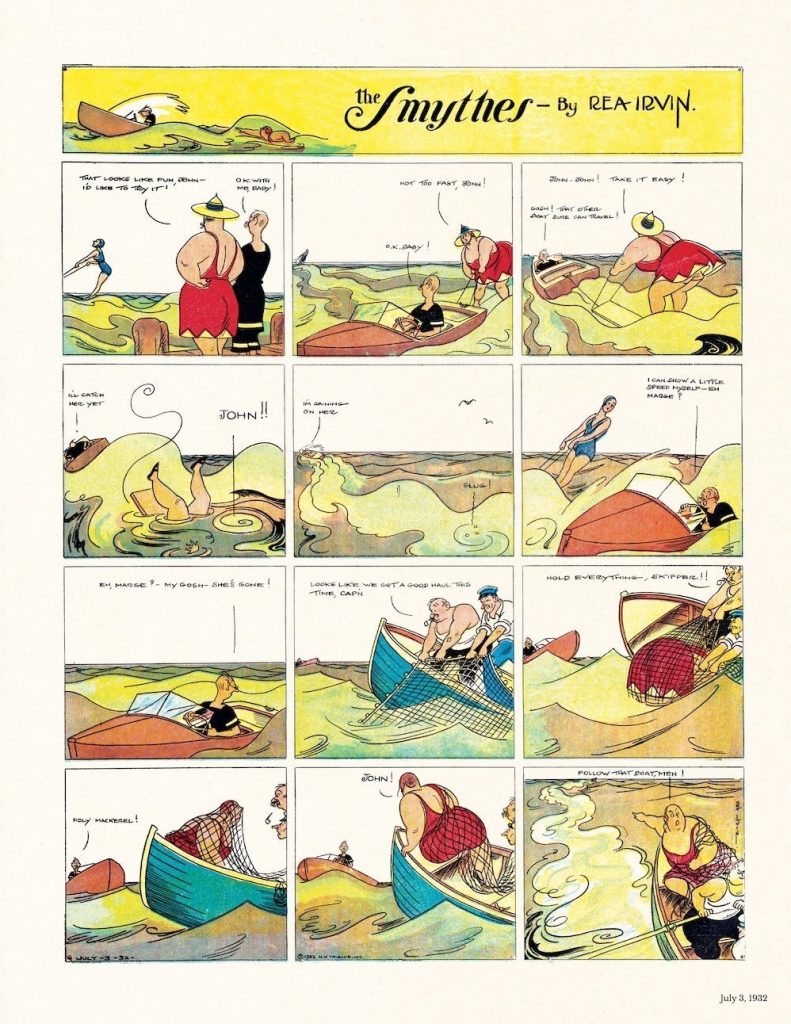
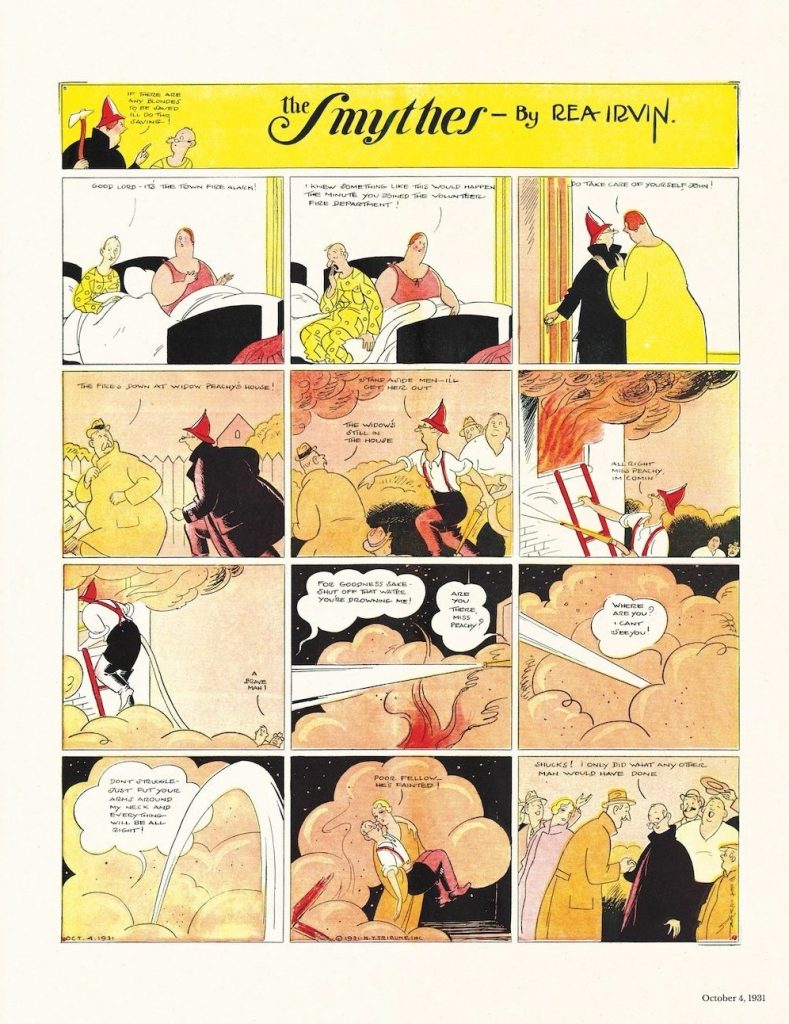
As a cartoonist, Rea Irvin is easily comparable to Frank King. His linework is crisp and measured, with careful set-pieces contrasted by the ‘warmth’ of curvilinear figure work. Like King in many Gasoline Alley Sunday strips, Irvin adheres to a rigorous twelve-panel grid, with panels only occasionally merged horizontally (never vertically — the only time Irvin breaks from his four-tier delineation is for a cleverly uncharacteristic slapstick gag wherein John is physically blown diagonally from the far-left panel of one tier to the far-right panel of the tier above it); like King, he favors neutral angles that are repeated throughout a given strip in a way more evocative of the stage than of film. The latter habit is a great help in more physical gags, as the space around the gag is fixed and defined; for example, take the strip published on April 12th, 1931, wherein Margie is trying to wake John up: as he falls back asleep, John dreams that he is doing his morning exercise, which “saves” him time in getting ready when he does get up. It’s a charming bit of choreography, the exercise sequence superimposed semi-transparently over the shot of John lying in bed. Irvin generally shines brightest when a drawing involves movement: see the sequences of Margie’s interpretive dance class on February 1st, 1931, with all the dancers’ gowns flowing in the air, or the lakewater on July 3rd, 1932 — Irvin’s very line seems to come alive and swell with energy in these moments.
And yet, as is often the case, a comparison is not an aid but a burden. A single strip, from May 8th, 1932, demonstrates exactly where Irvin diverges from King: it’s a lovely spring day, and Margie suggests that the whole family go on a picnic; out to the car they go, and drive to a nice, isolated spot in the woods. The spot is nice precisely because it is isolated, giving the Smythe family peace and privacy, but very soon the rest of the world has the same idea for a spring day’s pastime, and the Smythes are positively encroached upon, smothered by the crowds. It’s a well-executed gag, with more and more people crowding the shot from one panel to the next, but it also brings to mind the recurring thread of nature and hiking strips in Gasoline Alley — the difference being that, where Walt uses these excursions to teach Skeezix about life and the world at large, the Smythes learn very little indeed.
Gasoline Alley, of course, is a properly narrative strip; King cared about his characters’ lives and interiority, and his writerly approach was imbued, for better or worse, with a distinct romance for life. The approach of The Smythes, by comparison, centers the individual strip as a largely standalone unit; to be sure, there are recurring motifs that intensify over time, but each strip is more a comedy sketch than a dramatic progression, and Margie and John (certainly their kids, who could go for months without appearing at all) are more Vaudevillesque types than proper characters. As is the case with many newspaper strips, through no fault of the material itself, this sense of stasis, although satisfying when spread out over the course of several years, becomes almost oppressive when viewed in such concentrated doses.
As the strip progresses, this stasis on the dramatic level finds its counterpart on the political level as well. The Smythes, it should be noted, started in June of 1930 — just a few months after the 1929 Wall Street crash, the long-term ramifications of which began to assert themselves soon into the strip’s six-year run. Irvin’s initial intent — to wryly remark on the way the ‘new money’ of the Roaring Twenties (young, hip, trendy) wished, and often failed, to distinguish itself from the ‘old money’ of previous generations (stifled, out of touch) — was sabotaged by the reality around him. The dilemma faced by Irvin’s strip, then, is not at all dissimilar from that of Takano Fumiko’s Miss Ruki, which NYRC released in translation just a few months before their reprint of The Smythes: the extent to which changing real-world conditions should affect the artist’s comedic formula. By using the worsening economic conditions of the early ‘30s as setups for jokes, Irvin tries — and mostly succeeds — to have his cake and eat it too: “we must economize in every way these days,” says John to Margie on November 8th, 1931, and later on in the same strip she comes to him with the great news that she “saved a lot of money today” (by buying a seven-hundred-dollar coat for five hundred dollars); a few months later, John and Margie visit their safe deposit box at the bank, which has been emptied of securities but John continues to pay the rent for anyway, using it to store his pipe cleaners.
That the reader only rarely sees any active deterioration in the Smythes’ lifestyle1 works in Irvin’s favor — past a certain digit-count, money is such an abstract concept that the idea of ‘saving’ becomes foreign, and a riches-to-rags story isn’t quite as funny as the knowledge that the out-of-touch are beyond help. (The bourgeois mindset, it merits noting, does get the best of Irvin, on occasion, as the notion of leftist politics becomes synonymous with disorderly conduct or with plain mooching: see the communist street-speaker on November 27th, 1932, who pretends to take an interest in John just so he can follow him home for a free meal.)
A memory: when I was a kid, my parents had a couple of friends who were, to put it mildly, rather wealthy; the wife was caring but often out of touch, and the husband was one of the stingiest and most obnoxious people one is likely to ever meet. One evening, my mother got a call from the wife, asking if we would like their old “flat-screen TV,” as they were upgrading to a newer model; my mother happily said yes, and we got into the car and drove about thirty minutes to their house. When we arrived, my mother’s friend brought down a bulky, rather inelegant CRT model. “Didn’t you say a flat-screen?” I asked, confused, and she replied, affronted, “Yes! Can’t you see that the glass on the screen is flatter than normal?” She paused for a moment, then, on realizing, asked, “What, did you think I meant I’d give you a thin-screen TV for free?”
I think about these people, now, as I read The Smythes. To Rea Irvin’s credit, what’s frustrating in four years of comics is even more perplexing over ninety-odd years of real life: some things — some people, some types — never do change.
- Though the strip continued into 1936, co-editors Johnson and Shaw choose to end the main part of the collection in July of 1934; one strip from August of that same year appears in the supplementary gallery section, wherein Margie is depicted in housewife’s clothes, broom in hand, the cleaners and house staff having already been dismissed for good. ↩︎
SOLRAD is made possible by the generous donations of readers like you. Support our Patreon campaign, or make a tax-deductible donation to our publisher, Fieldmouse Press, today.
Leave a Reply