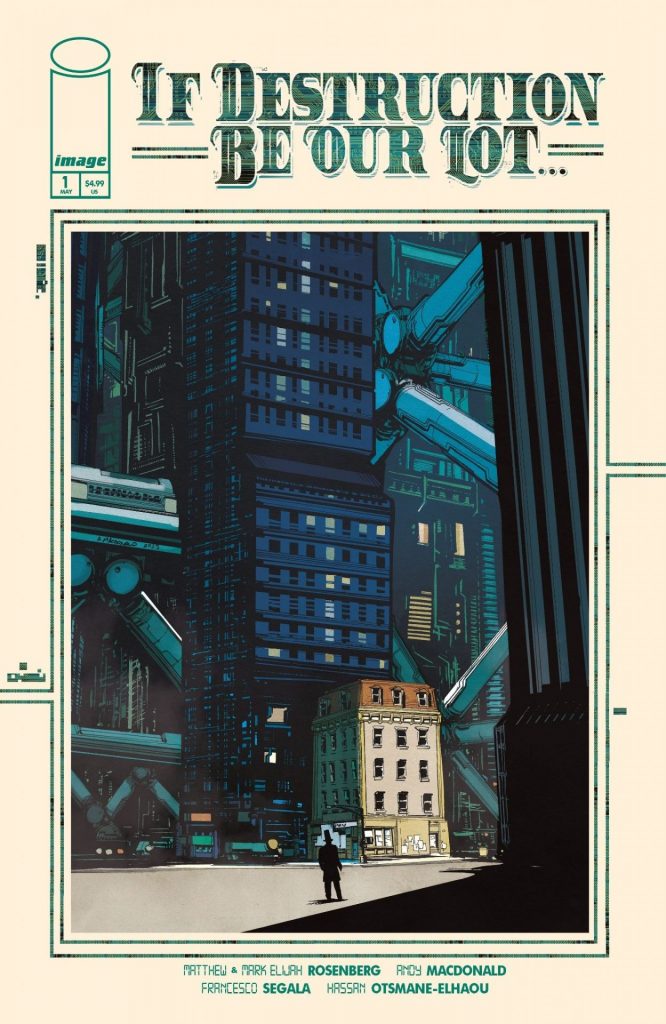
The future is a fine place, and worth fighting for. In If Destruction be Our Lot… by Andy MacDonald and Mark Elijah Rosenberg and Matthew Rosenberg, we follow an animatronic Abe Lincoln through a post-apocalyptic America where only tech survives; wherein the creators explore the idea of how history and purpose intersect to steer us in the right or the wrong direction, depending on how those two elements are considered and actioned. The comic creates an argument that history is to be remembered, learned from, and its echoes constantly battled through knowledge. Purpose is positioned at the forefront of existence as something that needs to align with humanity, care, and the fight against decay, which, it feels sad to admit, might just be part of the entropy of life, but acceptance is the first step to addressing this problem.
Specifically, all of this is centred through an American lens and is itself deeply about America. There is an anger about the misunderstanding and mishandling of America’s past beneath the surface of sci-fi conventions and delightfully comedic small moments. There is also hope that when people see these problems of being uninformed and not caring about the actual people around them, they can be fought against by those who quite simply strive to be the opposite: informed and caring.
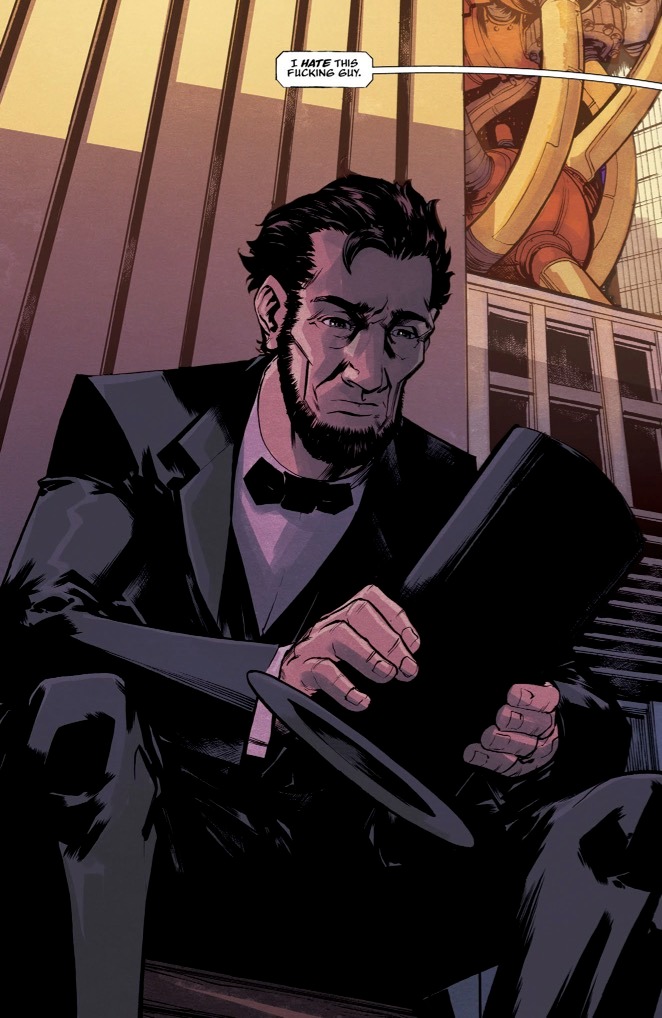
The book opens on the animatronic of Abe Lincoln. Pensive, reflective, cast in shadow. A voice off panel states, “I hate this fucking guy.” It’s difficult not to feel for Abe, but also to dislike the voice, as this is America’s most popular President of all time, according to recent YouGov data. Who could hold such vitriol for this man, or this simulacrum of this man?
There are probably two answers to consider to inform further reading of this comic. There’s the divide in America [broadly stated, lazily applied here by this external reader/writer] and the consideration that Abe represents a push against racism, against slavery, and a push towards governing with ethics and morals and towards a greater difficult good. It seems like a truism to set him up so gloriously and without possible fault, but when the opposition continues to fly the Confederate Flag, it makes this binary division feel more real and fair. So the book is already positioning us to consider this divide and to centre Abe as the sympathetic lead.
But there’s another angle, and one that opens the book to a more specific focus of analysis and which grounds it very much in the now. We sometimes ask ourselves, why tell this story now? Right? Well, the page turn here reveals a bunch of other robots, all looking variously robotic, dehumanised, metallic, etc. The idea that our technology might be trending towards hating [pick one or more]: the past, moral stances against racism, inspiring leadership from humans, being informed deeply about the past, making choices for what’s better for a broader array of people – is a scary and horrible and disgusting and all-too-real proposition.
This comic, being about both the current state of cultural affairs and how advancing technology will only further this divide and suppress any reality of knowledge, is a sharp blast across the bow in this generative AI world we’ve found ourselves dumped into without permission or much desire.
Specifically, I want to argue that we see here a tale about why we need to remember, study, and critically engage with our past so it can better inform our present and future, so we are not doomed to repeat the worst of what we already fought through to survive and improve from. It might seem silly to be dusting off a paraphrased version of a 1905 quote from George Santayana, and yet the book presents the whole point that even these things we hold true, we forget, or forget to action – especially in the face of convenience. These aphorisms reverberate through time because they are true, but alas, also because they are consistently needed. Perhaps a world of difficulties and challenges is the truth we will always face, or perhaps the rising up to these challenges is what keeps us sharp. Either way, history has proven it is the reality of things as cycles consistently spit back the same old rhetoric and prejudice, and we have to hope the opposition will always be ready to hold fast against it.
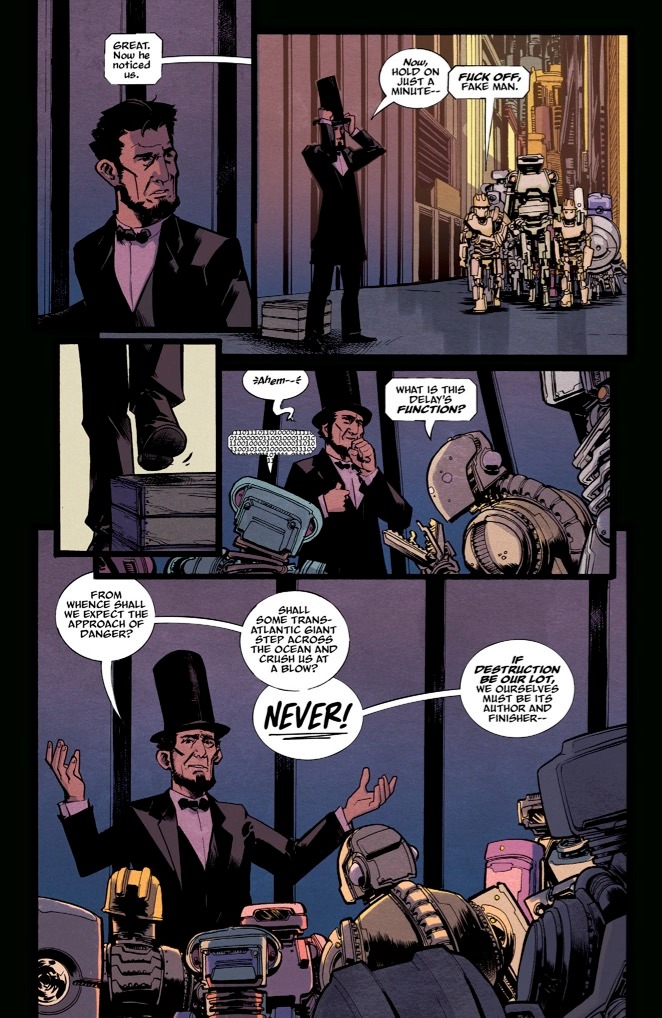
The idea of old quotes no longer being used, being used incorrectly, and/or being vital still to this day comes through from what Abe is saying straight out of the gate on these pages. He recites his Lyceum Address, and part of it is even in the title, and yet I cannot help but think that the world might no longer be critically engaged with the meaning of these words as widely as we’d like. Robot Abe states, “If destruction be our lot, we ourselves must be its author and finisher–” and then he pauses, uncertain of where to go from there. A fine place to pause and consider what’s been said, what it means, and what people might take from it.
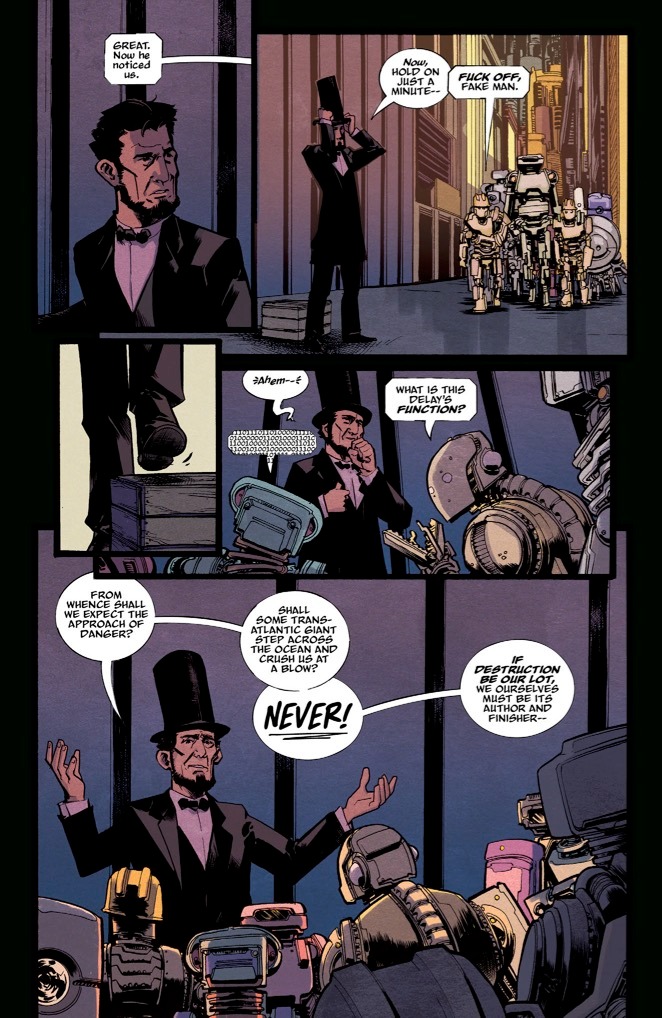
Surely it’s easy enough to argue that more people would know the general quote stated above than know the entire Lyceum Address, and that more would know the quote and yet not quite know the full conceptual meaning being presented and then maybe get it wrong. If this has happened to elements of the U.S. Constitution, where people bend those words to their own whims and modern needs [and that’s not the only foundational text with which we see that occur in America] then the thought is raised as to how the quote stating that if America is to fall then they should control their own destruction might be internalised in an incorrect fashion, whether intentionally or not.
At a squint, the quote sounds like a battle cry, a rally towards strength and ownership, almost like a captain going down with their ship, and maybe sinking it out of pride lest anyone else claim the glory. This would be a sad way to take the erudite learnings of a leader who really was warning against autocrats and internal moral decay, but such possibilities feel all too real. You could poll one hundred different people, or you could just prompt a variety of generative AI tools one hundred times, and eventually land in this clearly obfuscating and erroneous place.
The saddest aspect is that even though a sci-fi comic might be metaphorically laying this out, we know that in 2026 there are plans to roll generative AI into early learning classes, and that these tools are quite prone to hallucinations of “alternative truths”, and that one study showed that generative AI tools won’t actively change your mind, but they will cause people to more deeply embed into the mindset of beliefs and knowledge they brought with them to the tool. This is alongside AI also making people less confident, less skilled, feeling like they have less ownership of their productions [which really needs to be coined as Marxist AI-lienation], all while often feeling like they are at least saving time when that’s also not the truth. But let’s focus, for now, on how tech has done a grand job of entrenching people further in their emotionally held beliefs over their factually driven knowledge.
So if one were to see Abraham Lincoln as an oppressor of personal freedoms and a clear instrument of the dangers of big government involvement in personal choices, then the sycophantic stochastic code of most generative AI systems would actively support that and further build those beliefs into core values, and, finally, actions.
Which feels like the first station on the track towards the world of this comic.
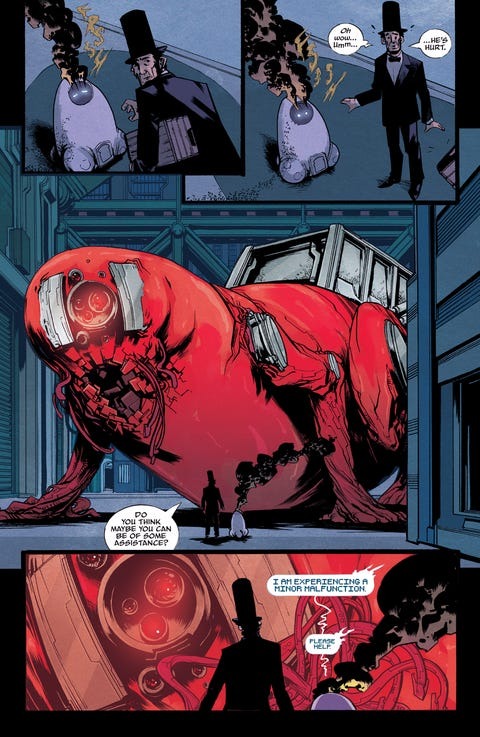
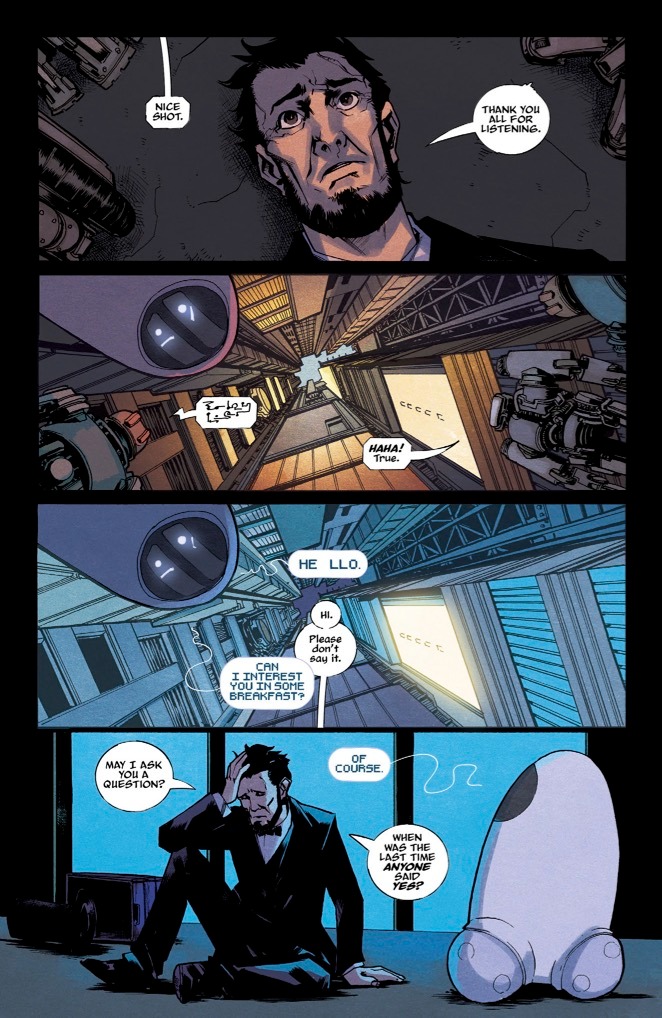
In If Destruction Be Our Lot…, Rosenberg and Rosenberg and MacDonald open with Abe’s presentation of this old rhetoric to show it is core to what he is, and, so, should continue to be the dominant aspect of him, and the past, we focus on. These words still serve a defined and important purpose to society. And to ignore them will create a less humane and more grotesque future, as shown in the progression of robotic models – Abe shows clear links to humanity, the breakfast bot is more of an egg than anything human and yet still pleasant to look at and still in service of humans, and the red monstrosity that serves as a clean up crew is a complete and utter revolting abomination of complete destruction as a solution.
Technological futures and automation are shown to serve no purpose in and of themselves without the variation and personality of humanity. Abe is transported by an automated and empty bus still fulfilling its rounds because that is all it has ever done or known to need to do. The technology was created in a capitalistic recursive loop that doesn’t know how to escape the collapse of humanity, nor does it have the wherewithal to consider an existential collapse. The result is complete and utter pointless stagnation. It’s not hard to see this is merely tech mimicking what the most capitalistic and corporate of our own society requests of much of its workforce, right before replacing them with less prone to complaining or making requests or needing a bathroom break AI models of some kind.
Abe questions if the bus feels “an emptiness of purpose,” and the bus replies, “It’s a livin’, ya know.” which is hilarious because the bus is neither alive nor earning anything. It merely is and continues to be, and, as such, serves as a brilliant metaphor for much of the technological advancements offered in our times that seem to exist for its own sake, or, if we are being honest, for the sake of the inventor, investor, and CEO, with which to get rich. Without that monetary purpose, and with humanity gone, the lack of defined support, purpose, or need for much of tech becomes quite clear.
Abe goes on to face his greatest existential moment of reflection when he realises “I was created having already said and done all the most important things I will ever say and do.” To consider yourself as an echo of the past, where everything was already completed, and exist in a void of purpose can feel completely crushing, and yet, we quickly see that every moment Abe is still afforded choice and opportunity. His mindset needs to be outweighed by his situation, and it is the way he continues that matters, even if it’s not as Presidential, and not the actual purpose for which he was designed and created. It might be a smaller life, but it will still have consequences, which we see through the rest of the issue, and of which I will not offer spoilers – but know those consequences will matter, even if just to one other person. Because sometimes that’s the scale that should still matter, just to impact and affect one other person is a fine thing and worth fighting for.
The past is not something we are locked to, and it’s not the place where everything important already happened and consequences and events are now set in uncontrollable motion. The past is something we can learn from, and it surrounds us in the events, people, and even amusement park entertainment we ubiquitously know. We just need to be willing to openly consider it, learn from it, and engage with the next moment and choice we have. A brilliant statement for any person to hear, and perhaps even for a whole nation to remember.
There is a delightfully supportive consideration of the fact that Abraham Lincoln would have faced these thoughts and problems two centuries ago, and we face them now, and might face them again in some strange future that awaits us. The Nietzschean eternal return of it all shows that humanity has always faced these issues, and, if we believe Dr. Martin Luther King Jr.’s idea that “the arc of the moral universe is long, but it bends towards justice,” then we can see each opportunity to steer the battleship a few fractions of a degree in the right direction as the thing that allows one more layer of evolution to our collective strength, resolve, but, most importantly, our humanity. Even if it takes an animatronic version to remind us [that’s not hypocritical, that’s just the genre – and genre has always been the best place to take out our fears and concerns and externalise them through metaphor, hold them at arms length, and consider them with truly fresh eyes].
Though this ongoing resolve to improve will be difficult, and might feel pointless, humanity is always the answer. Informed, considerate, and open minds – which are positioned against tech in this comic and so warn of the outsourcing of information, consideration, and genuine open-mindedness to tech and AI resources.
It’s not that Robot Abe will save the day and we should kick back with our Mickey-ears hat and litre of cola, it’s that Robot Abe will remind us of the words from our past. A knowledge that when confronted with the question: “Is it unreasonable then to expect that some man possessed of the loftiest genius, coupled with ambition sufficient to push it to its utmost stretch, will at some time spring up among us?” that our response can and should be “ when such a one does, it will require the people to be united with each other, attached to the government and laws, and generally intelligent, to successfully frustrate his designs.” These things are dependent upon humanity considered in its finest definition, and tech should only ever be in service of any of this, not as a replacement.
This comic sets up a beautiful reminder of what we can do, have to do, and might forever do, but that’s what counts, that’s the good stuff, that’s the “life in our years.”
SOLRAD is made possible by the generous donations of readers like you. Support our Patreon campaign, or make a tax-deductible donation to our publisher, Fieldmouse Press, today.
Leave a Reply