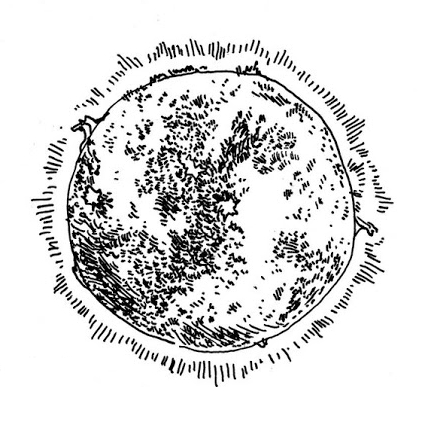
48F PMH MEN IIa with 2d neutropenic fever. 35M mesenteric ischemia s/p bowel resection. 63F c hemorrhagic cystitis + nephrolithiasis ℅ frank hematuria. Medicine is complicated and has a serious communication problem. Comics can help.
There are myriad forms of communication in the healthcare field. There are the patient notes, which is how doctors document the clinical progress and medical treatment of the patient. There are online communiques between patients and their healthcare team through an Electronic Health Record’s patient portal. But perhaps the most important communication is between physician and patient, and between physician and physician.
This last type isn’t simply important for the conveyance of information. In the 2025 Press Ganey survey of over 10.5 million participants, patients cited healthcare worker communication and facility safety as the top reasons why they would recommend or not recommend a medical service (1). When doctors talk to patients well, health outcomes improve. When they don’t, they get sued (3). In a meta-analysis of medical malpractice claims across the US, in 70-80% of cases the plaintiffs sued a healthcare provider not because of a medical error, but because the medical error was inadequately explained to them, and they felt civil litigation was the only way to hold physicians accountable (2). Even gathering the story can prove a difficult skill when physicians are not practiced enough in doing so. Physicians should know how to ask the right questions while sifting for important mitigating factors. Doctors are taught, by rote, to ask about fevers, right upper quadrant abdominal pain, and skin jaundice when evaluating for ascending cholangitis. But if doctors aren’t sensitive to an elderly patient’s story, the patient’s wife reporting of her husband’s new onset lethargy and confusion could be a masked biliary sepsis, and this deadly diagnosis can be missed altogether (5). Efficiency in documentation is vitally important in medical care, but sometimes these extra details determine successful versus poor outcomes.
So what does this mean practically? When you read the sentence “63F c hemorrhagic cystitis + nephrolithiasis ℅ frank hematuria” – austere and decidedly unflorid medical shorthand for a 63-year-old female with a bleeding bladder and kidney stones, complaining of blood in the urine – you should know that this sentence summarizes what one doctor feels is most significant about a patient to another doctor. But what about the valuable parts of the story that can’t be condensed as easily by medical jargon?
Medical schools have sought for decades to improve medical communication in students and have made enormous strides, particularly in the medical humanities. Programs like the Medical Humanities Track at George Washington University School of Medicine exist to “develop and nurture skills of observation, analysis, empathy, and self-reflection, skills that are essential for humane medical care (6).” Medical humanities students hone their analytical and observational skills in painting, writing, videography, and narrative medicine storytelling classes. The different media all have their merits and drawbacks: painting trains purely visual observation skills but lacks sequencing; videography trains how to record, cut, and edit a story but eschews the literary component of storytelling; and writing clarifies and illuminates details and ideas in medicine but completely foregoes visual accompaniment. To best equip future doctors in developing their empathy and empowering their communication skills, they need to train in an art that combines all the skills essential to the doctor-to-doctor, and patient-to-doctor conversation – static and fluid visual observation, emotional language, sequencing, pacing, cutting and editing simultaneously.
That’s where comics, and in particular, Graphic Medicine proves crucial. Graphic Medicine, a concept created and co-founded in 2007 by UK-based physician Dr. Ian Williams and Illinois-based Nurse MK Czerwiec, is defined as “the intersection between the medium of comics and the discourse of healthcare (7).” More bluntly: it’s comics about medicine. The scholarship and discourse around medically-related comics has bloomed recently in this very young field, with lodestar, genre-defining titles like David B.’s “Epileptic” and Ellen Forney’s “Marbles” leading the way. Comics like these can vividly describe the devastating impact of growing up with a sibling with epilepsy or the swooning impossibility of bipolar disorder in vastly instructive ways for student doctors, while teaching them novel ways to communicate these ideas to patients and each other.
In what ways does Graphic Medicine accomplish this? In Brian Fies’s 2005 collected webcomic Mom’s Cancer, the author describes the daisy chain of treatment events in the wake of his mother’s metastatic lung cancer diagnosis. The effects that large cell lung carcinoma inflicts on Fies’s mother and his family are familiar to the millions of Americans with cancer, but its nuanced descriptions of the cancer diagnosis and the drug side effects were completely novel.
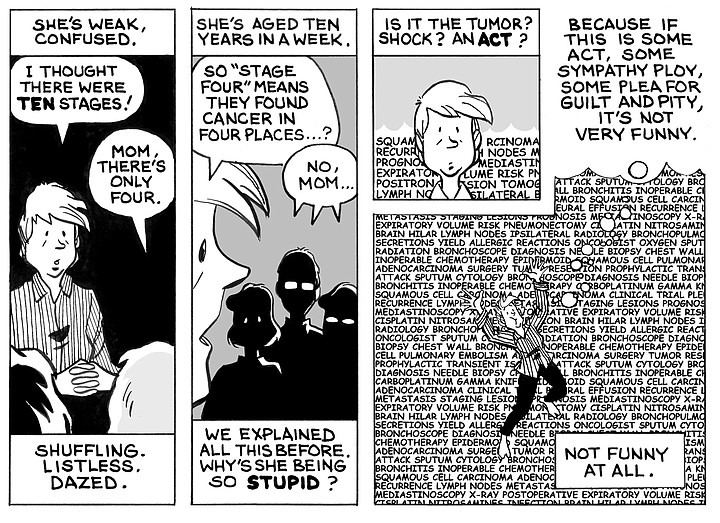
Physicians have long been aware of the shock-like effect of hearing a cancer diagnosis for the first time. The solution has classically been to repeat the information and ask the patient to summarize what they understand. What Fies shows in the page above is just how much this approach elides reality. Doctors might presume most people know there are only four stages of cancer metastases, but panel one, above, highlights this falsehood. Doctors may know that families can become exasperated with a patient, but we understand the family’s anger when we see their frustrated silhouettes in the background of the second panel. Physicians are taught how medical terminology acts as a barrier to communication, but the visual of Fies’s mom literally drowning in oncology jargon illustrates this idea much more succinctly.
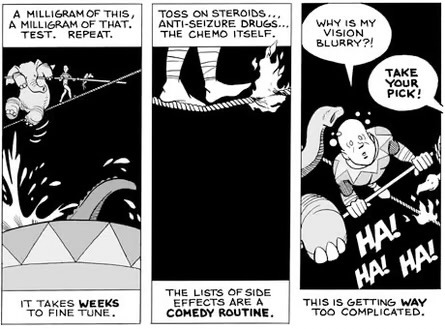
Cancer drug titration, and the management of subsequent adverse effects, is enormously complicated. Physicians treating these patients often document side effects and symptoms as a series of check marks on a computer dialogue box, without understanding quite how it feels to deal with it all simultaneously. In 3 spare panels, Fies shows the vaudevillian nature of it all — the feeling that one must tightrope walk over constant dangers, must teeter milligram by milligram, and must pick and choose which insults to bear while performing in front of a cruel, disembodied audience. The power of this page lies in the combination of its literary description, its switching of camera angles, and seeing all three images in a static sequence. It is also an image that communicates these ideas better than any checklist could.
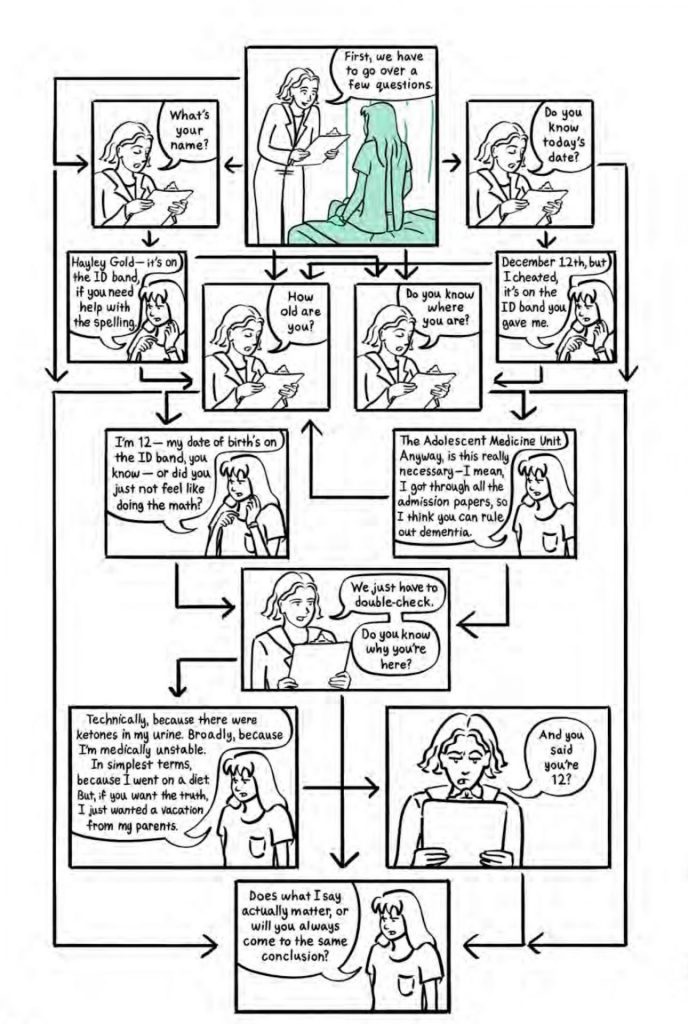
Navigating the labyrinth of the American healthcare system is bewildering. Haley Gold’s Nervosa is an earnest graphic memoir about the author’s struggles with her eating disorder and the system meant to treat it. In it, Gold candidly recounts her odyssey with inventive use of panels and action-to-action transitions. This is perhaps no better demonstrated than in her dizzying full-page spread describing her inpatient eating disorder intake interview. Resembling an askew board game with no end, the series of circular questions continually run into each other. And as any former patient can only read and nod their head in recognition, doctors are learning just how perplexing an experience they are providing for the patient.
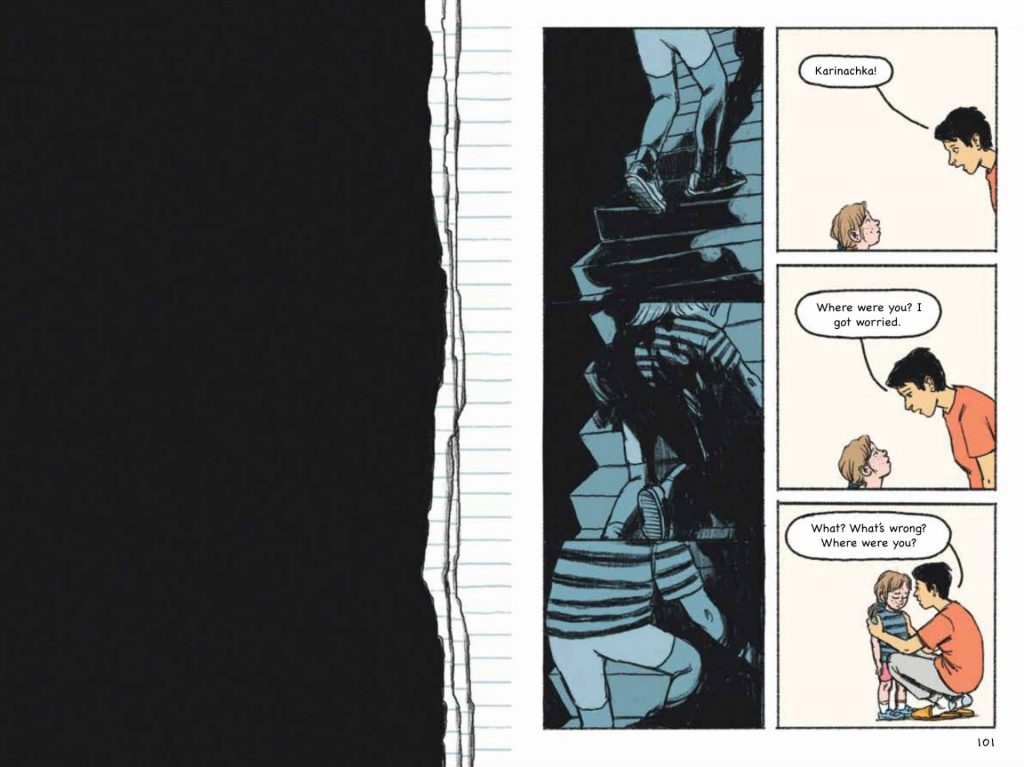
Graphic Medicine isn’t limited to depicting healthcare scenes alone. It also has the power to encapsulate some of the most difficult and harrowing subjects in ways unique to the medium. This is overwhelmingly demonstrated in Karina Shor’s haunting memoir, Silence, Full Stop. An unflinching exploration of how isolation — of a new country, a new language, of a traumatic sexual assault — can beget further alienation and self-harm, Silence, Full Stop is a beautifully rendered, deeply felt self-examination that follows the author through despair to the kindlings of redemption. The scene of her abuse is never directly depicted, as the fragmented, obscured memories of the horrific event are blank spaces, the pages ripped from her mind. Where clinicians may struggle to elicit complete histories in traumatic cases is where they might learn the most from these spare black panels. Instead of cutting down, Shore decides to add a panel of silence to communicate this darkness.
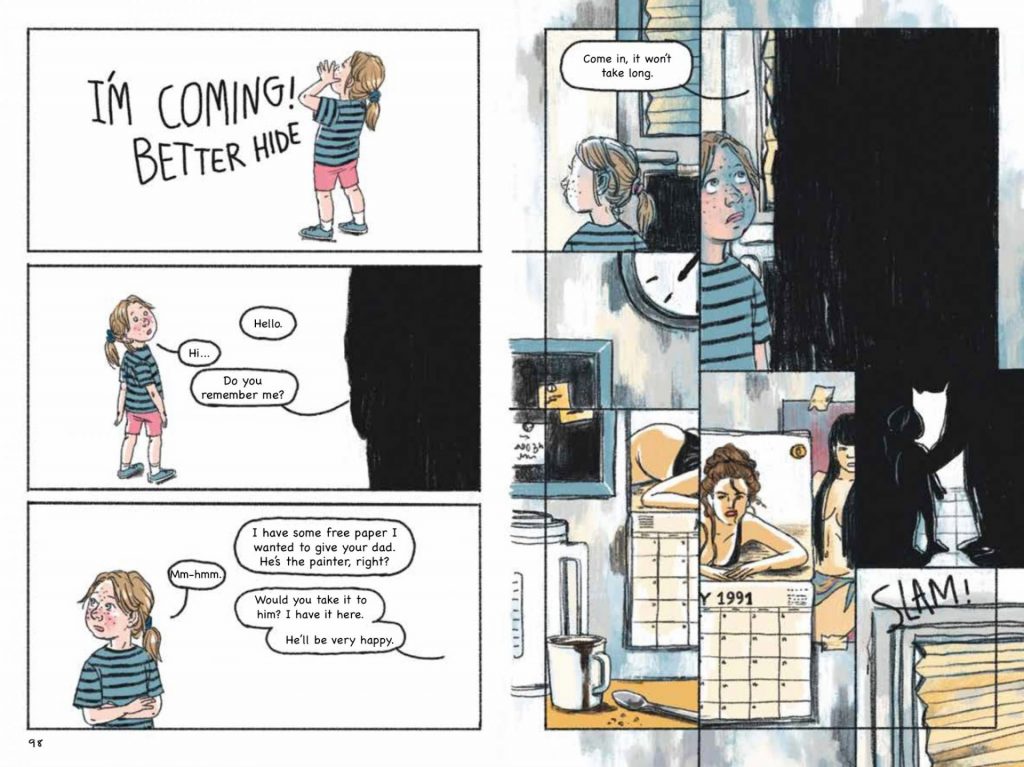
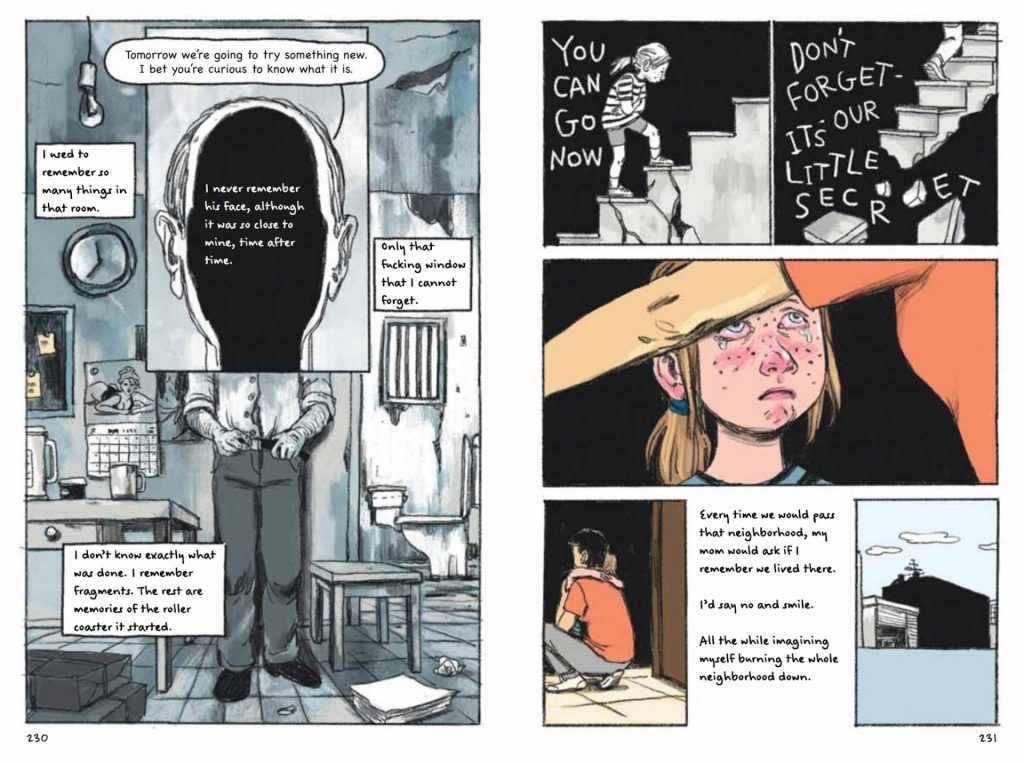
Shor’s depiction of time in Silence, Full Stop is enormously instructive as well. Time is not linear in the narrator’s memory, nor is it completely reliable. The above two pages, while occurring at completely different points in the book, demonstrate how the memories survive in Shore’s head: details of the swimsuit calendar on the wall flit listlessly with cracks in the wall. And while a traditional American comic reads left to right, top to bottom, the central panel on page 230 with the large, obscured face compels the reader to look towards and away from the perpetrator. In a manner of two pages, Shore illustrates what often takes clinicians years to understand about sexual trauma.
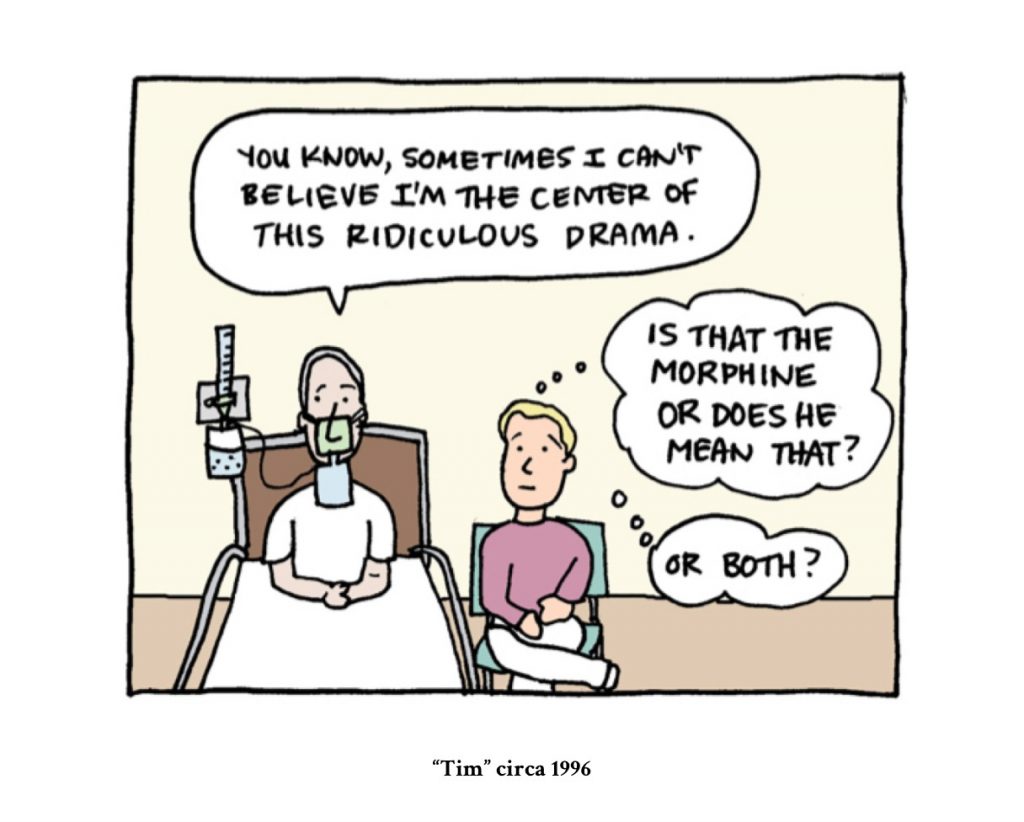
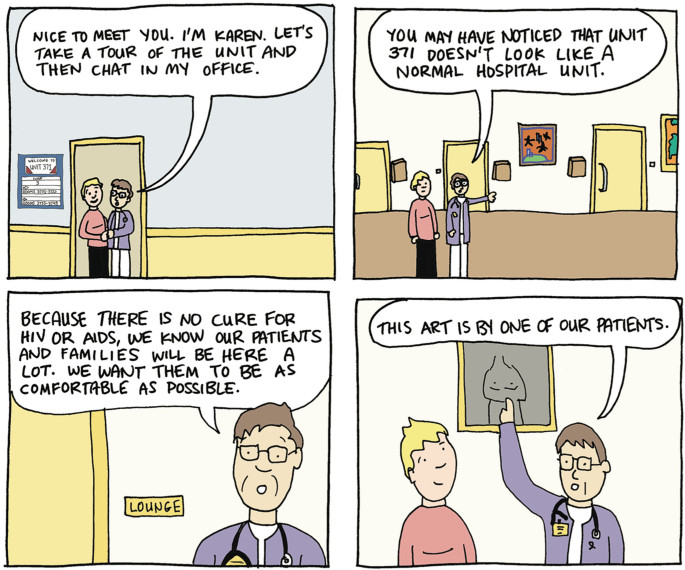
Comics also educate clinicians about their own world. In Graphic Medicine co-founder MK Czerwiec’s tender seminal work, Taking Turns, she explores the healthcare worker as a rounded entity, highlighting the excitement, trepidation, fear, and resolve of those treating some of the first AIDS patients in a specialized clinic in Illinois. Whether it’s a moment of unexpected profundity from a morphine-treated patient or entering a care team tasked with treating an untreatable disease, Taking Turns describes what every single healthcare student feels when training – Should I be here? What am I doing? Will I quit?
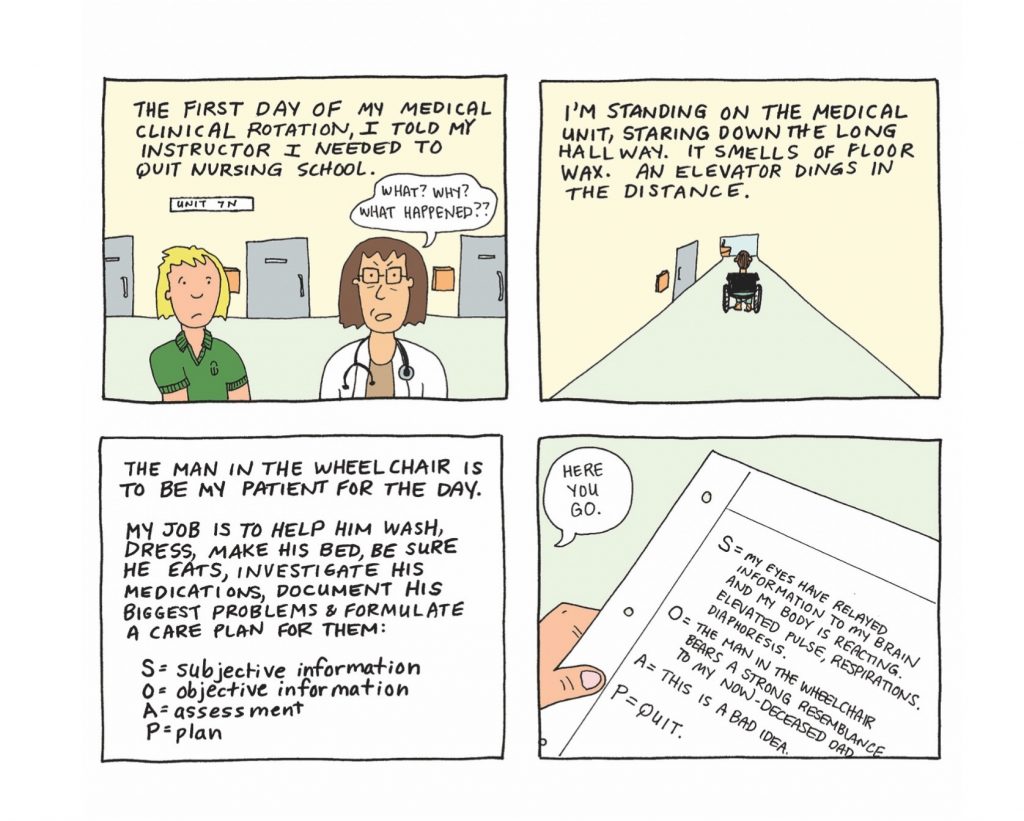
While Taking Turns can be viewed as a thoughtful reflection of a specific, indelible period in American medical history, there is an obvious universality and timelessness to anyone in the healthcare field. The expansive relatability stems from astounding details, like MK’s panic at seeing a patient who too closely resembles her recently deceased father. Every doctor and nurse has that story, and it’s hardly covered in our core curriculum.
That core curriculum – the two so-called “pre-clinical” years devoted to book learning and studying for the USMLE Step 1 Board Exam – covers the science and pathophysiology building blocks of medical knowledge. Many schools use this time to prepare students for years 3 and 4, or the “clinical rotations,” by teaching them basic interviewing skills or physical exam maneuvers before they finally, disquietly interact with patients. This period immediately preceding clinical rotations is where Graphic Medicine should be required teaching.
Much of the training and focus before clinical rotations is on timing, efficiency, and, alarmingly enough, medical ICD-10 coding. In that sense, and in the world of managed care, medical schools are simply being realistic – seeing the most patients for the least amount of time while billing for the highest possible level of care is how our fee-for-service systems are designed, doctors’ intentions be damned. But think about how much humanity is stripped from the interactions between doctor and patient, and, just as urgently, how this can harm patients. The rapid integration of AI into training and Electronic Health Records promises to vastly improve documentation, but will deprive students further of synthesizing their communications with patients and figuring out how to edit this information into a complete story. Requiring courses in Graphic Medicine, not simply as an elective course, can be the antidote.
And here is where we should discuss just how biased I am. As a practicing Family Medicine physician and comics artist for twenty years, I have a lot of skin in the game. In my medical work at Federally Qualified Health Centers and Prisons, I have found my communication skills with patients to have been heavily informed by comics storytelling techniques, and the practice of breaking stories into beats, considering the gutters, and adding visual detail while withholding distraction. I believe in comics’ power to reform medical communication. I want this to work, and I have evidence that it already has (8). In pioneering programs at Penn State College of Medicine (9) and Northwestern Feinberg Medical School, nascent Graphic Medicine programs have shown enormously positive results from the students, who believed the earlier it is integrated into the preclinical course curriculum, the better (10). Students have been talking. We just need to listen.
So when a young doctor in training is taking the history of a 48-year-old female patient with a past medical history of Multiple Endocrine Neoplasia IIa with 2 days of neutropenic fever, they have a choice: rush to document the abbreviated description, or use their storytelling skills to synthesize more information. And maybe add one more panel.
Resources
- https://www.pressganey.com/resources/e-books/patient-experience-2025/
- https://www.uchicagomedicine.org/forefront/news/communication-skills-diminish-malpractice-risk
- https://pmc.ncbi.nlm.nih.gov/articles/PMC1201002/
- https://www.graphicmedicine.org/why-graphic-medicine/
- https://emergencycarebc.ca/clinical_resource/clinical-summary/ascending-cholangitis/
- https://ospe.smhs.gwu.edu/medical-humanities
- https://www.graphicmedicine.org/why-graphic-medicine/
- https://www.bmj.com/content/340/bmj.c863
- https://sites.psu.edu/humanities/green/
- https://www.usd.edu/academics/colleges-and-schools/sanford-school-of-medicine/south-dakotan-medicine/graphic-medicine-a-powerful-tool-for-teaching-empathy
SOLRAD is made possible by the generous donations of readers like you. Support our Patreon campaign, or make a tax-deductible donation to our publisher, Fieldmouse Press, today.
Leave a Reply