Hey…let me ask you…
Is this how it really ends?
Wow. Time flies.
Have I said that already?
Are you washed in the blood?
We could never be like them.
…ever been stuck in a loop?
Hey…let me ask you…
What do you see when you turn on the news?
I see a new war. A new massacre. A new societal ill I am complicit in by action or inaction. A new (old) hate repackaged, repurposed, remade for a new generation. A new system of extraction I’ve been enrolled into, unable to see a way out – a new aristocracy of silicon and financialization and grift joining the old ones of oil and steel (and grift.)
I see a new string of invectives burbling up and trickling down, flung from the highest echelons of power, picked up and acted upon by a disgruntled and increasingly dangerous population. The planet is burning and freezing and melting down and our institutions are rotting and rotted and being destroyed by the most asinine choices, lauded and made with glee and cruelty and all I can do is observe in horror and shame, seeing family, friends, loved ones slip into despair and death, not knowing what to do or how to do it, how to save them or help them before it’s too late, and and and it’s all so much, too much to bear, day by day, week by week, moment by moment, and and and and –
Is this how it really ends?
Being alive in 2026 (as a rational, caring human) is, to put it mildly, a fucking nightmare. Whether or not it’s induced by our supercharged social media moment, or it’s literally, actually, true, this feeling of endless crises all around us is pervasive.
You know it to be true. I know it to be true. In the time it took to write and edit this piece, it only became more acutely true. And, clearly, Deniz Camp, Eric Zawadzki, Jordie Bellaire, Hassan Otsmane-Elhaou, and Tom Muller do as well.
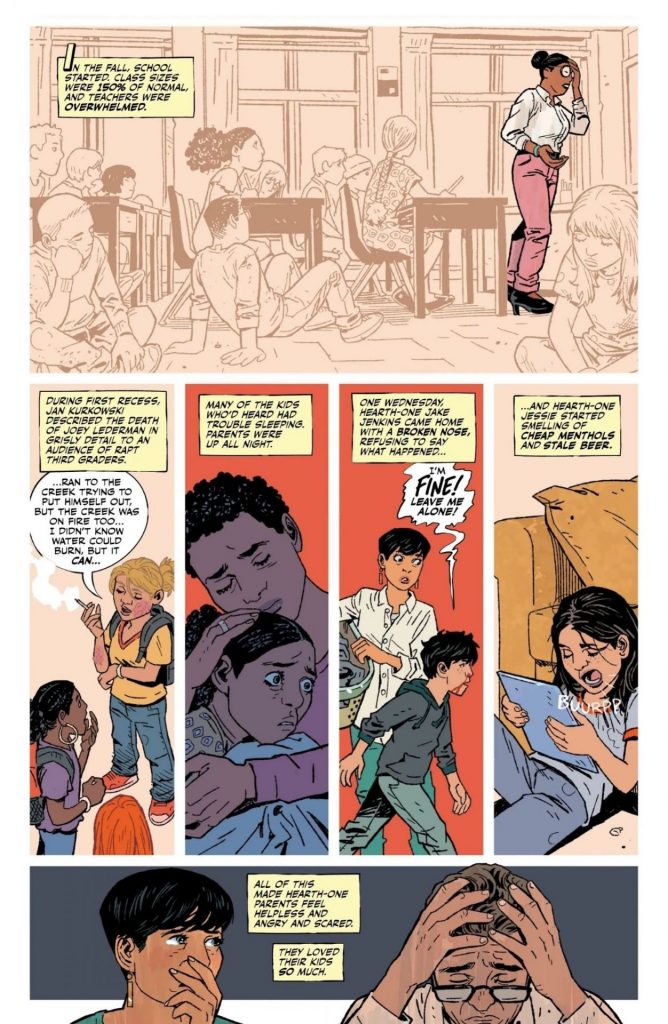
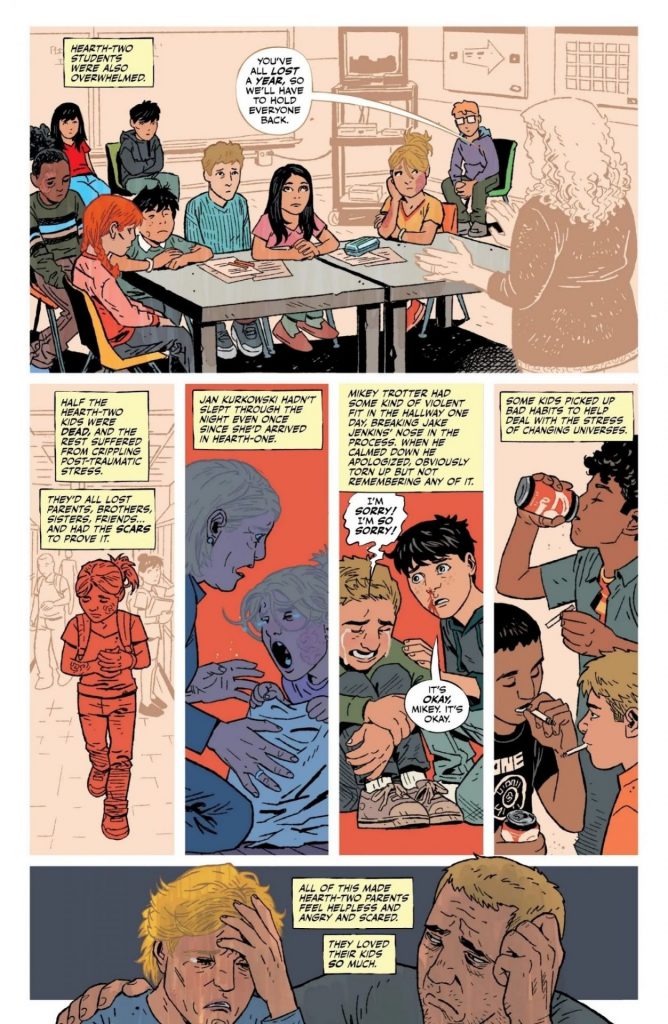
Across five issues, this first volume of their new series Assorted Crisis Events presents us with a feast of crises: of world ending, or fracturing, or redefining, events. Think of something you’re stressing about? There’s a crisis for that.
One would be forgiven, from its title and my description, for thinking Assorted Crisis Events is a commentary on the Big 2’s obsession with world-shattering event comics where they promise that “nothing will be the same again” and then everything is the same. Again.
It is not.
…ever been stuck in a loop?
Instead, Assorted Crisis Events Volume 1 is an anthology title about a world where time is broken and, well, crises abound. Issue five focuses on the twin crisis of isolation and doubt, one is a maximalist representation of now, #4 is the plot of Click without the remote, number two is about immigration, and issue 3 concerns the radicalization of the everyday. Each exploration is new, with a new cast, uninterested in the hows or whys of said brokenness (thus far). It is as human as human gets, with enough space for velociraptors, robot invasions, and parallel worlds as well.
Titled ‘Apocalypse Wow!,’ the first issue of Assorted Crisis Events sets an appropriate stage. A clock ticks happily along until it falls off a countertop and smashes on the ground. The seconds hand cycles back and forth, back and forth, arrested in this one moment; always the same, even as the world around it isn’t. The room is dark. Cool blues and greys, broken only by the harsh reds and oranges that accompany the sounds of gunfire and explosions outside the window color our view.
Are you washed in the blood?
On the next page, Ashley, the bedraggled and beleaguered focal character of issue one, picks up the clock and comments on the apocalypse outside her window. The newest and latest (fictional) world-ending moment, crafted by auteurs (a surly bunch) for a populace awash in a horrific reality where temporal anomalies are, simply, commonplace. Slip out of time, be killed by being born, find your long-time job was never your job and they don’t know you exist, bump into your temporal doppleganger, or suddenly have your block turn into a future war – just another Tuesday. Or is it Monday?
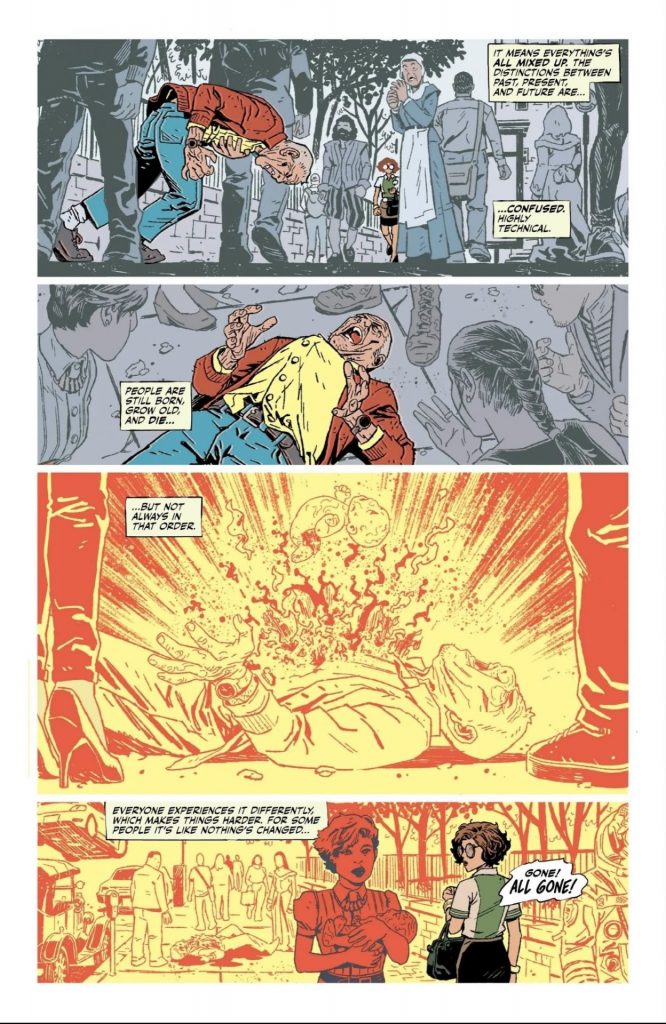
The meaning of time has been lost. Wow. Time flies.
Ashley is the perfect protagonist to introduce us to this world. She is a bystander. An observer. If an event doesn’t affect her, isn’t perceived by her, it remains out of focus. Bellaire literally washes their colors out and places them in a grey haze, making it trivially easy to gloss over the sight of a caveman and a viking woman and a doppelganger and a pirate walking down the street. In many panels, only Ashley is fully colored, creating a stark hyperfocus on her and her alone, until someone or something stumbles into her perception, and then they, too, stand out against the crowd. It’s a favorite touch of mine and one of the series’s distinctive looks.
Needless to say, ACE #1 is a stuffed issue. Overwhelming. A maximalist representation of the feeling of our current moment…have I said that already? One minute we’re trying to get a clock fixed, the next we’re walking down the street to a fascist nightmare and it all feels…normal. Surreal, but normal. Isn’t that chilling?
We could never be like them.
Yes, the satire in ACE is not particularly hidden. In fact, there’s a quote I’ve become quite fond of that I think sums up Camp’s approach. It comes from acclaimed horror author, dream weaver, visionary, plus actor Garth Marenghi*: “I know writers who use subtext and they’re all cowards.”
To wit, issue 2 is a story about how mass slaughter dehumanizes us; the abject horrors of the factory farming system for animal and human alike; the lie(s) at the heart of American business; how modernity, distance, and mechanization hides its brutality; and how this all mirrors America’s (lack of an) immigration system. To make these connections, I didn’t have to dig too hard. I mean, the issue has Zawadski & Bellaire slowly filling the gutter space with a waterfall of blood. A countdown clock of deep, deep red that is – unsettlingly – easy to miss until at least a quarter of the way in. Simple and effective.
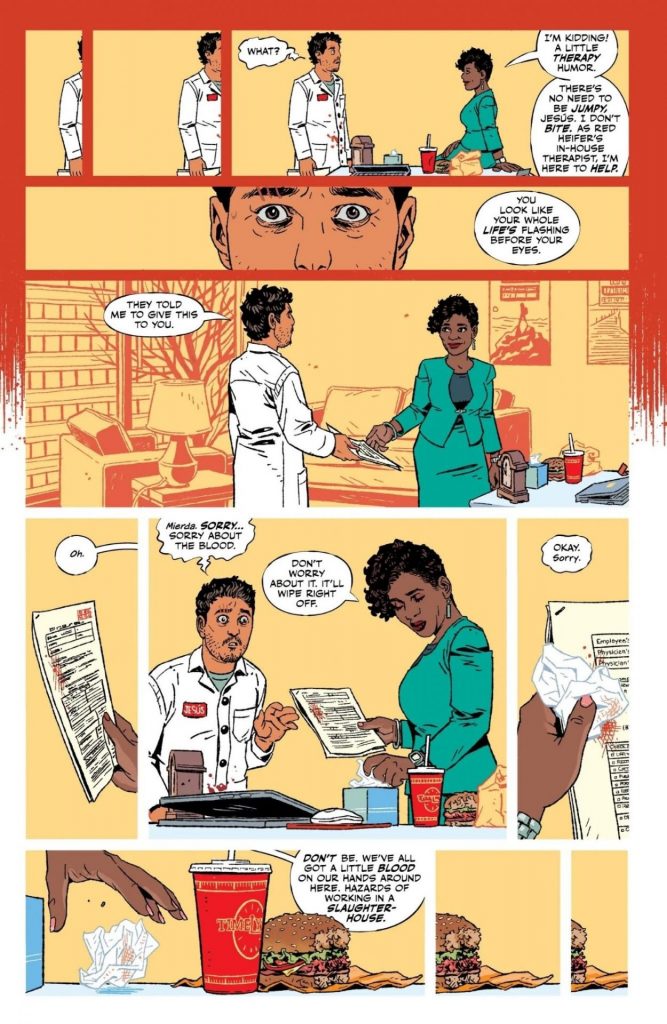
ACE is not one to sit on its laurels or do anything “simply.” ‘Slaughterhouse 9-5!’ (subtle, yes?) is a twisty affair, bouncing back and forth, page by page, in Jesús’s life, juxtaposing events and drawing atemporal connections between them. Each page opens and closes with the same structure: three panels, the largest 2/3rds of the page wide, the next 2/3rds of the remaining third, and the final sliver of a panel filling out the rest. It creates a rhythm for our reading, like the kerthunk of the knocker, lulling us into a pattern before violently upsetting it in the last third, leaving us disjointed but not necessarily disoriented.
Are you washed in the blood?
An aside: I was reading issue 2 of Panel X Panel the other day, where Zawadski talked about the process of making a few pages for “The Dregs.” The article featured a couple pages that employed the same cyclical tricks and layouts used in issue #5 of ACE. It was like finding a Rosetta Stone. The dance of writer and artist contributions revealed and exposed. I wonder if that issue – featuring a “Redlands”-based essay by Camp and an interview with Bellaire and Ostmane-Elhaou – was the one that put these four on each other’s radar.
Regardless, reading ACE is not easy. OK, it is easy to read – for one, it’s not overburdened by much of any sci-fi jargon – but it doesn’t feel easy. It is an emotionally draining, thoughtful anthology with a mind-bending conceit and pages that are absolutely packed to the gills and, often, wildly overwhelming. It should, by all accounts and with a lesser team, be a confusing mess and a slog, yet it remains one of the clearest, most compelling comics of the year.
Wow. Time flies.
It helps that time is already a malleable dimension in comics. The medium’s static nature, overhead view, and visual content allows this intangible, difficult-to-grasp dimension to be made digestible. The great trick of ACE is that, through its maximalist first issue (have I said that already?), we’re taught how to read the series. Look to the background. Disorientation is the status quo. The world is broken, but people aren’t yet. Things will repeat and repeat and then, wait, no, that wasn’t repetition, it just looked the same.
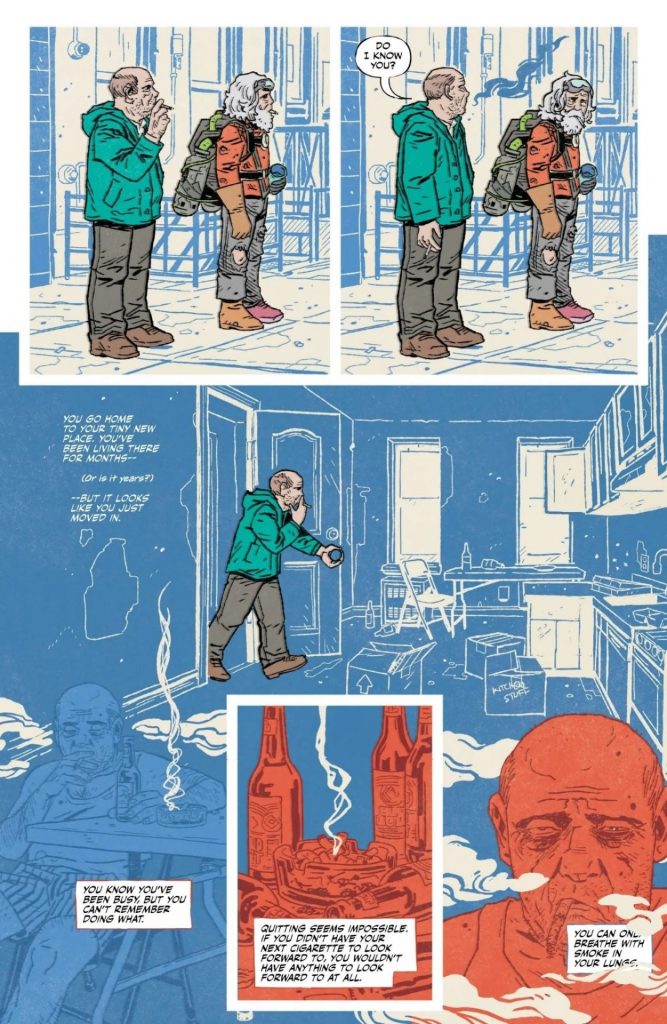
Thus the team can focus on exploring their concerns without worrying about losing the reader, though it still often takes a bit to gain one’s bearings. This is the case for #4, ‘Time Flies,’ which is the weakest of the bunch, for me at least. A little too simple, a little too much of a nothing protagonist (which is the point). For my money, the concluding issue of the volume is its pearl.
…ever been stuck in a loop?
Issue #5 aka ‘…Strange Loops!’ tells the story of Anna, a girl who was stuck watching the same sixty-second loop of her parents screaming at each other and her father slapping her mother and her parents screaming at each other over and over and over and over and over and over and over and over and over and over and over again. It is not the story of that moment, but the many millions of moments after.
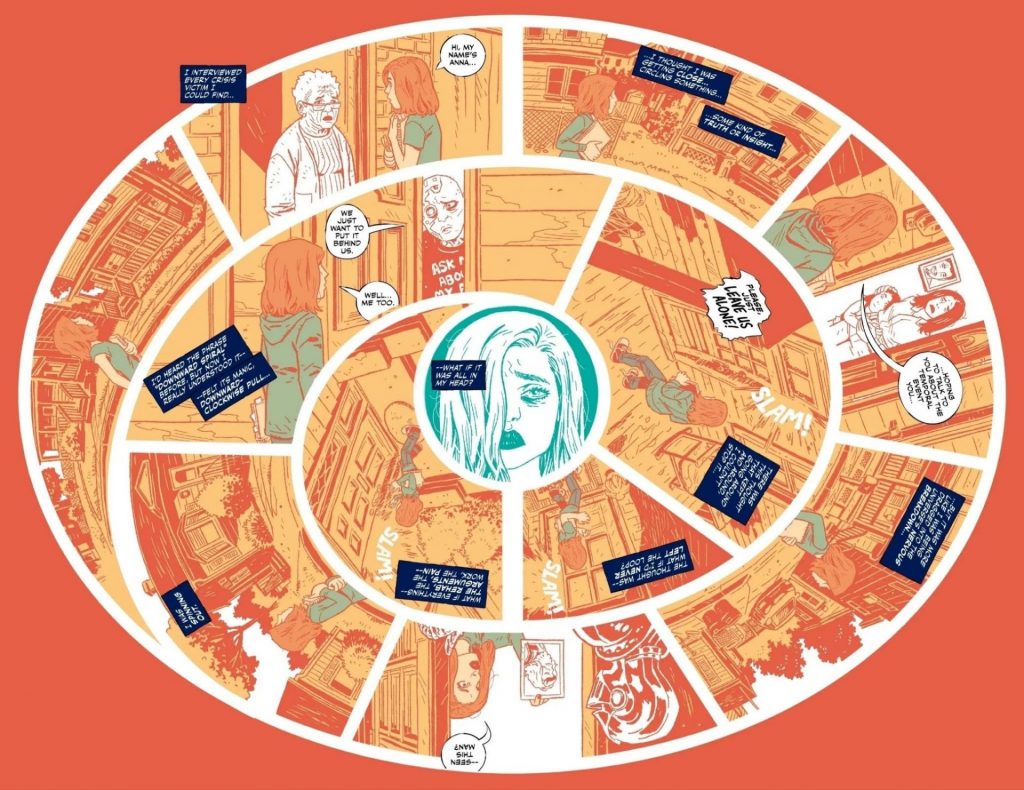
Anna is dismissed. Ignored. Diminished by those around her who impose their realities onto hers without ever truly absorbing what she is saying. So she is re-traumatized in loops we can read as many times as necessary, each repetition an exercise in emphasis. She tries to find her way out and only feels herself hemmed in more and more, by expectation, by life, by fear and knowledge.
It’s a cavalcade of misery, a maze with no exit, filling with water and building and building for you and for me and for Anna, unable to see an end that isn’t pain and death and then…
Have I said that already?
Then I cried. I was Anna, watching myself swing from the ceiling fan. I was Anna, watching myself trapped on the floor. Unable to move. Unable to think. Only able to count the seconds. And observe.
It was like Camp reached into my brain and plucked out the scariest, most vulnerable part of my psyche and laid it bare on the page. Cracked me open and let it all spill out; the neverending doomloops and replays of mortifications and moments and conversations that dance in my mind. It was surreal and emotional and affecting. To separate that experience from a technical dissection and critique of the work feels…impossible. The human is the center, and to deny the center is to deny the whole.
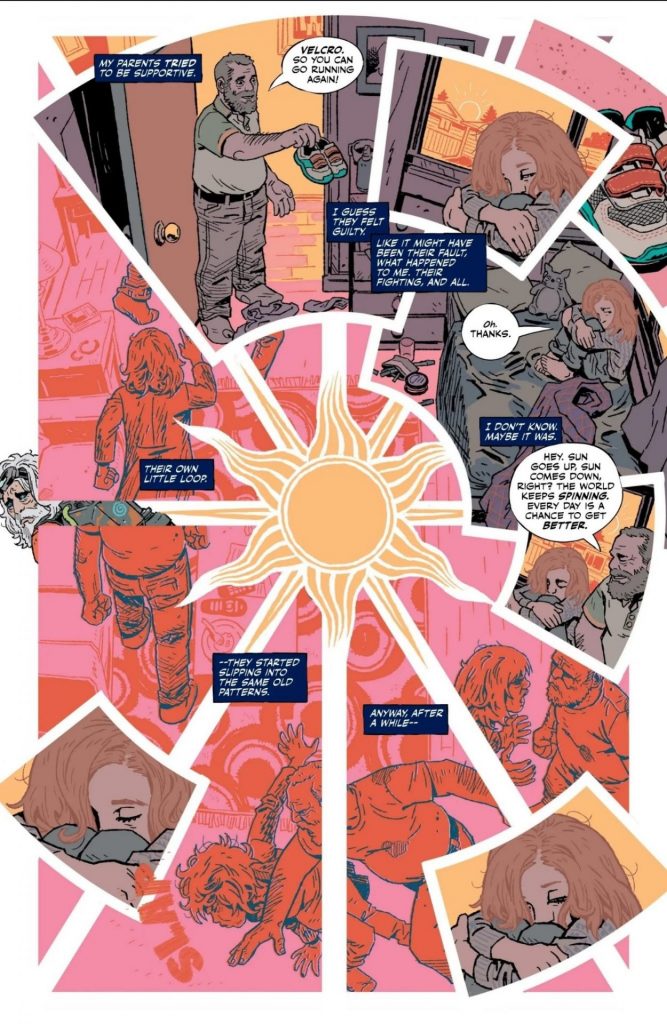
‘…Strange Loops!’ more than any of the other issues in this collection, captures and visualizes the broken spirals of these moments and life after. From outside, from above, from the man-who-is-not-a-time-traveler’s perspective, there is a rhythm and sense. From inside, each moment is a whole and one can only proceed a second at a time
And not all pages are perfect loops. About halfway through, there’s a brilliant page of layered realities. Zawadski places the now atop Anna’s original loop (sans dialog save for the ringing slap that breaks through). However, the now never quite makes a complete loop. It is fragmented and fractured, the past reasserting itself, and the present unable to move beyond.
Major kudos also needs to be given to Otsmane-Elhaou for guiding us through and around these complicated pages with very few hiccups.
Is this how it really ends?
It’s most apparent here, but ACE is concerned with cycles. Cycles of violence. Cycles of hate. Cycles of indifference and trauma and, yes, love and care. It makes sense. When you play with time, you will inevitably find patterns. Humans are cyclical creatures, but, because we live in a universe where time moves inexorably forward, we are terrible at seeing anything but the space around us. Camp wants us to see the patterns…and then break them.
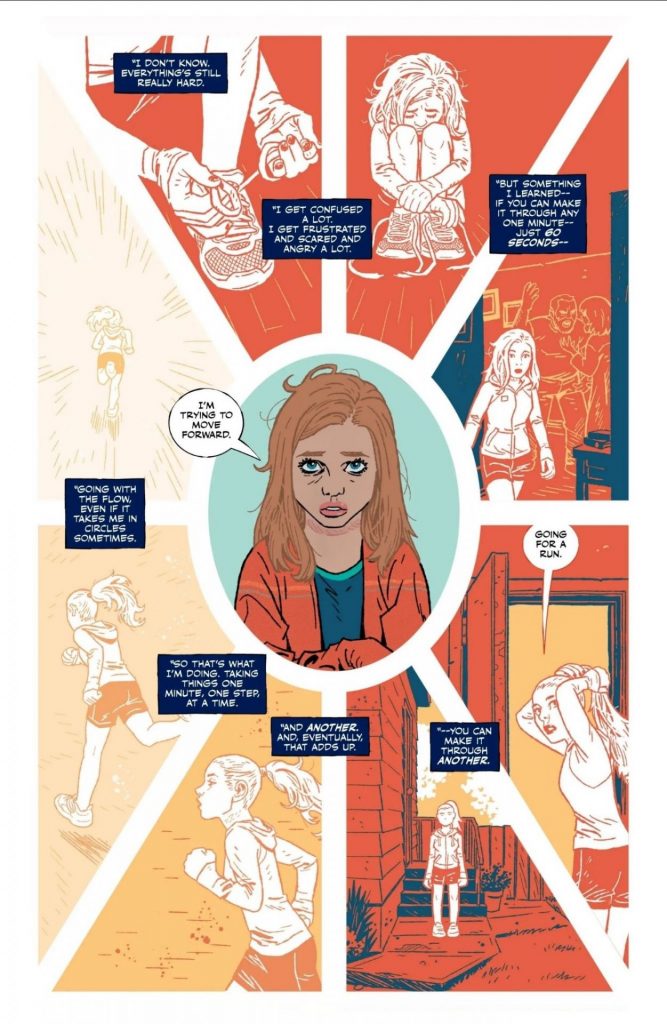
I think it would be easy to look at Assorted Crisis Events and read the comic’s ethos as “we’re all fucked. Let us count the ways.” If time is broken, then there is no future, the first issue seems to say. “The harvest is past, the summer is ended, And we are not saved.” It’s all a perpetually miserable present. Every issue is about awful things happening to everyday people by an indifferent, often cruel world. There are almost no happy endings and the happiest ending — ‘…Strange Loops!’ — isn’t all that happy.
But. But! But it’s also shockingly hopeful. Hopeful in the younger generations’ abilities to see through the bullshit of today. In people. In us, if we let ourselves.
Camp isn’t naive in his hope, of course, as the parable of Hearth in issue 3, a pretty explicit refutation of pure optimism in our better natures, shows, but neither is this a comic of hopelessness and despair. Time and again, in issue after issue, scattered throughout these awful crises are moments – some fleeting, some longer-lasting – of personal, human connection shining through. Of people supporting each other, not just when things are easy but when things are as hard as they can be. It isn’t often, and it isn’t big or world-changing, but it’s there in Anna in the support group; in the kids of Hearth and Hearth-2 questioning the newly born hatreds; in Ashley reaching out to the time-traveler.
It is a comic with much to say, if we will listen, and at least one message that I know I needed to hear: “We believe you. We love you. We are going to help you get better.”
Hey…let me ask you…
*Yes. I know. Don’t @ me.
SOLRAD is made possible by the generous donations of readers like you. Support our Patreon campaign, or make a tax-deductible donation to our publisher, Fieldmouse Press, today.
Leave a Reply