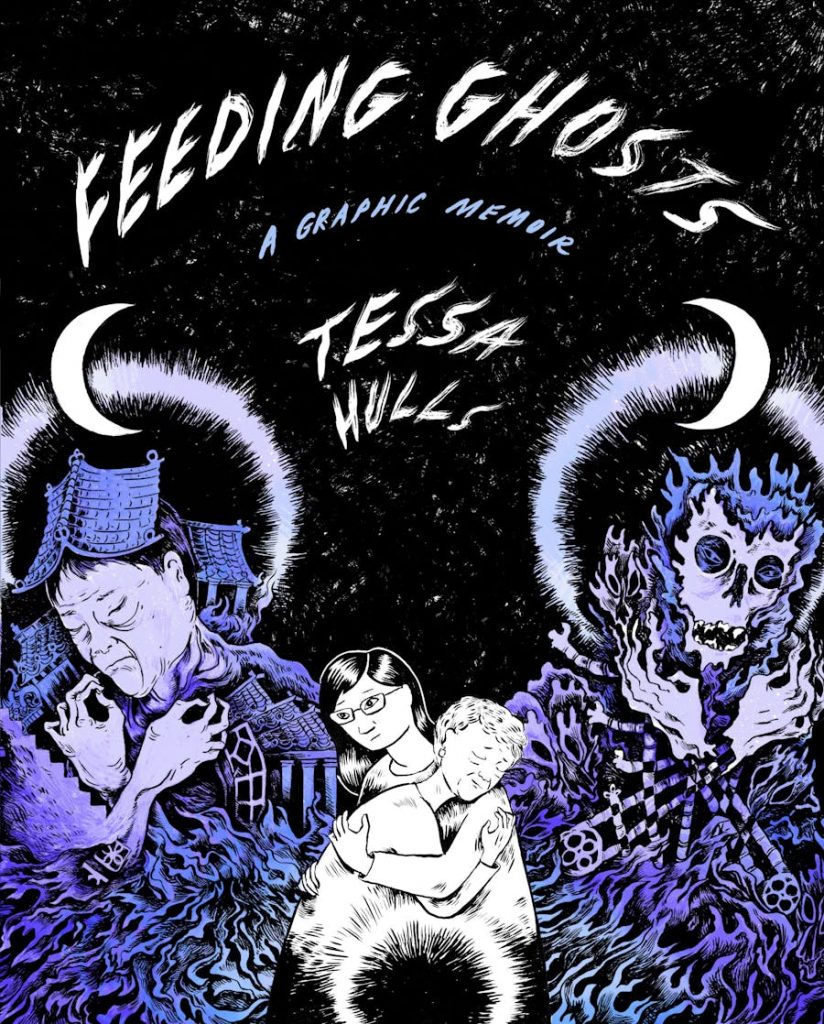
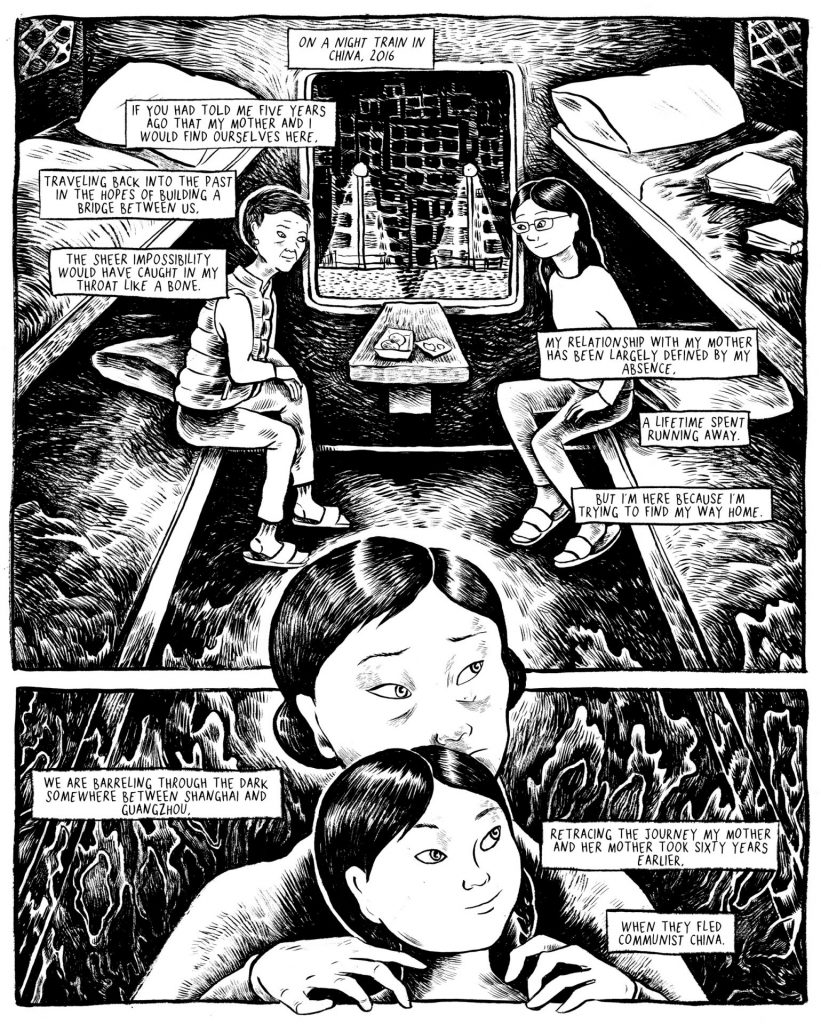
Moving deftly between the past and the present, Tessa Hulls’ Feeding Ghosts, is a memoir within a memoir. In a manner both exploratory and intimate, it spans three generations from her maternal grandmother (Sun Yi) to her mother (Rose) to herself. The book begins with a black and white photograph of her grandmother and her mother (as a child) and is followed by a hand-drawn visual timeline from the 1900s to the 2020s, that succinctly identifies the sociopolitical events in China and Hong Kong that led to the fractures in her familial history. Quoting Toni Morrison at the very start of the intergenerational journey, Tessa Hulls reiterates that water has a perfect memory. Then, on a night train between Shanghai and Guangzhou, her mother, who is traveling with her on her research trip to get to the bottom of this labyrinthine story, tells her, “[Sun Yi] always was a drowning woman, trying desperately to throw me on the shore so I would not drown with her.” Leaning into the meta-narrative structure that autobiographical comics often gravitate towards, Hulls, the writer of the story, and not necessarily the character, interjects the scene to equip us readers with context that led to this moment.
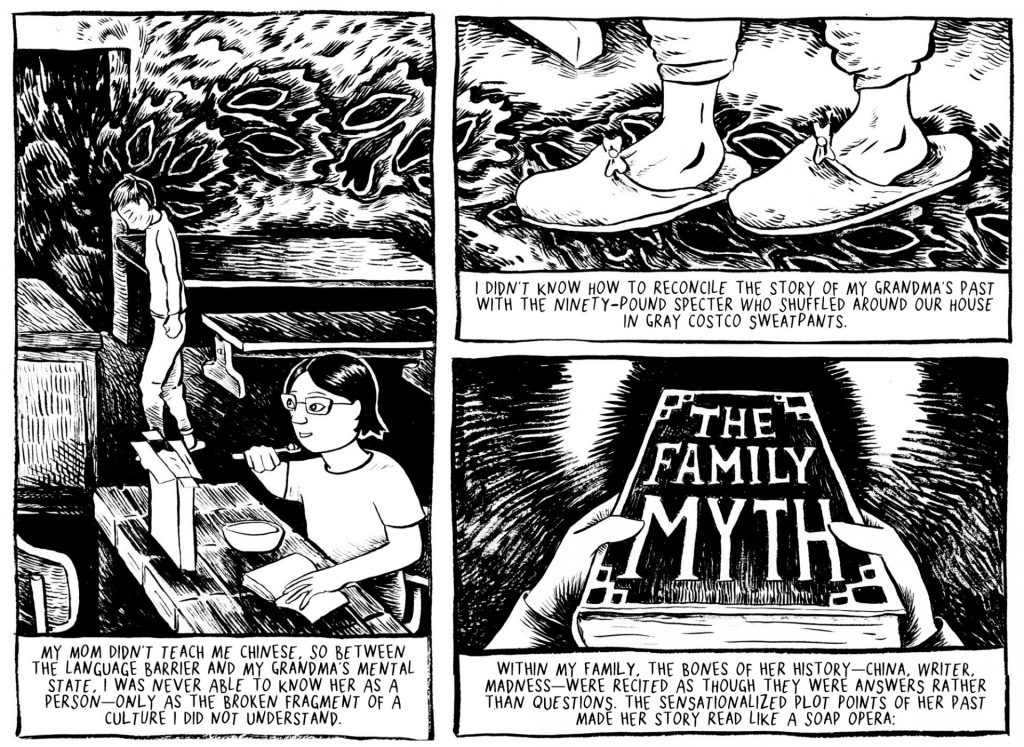
Sun Yi, her grandmother, was once a journalist and a best-selling memoirist in China. This book is Hull’s attempt to reconcile the two grandmothers, the one who had fled Suzhou as a child to escape the Japenese soldiers who raped her cousin and hanged her uncle during the Sino-Japanese war, who despite her turbulent childhood became a journalist for pro-nationalist newspapers at a time when women’s education was considered secondary to men’s, who was persecuted by the communist government and, in turn, wrote a best-selling memoir about it, and the other grandmother, “the ninety-pound specter who shuffled around [their] house in gray Costco sweatpants” bitterly consumed by her mental illnesses, when Tessa was growing up. Tessa’s mother, Rose, upended their lives in trying to take care of her grandmother and believed that it was her writing — her propensity towards creative pursuits — that caused her (Rose’s) mother to lose her mind. Consequently, Rose became unduly protective of her daughter. “Unresolved ghosts grow stronger across generations, destroying children with the very things their parents swore to save them from,” Hulls explains.
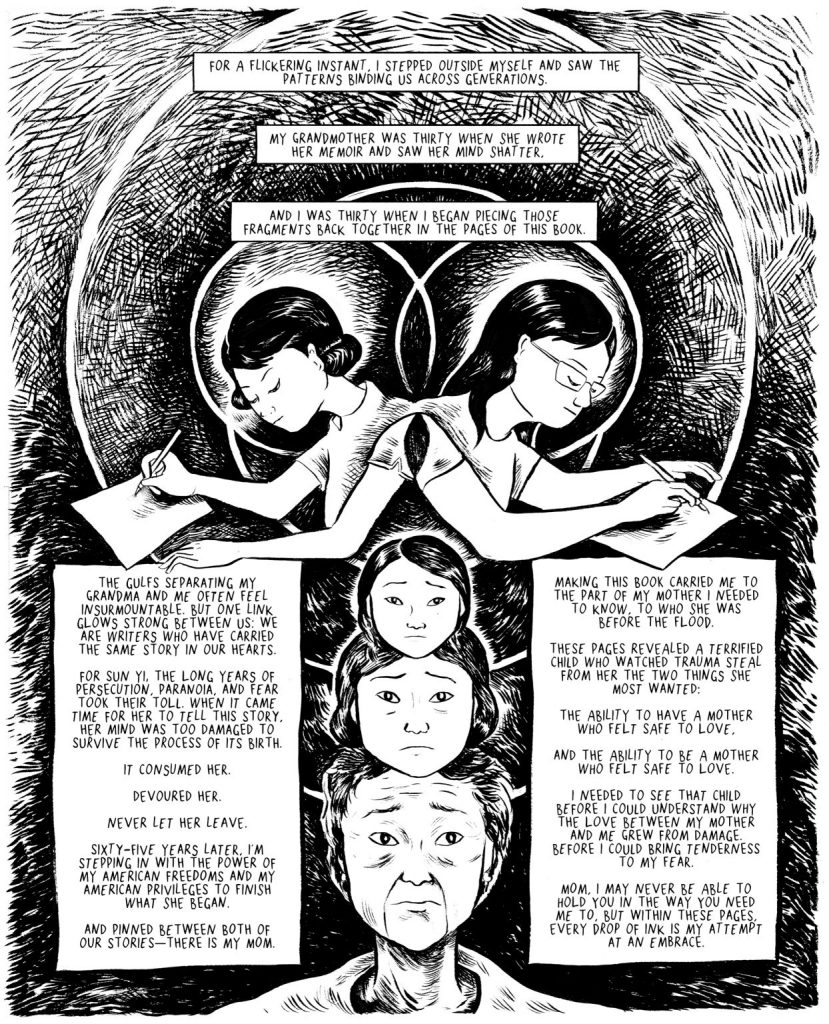
This is the crux of the book. The first chance she got, Tessa ran away to the wildernesses that she fantasized about as a child, to distance herself (quite literally) from the troubles in her lineage. When her grandmother dies while she is hiking in some other continent, she realizes that in order to overcome her past, she first needs to face her ghosts.
In 2025, Feeding Ghosts became the second (the first in a regular category) graphic memoir to win the Pulitzer, after Art Spiegelman’s Maus, which was awarded a special prize in 1992. I interviewedTessa Hulls for an hour over Zoom about her book, her decade-long process, the complex history that inspired it, how she had to become a character in the story in order to uncover her grandmother’s — a journalist who wrote against the regime — escape from communist China, and the intergenerational traumas that followed their family as they escaped to Hong Kong and then to the United States. The conversation elaborates on her laborious research, why she chose comics as a medium despite being a writer first, 4,000 square feet of maximalist drawings, literary inspirations, the implications of telling someone else’s story, and how she is using her Pulitzer fame to build up other writers.
Kay Sohini: You mention that you have been working on Feeding Ghosts for a decade. Can you walk us through the research, writing, and drawing process?
Tessa Hulls: I spent the bulk of the time trying to not ever have to tell the story, so that took me about a decade of running away. When I started, I hid in the research for as long as possible, because I knew that in order to unlock my grandmother’s story, I was going to need to understand China during the era that she lived through. I justified that choice and hid from the part that involved me facing my feelings by saying, Oh, I know there’s gonna be a lag time between when I can get this translation of my grandma’s book, so I’ll just spend a couple of years just reading voraciously. The point at which the project started shifting in earnest is when I got that translation of my grandmother’s memoir and realized this is so much more complicated than I thought it was going to be. The years after felt like this successive unraveling of the book I thought I was going to make as I came to terms with the book I had to make. The hardest part was admitting that I was going to have to become much more of a character in it, and that I couldn’t, in all fairness, reveal my grandmother and my mother in these deep levels if I didn’t do the same for myself. So, the research side of it took me about 4 years, and that included multiple trips to Hong Kong and China. And then I started drawing and writing it in earnest in 2019. The scorched earth production phase of it lasted about four and a half years.
KS: Before you discovered that you would have to become a character in the story, were you planning for this to be a work of graphic journalism?
TH: Yes, I was gonna hide from all the hard parts by just saying, this is the history, this is what happened to my mother and my grandmother. Kind of like what I talk about in the book where I quote Karen Russell, who wrote Swamplandia!, which is one of my favorite novels. She said to be a true historian, one has to mourn amply and well. That was the way my family’s story tricked me into telling what needed to come out, by changing my definition of history. I think I was lucky to have an editor who encouraged me to lean in…to that breaking of the fourth wall, and to really make that idea of being dragged into an emotional vulnerability that I was determined to avoid become part of the overarching of the story.
KS: There’s a documentary aspect to the memoir in the vein of Joe Sacco or Guy Delisle. Can you talk about the influences on your style?
TH: Delisle’s stuff was actually some of the first that I read when I was trying to teach myself how to make comics. At first, I really loved it, and then I kind of got frustrated with this recurring trope of white man gets sent to another country, and then sits in his hotel room and pillories everything around him. I think he’s a great comics artist, but I also have some side-eye towards the way that he tells stories about going to other cultures, for sure.
Fun Home was the first thing that I read that became the closest proxy for what I wanted to do, and part of that is because I’m coming from a background of both a writer and a visual artist, but not a comics artist. I think I’m really picky when it comes to the quality of writing, and whether or not a comics maker has made sure that the story they’re telling works structurally. With the written side first, and I think most comics fall flat on that count because they’re not thinking about it from that structural perspective. So, when I found Fun Home, I realized, oh, here’s a graphic novel where you can actually take all of the images away, and the text reads as a standalone essay. I’m not a full-time teacher in any capacity, but sometimes I moonlight teaching workshops, and that’s one of my favorite things to do. I give students the text of Fun Home as essays first, not telling them what it comes from, and have them look at all the thought and care to literary structure that went into this before it became a kickass graphic novel.
Some of my other favorite projects come from makers who aren’t traditionally working in comics, like Thi Bui’s The Best We Could Do. She tried to write that as a history dissertation, and I think that’s why I love it so much: it was that same sort of process of, oh, I have this story to tell, I could write it as an academic examination and nobody outside of universities would read it or see it, or I could take all of the research, put it in a format that allows for more emotional tenderness and connection, and have it become something more. There’s a really similar story with Rebecca Hall’s Wake. The premise behind it? I loved it, but I admit I was a little disappointed by the execution. She did the writing and had another person as her illustrator.
My guess is the artist was someone she probably had a pre-existing relationship with, and so by the time they moved forward with making it a graphic novel, that was already an established pairing, and as much as I wanted to love that collaboration — it felt like the artist couldn’t live up to the strength of the writing.
KS: Maybe if she did it herself…because comics have a lot of give, in the sense that you do not necessarily have to be a trained artist to be able to make good comics. There’s a way to make comics and still have it be effective, even if you’re not a great draftsman.
TH: That’s a great segue, because two of my favorite comics that I read last year, they’re both memoirs. Sarah Levitz’s Something Not Nothing and Teresa Wong’s All Are Ordinary Stories. Those are two artists who “can’t draw.” But they made these works of such profound emotional impact. There’s a way in which the visceral emotional quality that makes comics come alive is sometimes better served by somebody who’s not a great draftsperson.
KS: Absolutely. Speaking of which, you mentioned that while you were experienced in painting, you were not familiar with graphic novels or the comics medium before you started working on Feeding Ghosts. Can you tell us a little bit about why and how you decided that this story has to be comics?
TH: Basically, for the same reason that Thi Bui did. I had something that was gonna be dense and academic and that wouldn’t connect with an audience if I just did it as a wordsies book. It’s funny, because one of the things I didn’t realize until I was pretty far into this process was…I talk in the book about Rupert Bear and the moment where I realized that my family is this microcosm of British colonialism, and so my British grandparents, every year, would give me the Rupert Bear anthology. It’s this British comic, where the format is four panels, and then there’s a rhyming couplet beneath each one. But then, below that on the page, the same story is written out as a narrative. And… looking back in retrospect, I’m like, oh man, that apparently sunk into me on a level that went on to inform maybe everything I’ve ever done, because it was this idea that you can read a story on three levels. Visually, with text boxes, and then as a narrative, all simultaneously on the same page. So I think that idea was actually instilled in me in this quiet, subversive way from childhood. The first thing that made me want to be an artist was Calvin and Hobbes. Bill Watterson remains my favorite artist, and I have this kind of perverse side where, you know, sometimes I end up in very fancy spaces now, especially in the fine art world, where people are talking about their favorite artists, and I’m like, yeah, Bill Watterson. Ride or die, always. That’s never gonna change.
I think I was primed to understand the power of comics, and I’m actually really grateful that I didn’t come in more versed in them, because I think it really gave me the leeway to break a lot of rules.
KS: I empathize with that. I completed a PhD in English three years back, and I drew my graphic dissertation as a comic. I was thoroughly inspired by Alison Bechdel and Thi Bui. It was part memoir and I figured that if I were to do it in the conventional way, it would likely never be read by anyone but my committee and I wanted more from it. I get asked why the pages in my first book are splash pages or not conventionally comics, and I wish I had a profound answer for that, but the truth is when I started I didn’t know better. Once I did, I found all the ways in which breaking the rules can be useful.
TH: I was recently hanging with a graphic novelist friend here in Seattle who shall remain nameless, but we were talking about one of the unintended side effects of comics gaining so much more credibility and there being so many more programs where you can study them academically is that, for the first time, you are seeing this homogenous output, where you can see… oh, I know where that person went to school and I know who they studied under. We were swimming at the lake together, and being like, are we just assholes? Show us people who are reaching for something they can’t quite grasp, rather than people who have become technically fluent, but there’s no stakes in their work because it’s so polished.
KS: I find that in comics, by experimenting with page compositions among other techniques, there’s a way to braid together seemingly disparate threads from the past, present, and future. Your comic dabbles in that quite a bit. Can you tell us a little bit about the non-linear nature of the narrative and how that was aided by your choice of medium?
TH: Yeah, that was incredibly deliberate. The way that I structured the book, everything is based around trios. I was thinking about the context of Renaissance painting compositions and triangles, and triangles being one of the strongest shapes that you can encounter structurally, while also being very dynamic. I had myself, my mother, my grandmother, past, present, future, Hong Kong, China, the United States. It was really deliberate that everywhere that I could, I was working on this idea of everything being in threes. The structure of the book more or less unfolds chronologically in terms of where the meat of each section is. But I made sure that every time signature was in every section. I made this giant map on my studio wall in painter’s tape and color-coded post-its so that even though the book had 11 sections that moved chronologically from start to finish, each section contained all of the trios.
KS: When you say a giant wall in your studio, do you mean the entire book is hand-drawn as opposed to drawn on a digital drawing software?
TH: Oh, yeah, the whole thing is drawn by hand with a Japanese brush pen. It was analog and it was 4,000 square feet of drawings.
KS: I am fascinated by how detailed your backgrounds are. There is a lot of very inky and intricate design that scaffolds the characters or the primary scene unfolding in the foreground. How did this style come into being for you?
TH: It’s because I was a painter. When I was first teaching myself to draw comics, the hardest part was unlearning the visual vocabulary of being a painter, because sometimes it’s not helpful for you as a comics artist to be able to render things accurately. It was already such a maximalist story by every possible measure: I needed to find ways to streamline the viewer’s experience. Part of that was choosing to do the book in black and white, because if you look at my paintings, I love color. I am a creature that lives for color, so that was the first thing that I extracted. The first pages that I drew, they didn’t have that density of ink, because you could tell that I was learning to make comics, and I just didn’t have the relationship between depth of focus really right yet, but as I started to gain more fluency in the language, that’s when the decades of training as a painter just started to come out, and I realized, oh, I had to unlearn being a painter, but now that I’ve learned this, I can be a painter again. That’s the point at which I embraced there’s not going to be any white space anywhere. I probably went through more than 80 Japanese brush pens. I was using the Pentel color brush ones, where you can change out the ink barrels, and I really wish that I had kept track of how many of those I had used.
KS: That’s something. I wish your book had some sort of a behind-the-scenes at the end where readers could peek into your process.
TH: I have always been way more interested in process than product.
KS: Do you have a favorite page? Something you wish readers would take time to notice or decipher?
TH: There’s a couple of instances where I have double-page spreads that were my morale survival pages, where I could just give myself a break and just let myself be a painter. Part of what was so agonizing for me about this book is it forced me to stop being a multidisciplinary artist and just do one thing that looked the same forever. So, those were the pages where I let myself just experience the somatic joy of letting ink soak into paper in a really detailed, fluent fashion without thinking about layout. There’s a two-page spread when my mom and I are in China for the first time, and I’m talking to her as I’m brushing my teeth, and I was saying, I kept hearing this phrase, Hui Lai, Hui Lai. She says, oh, hui lai, it means come home. Drawing that spread was probably where I got to be the most meditative and detailed.
KS: Early in the book, when you are explaining the birth order in your family, you draw an illustration of a photograph and then, on the very next page, we see an actual photograph. Can you talk a little bit about your inclusion of photographs in comics? I was recently asked a variation question and the only thing I could think of was how deep down I wanted to preserve the authenticity of that moment, but it didn’t feel like a full answer. When I read your book soon after, I wondered where this impulse comes from, to punctuate an otherwise hand-drawn narrative with photographic evidence.
TH: There’s a couple of reasons. The first is that I wanted to tell this book as a graphic novel because perspective is embedded into the format, and it reminds the viewer over and over again that history is something that happens to people. By including photographs, it really drills that point in. You cannot lose track of the fact that this is a true story, and these broad, sweeping atrocities you hear about are more than just unimaginable death tolls: these were individual people and individual lives. I wanted to reinforce that experience of history, and also to subtly remind the reader that this is a family story. Photographs force you to confront the idea of continuity and generations, because you see faces change, you see echoes, you see memories, and there’s a way in which we’re so primed for recognition that a photograph has a different level of impact, especially when they’re scattered sparsely. It’s still a surprise, it’s still fresh.
The other reason was because so much of the book was about research. I used an old-timey typewriter font when I was coding my grandmother’s memoir, or when I was looking at archival materials. By including primary documents and photographs in some places, I wanted the reader to have to remember that the act of finding all of this information was analog. I went to all of these places, I sifted through all these files, I went searching, and…. there’s a different level of impact when I’m using the original documents, rather than just redrawing them.
KS: When you were sifting through these files and archival material, were you drawing simultaneously or sketching loosely at any point?
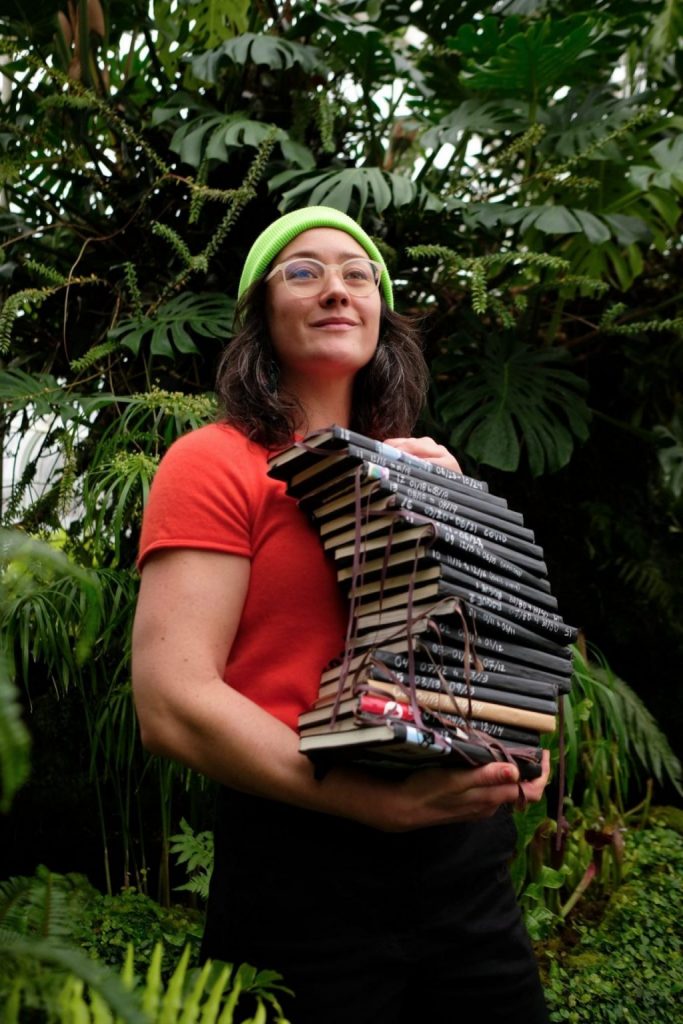
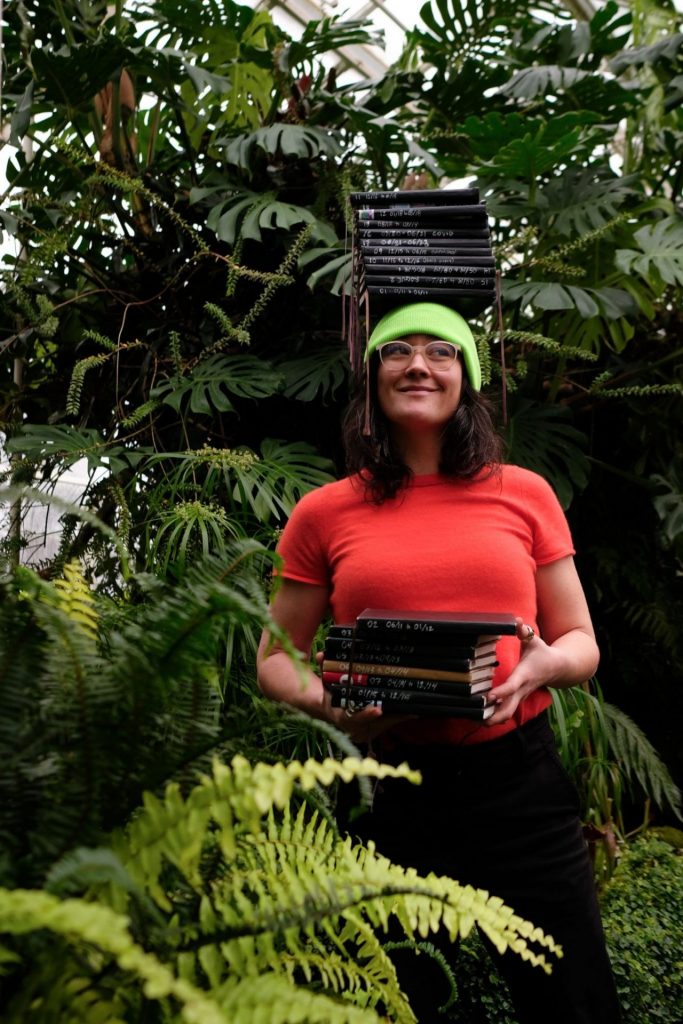
TH: Yeah, I am a Moleskine person. I’ve just got a huge stack of notebooks, and if anything were ever to happen to them, it would be like losing my life’s research library. I should really scan them. So for me, these are my field notebooks, where I’m just writing down all the first impressions, but I’m not trying to make any sort of honed or polished work while I’m in the field, because I’m somebody who gets the first 80% of the way towards something very, very quickly. I’m a creature of motion. And then the remaining 20% takes me six times longer than a normal human being. And I think the magic of any work or any story has to come from that 20%.
KS: That truly shows in your work.
TH: Oh, thank you. Well, you know, that’s…. I really feel like I could not have started this story any earlier. There is an amazing sense of coming full circle, or completing a cycle where I started it at 30, it came out when I was 39, and with 40 being such a huge cultural milestone — There is something about the fact that I can now nod at my ghosts like, “Yeah, I gave you a decade. I gave you the chapter of my life in which you’re cementing the form everything is going to take moving forwards.” And it has been a really interesting thing to process, this feeling that I completed the largest task of my life. And my gift is that I don’t have to go into my future haunted.
KS: You mention that you thought about quitting all the time. Having finished the work of excavating your own past and then the mammoth task of arranging a complex intersection of the historical and the personal into panels… was it cathartic at all?
TH: I don’t know if catharsis is the word that I would use. I think I knew there was a task I had to complete, and it wasn’t just for myself, and I do feel an immense and extraordinary freedom on the far side of it. And I don’t think that relief was necessarily through making the work, but rather about having answered a call.
I actually just got back from 11 days in Alaska with my mom, who, at this point, has very advanced Alzheimer’s. And she said to me about a year and a half ago — because she has some awareness of what’s happening — she said, Tessa, “While I can still be in the world, I want you to take me to Alaska so I can understand why you’ve loved it for so long.” So that had been in the works for a while, and having just had this experience of taking my mother, who in some ways has reverted to a childhood she never got to have, and bringing her to the place that I love above all else. To be able to share with her the place that has always represented sanctuary and escape to me, that’s what I got out of making this book. I don’t…. feel like catharsis is quite the right word for it, but it reconnected a series of bonds that had been severed for generations. And I’m extraordinarily grateful for that.
KS: That’s beautiful. Can you talk a little bit about how wilderness informs your book and life?
TH: Wilderness is the place I feel safe; it’s where I feel connected. It was my refuge in childhood, and it made me a very unusual and contradictory person, where the two frontiers I love the most are the literal back country and the library. So I’m a very, very bookish nerd who also likes to go do really ambitious, wilderness things in the middle of nowhere, ideally alone. It’s the place where I can just be silent, and where I can put down the weight of everything, and I’m moving into a next chapter where I’m really trying to allow that relationship with wilderness to be the driving force of the professional choices that I’m making. That’s where I want to be of service, and that’s where I want to show up, using my voice towards the protection of these imperiled systems that we’re destroying.
KS: Do you think you’d want to write a book about it?
TH: Nope, never. I’m never making a book again, I’m really not. I am going to continue to be an artist and a writer, and use comics, but I just know that my cadence is working on something for 3 to 9 months. That is where it’s enough time to really do a deep dive into something, but in a way that it doesn’t become your entire world. The act of making Feeding Ghosts forced me to willingly step into the cage I was the most afraid of. I grew up with my mentally ill grandmother writing all day, every day, within an unchanging story that she could never escape. And there’s something very ironic in the fact that to bring closure to the tragedy of her life, I had to do the same thing. I had to go into a room and write alone all day, every day , until we could basically carry her story forward to the point of the present, and instead of going back and repeating the cycle, choose a different path. But… it was so isolating, and I don’t have that in me again.
KS: That is entirely understandable. I mean, I’m not an extroverted person, and I’m scared of the wilderness, but comics can be a lot. I love the magic of the medium and what you can do with time and space. But also, it takes an unfathomable amount of time. I was in the middle of writing this intergenerational story on the Partition of 1947, when I realized that it has to be prose. If I tried to draw it as a comic, with my style and pace, it would take ten or more years.
TH: People talk about how the emotional toll of writing is hard because you have to relive a scene in your mind. I want to be like, try drawing it! Because the way that your brain is wired, you can’t help but mirror the expressions you’re drawing. You can’t help but take on the physical poses. And I try to tell this to friends of mine who are writers. When you’re drawing, you’re not just rewriting a scene, you are reenacting it with your body as you’re making it, and I think there’s a heavy somatic burden to that. That isn’t talked about enough.
KS: You probably know this, but Bechdel has this habit of reenacting every scene she draws. She dresses up in a suit to pose as her father, takes a photograph of herself on a self-timer and then draws it. I don’t know if she does it literally for every panel, but….there’s a toll to that.
TH: There is, there is. There’s a toll and there’s power.
KS: A memoir is rarely one person’s story. This process of finding one’s roots, tracing intergenerational trauma, can be a delicate thing because one is tasked with asking questions of family members that they themselves might have unprocessed or complex feelings about. Then there’s the question of the privacy of others. How did you navigate this complex dynamic?
TH: It was easy in some ways, because the throughline of the story was: trauma created a heartbreaking level of isolation, and with my mom and grandma coming to the US and not becoming part of an immigrant community and not having family over here, there just weren’t that many people. I was insulated from a lot of that judgment and a lot of that complexity, because there wasn’t really anybody whose permission I had to get. My biggest concern was over my family that’s still in mainland China and not wanting to do anything that was gonna expose them. I did have conversations with them about that, and that is why I chose to follow my grandmother’s example and redact names and remove identifying information.
Then, in terms of my mom, that was really the only relationship where I had to navigate that. In the places where we disagree, I just offer that up to the reader, and really force the ambiguity onto them. If I have to pick this up, you have to pick this up too. In some ways, the book is a Rorschach test, where people bring their own relationships with their mother into it, and I’m really fascinated by the people who come off feeling that I was very judgmental and critical of my mother, and other people who think that I was enormously compassionate. It’s not my job to tell you how to feel, but the wild array of interpretations of my mother makes me feel like I did my job.
KS: That actually brings me to my next question. My mentor from grad school, Professor Lisa Diedrich, who is teaching Feeding Ghostsin her “Documenting Mental Illness” class at Stony Brook University, mentioned to me that she is very interested in the incorporation of your grandmother’s memoir into your own memoir, in what she theorizes as a “clinical gaze.” There’s a part in the book where your grandmother and your version of reality diverges. As a reader, I can see that you are trying to get as close to your grandmother’s version of the story as possible, but there’s still a gap in between her written words and what you discover. Did comics as a medium come in handy in representing these discursive truths?
TH: Yes, I love this question because you basically just said my answer to why I chose comics, or for that particular element of it. When you have words and images, going back to my obsession with triangles, comics have that invisible third point that is the synergy of those two things. If you’re making a metanarrative about what is the truth in the face of profound disagreements of perspective, you can actually show that visually in comics in a way that you can’t do in any other form. Between a combination of being able to interject myself as the narrator, and literally point to parts of the story that I disagreed with, and put the words and images in tension… I think anybody who’s reading it closely will see that there’s a deceptive number of choose-your-own-adventure options embedded at every layer of the story, where if I’ve done my job well, the reader is having to make a near-constant set of choices around what to believe, and I’m not telling them.
KS: I think that’s what great literature is made of, you’re not spoon-fed a version that is easy to digest. Now that the book is out in the world, is there anything you wish you did differently?
TH: Oh, God. The thing I wish I could have changed is completely outside of my control. I had to make Feeding Ghosts during COVID and I was in a really bad set of circumstances. To begin a project like that, while in total isolation… I had moved to Port Townsend, Washington, and had this bucolic rural life, where I was mountain biking alone through the woods to get to work, and I would just sit in a shed all day and wouldn’t see people… what I really needed during that time was a supportive community and friends and really close ties and a rich and vibrant life outside of making the book. I wish that I had found some way to have escape routes.
KS: Do you think it would have been a different book if you weren’t in that position?
TH: I think there were two factors that allowed me to go abnormally deep with the story. One was that I wrote the outline of it while I was living alone in the woods for half a year for a wilderness writing residency. I got something that pretty much no writer ever gets to have, which is a physical landscape in which to find the full measure of a story, with no distractions for six months. It would have been a completely different book if not for that. And then there was COVID…. there were no distractions. There was no outside world, so the depth of focus that went into every layer of that book is not something I would have been able to do if it hadn’t been externally forced on me. It would have been much better for my mental health to have made it in a different set of circumstances, but I think the book is stronger for the fact that it literally was my entire life.
KS: What was winning the Pulitzer like? Did it change your literary life in any way?
TH: I’m really grateful for the fact that it happened while I was in Alaska, incognito in my other life. I was working as a chef for the Alaskan State Legislature. I needed a winter to hibernate and just kind of be away from the public-facing persona of my life, and I got that for four blissful months. And then my cover was irrevocably blown. It’s been really overwhelming, and I spent most of last month alone in the backcountry. That’s when I finally was able to kind of just wrap my head around it, and find my own center again. Now I’m feeling really excited about the fact that it’s opened a lot of doors, and it gives me the ability to get other people past gatekeepers and question the status quo. I’m really looking forward to thinking about, okay, how can I use the recognition of the Pulitzer in a community-driven way? There’s a lot of potential and possibility attached to it, and I don’t fully know what that’s gonna look like yet. But I don’t want it for myself. I didn’t do this for external validation; I’m a conduit, not a focus. What I’ve been doing, is, you know, there’s such a deluge of people wanting things from me and wanting to connect, so I just texted a bunch of my friends who I know have books coming out in the next year, and I’m like okay, give me your details, give me your elevator pitch, and so I can tell them: this is what my friends are up to. Go talk to them instead.
KS: I love that. When I saw the announcement, reposted in Teresa Wong’s story, I was immediately telling my spouse that, look, babe, look at this! A graphic novel won the Pulitzer! A first for comics in a way because while Maus won it in 1992, back then, it was in a special category.
TH: I’m sure sooner or later somebody will want Art Spiegelman and me to do an event together. I’ve had people ask about Maus a lot for really obvious reasons, and the way that I think of Maus is that it was Feeding Ghosts‘ older brother, who opened those doors. Obviously, Feeding Ghosts could not have existed if Art Spiegelman hadn’t changed all of the rules with Maus, so I do look forward to the fact that at some point we’re likely gonna professionally get to meet and talk shop.
KS: I look forward to that, too. I mean, as do many, many people, I’m sure. This was great. We are wrapping up a little before time, so if there’s anything I didn’t ask you that you would like to talk about?
TH: For the first time in ages, I actually want to write something. My burnout has recovered, and I’m reading my friend’s book right now: Intemperance by Sonora Jha. Get yourself an ARC of this, it’s awesome. It’s not comics, but it’s such a good feeling to have something spark. It’s been so long since I’ve felt that rush, and I’m writing something. I’m writing something for the first time in years. It just feels really good to be like, oh, okay. The mending is happening. It’s not dead forever.
KS: It’s a novel?
TH: Yeah, it’s a novel, and it’s got me thinking about unhinged female desire, and what it means when women hit a breaking point. And go too far in a way that kind of elevates things to the level of myth. There’s a handful of female writers — most of them Asian women, now that I think about it, which is interesting in and of itself — who are writing about the monstrosity of female craving. I don’t know what it is yet, but I’m working on something.
SOLRAD is made possible by the generous donations of readers like you. Support our Patreon campaign, or make a tax-deductible donation to our publisher, Fieldmouse Press, today.
Leave a Reply