Stop me if you’ve heard this one before. A lauded writer of both fiction and travelogue and an old guard indie comic artist walk into a bar. The bartender says, “Never mind what I can get you, what the hell are you two cooking up?” To which they reply, “A crazy little thing called Crazy for You.”
Nearly three years and over two hundred pages of art later, a bold graphic novel adaptation of two iconic stories emerges: tales that explore themes of power, ownership, love, lust, self-delusion, and choices that cannot be overcome.
Paul Theroux has been writing books since his time in Africa with the Peace Corps in the 1960s. His short fiction regularly appears in The New Yorker, Harpers, The Atlantic, and The Sunday Times of London. His fiction is filled with characters who overreach and face retribution. His travelogue, by contrast, has been described as, “He’s literally the intrepid traveler, embracing discomfort and risks, in pursuit of the pure gold: Novel encounter with man, nature and everything in between.” He revolutionized the genre with books like The Great Railway Bazar, The Iron Rooster, The Old Patagonian Express, and On the Plain of Snakes: A Mexican Journey. Many of his novels have been adapted to the screen, most notably The Mosquito Coast, which has been both a film (1986) and an Apple TV series. (2021-2023)
Steve Lafler has been making comics since his days at the University of Massachusetts Amherst in the 1980s. His most recent series, 1956, is set in the jazz scene in 1950’s Manhattan. In Death Plays a Mean Harmonica, he explores a surreal world of American expats in Mexico who encounter a 2000-year-old Zapotec vampire and the musical stylings of Death. His BugHouse trilogy features a full cast of insect-headed people, but focuses on jazz musicians and deals with making music, band dynamics and controlled substances as a creative tool and a path of destruction. His comic bona fides go back to the heyday of indie comics in the late 80s and early 90s. As the publisher of Cat-Head Comics, where he and writer Stephen Beaupre produced Duck and Cover and 40-Hour Man, a classic rant on the down-and-out life of hourly employees. He was also editor of Buzzard, which published a veritable who’s who of the 1990s alternative comics greats, including Krystine Kryttre, Lloyd Dangle, Julie Ducet, Mary Fleener, Phoebe Gloeckner, Adrian Tomine, J.R. Williams, James Kochalka, and Aleksander Zograf.
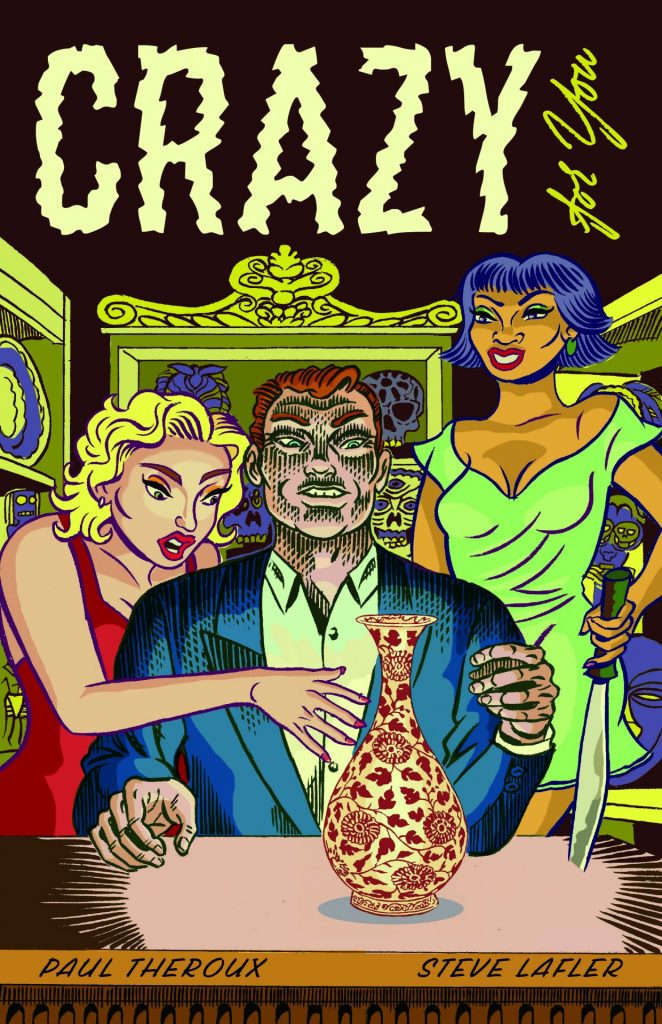
In Crazy for You, Lafler has adapted two of Theroux’s short stories into an intense 210-page graphic novel.
Minor Watt is about a wealthy art collector who experiences euphoric levels of power by destroying priceless one-of-a-kind art pieces in front of people who will be the most horrified by the destruction. Eventually, that is not enough, and he must raise the stakes.
Siamese Nights is the story of Boyd Oiser, an American corporate cog, working in Thailand. At first, it is just another overseas assignment, but eventually he falls under the spell of a local woman, and his life will never be the same.
The following interview was conducted over email and phone.
Tasha Lowe – So the most obvious question is, how did this collaboration even get started?
Steve Lafler– In early 2020, I read Paul’s excellent travelogue book, On the Plain of Snakes: A Mexican Journey. I love his brilliant travel journals, connecting with local people and cultures the world over with wit, empathy, and his splendid subjective ‘tude.
I’d lived in Oaxaca, Mexico, from 2007 to 2016, so this title was made for me. Paul captured the real Mexico. He certainly covered the troubled zones lorded over by the narcotraficantes, but he also shone his light on the patchwork of distinct cultures and many worlds that thrive in Mexico, including Oaxaca.
Delighted with the book, I sent off a fan letter to Paul. To my great surprise, he actually replied! He expressed that it was meaningful to him to hear from a migrant TO Mexico, that his book really hit the mark.
Paul Theroux – Steve spends a lot of time in Mexico, and he complimented me on my Mexico travel book, and mentioned he wrote and illustrated graphic novels.
SL – We struck up a convivial exchange of emails, and, in due course, I foisted a copy of Death Plays a Mean Harmonica on him, my fictive graphic novel on living in Oaxaca.
PT – I looked at his work and liked it a lot, and I told him how, as a youth, I loved comic books. I grew up with horror comics – the really gory ones, Tales from the Crypt, and the grimmest accounts of revenge and horror, which were much more real and visceral to me than the tame stories in schoolbooks. Steve knew these comics well, and I guess we bonded over them via email.
I also grew up with “Classic Comics” – Moby Dick and Huckleberry Finn in pictures, exciting stuff. I liked “Lil Abner” – Al Capp’s women were sexy, and Capp was a great satirist of American life.
Steve wondered whether I had any ideas for a graphic novel or a bunch of stories, and, of course, I had plenty of ideas.
SL – Yeah, Paul casually mentioned that it might be fun to collaborate on bringing some of his short stories into the comics medium. I was game; it sounded like a fun, exciting challenge.
TL – How did you choose the stories to be adapted?
PT – I suggested that he read some of the stories from a book I had just published, Mr. Bones. He liked many of them, and we decided on the two in Crazy for You.
TL – What was the process of adapting the short stories? How does the process compare with adapting for the screen?
PT – Steve ran with them – I had no advice to give. I handed him the rights to them. We drew up a simple contract, shook hands, and he started to illustrate. I was greatly impressed with the process. As you know, graphic illustration is laborious and time-consuming.
The movie business, on the other hand, is all about discussion and “notes” and compromise, except in rare instances. The graphic novel is purer and is completely the vision of the artist.
SL – For me, it started slowly; I was scripting the comics straight from his prose. It took a while to get used to the process. The first ten pages or so, I rewrote and even re-drew the script several times. I wanted to honor the stories, of course, but I didn’t want it to be a leaden literal copying of dialogue and details.
There is a lot of exposition in Paul’s short stories: establishing character, internal dialogue, and subtle interactions. I worked with his prose until I was comfortable enough to grant myself license to interpret his work.
Like a good song, it has to swing. Once I got inside the visceral feel of each story, I could run with it.
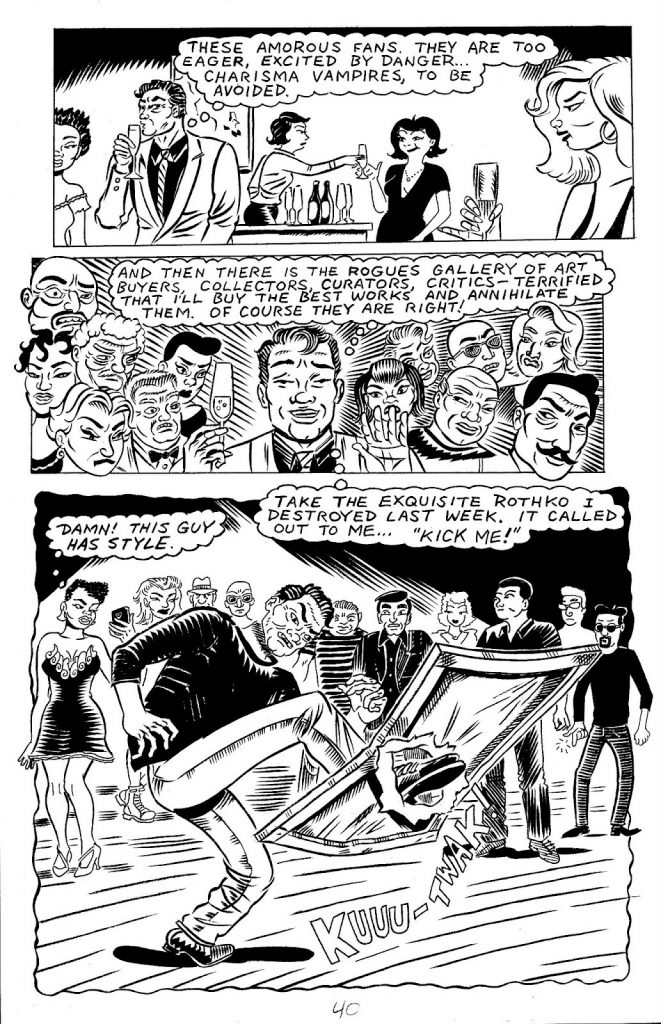
TL – So, the first story, Minor Watt, is about a very wealthy art collector who ends up destroying a great deal of his art. Steve, as an artist, how did you feel about Watt’s destruction of art?
SL – I really immersed myself in drawing the destruction of the art! It was a new kinda kick. Personally, I love Mark Rothko’s paintings. I would not kick a hole in one of his canvases. But it was fun to draw Minor Watt doing the same.
TL – Do you have a piece of art or other item that, if destroyed in front of you, would create the kind of devastation that Sonia experiences when the vase is dropped? If so, what is it and why is it so meaningful?
SL – It would be nasty to see a piece of my art destroyed! My original comics pages, I put a lot of love into my inky creations. They are indeed precious to me. But I think I could process such an experience. Look, if you rip up a page of comics, I still have copies of it, books still exist.
Interestingly, I did not keep a lot of the paintings I made in college. I have a few that I liked enough to keep, that have a special meaning to me. Most of them, I considered them developmental, and I was not attached to them.
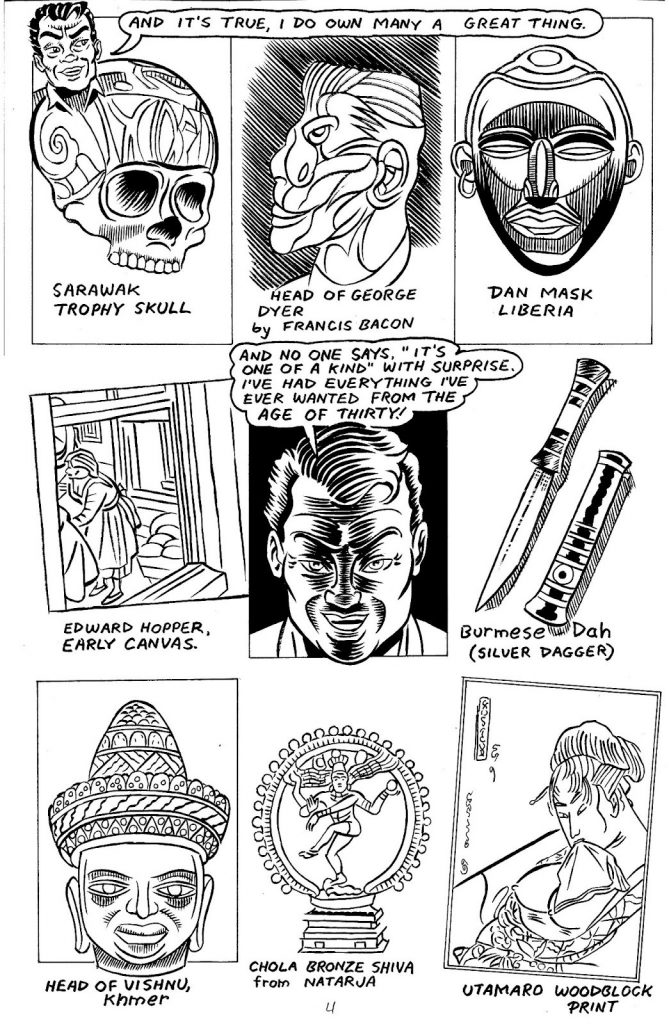
TL – There is a considerable array of art and artifacts in this story. Is that one of the reasons this story appealed to you?
SL – First, Paul knows his art. I’m assuming he himself is something of an art collector and owns some of the pieces that appear in the story. For sure, this is a story that really appeals!
I was an art major at UMass Amherst in the late 70s, a painting student, my professors working in a range of styles: Abstract expressionism, Photo realism, Figurative surreal expressionism. So, I had exposure to the “art world.” You get a glimpse of the showbiz/hustle side of the art game, the egos, the narcissism.
TL – Beyond the shock value of the destruction of priceless, often one-of-a-kind objects, the story examines the power inherent in ownership. I can’t help extrapolating that to the destruction of the environment because of land primarily being owned for industrial farming, building cities, and extracting resources.
SL – We are talking about the nature of capitalism. As we see in our current world, “Capital” doesn’t give a fuck about destruction. What it wants is simple. Capital wants EVERYTHING. It does not want to leave one scrap of food, one fucking penny on the table for anyone, anybody.
It’s worth knowing this, in that it helps the human race to understand what is needed. In the now, it is incumbent on every human being to work together, making common cause for the common good of all. It really is that simple. Another way to put it is Love (not Hate).
TL – I thought the ending was so impactful in the adaptation, but I can imagine Watt’s bruised ego striking back. What do you think he might do?
SL – His fits of destruction lead him to a willingness to kill. Without saying too much, it backfires on him. It’s another loss of power. The dude won’t handle it well!
Maybe he’d have a mental breakdown. He reveled in the infamy he gained by destroying art, but I don’t think he’d revel in the infamy of where he is at the end of the story. Of course, hhe’s still filthy rich! But, um, he’ll have to go find his wallet… ’nuff said!
TL – Steve, I know that you began a much deeper dive into visual research with your 1956 series. How much research went into the visuals for this? Was anything extra hard to find?
SL – I did use a ton of reference for many aspects of the story, from the art pieces to specific settings in New York City. I wanted it to be visually accurate, within the constraints of how I draw.
I wanted a bit of an old school comics look without actually working to ape the E.C. stylists like Wally Wood and Jack Davis. I love their works, but I’m frankly not in their league for that type of illustration. But I am a decent brush man, and I’ve reworked my approach in the last few years.
I’ve taken a loose, more expressionistic hand with the brush, taking chances, risks. Moving towards a bit of a Milton Caniff look, really. Denis Kitchen reprinted a lot of Caniff’s “Steve Canyon” strips in the early 80s, thank you Denis for performing that public service! I’ll pass on Caniff’s pro-imperialist stories, but his graphic storytelling, especially his inking, is fantastic.
Oakland horror artist Skinner recommended the Raphael sable watercolor brush to me, and it’s a different tool than a Windsor Newton Series 7 watercolor brush. Frankly, it’s more expressive; it can do more.
For example, in the Siamese Nights story, if a man is wearing a black suit, I’ll just sling, smear ink all over it. Gesture, contour, and mass! It’s alive, it looks fucking great! In rock & roll parlance: It swings, baby!
TL – In the second tale, Siamese Nights Boyd Osier is an amateur artist who keeps a visual travel journal. What did that open up for you in terms of adapting the story?
SL – Boyd’s art practice keeps him amused and occupied as he travels for work. To draw cements him in the moment, helps him pass the time.
On my end, the challenge was to draw a guy drawing, make him look relaxed, and move the story along seamlessly.
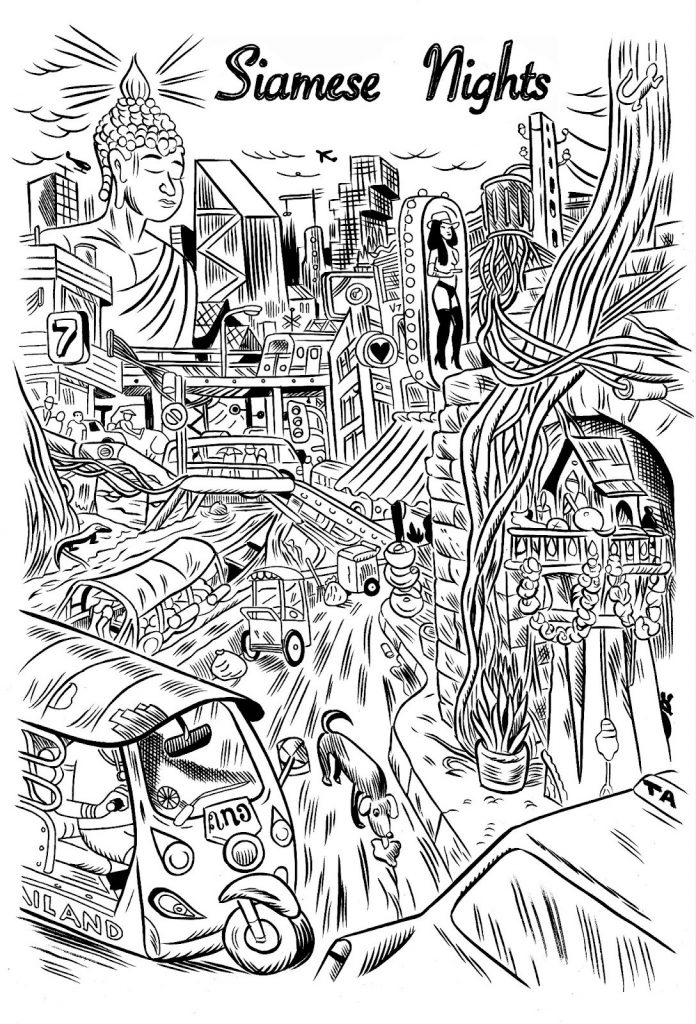
The super fun thing I did, I enlisted my friend Mats Stromberg to draw the frontispiece to the story, a sort of overview illustration of Bangkok. Mats has spent time in Thailand and Burma; he’s the perfect guy to draw this page. He is a world class cartoonist and painter. In a subtle way, it sets up the idea that Boyd sketched the frontispiece, as it looks different from my drawings!
TL – What appealed to you about the characters in “Siamese Nights”?
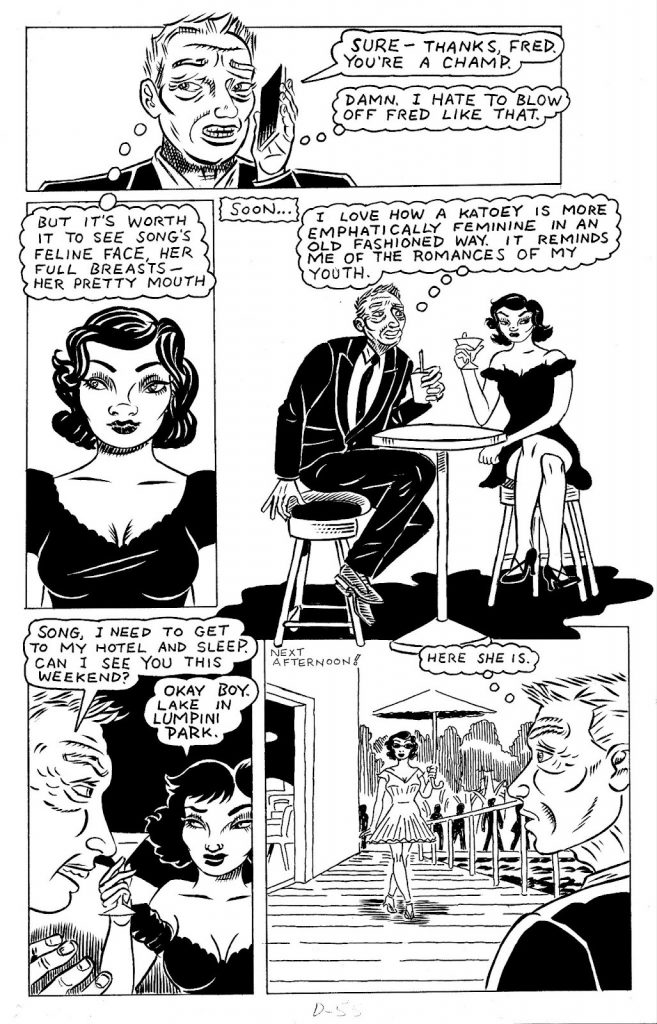
SL – Aside from the exotic location, it starts as a simple story about regular guys in a corporate work environment. Then it’s a slow, agonizing burn for Boyd as he falls into his obsessive relationship with Song, the Thai trans woman. Theroux sets up this long game where the stakes slowly build, a story structure that is new to me, and a real challenge. It took me out of my comfort zone, which is part of why I wanted to work with him.
TL – Paul, what excites you about Steve’s style and choices for the stories?
PT – Steve’s characters are strongly drawn, there’s inky power in them, and he has a great way of depicting scenes from oblique angles.
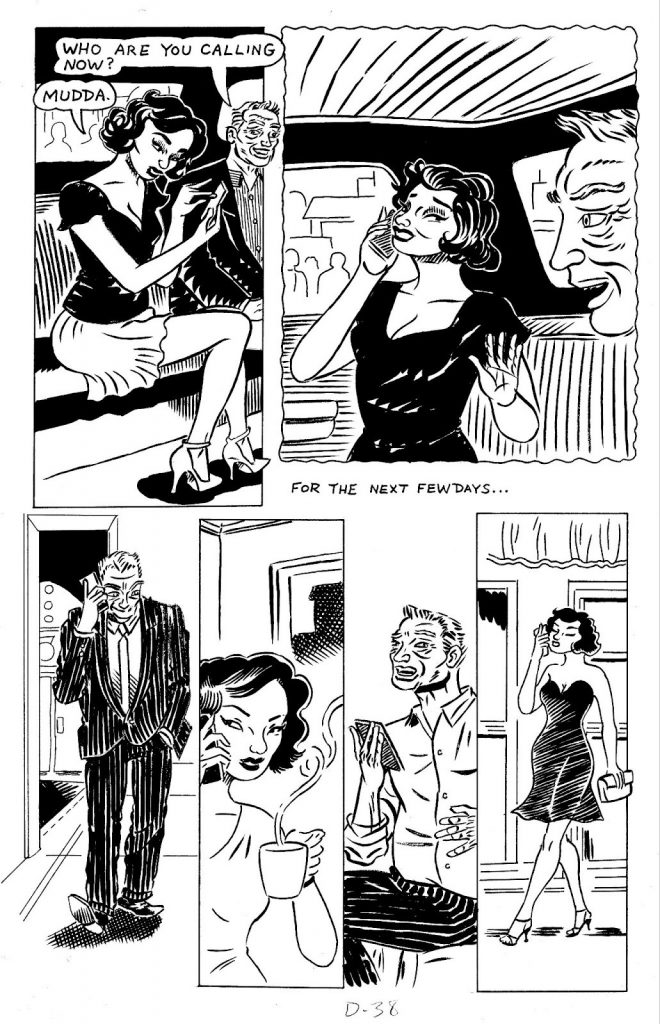
TL – Steve, you’ve written about and drawn trans characters over the years, notably in the 1956 series and your 2008 more autobiographical Tranny, by your female ultra ego, Fiona Mallratte (though I understand that she’s changed her name to Stevie Stix as of late). Song is a very different character from Ramona or Fiona. The subject is a hot button topic, with sometimes catastrophic effects on transpeople. Can you speak to your own experience.
SL – The whole idea of trans people looking for converts is laughably insane.
I can only speak for myself, but I experience “trans” as being on a spectrum; I feel it when I feel it, which comes and goes.
Being on the trans spectrum is normal, if you are on the trans spectrum. It bubbles up of its own accord from inside. NO agenda, just visceral feelings.
Here’s an example. I was four years old on the occasion of my older sister’s 8th birthday. All the girls were wearing their festive crinoline party dresses; this is 1961.
“It looks like fun,” I’m thinking. I ask my mom, “Can I have one of those dresses?” Mom grabbed me by the arm, brusquely pulled me aside, and, in a stern tone, says, “NO! And don’t ever ask me that again!”
It made no sense to me. Things went from fun to awful in a moment! I’m like, “What’d I do?!” I was just working from what felt normal.
I’m compelled to do a lot of stuff. Draw comics, run marathons, play caveman rhythm guitar, howl punky hillbilly songs at the moon, and, when the mood hits, I’m inclined to get all dolled up and go to art openings, musical and/or drag shows. These things come up in the general order I describe above.
It’s worth noting, some people who are trans are inclined to lay down rules about what transgender is. No such truths exist, except that each trans person has their own iteration of being trans that is true for them.
Conversely, transphobic and trans haters also have truly fucked up ideas about what “trans” is, and they are wrong and have no fucking idea. Unless they are trans and are describing their own self-hate!
TL – I think that almost everything in the world of human behavior is on a spectrum. Sometimes things are juxtaposed in seeming contradictions. The world would be a better place if we prioritized letting people do what made them happy as long as that doesn’t involve violence and coercion.
Having said that, Song is a very different character from Ramona or Stevie.
SL – As for Song being different from Ramona or “Stevie Stix,” you are correct! Quite simply, Paul has created a distinct character that I did my best to interpret in the comic art format.
Among other things, Song is a sex worker. I’m under the impression that many trans people do sex work, for better or worse. It is a field where people are exploited. Certainly, it would be best for sex workers to control their own jobs, their own business. I’d figure it’s the exception rather than the rule. I don’t consider sex work immoral, but I do consider cruel exploitation, all the way up to outright slavery, to be immoral.
I worked for four decades as a screen printer. I managed my own cooperative shop with a partner. We controlled our business, delivered a fair value, and reaped the rewards. It is a great model. I freely acknowledge that I had the advantage of being a white male from an upper middle-class background. There were almost no barriers to stop me from succeeding. That being said, I truly believe that it is incumbent on all of us humans to work together for the common good to share the benefits of our labor. To be really corny, LOVE is the answer. It’s the best we got!
TL – Speaking of Ramona, in addition to Crazy for You, you have finished another installment in the 1956 series. Want to tease a bit about that story for fans?
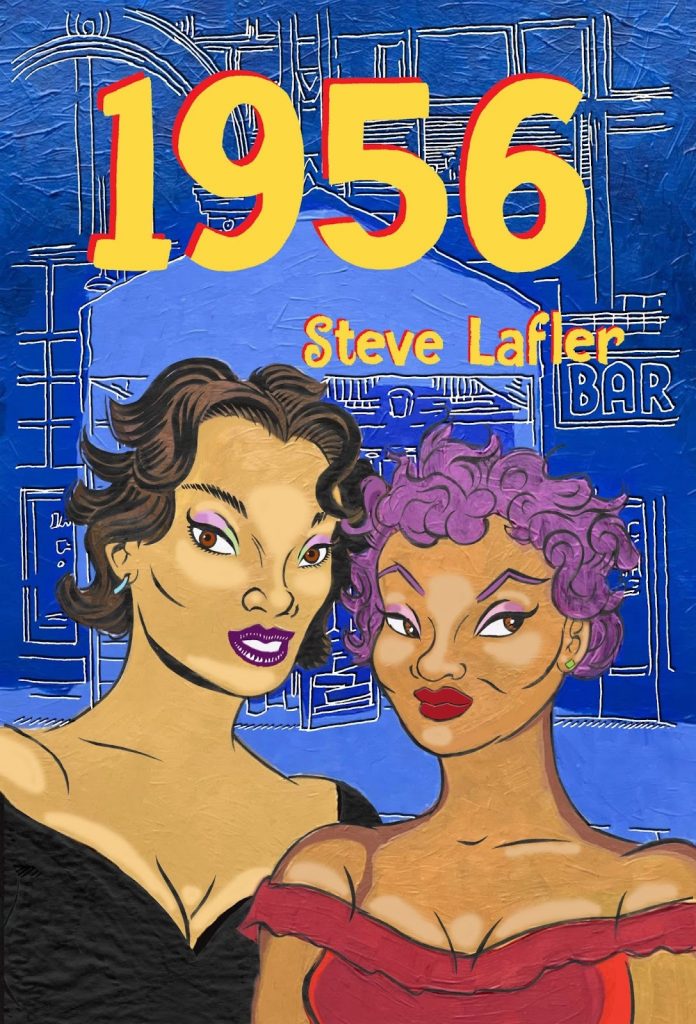
SL – What I did, after I finished drawing Crazy for You, I drew another 45 pages to finish the 1956 story. I’d actually written in early 2022, just prior to starting work in earnest on the book with Paul. So now, I’ll pull all three chapters of 1956 together in one graphic novel.
TL – Paul, you have a new travelogue slated for late 2026. Care to comment on that?
PT – I’ve been working on a book about my travels in Canada, True North: A Journey into the Heart of Canada, and I think one of the best things I read about Toronto was a graphic novel by Chester Brown “Paying for It” – subtitled “A Comic Strip Memoir about being a John.” Great insights about Toronto, loneliness, male desire, and the hooker-john transaction. That it was brilliantly illustrated made it all the more compelling.
TL – Paul, as a writer myself, I have to ask about your advice. In the New York Times in 2024, your advice for aspiring writers was:
“I suggest they leave home — go away, get a job. Never enter a “writing program.” Rather, invite experience and especially take risks.”
Would you have anything to add now, a couple years later?
PT – I consider that good advice and stand by it. I think I would add learn a new language and become fluent in it – Spanish, French, Swahili – whatever. It will add a new dimension to you.
TL – Steve, any advice to aspiring comic creators?
SL – What I always say: Pay yourself in time to draw.
TL – Thank you both for your time. Looking forward to what comes next.
SOLRAD is made possible by the generous donations of readers like you. Support our Patreon campaign, or make a tax-deductible donation to our publisher, Fieldmouse Press, today.

Leave a Reply