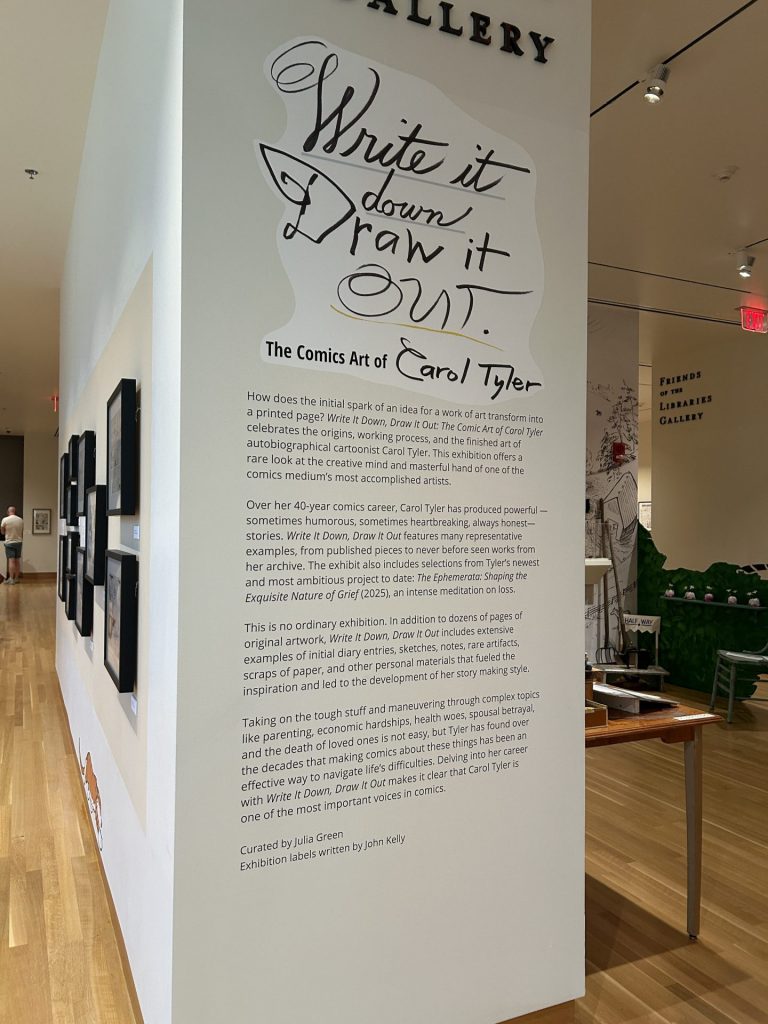
The artistic bravery and brilliance of Carol Tyler—newly inducted into the Will Eisner Awards Hall of Fame—were vividly demonstrated in last year’s exhibition, Write It Down, Draw It Out, at the Ohio State’s Billy Ireland Cartoon Library & Museum. I was lucky to see that show, a distillation of Tyler’s career story to date. For me, it affirmed Tyler’s status as not only a top-flight cartoonist but also a terrific installation artist and, in so many ways, a guide and teacher. The show took up just one of several galleries at the Billy Ireland (or BICLM for short), but I spent hours there and could have spent more. I took a lot of pictures and notes. Alas, the show is now closed (it ran from May 24 through November 9, 2025). I dearly wish that it, or some new edition of it, would travel.
Curated by Tyler’s daughter Julia Green, with crucial design input from Tyler herself, Write It Down, Draw It Out celebrated the intimate, confessional, and handmade qualities of Tyler’s art, while, in teacherly fashion, exhorting visitors to value and document their own creative processes. I haven’t seen a more effective display of cartooning as a documentary and autographic art, nor a stronger testimony to the power of first-person, autobiographical comics: simply put, an ideal exhibit of graphic memoir as both a literary and artistic practice.
Tyler (as faithful SOLRAD readers may know) is a disarmingly personal artist, even for readers like me who are used to, perhaps even jaded by, the continual outpouring of confessional autographics. What’s more, she is a genius at making-do: at upcycling the poignant detritus of everyday life and turning disused household stuff into haunting testimony. Write It Down, Draw It Out worked wonders with plywood, cardboard, papier-mâché, poly fence, and all sorts of salvage, while also revealing Tyler’s customary tools and materials: inks, paints, brushes, nibs, rags, and her own journals and sketchbooks. All these things, used and bruised, were abundantly on view throughout the show, foregrounding physical process, the joys and rigors of making stuff, and the artistic advantages of a well-documented life. Being in this space made me feel as if I were at Tyler’s elbow, looking on while she experimented and created. That’s a good place to be.
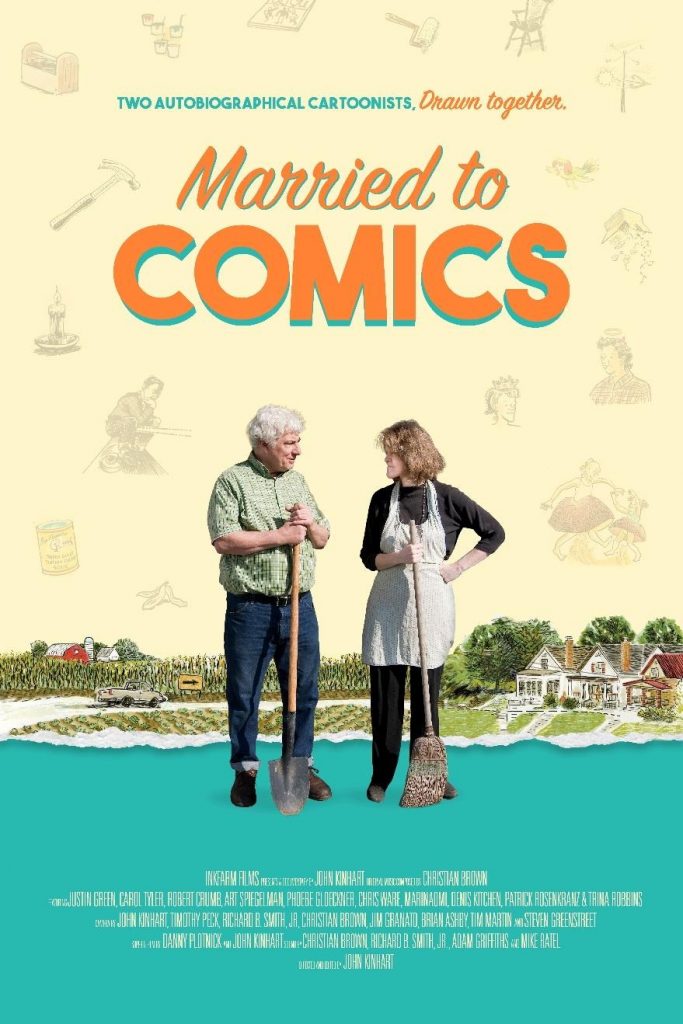
Hall of Fame status notwithstanding, Tyler continues to be an under-acknowledged artist. She is profiled in John Kinhart’s moving documentary Married to Comics (2023), a dual-career biography of both Tyler and her late husband and fellow cartoonist, Justin Green (1945-2022). Green, of course, authored the seminal Binky Brown Meets the Holy Virgin Mary (1972), an underground comic book that opened floodgates, inspiring the autobiographical comix movement. Tyler began cartooning professionally later, in the 1980s. She partnered with Green in life but not on the comics page (they cartooned in parallel, not in tandem). The film shows the complexity and rough edges of their loving, turbulent relationship, and, at times, its rawness is hard to watch. Green (or Jud) is an abiding presence in Tyler’s work, and so he was in Write It Down, Draw It Out, yet the exhibition’s focus was on her own more extensive body of work. On view were many of her contributions to comix anthologies in the 1980s and ’90s, notably Weirdo, Twisted Sisters, Wimmen’s Comix, and Drawn & Quarterly, as well as work from her books The Job Thing (1993), Late Bloomer (2005), Soldier’s Heart (2015, originally in three volumes as You’ll Never Know, 2009-2012), and Fab 4 Mania (2018). That’s one hell of an oeuvre, and it’s still growing. In fact, the show also previewed her newest work, the since-published graphic memoir The Ephemerata: Shaping the Exquisite Nature of Grief (released late in 2025). The Ephemerata, a wandering, immersive meditation on loss, is the first of a planned duology and a stunning new benchmark for Tyler artistically.
Tyler has had ample experience curating shows of comic art enriched by mixed media and what I’ll call the archaeology of process: material contexts that connect what she puts on the page to how she lives. In that sense, Write It Down, Draw It Out was a sequel to earlier efforts. I can’t think of another artist whose cartooning works so well on the page but also in a gallery setting, where sculptural and interactive elements, and even common tools and furniture, serve to inform and enliven the display of the comics as such. One forerunner of this show was Pages and Progress, Tyler’s solo exhibition at the University of Cincinnati’s DAAP Galleries in 2016, which exhibited original pages for Soldier’s Heart in clothesline style along with a mise-en-scène recreating her father’s workshop. Several works and installations from that show reappeared in Write It Down, Draw It Out. Similarly, Tyler helped design and assemble Binky Brown’s Funeral Pyre, a 2022 memorial exhibition for Justin Green at Cincinnati’s DSGN CLLCTV Gallery, of which Julia Green is co-founder, and that show too documented artistic process in an intimate way. For that exhibit, Tyler, her daughter Julia, and Catlin Wulferdingen (Justin’s daughter by a previous marriage) worked together to evoke Justin’s working life, going so far as to stage part of his workspace within the gallery—again, a workshop recreated. The title of the Funeral Pyre show, and much of its design, came from Justin himself, who brainstormed it even as he was dying of cancer. Ultimately, its scenography reproduced the messy but meaningful layering (what he called a “morass”) of art, artifacts, and sundry belongings that were part of his everyday working world. Write It Down, Draw It Out felt similarly layered, delicate, and raw: a successor to Tyler’s previous curatorial and co-curatorial work, though very much its own thing.
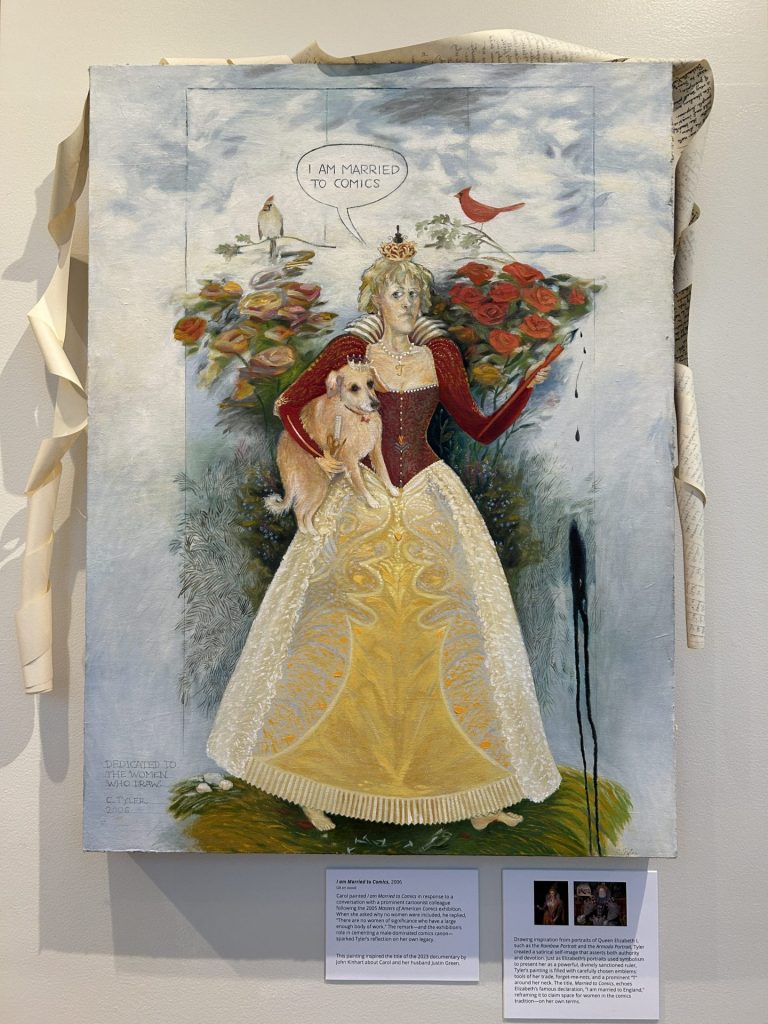
Write It Down, Draw It Out started just outside the BICLM’s Robinson Gallery with Tyler’s painting I am Married to Comics (2006), the namesake of Kinhart’s documentary. This mock depiction of Tyler as a queen (inspired by portraits of Elizabeth I) appears at a crucial early moment in the film when Tyler explains the painting’s origin: her frustration over the historical elision of female comic artists. The painting, “dedicated to the women who draw,” served the exhibition as an ironic, but then again accurate, epigraph, at once a determined Statement and a characteristic bit of self-ribbing. Next to it, at the gallery threshold, were a welcoming blurb by historian John Kelly (who wrote the object labels throughout) and copies of an exhibition guide, in the form of a zine or “keepsake booklet” by Tyler.
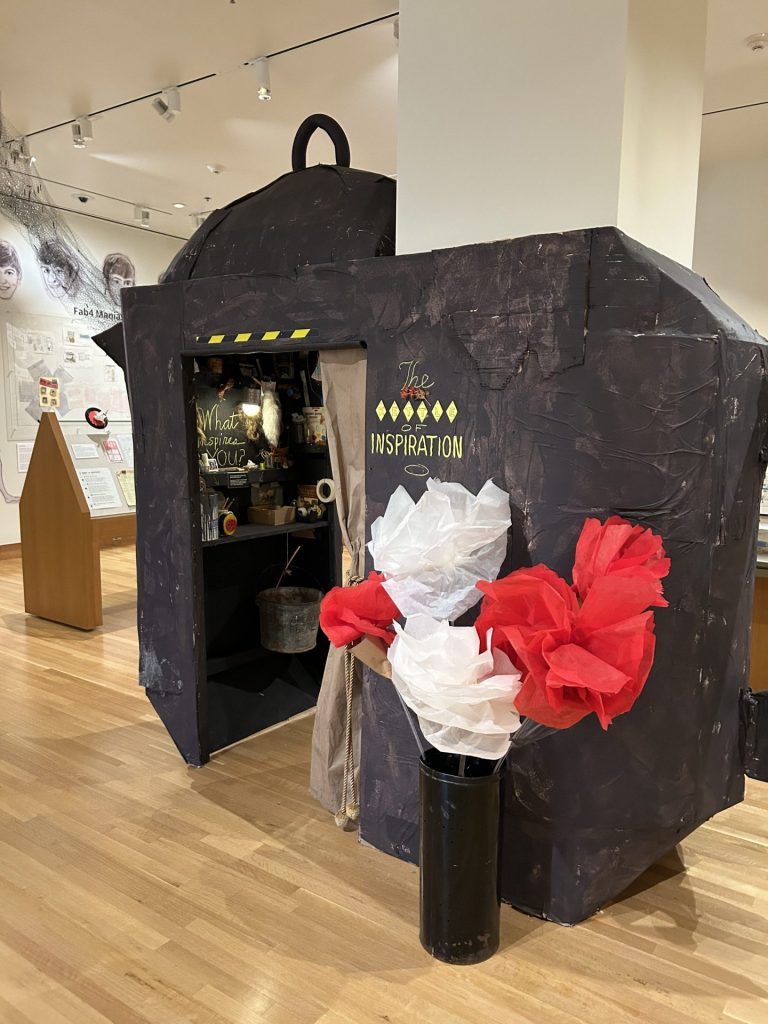
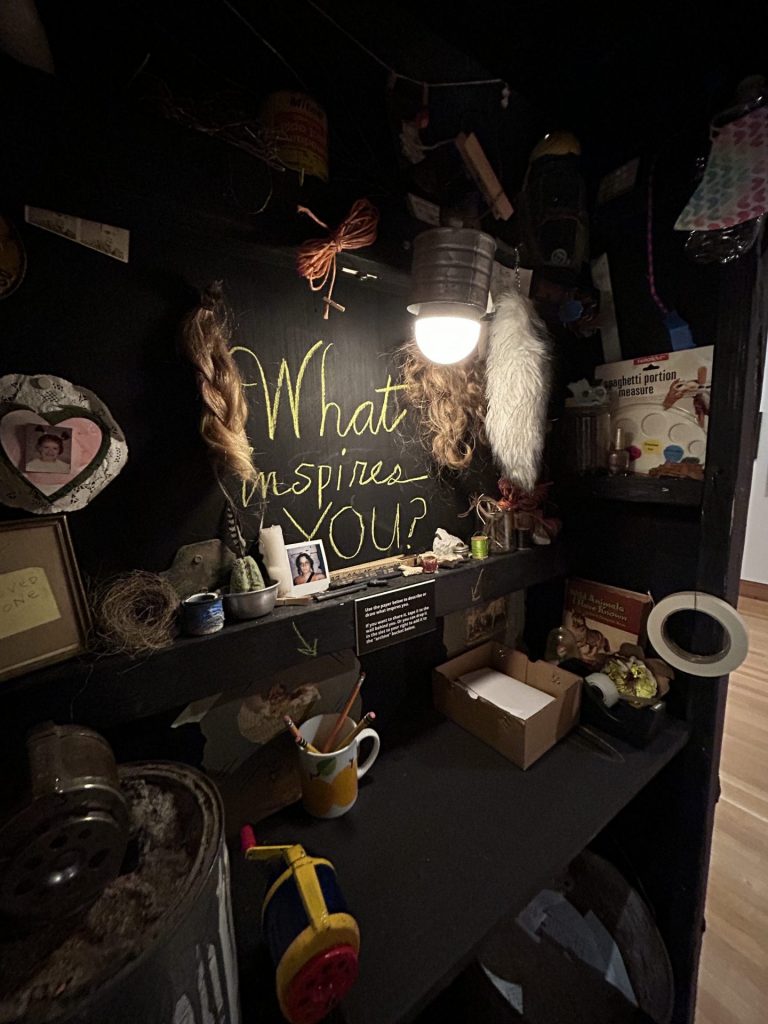
These gestures effectively ushered visitors into the space—but then, in the gallery’s center, impossible to miss, stood an enormous papier-mâché teakettle: a perfect eye-magnet. “Steam” (tangled plastic mesh) rose from its spout. Inside this “Kettle of Inspiration,” as I eventually discovered, was a roughly phonebooth-sized space filled with personal bric-a-brac. In this quiet chamber, visitors could stand and absorb the vibe: creative, woolly, homespun. A sign reading What inspires YOU? prompted visitors to make their own notes and drawings, which they were invited to leave for others to see (I did).
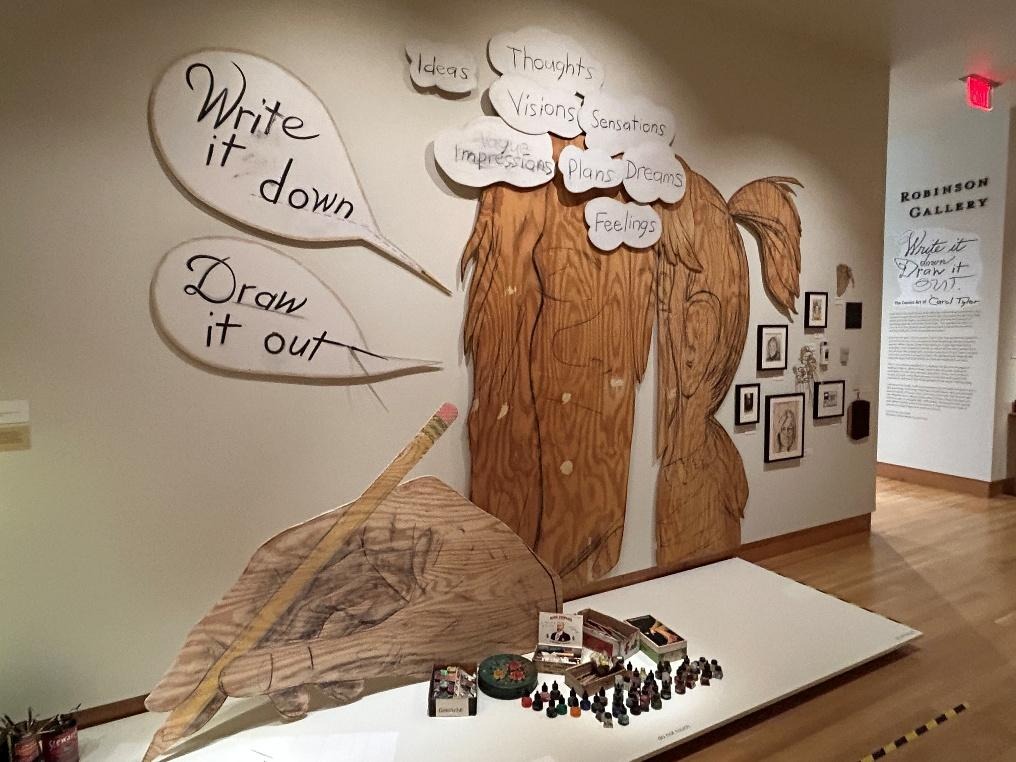
Just past the gallery threshold, the exhibition proceeded counter-clockwise, starting to the right with a cluster of eccentric self-portraits in various media (some of them found objects). These nested along the north wall next to a huge plywood self-portrait, a giant Carol speaking the exhibition title in word balloons, Write it down / Draw it out, accompanied by a scattering of Tyler’s ink bottles and other supplies on the floor.
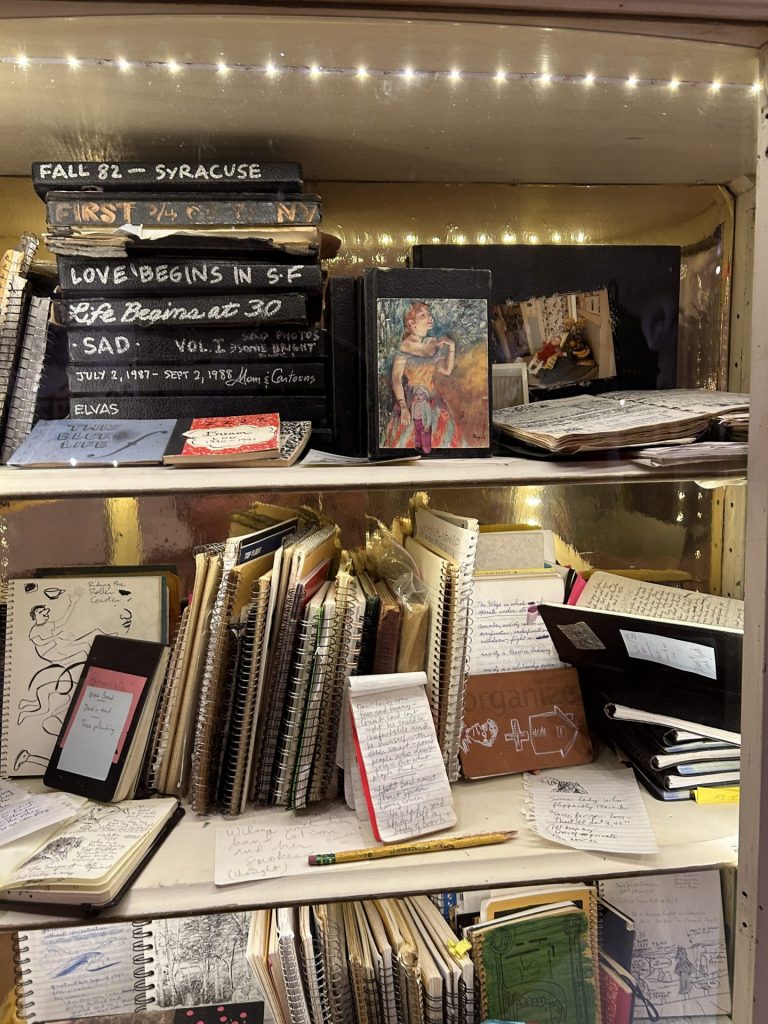
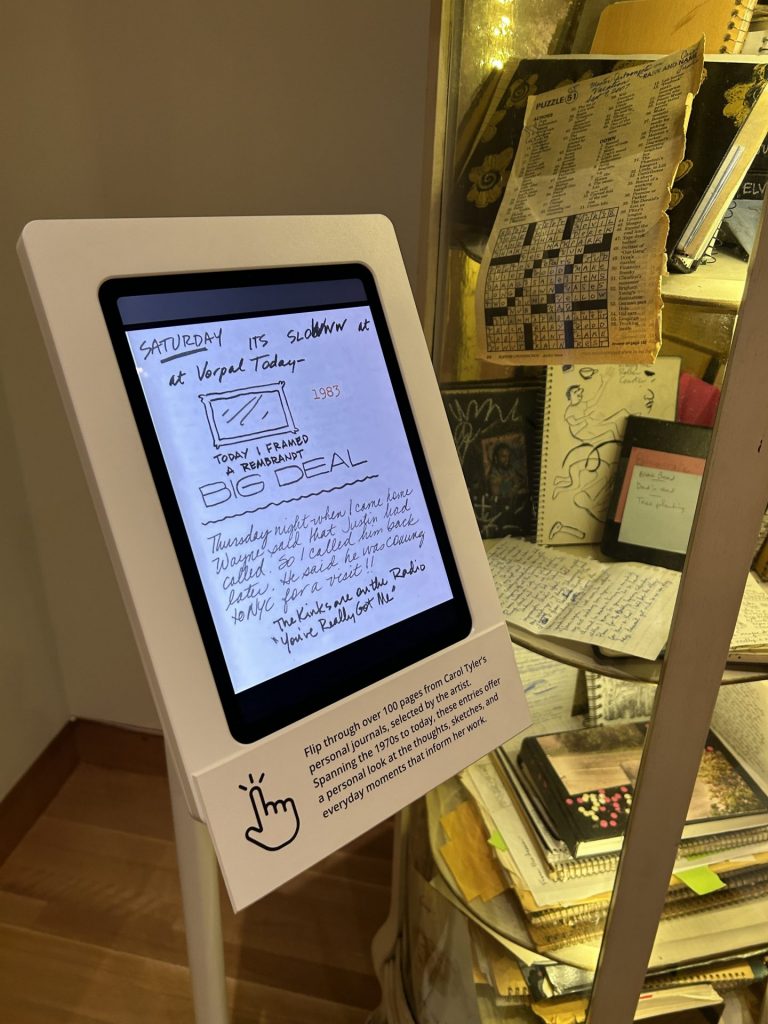
Then came a vitrine (lit by sparkling strings of light) sharing many of her journals, accompanied by an iPad that enabled viewers to swipe through facsimiles of quite a few journal pages. To say that this felt like an invasion of privacy would be an understatement!
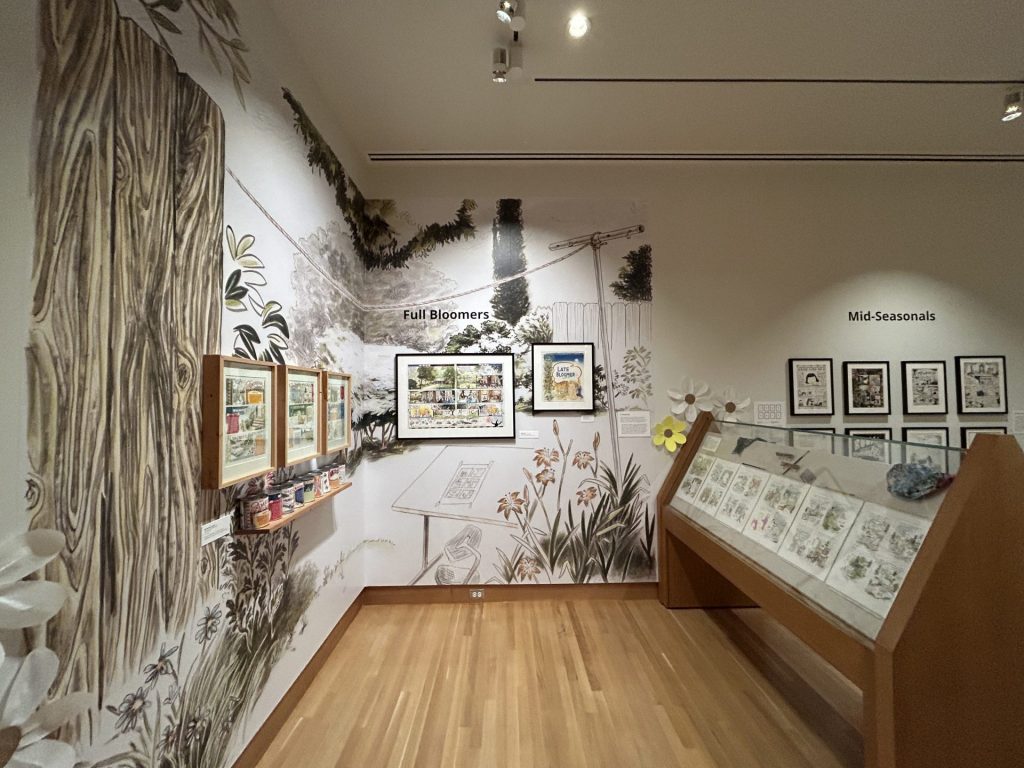
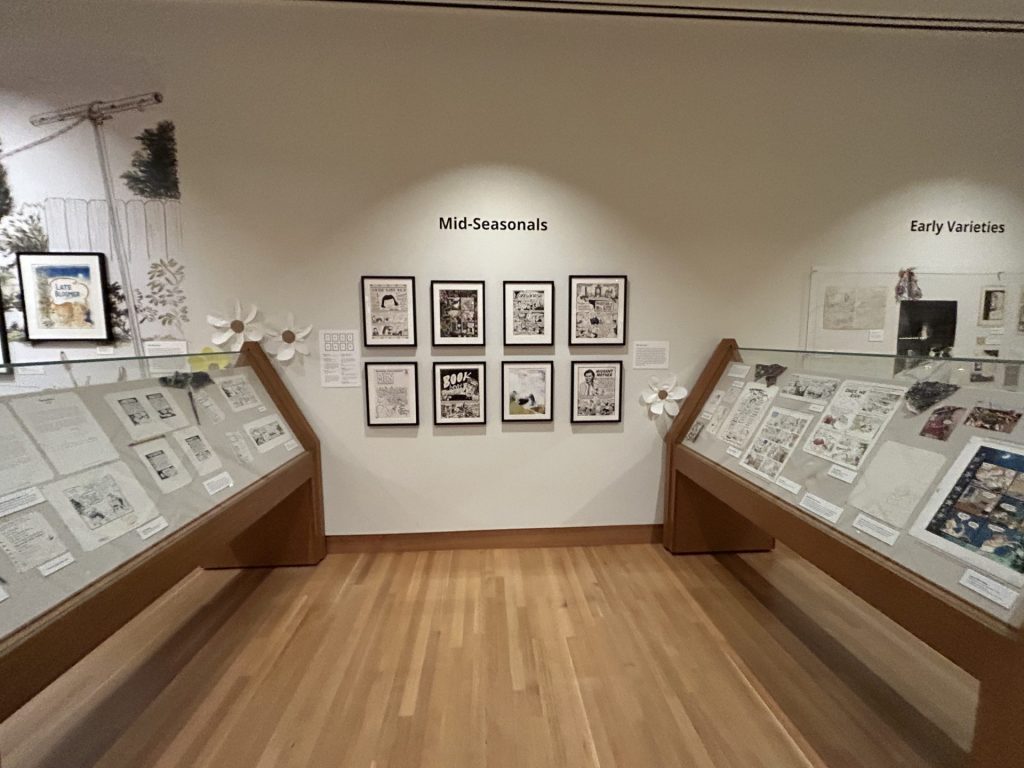
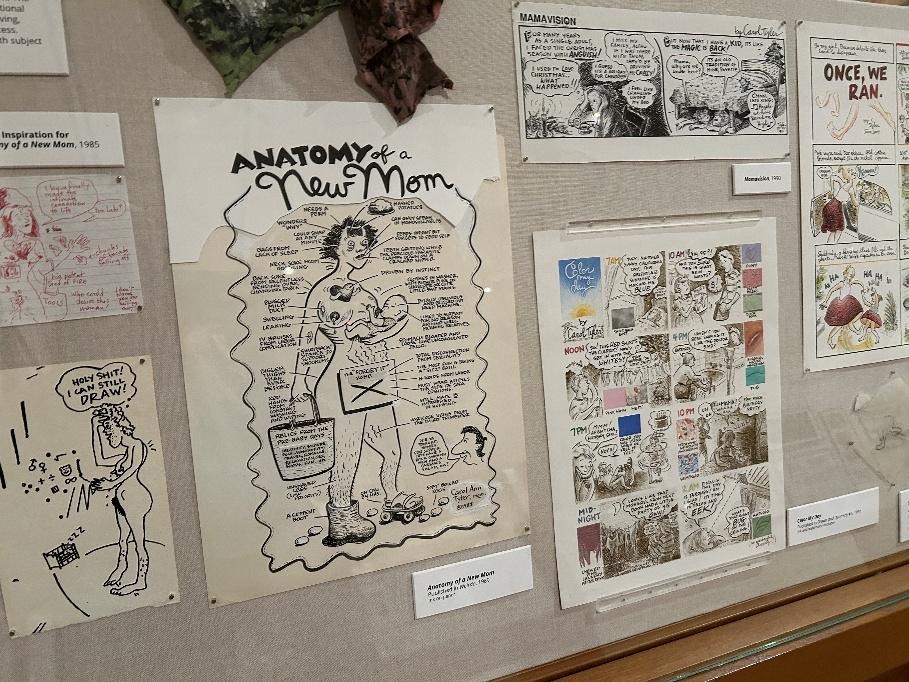
Further on, along the gallery’s west wall, came an early-career overview broken into three aisles by a couple of outward-thrusting display cases. These were labeled according to the gardening schema used in Tyler’s retrospective collection Late Bloomer: Early Varieties, Mid-Seasonals, and Full Bloomers. Here, Tyler’s anthology work, circa 1987 to 2004, dominated, along with unpublished work (including unsold pitches for syndicated newspaper strips) and pieces from The Job Thing. Most notable here was a focus on motherhood as a theme in, and essential context of, Tyler’s life and cartooning:
That would have been enough, really. Good grief. Yet, further counter-clockwise, against the long south wall, came Soldier’s Heart, Tyler’s family memoir and World War II memorial. That book, perhaps Tyler’s best-known, is big, capacious, unruly, sometimes shockingly frank, and soulful.
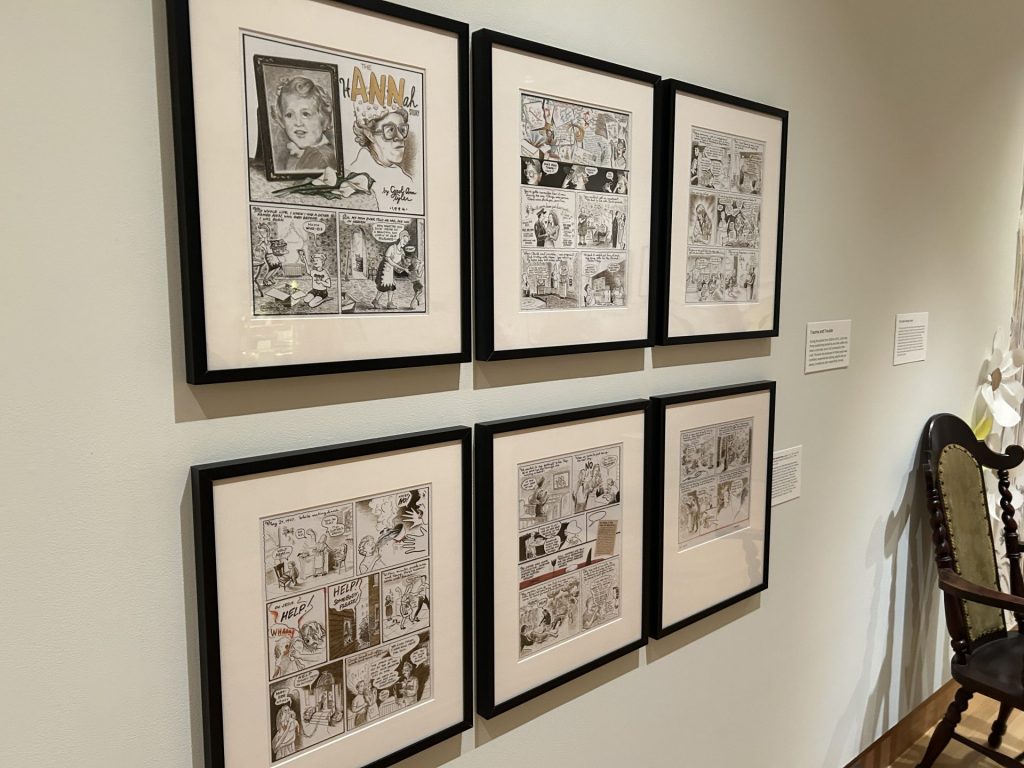
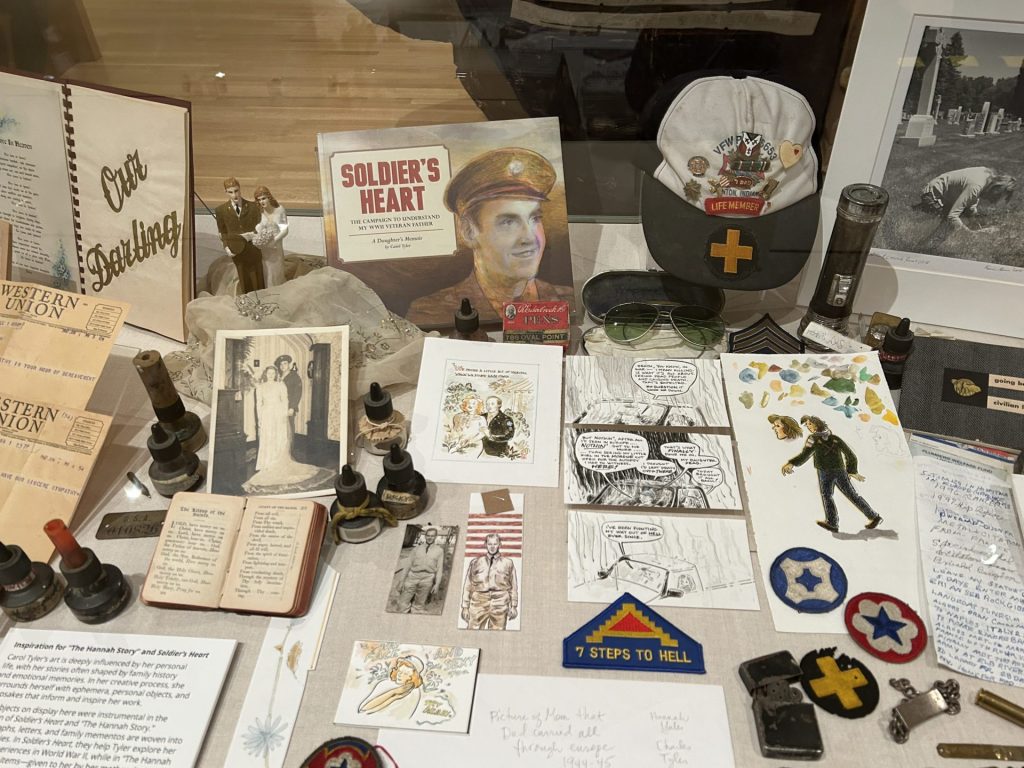
The germ of Soldier’s Heart was “The Hannah Story,” a tragic and beautiful short first published in 1994 that I’ve been rereading, and sometimes teaching, for about thirty years. The original pages of “Hannah” were shown on the wall—so I stopped there, for a long moment and a deep breath. Then I turned and saw a display of real-life memorabilia related to that story, tokens of memory, sadness, and condolence. Oh man (picture me goggle-eyed and verklempt.)
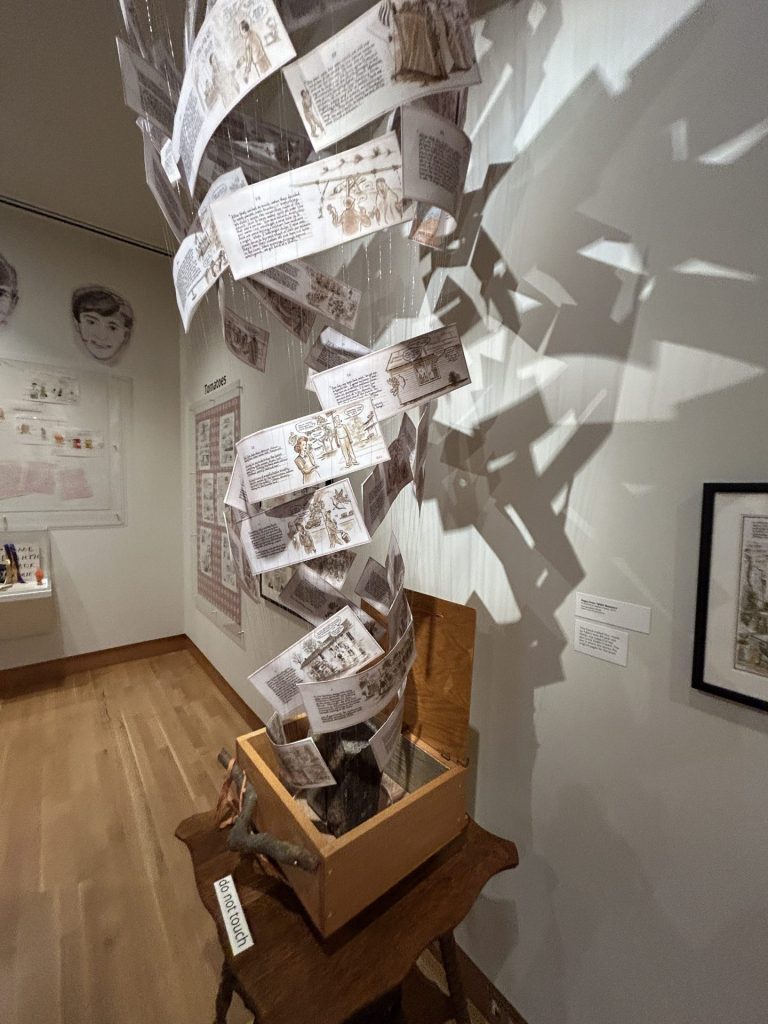
Farther to the left were other pages from Soldier’s Heart, including a cyclone of pages hanging by threads and swirling upward out of a wooden box—a box created by Tyler’s father Chuck, who is the very center of Soldier’s Heart. This whole wall, the long sweep of it, underscored what I love about Tyler’s work: the intertwining of memory, shared things, and handicraft.
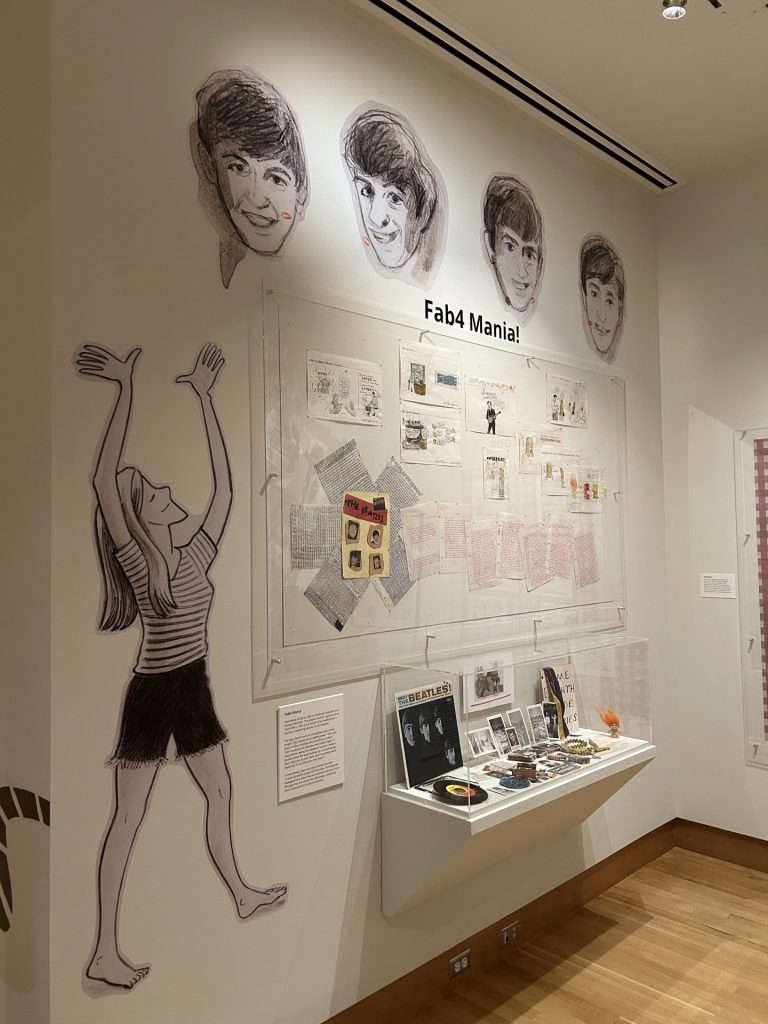
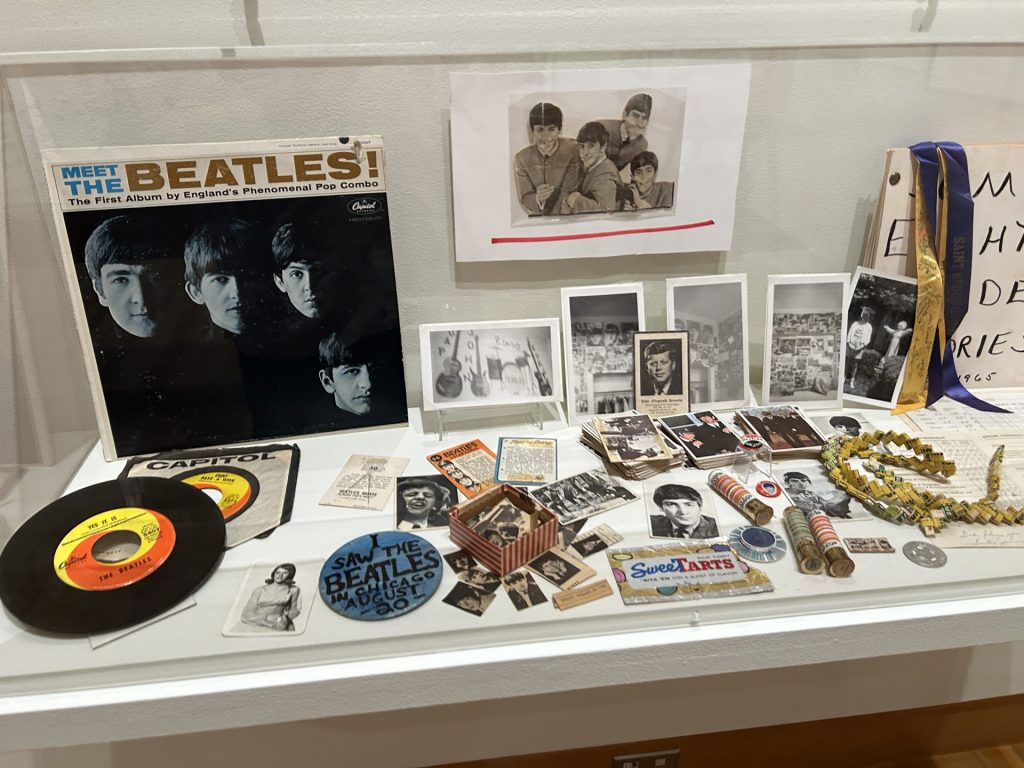
Moving still farther, to the exhibition’s southeast corner, was an installation that doubled down on all these qualities: an archive of some of Tyler’s sources and artwork for Fab Four Mania, her memoir of her intense Beatles fandom at about age thirteen, circa 1964-1965. Fab Four Mania (another book I’ve taught) is beyond category, a blend of handwritten prose, illustration, comics, and period artifacts that spans from Carol’s first glimpse of The Beatles on The Ed Sullivan Show (on February 9, 1964, natch) to a whirlwind Beatles concert at Chicago’s White Sox Park (August 20, 1965). It’s hard to tell which parts of the book are recreations and which are actual artifacts of Tyler’s eighth-grade year, including art she made back then. Seeing this installation only intensified that confusion. A frankly underrated book, Fab Four Mania captures, with convincing matter-of-factness but yet a deep nostalgic ache, a passage of Tyler’s Catholic girlhood that was animated by the Beatles’ newness and energy. It’s one of the best accounts of pop fandom I’ve read, the more so because Tyler’s whole life is wrapped up in it. I have the feeling that she has never gotten over the Fab Four and never will.
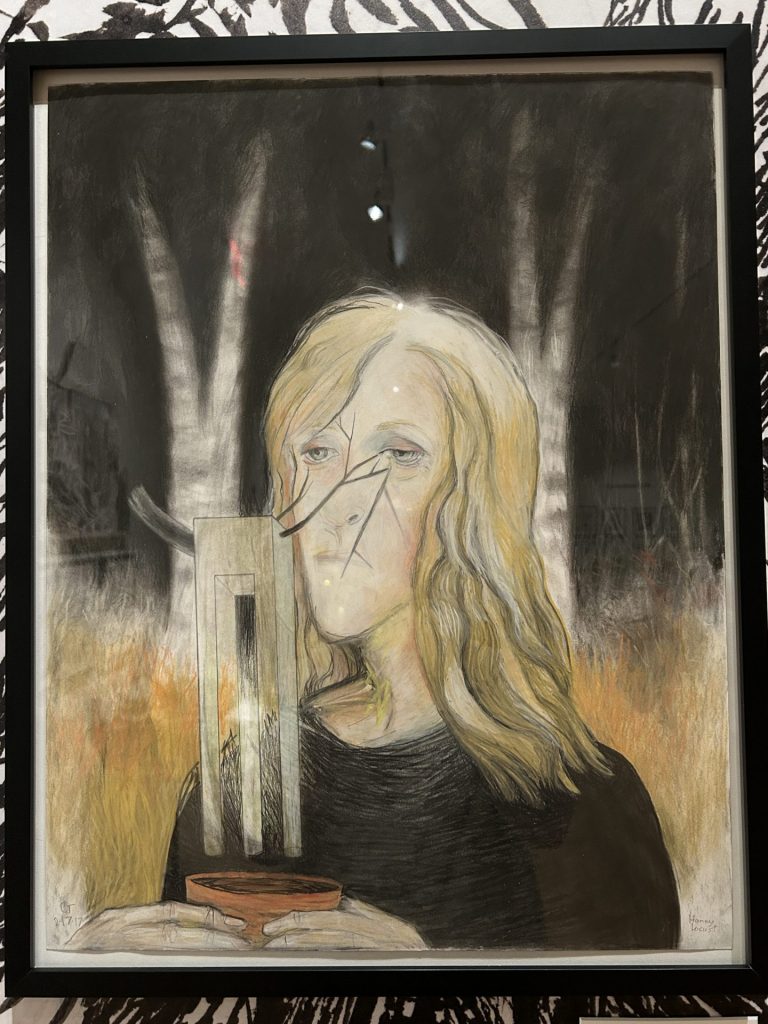
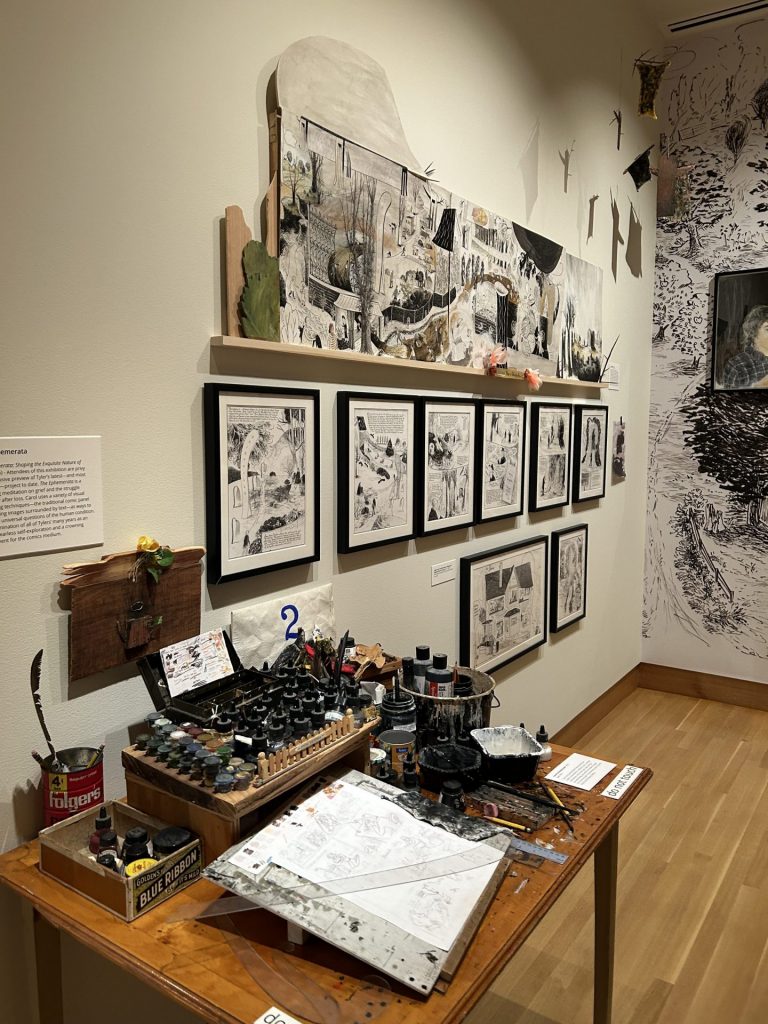
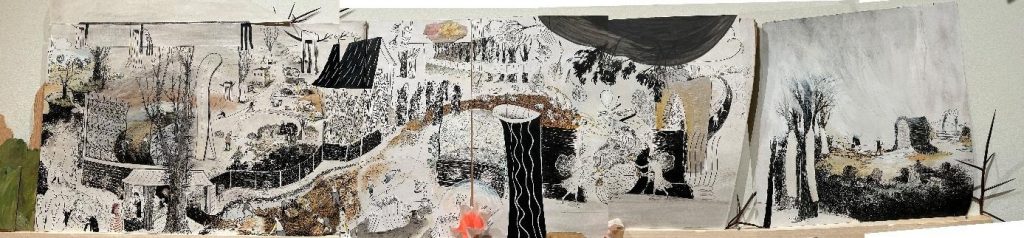
Moving on to the exhibit’s northeast corner—that is, coming full circle, back toward the entrance—brought me to a preview of The Ephemerata: a lovely, sad installation evoking that book’s emphasis on working and living through grief. This corner boasted original pages from the then-upcoming book; side-by-side portraits of Tyler (the book’s cover) and of Justin Green; and—for me, the coup de grâce—the Griefville Map, a panoramic image on matboards that did not actually end up in the published Ephemerata but fit brilliantly here (see my badly patched-together image, below). Alongside stood another reminder of Tyler’s lived-in craft: a weathered table covered with ink bottles, paints, and various distressed, spattered, and timeworn tools.
In sum, Write It Down, Draw It Out superbly captured Tyler’s art, its ethos, materials, and tensions, and above all its gritty intimacy and hard-won strength. Carol Tyler is a bullshit-free artist, and this exhibition made her case. I took so many pictures, and notes, and promised myself to review the show, somehow, somewhere, ASAP—but, damn me, I failed. I didn’t keep my promise; my notes and pics stayed mothballed for too long. However, a few months later, I did teach Soldier’s Heart to my graduate class on autographics, I did show my students Married to Comics and pass around the brand-new Ephemerata, and we did host Carol one night when she generously Zoomed in to discuss her work. Many students told me that her visit—passionate, funny, honest as a gust of wind—was a class highlight that they won’t forget. I know I won’t. (You can get a taste of Tyler’s voice and passions, and a long look at the exhibition, by watching her virtual walk-through recorded just days before the show came down.)
I’m glad to be able, at last, to reflect on Tyler’s art through my memories of this show—to see those pictures again and remember why the show affected me so. By now, more than forty exhibitions have appeared in the BICLM’s exhibition space since the Billy’s reopening in Sullivant Hall in 2013. I’ve seen about a dozen. Two have struck me as being very artist-centered, and essentially curated or co-curated by the artists. Write It Down, Draw It Out is one of those, of course, and the other is the current Chris Ware exhibition, Life Is Complicated (May 23, 2026-January 3, 2027), which I saw during the recent Comics Studies Society conference at the BICLM. Life Is Complicated, a stunning experience, spans Ware’s mature work and effectively bottles his aesthetic. It’s rigorous and full, and, of course, worth a lengthy article of its own (I did take a lot of pictures). I remember both exhibitions as material feasts, hypnotic evocations of craft, and demonstrations of how comics can reach beyond the page or screen into palpable, three-dimensional life. Of the two, I liked the Tyler more, because it’s the more playful, and serves as a paean and encouragement to creativity. I note how its title, Write It Down, Draw It Out, comes across as an exhortation and command. I remember how it made the gallery into a playspace, but then again a place of learning-by-example, how its myriad bottles, brushes, pens, and notebooks invited every visitor to envision themself as a maker, how its scraps, tatters, and ephemera conjured up memory, and how it moved me more than I can manage to say.
SOLRAD is made possible by the generous donations of readers like you. Support our Patreon campaign, or make a tax-deductible donation to our publisher, Fieldmouse Press, today.

Leave a Reply