A confession, dear reader: I, too, from time to time, find myself assailed by sinful thoughts.
What kind of sinful thoughts, you might wonder, so I’ll explain: on occasion I find myself, despite myself, contemplating “the place of comics in the broader culture.” An ill-advised topic of discussion, I know, and a fruitless one, but the truth is that ever since my visit to France in 2024 I am more prone to envy than I’d like to be: the sightings of Metro billboards advertising the second volume (not even the first!) of My Favorite Thing is Monsters (not even a French comic!); the bookstores with heaped comics shelves, more eclectically curated than your run-of-the-mill Waterstones or Barnes and Noble — to see comics so ingrained in gen-pop spaces is to get the optimistic impression that a better world is possible, at least in this remarkably narrow and ultimately inconsequential sense.
In this discussion of the respectability of comics we generally find two rivaling contingents: those who believe that comics, being an art-form, should strive to insert themselves into the broader discourse of ‘art’ alongside more broadly-accepted forms such as film or prose (not to mention painting or sculpture); and those who, out of an imagined purism, condemn any engagement with the broader artistic sphere as a sort of kowtowing that stands to dilute the uniqueness of ‘our’ chosen vocation.
In this regard, Paul Auster’s City of Glass feels like a turning point. The 1994 Auster adaptation by David Mazzucchelli and Paul Karasik, originally published under Avon Books’ short-lived Neon Lit line overseen by Bob Callahan and Art Spiegelman, is, of course, universally lauded as one of comics’ foremost truly transformative adaptations: far from the largely styleless mold of Classics Illustrated1, here was an endeavor that engaged with the source material on the terms of the adaptor rather than the adaptee, omitting, interpreting, and abstracting as Mazzucchelli and Karasik saw fit.
The road there, naturally, was not a simple one. In his introduction to the 2004 edition of the City of Glass adaptation, published by Picador a decade after the original release (and prompt slipping-out-of-print), Spiegelman described the inception of the project more or less as a result of beleaguerment and frustration:
In the mid-‘80s some well-intended journalists and booksellers tried to distinguish a handful of book-format comics from other, less ambitious works by dubbing them “graphic novels.” But even though my own book, Maus, was partially responsible for making bookstores safe for comics, the new label stuck in my craw as a mere cosmetic bid for respectability. […] It would take another decade before enough long, ambitious comics gave the concept critical mass—until enough work worthy of critical attention made a bookstore section of some sort inevitable—but, tired of seeing my Maus volumes surrounded by fantasy and role-playing game manuals, I tried to jump-start the process. In the early ‘90s I groused to one of my editors that if my work was fated to be ghettoized in a graphic novel section, perhaps the neighborhood could be improved by hiring some serious novelists to provide scenarios for skilled graphic artists.
Spiegelman expanded on this in a 2013 panel alongside Karasik, Mazzucchelli, and Auster, moderated by Bill Kartalopoulos:
I didn’t want to do it. I just didn’t want to do it. I don’t believe in adaptations very much. Although there have been some good ones. And this was a devolution of that original idea of something else I don’t believe in, which is collaboration, which I do more and more of. But I thought that the best graphic novels, comics, were made by single humans. And the idea of marrying novelists to illustrators/cartoon artists of one kind or another seemed possible, but I’d become allergic to it growing up with “inked by,” “colored by,” “penciled by” credits in comic books. And so I was wary of that as a process. Bob Callahan, who was desperate for money at all times, said, “We’ll do the adaptations!” I said, “I don’t want to do adaptations.” And he said, “You gotta do it! I can’t pay my rent!” [Laughs] Which, I finally caved and allowed it to happen.
Right away, then, we can see that Spiegelman himself falls into both camps, both a purist of comics and an expander of idiom. But it is at this stage that I must stop talking about Context, because — as you may have noticed, dear reader — so far I have expended upwards of seven hundred words without offering a single novel insight about the comic itself. This, of course, is not a coincidence, as today’s topic of discussion is not necessarily City of Glass as a work of comics so much as City of Glass as a ball and chain.
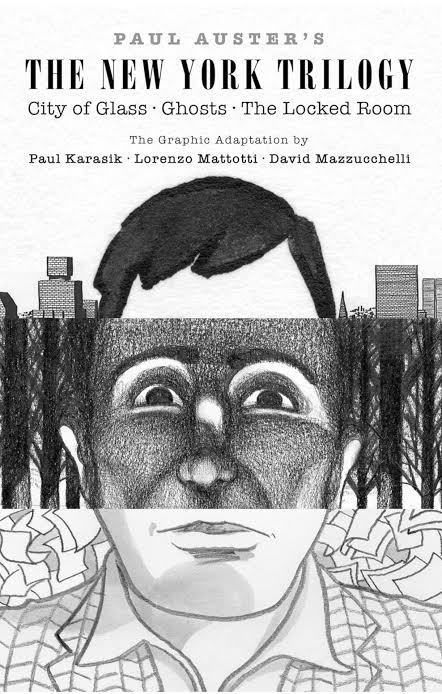
Courtesy of Pantheon, last year saw the release of Paul Auster’s The New York Trilogy, a compendium of three works, one old and two new: City of Glass, adapted by Karasik and Mazzucchelli; Ghosts, adapted by Karasik and Lorenzo Mattotti; and The Locked Room, adapted by Karasik on his own. The front flap of the dust jacket tells us that graphic novel readers have been waiting for years for the other two tales [in the trilogy] to be translated into comics. And, indeed, for what it’s worth, we may look at entry #45 of The Comics Journal’s still-contentious-after-all-these-years list of the 100 best comics of the 20th century, which submitted that “[i]f there is one drawback to Paul Auster’s City of Glass, it is that the remaining parts of the trilogy (Ghosts and The Locked Room) haven’t received similar treatment.” But this was in 1999, just five years after the adaptation’s publication — if there is one thing that time knows how to do, it is to make shadows ever longer, heavier, and harder to escape. Nonetheless, it would probably be wise to start with a discussion of City of Glass as a comic, isolated — as best one can, at least — from the noise of repute.
At the center of City of Glass is a man unmoored: Daniel Quinn, once an ambitious writer and family man, essentially gave up on his life following the death of his wife and child; under a pseudonym, he began to write a series of private-eye potboilers. When a random phone call mistakes him for a private eye himself, Quinn decides to take up the case out of a new sense of mission. The client, it turns out, is one Peter Stillman, a young man, rich but deeply traumatized by the abuse he was subjected to by his father, a brilliant academic driven mad by his own studies of obscure religious ideas from the early Renaissance period. After a thirteen-year term in prison, the father, also named Peter Stillman, is about to be released, and the son and his therapist-turned-wife Virginia are worried that the father might come back and murder Stillman-the-younger. Quinn — still believed to be a private investigator named Paul Auster — is thus asked to track down the father and make sure that he stays away.
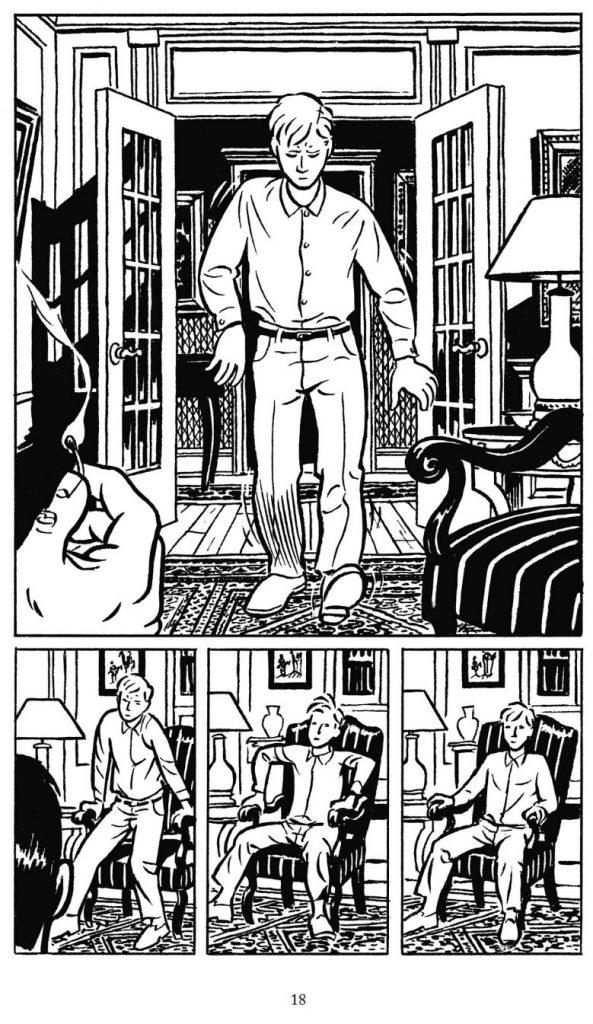
Given City of Glass’ central preoccupation — genre narrative as viewed from the outside, through a lens of detached ‘realism’ — there is an immediate case to be made for Mazzucchelli, specifically, as the perfect fit: the graphic novel adaptation, notably, was his first long-form work in a few years, having turned to alternative comics and personal experimentation after a brief-but-still-celebrated stint with DC and Marvel. And, indeed, there is a distinct beauty to his cartooning here — his brush-work is lush and classical in a way that certainly fits in the same milieu as adventure-pulp artists like Caniff or Raymond, while at the same time taking on a stripped-back naturalism. Consider, for example, the above page, which introduces young Peter Stillman. Note the wobbly, jerky limbs; the forceful landing in the chair, hard enough to send his hair jumping upwards; and all the while that expression, at turns anguished and stony — it feels, in every sense of the word, theatrical: thunderously intentful, but not melodramatic or unjustified.
But naturalism, of course, is only part of the story. Since its release, the City of Glass adaptation has been lauded for its manipulation of form, most notably in its use of the nine-panel grid (starting with a beautiful use of grid-tiers as ‘phrases’ of three panels and then gradually devolving as Quinn’s obsession with the case gets the best of him) and its use of non-literalist, iconography, especially in the younger Stillman’s introductory monologue. The monologue, which employs an opaque-by-comparison phrasal style — childish word-choices, ample repetition — to demonstrate the depths of Stillman’s trauma, appears in the original prose as an uninterrupted gush of text, making it the most difficult part to convey effectively; to take the literalist route (either by representing the man in stasis as he sits and talks, or with a literal visual flashback) would not only be trying to the reader’s visual interest but also run completely counter to Stillman’s trauma, his grasp over language — indeed, on reality — having grown tenuous in a way that no amount of therapy will ever entirely untangle. For this purpose, Mazzucchelli and Karasik break away from figurative visual representation, instead inundating the reader with ostensibly-unrelated images (a well, a baby bird in its nest, a Charon-like figure rising from the ‘sea’ of the blank page) at an ever-accelerating pace, going gradually from a new image every page to a new image every panel. (When it falls to Stillman’s wife, Virginia, to elucidate the monologue in a way Quinn can understand, it is illustrated in a terse pictogrammatical style — a pointedly blunt contra.)
In more recent years, Mazzucchelli has become somewhat synonymous with formal–textural polyphonics due to his other literary graphic novel, 2009’s Asterios Polyp, and, for a long time, I couldn’t understand exactly why it is that I found that book’s brand of formalism more compelling, more affecting, than that of City of Glass. The explanation I’ve finally settled on has to do with sheer practicality: on numerous occasions, Mazzucchelli has recalled that the beginnings of City of Glass were something of a struggle due to the abundance of sections that do not describe any specific action to be easily portrayed; Mazzucchelli’s initial approach was far more ‘cinematic’2 and evocative, and it was Karasik who suggested both the rhythmic rigor of the nine-panel grid and the incorporation of non-literal imagery.
This mode of work grounds the element of formal novelty in, essentially, mechanical problem-solving — an aesthetic additive that builds on the preexisting basis rather than serves as the basis itself. This is fundamentally different from the underlying approach of Asterios Polyp, best classified as ‘formalist spectacle’ — its use of visual and graphic language is impressive, rich, and multifaceted, but, where City of Glass feels ‘at home’ while taking the naturalist route, Asterios Polyp’s core story (at a time of personal crisis, a patronizing, classically-elitist academic learns to view the “simple man” as his equal) more or less falls apart into lit-fic banality. Where the earlier work is a middlebrow success, the later work, though not without its merits and ambitions, is nonetheless a highbrow failure.
Stillman-the-elder’s academic discipline, it warrants pointing out, is semiotic in nature: specifically, his focus is on the theoretical state of language that existed in Paradise before the fall of man, wherein language was devoid of moral connotation because the idea of morality did not exist. The reason Stillman abused his son was his belief — which, as one of several gestures to Don Quixote, he frames as the writing of a fictional 17th-century Puritan philosopher — that the discovery of the New World was an opportunity to reach a similar state of uncontaminated linguistic unity in order to establish a new Paradise on Earth, and that through a period of total withdrawal and isolation from the culture at large one may emerge reborn and “speaking God’s language.” The metaphorical significance here is, of course, obvious: ‘genre’ is its own kind of language, with its set of preconceived and agreed-upon rules determining how one views the world and blocking out divergent views as a result; it is, simultaneously, a prism and a prison. Inadvertently, then, Stillman and Quinn are kindred spirits, drawing from different wellsprings of myth, and thus following different methodologies (Quinn, the pulp detective, seeks total observation and immersion, while Stillman, the would-be monk, aspires, and enforces, total retreat), but nonetheless coming up with the same bottom line: the fantasy of a total perceptual neutrality and objectivity — the myth of order out of chaos.
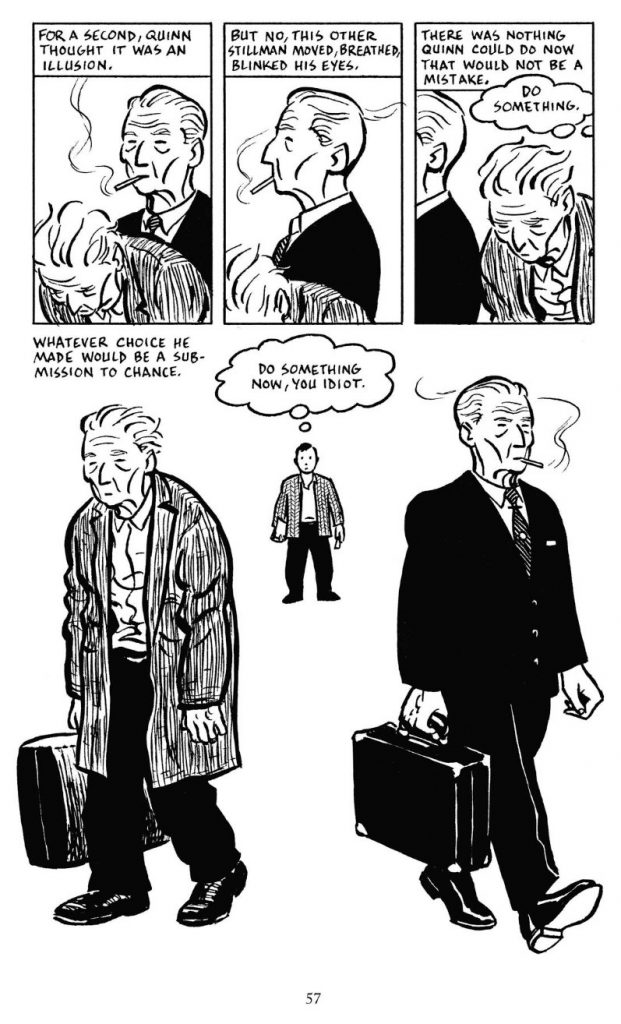
A recurring existential ‘joke’ in City of Glass — effective precisely because it is played perfectly straight — has to do with chance, as Quinn’s supposed intuition practically reaches the superhuman: “You must come here,” the younger Stillman tells Quinn over the phone, not saying where here is, yet when Quinn starts simply walking through the city without any aim or system he finds his destination without any discernible trouble; when Quinn sees two different men who fit the profile of Stillman the elder, he chooses one of them at random, and that man does turn out to be the right man; when the elder Stillman starts leading Quinn on strange walks around the city Quinn interprets the courses of these walks as a hidden message written out one letter at a time — a message that comes out, of course, perfectly coherent.
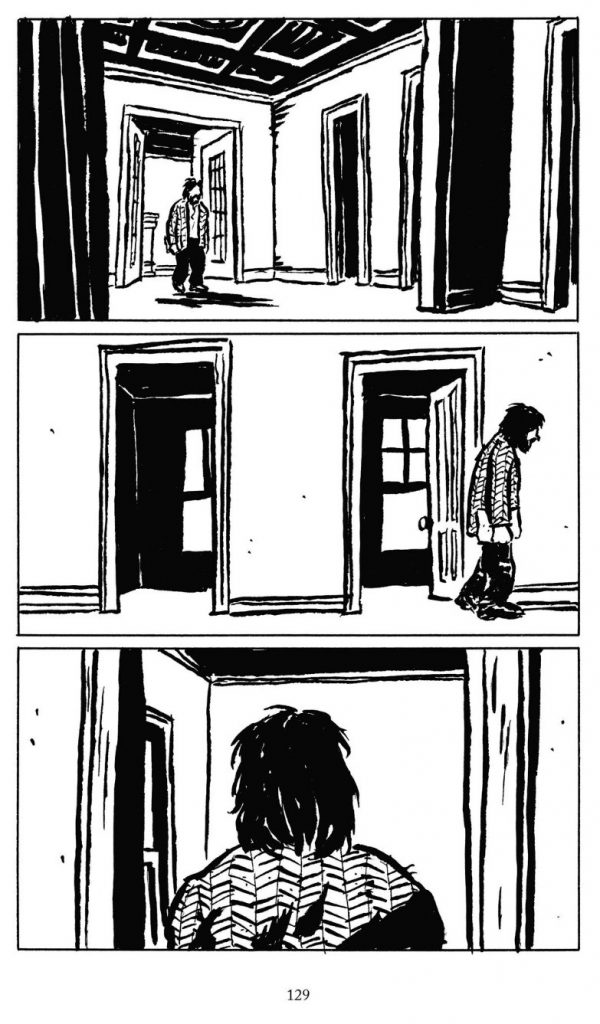
And the punchline to this road of chance and happenstance? Why, there’s only one way an existential joke could end: with total deflation. Quinn, one must remember, is not a classical detective, intentional and methodical, but a paperback writer whose narrative fantasies have overtaken his life simply because he has no real life to speak of; more bluntly, he is a voyeur whose choice to insinuate himself into a case that has nothing to do with him is quite probably dangerous to the client he purports to protect. (Mazzucchelli cleverly plays into this interplay of self-perception-as-self-deception with a handful of sequences where, for one fleeting flicker of a panel, a character changes form: Quinn becomes his own private-eye character, Max Work, in all his Dick Tracy swagger; Virginia Stillman, who gives some ambiguous signs of seduction, loses her clothes.) Inevitably, Quinn overplays his hand by deciding to approach the elder Stillman and make conversation with him (this happens three times, each under a different pseudonym, as Stillman does not seem to recognize Quinn at all); after the third encounter, the elderly ex-con simply disappears — as do Quinn’s clients, having evidently skipped town for fear of death. If the case itself isn’t the problem, then it must be the detective handling it.
That doesn’t mean he doesn’t try his damnedest. Quinn maintains his fruitless investigation for a while, but finally, left without a client, without a subject, and most importantly without closure, he decides to go home — only to find out that, having stopped paying his rent, he is left without a home as well. One step at a time, he finds himself tossed out of the Paradise of his fantasies, until finally he falls apart and vanishes into thin air. It’s an effective ending, simultaneously inevitable and unbelievable: inevitable because one knows better than to expect a tidy resolution from the distance of meta-commentary, unbelievable because, against all logic, the hope for resolution persists. And yet this is what happens, you see, when you cling to fantasy: even mere hope becomes absurd.
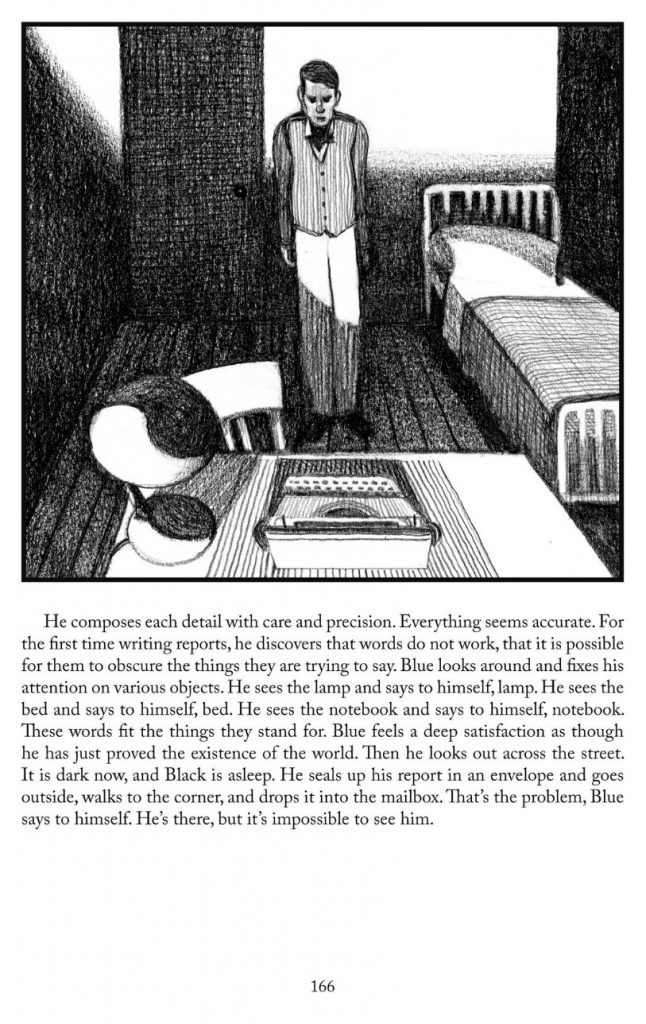
Where City of Glass takes an additive approach, using metanarrative elements to build on traditional detective-story conventions, Ghosts, for its part, takes the subtractive, almost-metaphysical route. Its setting — New York, 1947 — is nominal, rendered in broad strokes; the driving forces of the ‘case’ (its motives, the parties involved) are left pointedly vague. The protagonist, Blue, is a private investigator hired by a man named White to tail a third man, Black; he is not told who Black is or why he should be watched, in fact is not told anything outside of the bare instructions, but he nonetheless takes the case. For a prolonged period, Blue watches Black but fails to learn anything at all, as Black does little beyond read, write in his notebook, eat, and get groceries; his life, as far as Blue can tell, is completely devoid of any specific lead. As the blankness becomes routine, Blue loses himself in conjecture and speculation.
Karasik and his Ghosts collaborator Lorenzo Mattotti, of course, go back the better part of four decades (Mattotti contributed several pieces to Spiegelman and Françoise Mouly’s Raw, where Karasik was an editor). This connection, however, by conjuring a certain mental image of the avant garde and experimental, only stands to make the finished product more perplexing. For the first two thirds or so, the default mode is closer to a picturebook than a proper comic, with a uniformly-sized square illustration followed by a passage of prose (always concluding at the end of a paragraph — sentences never run over into the next page, as the image is largely illustrative of, and thus subjugated to, the corresponding unit of text). Sometimes there will be a divergence from this neat division, bringing the book closer to proper ‘comics’ — the illustration will be broken up into a panel, or the page will be made up of panels with the narration inside. Other pages are stranger still: one spread is comprised exclusively of prose, whereas one page sports one tier broken up into two panels (a block of prose and a corresponding illustration), a passage of prose stretching across the entire page horizontally, then a proper ‘comics’ panel with word balloons illustrating the above passage — a hybrid arrangement I can only describe as Posy Simmonds-esque, an inbetween-mode I am fundamentally suspicious of.
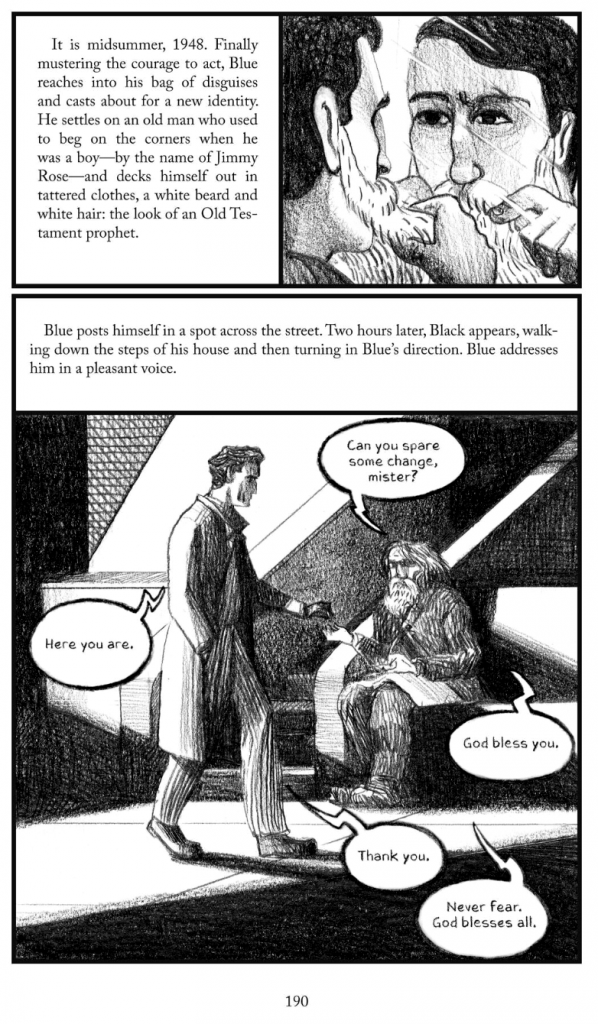
The book’s visual approach seems to stem directly from this formal constraint. In the brunt of his work, Mattotti is an artist of gesture and of gestural malleability, his human forms stretching and distending, his depictions of light and shadow taking on hard materiality; there is an operatic heightening that is integral to his cartooning. For Ghosts, however, he opts for an unwavering physicality and solidity closer to the Swiss scratchboard cartoonist Thomas Ott than to the common image of Mattotti himself. His characters are square-jawed and rough-hewn; his environments, while broad, are realistic and vividly rendered. Where symbolist divergences do occur, they are too literal to evoke any real atmosphere: Blue physically looking down into a box that contains Black, or walking in midair down the street, floating but held down by a ball and chain. These images would have been more charming in their quaintness if drawn by Mazzucchelli, whose idiom of cartooning is one of streamlining and simplification; with Mattotti’s sense of physicality, they are almost embarrassingly immediate.
This raises the question of the nature of collaboration. For City of Glass, in lieu of a script, Karasik and Mazzucchelli’s process was essentially a gradual back-and-forth, with the two cartoonists editing and building on one another’s drafts and notes until they finally arrived at the end result, having infused naturalism and symbolism in a mostly seamless manner. Reading Ghosts, one can’t help but wonder precisely what sort of equivalent back-and-forth took place between Karasik and Mattotti, if indeed there was any real back-and-forth at all — its initial dependence on clean prose, and its lack of visual-graphic ambition, feel stifled and phoned-in.3
If City of Glass focused on the detective as a frustrated storyteller, Ghosts’ detective is a frustrated reader — a spectator whose only method of producing meaning is by projecting himself on the work at hand. Black’s ‘work’ (his routine, his writing) is inaccessible to Blue, and so he begins to track its origins: he tries, and fails, to read the same works he sees Black read, and then to come into direct contact with Black (using, like Daniel Quinn before him, a succession of disguises and false identities). During Blue’s first meeting with Black, Blue claims to be an insurance salesman, while Black claims to be a private detective — working a case revolving around a man who simply sits reading or writing his whole life. At the end of the meeting, when Blue, playing along, suggests that the frustrated Black can resign from the case, Black ardently refuses. “Because he needs me. He needs my eyes looking at him to prove he’s alive.”
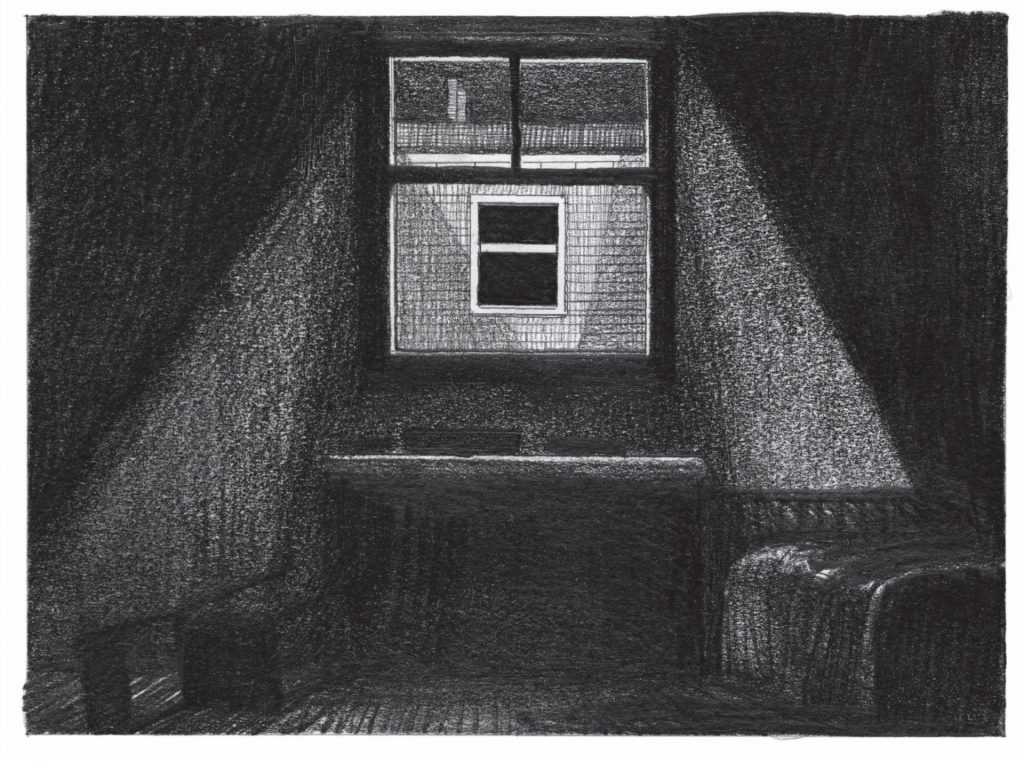
As he comes closer and closer to Black, Blue begins to receive messages from his client, White, warning the detective not to depart from their agreed-upon methods. Finally, when Blue is compelled to enter Black’s apartment, he finds a surprise: Black, it turns out, was White all along; White hired Blue “To remind me of what I was supposed to be doing. Every time I looked up, you were there, watching me, boring into me with your eyes. You were the whole world to me, and I turned you into my death. You’re the one thing that doesn’t change, the one thing that turns everything inside out.” The author, then, depends on the reader — but only from a distance, and only for a limited time. Now that Black, the persona, has completed his task, White, the person, can kill his spectator.
The confrontation sequence is the only instance where Mattotti’s cartooning gets close to the cartoonist’s zone of comfort and familiarity. Now doing away with typesetting-font narration and playing out as a ‘pure’ comic, it initially depicts Blue and White sitting in front of one another from several feets’ worth of distance away, with some distance between the two men as well. For the following five spreads, it then comes closer and closer in a fashion similar to a cinematic dolly zoom, the perspective shifting to eliminate the distance between the two of them until they become one shadowy mass, at which point a dramatic choreography sees Blue overpower White and finally kill him before escaping, never to return. It’s an effective final crescendo, mirroring Quinn’s unraveling in City of Glass with an added forcefulness, but one that is entirely undermined by all that came before it, the seemingly arbitrary changes in format having established a trundling sort of anti-pace that deadens much of the impact.
Ghosts, one might say, is the story of a writer needing an audience but not managing to hold its attention on the writer’s own terms. At least in one way, it is a success.
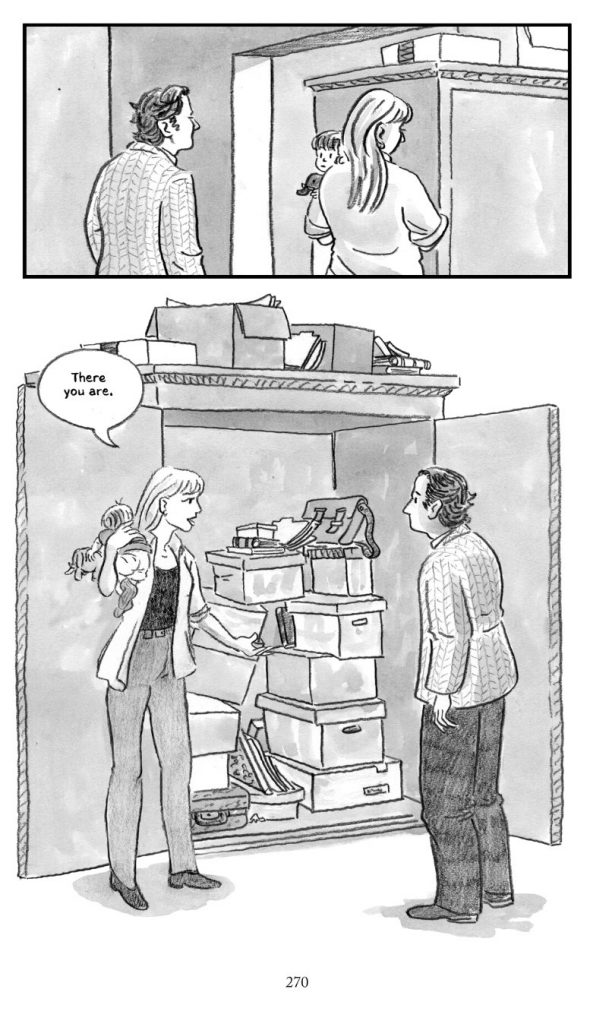
For the final movement, The Locked Room, the authors — both Auster and Karasik — take a step sideways, not ‘adding to’ or ‘subtracting from’ the detective narrative but finding its metaphorical parallel. The protagonist is, once again, an author; when a childhood friend of his, Fanshawe, disappears, the protagonist is charged with an unusual task: Fanshawe leaves behind him a rich body of writing, all of it unpublished — the protagonist is to serve as his literary executor, deciding whether or not these writings are worth any manner of attention and, if they are, seeing to their publication. (The person giving the protagonist this assignment is Fanshawe’s wife, Sophie, for whom the protagonist feels an immediate sense of responsibility, whether because she has just recently given birth to Fanshawe’s child or because she is strikingly attractive.)
With time, the protagonist settles into his role successfully: Fanshawe’s books are published and one-act plays staged to great acclaim, prompting great speculation as to the “true” identity of this mysterious author; on the personal front, he marries Sophie and adopts her child with Fanshawe as his own. The initial period of familial bliss comes to an end when the protagonist receives a letter from Fanshawe, still alive and in hiding, thanking him for taking such good care of his family and his writing. While Fanshawe states that he will not reach out again or return to ‘take what’s his,’ he nonetheless insists that Sophie cannot know that he is still alive and threatens to kill the protagonist should he seek Fanshawe out — thus forcing the protagonist to keep a secret from his now-wife Sophie, marking the first crack in their idyllic life.
The Locked Room, importantly, is a work of autofiction; while Auster stops just short of naming his protagonist explicitly, he namechecks City of Glass and Ghosts as the two books that came before the present one, thus making his stand-in identity known4. This authorial act grounds the story in a recognizable real world, allowing Auster — and, consequently, Karasik — to return to the nigh-apostolic narratorial conceit of Don Quixote, referenced several times in City of Glass5. But, while Auster may be the ‘protagonist,’ he is not, so to speak, ‘the main character’: like the protagonists of the two preceding novels, he is pointedly blank, pursuing an absence and disclosing no part of his life that isn’t connected to Fanshawe directly. This, then, is The New York Trilogy’s idea of the self: completely tethered to the other, encroached upon by it, and yet at the same time entirely unable to access it; the other is simultaneously unknowable and all-devouring, a force that warps reality around itself, and it is in the self’s search for the other’s coherence that the self is, ultimately, annihilated. In becoming Fanshawe’s literary executor, the Auster of The Locked Room oversees a legacy that quickly becomes far greater and more successful than his own (“By now,” he narrates, “everyone knows what Fanshawe’s work is like. There have been articles and studies, it has become public property.”), all while becoming virtually unable to write anything of his own and having to keep the secret of Fanshawe’s survival from his family. Fanshawe thus becomes Auster-the-protagonist’s entire life, resulting in a repressed feeling of envy and powerlessness, which he tries to combat through brute force: on the professional front, by trying to author Fanshawe’s biography to gain a sense of dominance over the endeavor that has overtaken his own work; on the personal front, by having sex with Fanshawe’s mother as an exertion of power. Both of these, of course, backfire — the former because it means that Fanshawe consumes even more of the protagonist’s life, the latter because it creates another secret, another source of guilt.
As The Locked Room butts the trilogy from detective fiction closer to Auster’s standard mode of literary fiction, Karasik makes the wise choice of breaking from the previous two volumes’ habit of initially-fixed page layouts (the nine-panel grid in City of Glass, the illustration-plus-paragraph in Ghosts); The Locked Room’s pages vary in panel counts and arrangements, creating a cadence of spontaneity, as if to say, This isn’t fiction, this is life, in all its sputtering irregularity. Yet Karasik’s cartooning, his actual line, is best viewed as part of a New Yorker-like lineage: rendered in pencil with gray washes, it is clean, handsome, readily communicative — but at the same time polite to the point of detachment, completely devoid of any real idiosyncrasy or personality. His environments feel like ready-made theatrical set-dressings; his characters feel like mere ‘types,’ reenactors with no emotional spontaneity to them.
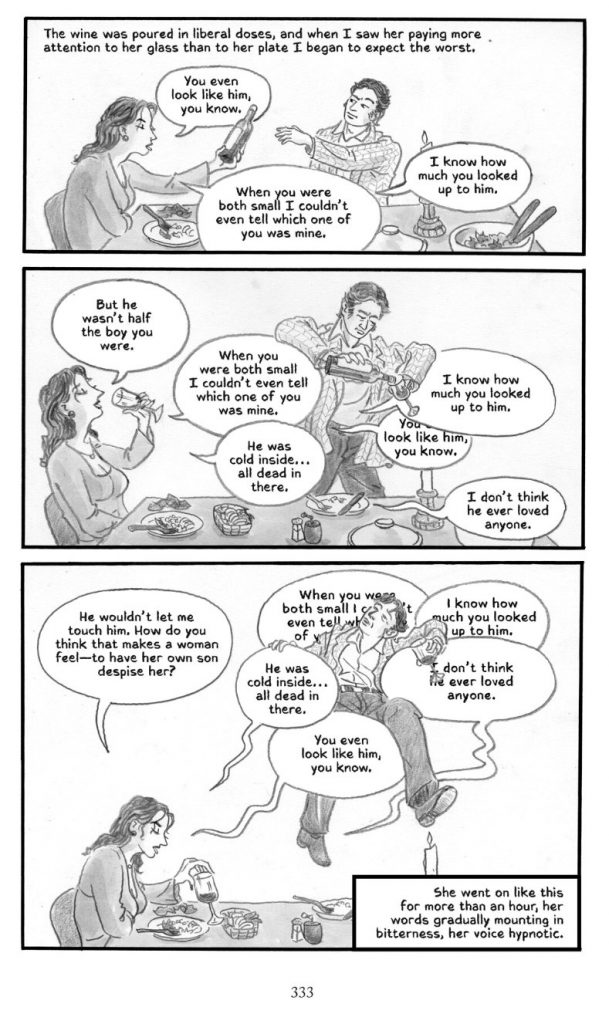
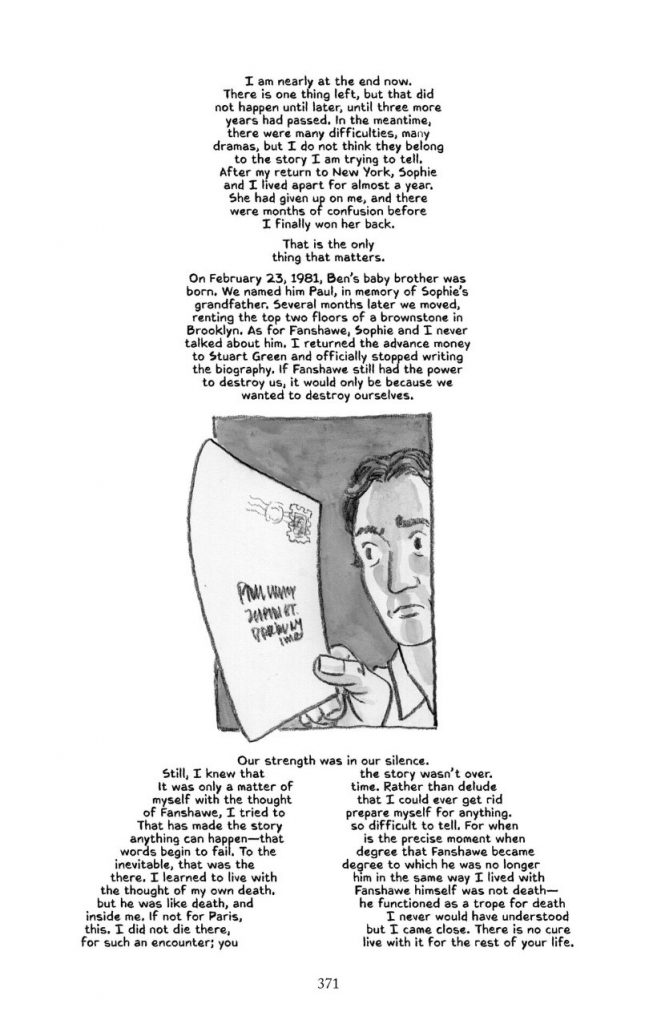
Like Mattotti before him, Karasik’s limitations are most evident when he tries to reach past the literal. His metaphors are crude, obvious: “I was floating inside that voice,” narrates the protagonist as Fanshawe’s mother monologues about her disappointment in her son, while the art depicts the protagonist physically carried away through the air by her speech balloons. Worse still are those instances where these attempts impede on actual legibility. On several occasions, when discussing Fanshawe, Karasik arranges his text in the simplified pictographic shape of a man (head, torso, legs); when the text reaches the legs, he elects to have his lines read across the increasing gap between the legs rather than use each leg as its own body of text. It’s astonishingly inelegant, as the eye instinctively approaches each leg-shaped block as a discrete unit — every line, when the time comes for the ‘jump’ from one block to another (a gap that grows wider and wider, as the legs are drawn diagonally), serves as a reminder of counterintuition.
As the Auster stand-in devotes more and more effort to Fanshawe’s biography, he finds that he simply can’t understand Fanshawe on the human level: his strange way of life, establishing a routine — work, and now marriage — then up and leaving it and seemingly starting anew; the ‘paper trail’ (letters, for the most part) outlining a broad biographical timeline but betraying little interiority and revealing even less about the body of written work the protagonist was charged with publishing. The recollections of Fanshawe’s mother (“I don’t think he ever loved anyone,” and “you can’t force a child to love you just because he’s your child”) and Sophie (“Fanshawe was not an easy man to love”; “Fanshawe had been given to her for a number of years, she decided, and that was all”) paint the picture of a soul deeply ill at ease — and yet the would-be biographer cannot seem to find any real way of accessing it.
As a narrator, the protagonist is notably omissive (see page 371: “there were many difficulties, many dramas, but I do not think they belong to the story I am trying to tell”). This is, in itself, a clever choice — by rendering explicit the generally unspoken assumption between reader and story (that there are things the reader, for one reason or another, doesn’t need to know), Auster-the-author makes the reader feel, if only for a moment, the same way that Auster-the-protagonist feels: like things are being hidden that they will never be able to reveal. But, of course, Auster-the-protagonist has far more at stake than we do: of all the protagonists of The New York Trilogy, the Auster stand-in is the only one who is explicitly said to be happy with his life — Daniel Quinn is a husk of a man following the death of his wife and child; while Blue was engaged to be married prior to his involvement, an engagement that in effect is called off when he disappears for months on end to trail Black, Auster’s clinically restrained prose and Blue’s total focus on his investigation leave little room for any real emotional distress. The Locked Room, then, is a leap forward: there is a humanity there that has the capacity not just to descend but to ascend as well — and that precisely is what makes it dangerous.
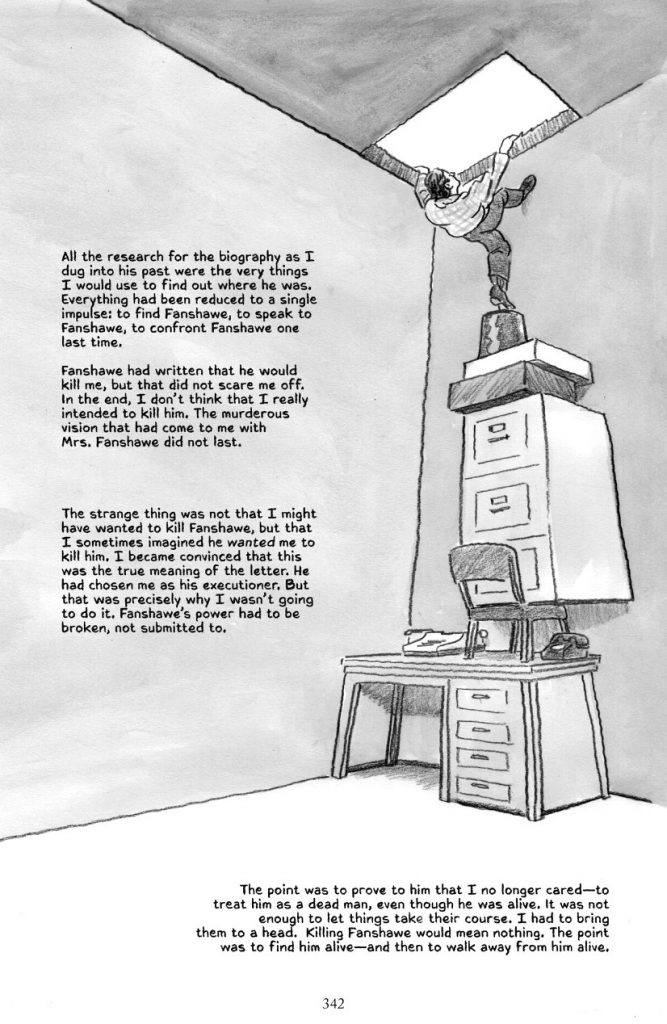
At the end of The Locked Room — when the protagonist has already given up on the biography, and following a period of marital strife and reconciliation — Fanshawe summons the protagonist to where he has been living for some two years, an otherwise-abandoned tenement in Boston. When the protagonist arrives, Fanshawe is hiding behind a locked door; he rejects his own name and threatens the protagonist not to try and break down the door. These moments are perhaps the most emotionally-moving in the entire trilogy, precisely because Fanshawe alludes to how he has felt all these years — “I wasn’t meant to live like other people,” he says, and that his escape voyage was “disgusting, truly repulsive from beginning to end. But I deserved it,” and finally that “I’ve lived with [death] so long now, it’s the only thing I have left” — and yet seems entirely incapable of, and indeed uninterested in, articulating the why of it all; there is only the feeling, eclipsing all else.
As he waits for his train back home, the Auster stand-in reads Fanshawe’s last will and testament: a notebook where he explains why he left, how he felt throughout his years of trying, and succeeding only outwardly, to be part of civilized society. The protagonist reads, and reads — and understands nothing. All the while, the reader learns nothing of the actual contents of the book, the actual details; all we get is the protagonist’s reaction, his interpretation. The protagonist finally destroys the notebook and gets on his train home.
This, then, is Paul Auster’s bottom line: the other is a locked room which you cannot access. You can try to gather as much information as you can, but there will always be a distance past the point of bridging. At that point, the choice is yours: either to accept it — or to walk away, deflated and alone.
My father was a private investigator, incidentally. I don’t tend to talk about that, not out of any sort of shame or embarrassment but simply because I don’t feel like I learned enough about his work — his cases, his methods — to imply that it is somehow a part of my life. But that’s what he did, for most of his life, and in fact for a time he became the most prominent private investigator in the country, contacted by politicians and industry leaders and appearing on television whenever an expert in the field was needed. One time, toward the end of his career, he was contacted by a well-known politician about a potential case. The case was not, in itself, political in nature; the front yard of the politician’s apartment building had housed a big and beautiful tree, but the tree had mysteriously died, and she suspected that a neighbor in the next building had poisoned it. After looking into it, my father told the politician there was a decent chance the tree had in fact been poisoned — but that, even once it was verified, there would be nothing, really, to be done about it; if she could act on it in any way, it would be a different story, but in truth she’d be paying a private eye’s fees — a substantial cost out of pocket — just for her own ultimately fruitless closure. She agreed and, amicably, they went their separate ways.
With Pantheon’s The New York Trilogy, Paul Karasik has found his own poisoned tree to latch onto for his own fruitless closure. That the City of Glass adaptation is back in print for the first time in over a decade is some cause for celebration, but the notion that from now on it will only be available within this three-in-one book does it no favors: the successes of the initial Mazzucchelli effort are reframed, outnumbered by the sputtering attempts to repeat them; what was once a surefire whole is now a mere drowned-out part.
I guess that’s the thing to remember about glass: hold onto it too hard, or put too much pressure on it — and, unceremoniously, the whole city breaks.
- The original run, that is, published by Gilberton from 1941 to 1969; one might find some more risk, albeit still constrained, in the First Comics iteration: https://www.tcj.com/take-a-look-its-in-a-book-classics-illustrated-at-first-comics/ ↩︎
- From a brief interview conducted by Bill Kartalopoulos for Indy Magazine: “Most of the comics I made before City of Glass have cinematic tendencies — and by “cinematic” I’m referring to the way each panel creates a kind of mise en scene; and the way the sequence of panels — often without narration — evokes a linear progression of time. (Actually, I dislike comparisons between comics and movies, but this is the clearest way I can describe what I’m thinking of.) Paul thinks of comics in much more graphic terms — drawing as symbol, cipher, icon…cartoon!” ↩︎
- Lettering, in this respect, is a key factor. One of the very few ‘rules’ I have in comics is that, when it comes to lettering, textural cohesion should be the ultimate aim: even if applied on a separate layer, the constituent gestures and line-weights of the letter-forms and balloons should look like belong on the same plane. City of Glass, produced before digital lettering became the norm (and, in commercial circles, the default), is, of course, a perfect example, as Mazzucchelli’s hand-lettering creates a perfect congruency. In Ghosts, we see the opposite: the narration is typeset in a standard prose font (even when it appears directly on the art), while speech balloons are populated by a font based on Karasik’s hand-lettering. The result is a stiff manneredness that ‘sounds’ little like the nightmarish solidity of Mattotti’s art. ↩︎
- The Paul Auster stand-in of The Locked Room, it’s worth noting, is not the Paul Auster, as himself, who appears in City of Glass, showing no sign of recognition when Daniel Quinn is mentioned. ↩︎
- In the fictional 17th-century Christian thinker Henry Dark; in Quinn’s meeting with Auster himself; and in the final sequence, in which the narrator speaks in the first person, explicitly distinguishing himself from both Quinn and Auster but not revealing who he is. ↩︎
SOLRAD is made possible by the generous donations of readers like you. Support our Patreon campaign, or make a tax-deductible donation to our publisher, Fieldmouse Press, today.
Leave a Reply