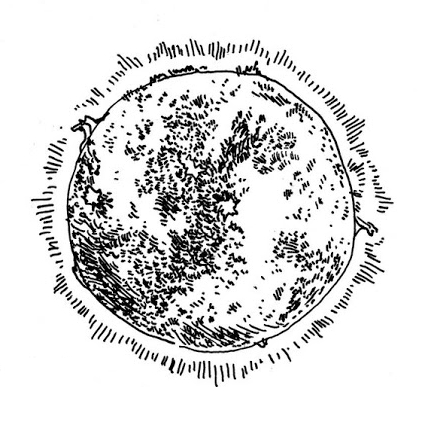
There’s an unspoken (or spoken, depending on the scene at your local comic shop) assumption that cultural products from China tend to be predictable or bland. Paradise Systems challenges that assumption with each book they publish; and most recently, with the anthology Hot Net Hotel. This collection of 15 standalone stories by creators from China offers a kaleidoscopic view of contemporary Chinese aesthetic and narrative styles. This is the first volume in a planned series called SYSTEMS.
Founded by Orion Martin in 2017, Paradise Systems translates comics from China, Hong Kong, and Taiwan, and publishes English editions out of its binational headquarters in Brooklyn and Toronto. SYSTEM 01 represents a new development for the publisher because while it’s their third anthology after Naked Body (the first significant anthology of Chinese comics published in the US) in 2019 and First Wave in 2020, it’s the first for which they commissioned new work.
“We have longtime collaborative relationships with just about all the cartoonists in this anthology,” Martin said in an exclusive statement to SOLRAD. “Many of them have significant bodies of self-published work that we have enjoyed for years, and gathering them all together in a single book is a dream come true.”
Martin collaborates with Xinmei Liu and Jason Li to edit and translate. “All of us take turns reviewing the translations before we move forward with typesetting or with asking the authors to write the translations,” he said. In Hot Net Hotel, artists’ names and story titles are in both English and the original Mandarin (using Simplified Chinese characters).
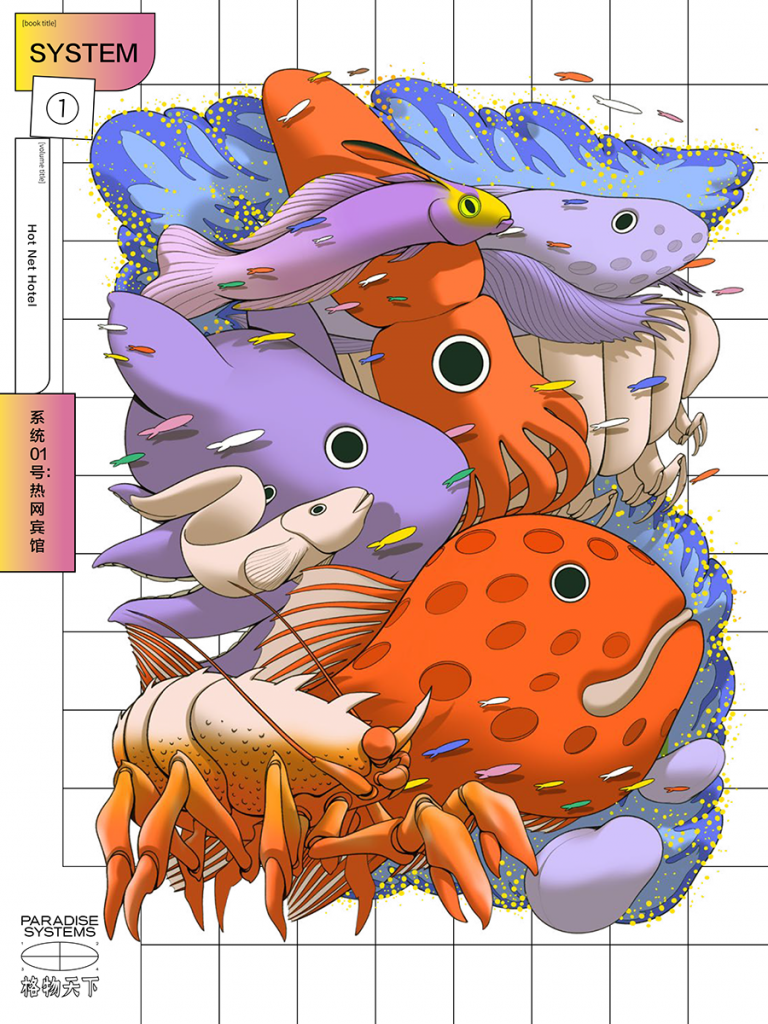
The page dimensions of Hot Net Hotel are spacious, larger than a tankōbon manga, with perfect binding that make the paperback sturdier than a US-style floppy. The book design by Patrick Crotty of Peow Studio is cohesive and clever, beginning with the cartoon marine life cover art by Mojo Wang, and continuing with the sprayed edges in the same juicy color gradient as the inside covers. The interiors have a vaguely vaporwave yet distinctly contemporary page layout.
Some of the contributors here, including Xiang Yata and Ganmu, have been active for years, while others, including Woshibai, are still emerging, which makes the curation of the anthology genuinely heterogeneous. All but one entry can be effortlessly categorized as alternative, in the sense that there’s not much relation to the design schema of mainstream comics, or even to the visual language of Chinese mànhuà, which itself is more influenced by Japanese manga. There are no ancient Chinese costume designs or red and gold motifs in these pages. Instead, each story has its own idiosyncratic tone and eclectic color scheme.
Hot Net Hotel feels like strolling through a night market, each entry emanating its own glow. A close look at the title pages reveals a delightful editorial detail: the theme of each story that functions as a kind of creative prompt, with playful names like Glamoform System, Cuddlescape System, and Glimmerance System.
A recurring theme throughout this volume is engagement with everyday Chinese life. Excursions into themes of embodiment and disembodiment counterbalance acerbic humor with genuine tenderness. Vicious workplace drama shares space with critical environmental issues, and concerns about displacement are stacked neatly next to wistful reflections.
There are some culturally-specific details here. For example, each creator uses an art name, a longstanding tradition for artists and writers in the Sinosphere, from Tang Dynasty painters to contemporary novelists. But the comics themselves don’t necessarily demand an awareness of cultural contexts.
The narrative styles vary from the hilarious post-structuralism of “The Checkers Hotel” by Boilingman, in which bizarre humor and vector art co-exist outside of any pre-established comics structure, to the absurdism of “Constipation of the Soul” by Wang XX, in which an anthropomorphized manatee and seal have existential discussions in a metaphysical public toilet.
Standout stories include the wordless adventure “Web” by toyoya, illustrated in a 16-bit video game style, in which two friends pick an apple to feed to a robotic spider who mechanically spins a representation of one of the friends into an .exe file. In the delicately drawn “Capture” by Xiang Yata, the viewfinder of a scope on a hunting rifle is used as panels. This wordless ecofeminist fable explores how we might interact with our environment if animals looked more like us.
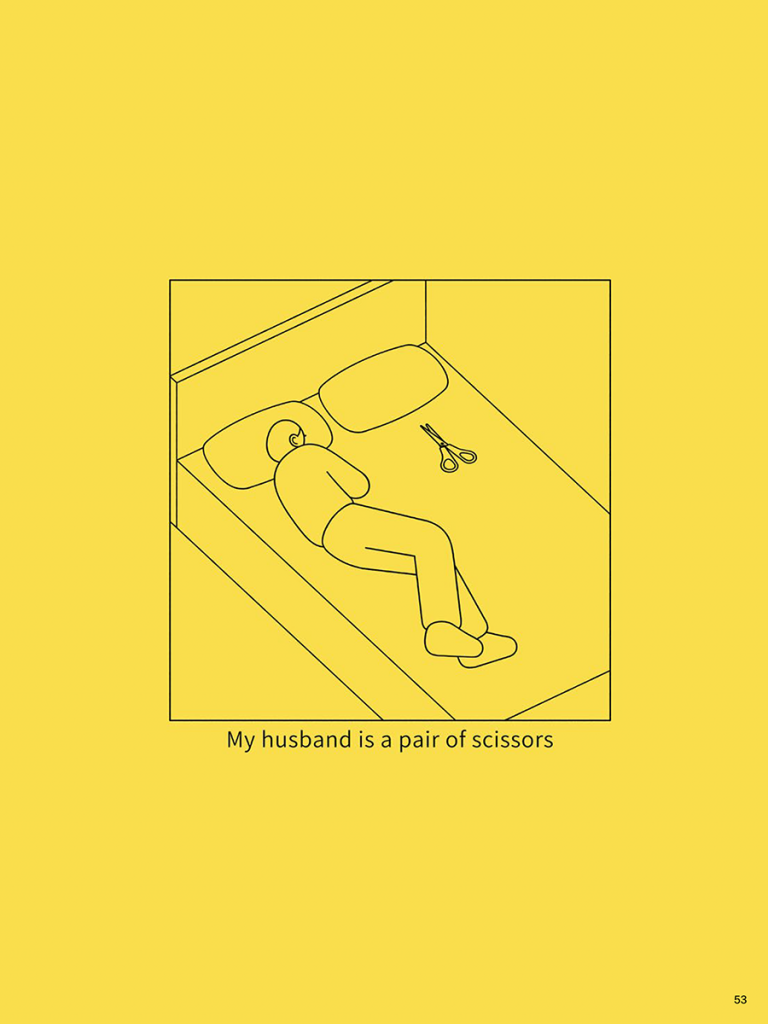
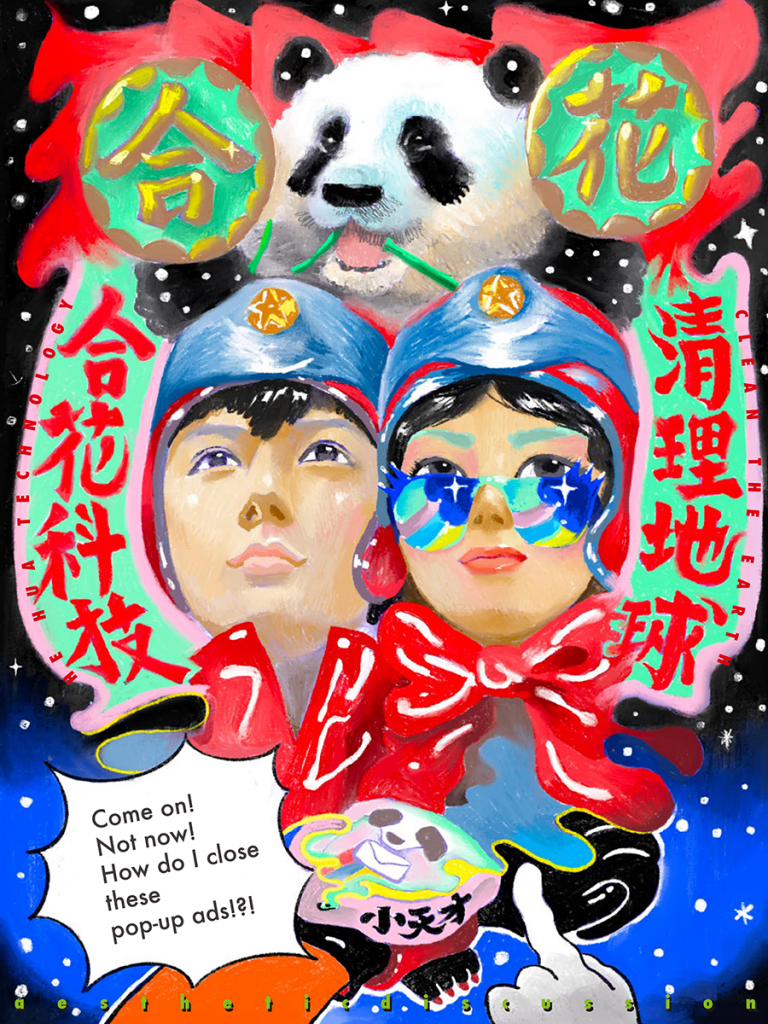
In “Husband” by Woshibai (translated by Tiffany Wu), off-panel narration offers a surrealist take on the utility of our intimate relationships. The full-bleed color — a saturated utilitarian yellow — and the uniform panel size across the pages create a rhythm that ends in a poignantly abrupt way. In “Hu Hua (Composite Flower)” by Fiona Peace, maximalist visual design with collage-like layouts nudge the eye across a frenzied description of a space craft designed to house Chinese people while Earth is rehabilitated enough to become habitable again.
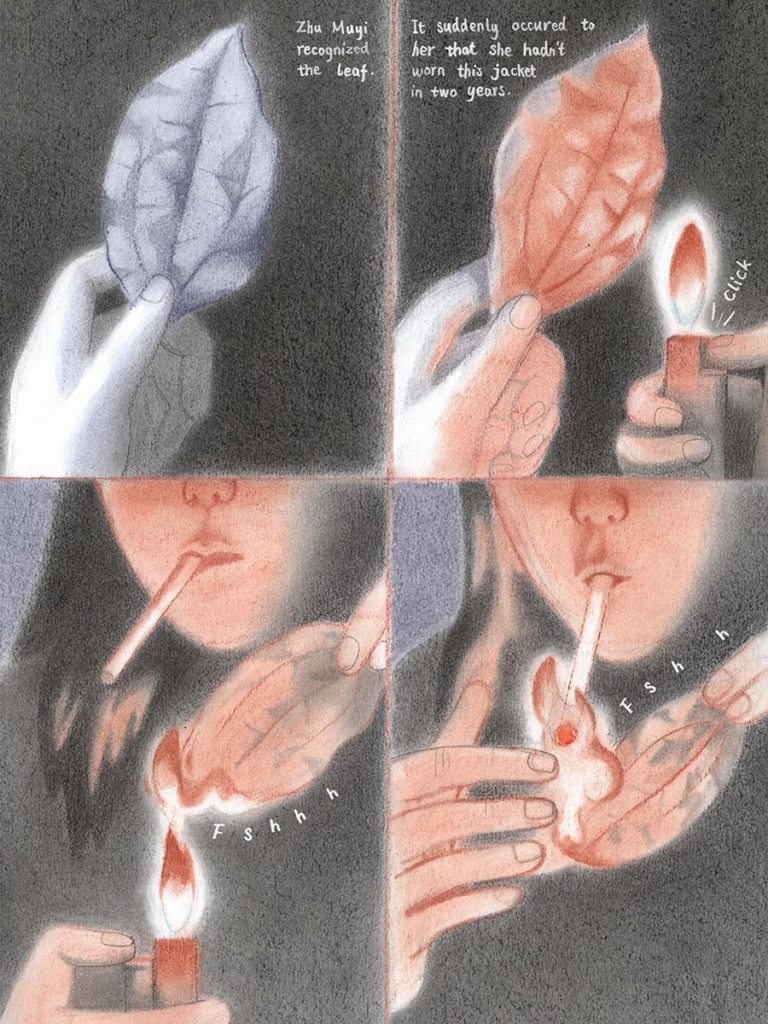
In contrast to the frenetic pace of the stories immediately preceding it, “Reflections by the Night” by Pigao presents soft, textural drawings in desaturated colors. This dreamy, contemplative moment, sequenced toward the end of a book that began with childlike markmaking and scribbled primary colors affirms that Chinese comics are neither predictable nor bland.
SYSTEM 01: Hot Net Hotel won the Society of Illustrators MoCCA Arts Festival Award of Excellence in March 2026. A publication date for SYSTEM 02 has not yet been announced, but should be actively anticipated by readers who love comics that defy assumptions.
SOLRAD is made possible by the generous donations of readers like you. Support our Patreon campaign, or make a tax-deductible donation to our publisher, Fieldmouse Press, today.


Leave a Reply