George Orwell begins his 1941 essay ‘The Lion and the Unicorn’, “As I write, highly civilized human beings are flying overhead, trying to kill me.” The bluntness of this declaration, characteristic of Orwell, echoes the tone for many texts written during wartime. It is an insistence of perseverance.
We have many social theories which attempt to reinforce our sense of agency in the world. Broadly speaking, the right has self-actualisation, the left collective struggle. But it is also the case that sometimes history happens to us, and it has often happened to humans around the world throughout time. We may be able to explain why, but that doesn’t mean we can impact the what. In those situations, what else is there, besides perseverance buoyed by hope?
Iran’s contemporary history, at least as it’s understood in the popular imagination, personifies both the active and passive experience of history. The 1979 Iranian Revolution, memorably illustrated in Marjane Satrapi’s Persepolis, is one of the 20th century’s most dramatic populist uprisings, one which has had history-altering impacts across the Middle East and beyond. On the other hand, in more recent decades, Iranians themselves have been portrayed, especially to those of us in the anglophone West, as solely victims, either of their own government, a failing economy which forces them into refugee status, or of various regional conflicts. Iranians, whose ancient country is fantastically diverse, artistic, and complex, understand this perception. An Italian friend of mine who hitchhiked across Iran many years ago recalls their unwavering hospitality, and their critical awareness of their portrayal in the West as terrorists and extremists.
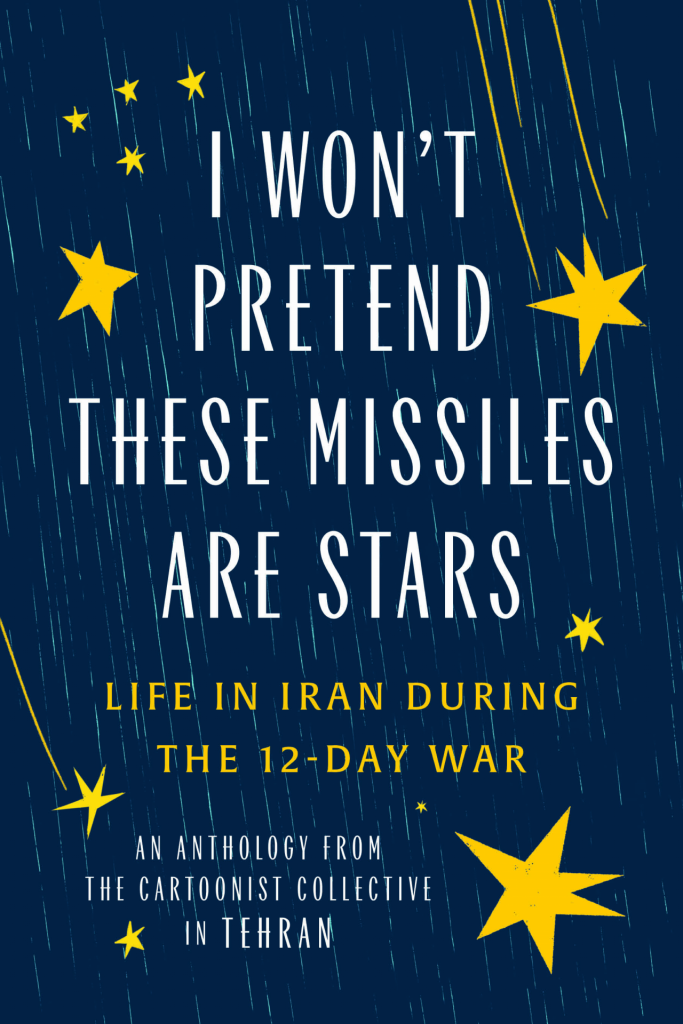
Inbetween economic and cultural blockades, a lack of curiosity in many parts of the world, and local restrictions on free speech and internet access, the voices of common Iranians have often been set aside for hardline ideological positions and politicking. I Won’t Pretend That These Missles Are Stars is a necessary remedy to this. Composed of fifteen short stories drawn by members of the Tehran-based The Cartoonist Collective, many of them students or recent graduates, it recounts experiences of 2025’s Twelve-Day War, an armed conflict initiated by Israel, and supported by the US. The latter would ultimately pressure the former to agree to a ceasefire. According to Al Jazeera, Israeli and US attacks on Iran killed 610, while counterattacks against Israel killed 28.
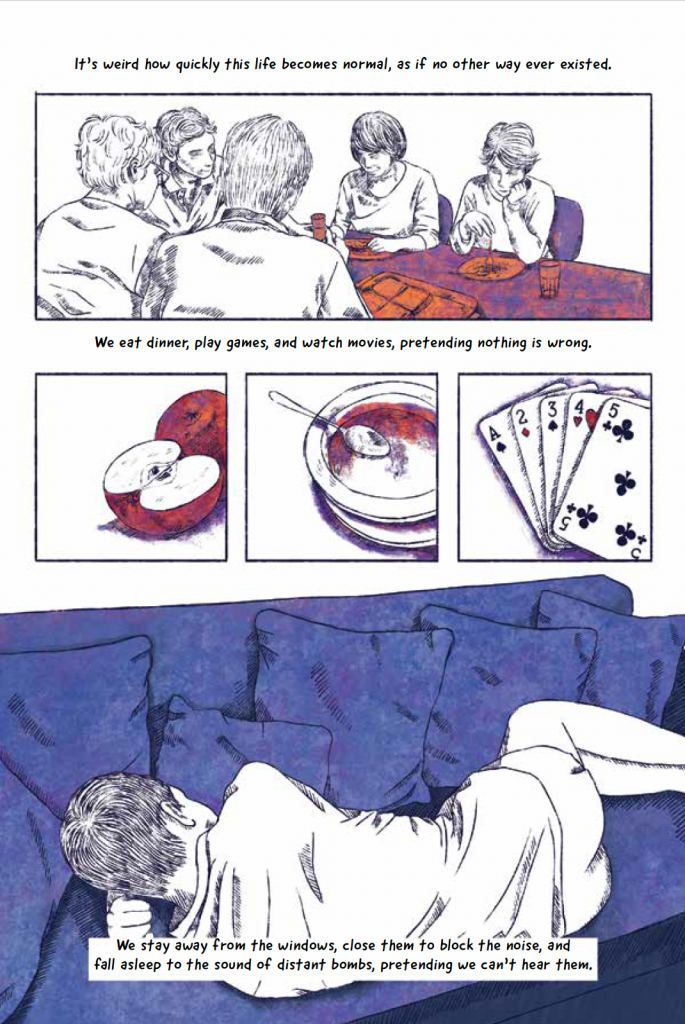
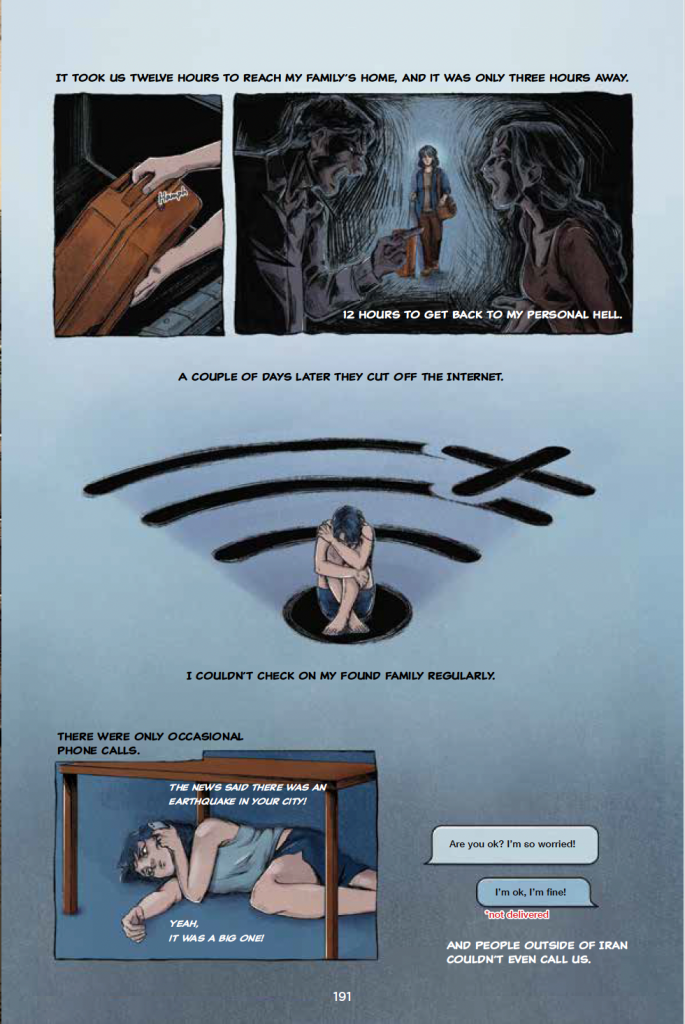
I Won’t Pretend is mostly a book about the personal stresses and traumas placed upon families and individuals by this war. For safety, people sleep in rooms without exterior walls, trying to ignore the sound of explosions while waiting for the internet blackout to be revoked. Education and graduation ceremonies are interrupted. Families are split up when some escape to rural areas, while others need to remain in the city for work or health reasons. Protagonists worry about these separations becoming permanent, of something happening to them or loved ones while they’re not with each other. A recurring theme is the way in which dreams and nightmares quickly reflect the reality of life under war, and how these start to blend with reality.
It isn’t a political book per se, insofar as the authors, who remain anonymous, don’t often discuss specific political decisions or political figures. In fact, one of the most politically-minded stories, ‘Nothing’, while being factual as to the persistence and impact of Israeli and US attacks, largely focuses its ire on the failures of Iranian leadership.
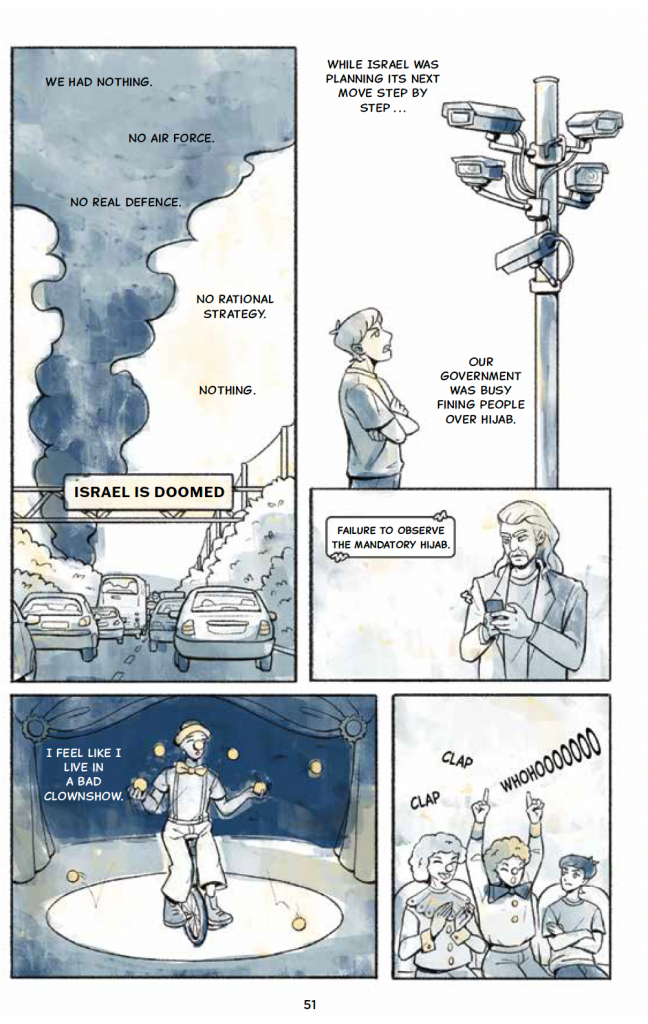
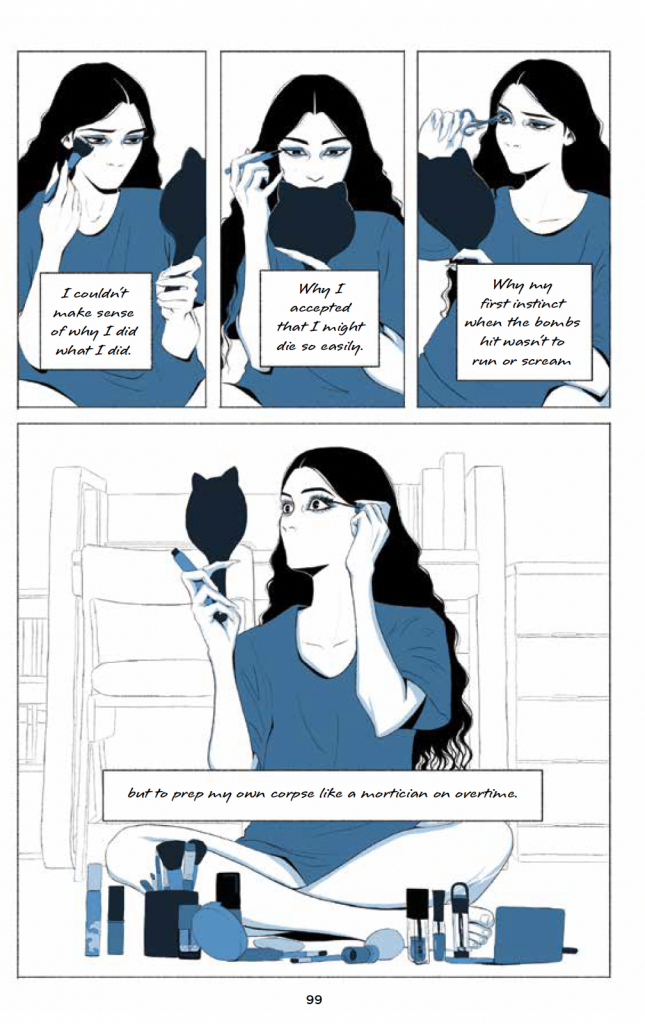
Another recurring theme in I won’t Pretend These Missiles Are Stars is people doing the opposite of what they imagine people would expect. At the sound of bombs, some don’t panic; instead, they offset their anxiety by doing something mundane. One calmly packs an emergency bag and waits for further news, another embroiders a nametag for their cat. One woman, in the story ‘Momento Mori’, applies makeup, an effort “to prep my own corpse like a mortician on overtime.” The sense of the storytellers’ powerlessness, when the context of the horrors that surround them is fully appreciated, is heartbreaking.
There is a sense of loss: a loss of the future; a death that is always around the corner. This makes it quite distinct from the aforementioned Orwell quote. Many of those reflecting on WWII at the time recognised that it was a battle for the future. The interpretation of WWII, then and now, was that it was a fight for different types of futures, liberal vs. authoritarian, socialist vs. fascist, imperial vs. anticolonial, etc. Sometimes in complicated formations.
The interpretation of the Twelve-Day War offered by this collection of stories is that the conflict was part of a broader “slow cancellation of the future”, to misappropriate Mark Fisher’s term, one in which ‘sides’ are not easily taken, and the dignity, hopes, and dreams of those who suffer under Israeli and US bombardments one week, and the Supreme Leader’s boot the next, are the last to be considered, if they are considered at all. This is not to imply that the authors support attacks on their own country, but only that they struggle to annunciate a defence of their country as it is.
The subsequent presentism, one constantly threatened by an existential threat, makes itself known visually in a number of moments across the book, especially when things fragment: people, and sometimes the panel itself. This shattering points to literal explosions, and, perhaps, also to a feeling of a lack of psychological cohesiveness. Young people in literature are often building towards something. Here they are coming undone. As the female protagonist in ‘My Dream City’ reflects, “I’m not mourning what was, I’m mourning what never got to be.”
Between June 2025 and now (April 2026), Tehran has witnessed a large bazaari and civil rights uprising, and the threat of evacuation due to drought. As I write, we are a little under a month into a new conflict, again initiated by Israeli and US forces, which doesn’t yet have a name, but which seems to have permanently put to rest the potential of a long-term diplomatic settlement, and is yet again killing civilians. It is hard to fathom the persistent devastation faced by Iranians.
I Won’t Pretend joins a comics corpus that traces the personal and familial stories of those who have lived through generations of conflict in the Middle East (or ‘the center of the world’, as the tagline for the literary journal The Markaz Review reminds us). Notable works include Joe Sacco’s Palestine and the aforementioned Persepolis, Mazen Kerbaj’s Beirut Won’t Cry, and Riad Sattouf’s The Arab of the Future. It is tragic but feels sadly inevitable that, for the foreseeable future, these sorts of stories, ones of exile and of surviving political oppression and war, will continue to not only be relevant but also be written anew by future generations.
The book opens with a request from the The Cartoonist Collective: “In the end, we have only one request, remember us, remember Iran, and speak loudly about it.” This is a common refrain from protesting Iranians who manage to gain a platform on Western media. If war is a universal experience, then so is surviving and resisting it, and seeking a voice to raise above the din of imperial violence. This is a demonstration of perseverance, and I am reminded of Emily Dickinson, who insisted that
“Hope” is the thing with feathers –
That perches in the soul –
And sings the tune without the words –
And never stops – at all –
SOLRAD is made possible by the generous donations of readers like you. Support our Patreon campaign, or make a tax-deductible donation to our publisher, Fieldmouse Press, today.

Leave a Reply