A couple of months ago, an article on The Atlantic overtook my social media feed by storm (at least compared to the usual responses to The Atlantic in my algorithmic circles). The article, titled “What if Our Ancestors Didn’t Feel Anything Like We Do?”, focuses chiefly on Rob Boddice, a historian of senses and emotions who argues that emotions are formed — not merely informed — by the sum total of our circumstances and our cultural and experiential prisms, and, thus, become increasingly unrecognizable with the widening of chronological and cultural disparities. Boddice bristles against the notion of emotional universality, arguing that the prevalent idea of ‘empathy,’ as an understanding of the other through the conceptual vocabulary of the self, is, in practice, an irreparable reduction, and that, in practice, the broad labeling of emotional categories such as ‘happy’ and ‘sad’ constrains the extent to which we understand our own, and consequently others’, emotional reality.
Even just applied to the present day, the premise is distinctly poststructuralist: the question becomes what tools we have to understand one another outside of our respective conceptual vocabularies, and how it might be possible to mediate those conceptual vocabularies in ways that are affecting and profound rather than superficial telegrams. This becomes several times more challenging where history, not the present, is concerned. Boddice gives the example of a medieval carpenter who has accidentally hit his thumb with his hammer while building a table:
To understand what the carpenter experiences, then, we need to begin with a series of questions that might help us reconstruct the meaning produced once the [pain] signal reaches [the brain’s pain receptors]. Does this happen a lot? Is the sensation of hitting his thumb a daily or weekly occurrence—something that goes with the job? And then, if religion infused every second of his life, as might very well be true for a medieval carpenter, where would his concept of suffering come from? Does he think about Christ and perhaps feel purified? If suffering, sin, and love are conjoined in an idea of the divine in the carpenter’s brain, and these are “lived connections,” Boddice said, “and you’re surrounded by them,” how might he feel when that hammer hits his thumb?
There are some significant kinks in this hypothetical — even within structured orthodoxy, religious faith is itself deeply subjective, and the depth and conviction of one’s belief isn’t necessarily as uniform as Boddice makes it out to be. More crucially, however, the core premise is appealing in no small part because its very fundament is speculative: so long as one cannot enter into continuous (and spontaneous) dialogue with one’s subject, one is limited to historical findings, the range of which — and the inferential potential of which — grows narrower and spottier the farther back one looks; projection remains nonetheless a key component, as the individual subject is reduced to a profile, an implicit average.
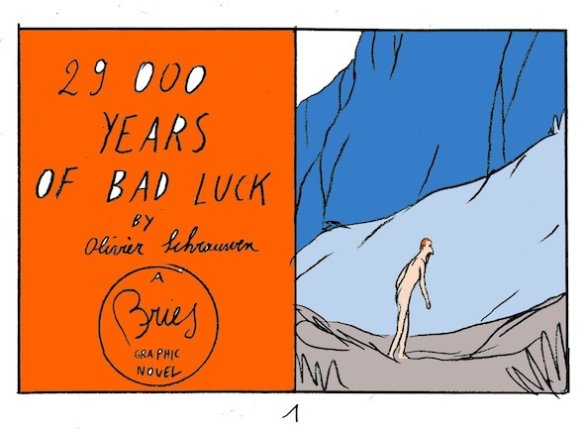
With all this in mind, we may set our sights to Belgium — more specifically, to one Olivier Schrauwen, whose mini-comic 29,000 Years of Bad Luck was sent to me some months ago by Fieldmouse Press’ own Alex Hoffman. As far as print objects go, 29,000 Years of Bad Luck is best described as ‘unassuming.’ For all the bombast of its title, this little number, published by Bries in 2010 and cheekily described on the cover as a “graphic novel,” is just sixteen pages long; its dimensions are those of a Chick tract — and the comic, dare I say it, is just as effective in articulating its worldview.
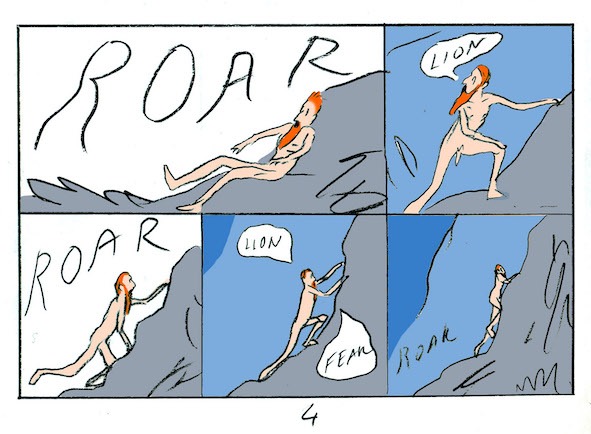
The plot revolves around an orange-haired neanderthal. As he roams the mountainous prehistoric landscape, he encounters a woman and her two children: a roughly-teenaged daughter and a toddler of indeterminate gender. They band together, becoming a family. The teenage daughter dies first, as she stands on the edge of a cliff and the rock splinters off, then the mother is mauled by a lion (the man and toddler manage to escape through a narrow opening between the rocks, but the woman, being significantly larger, cannot squeeze herself through). In the end, only the man and the toddler remain, then only the toddler, as a large bird of prey swoops in and abducts the man to his presumable way-of-all-flesh.
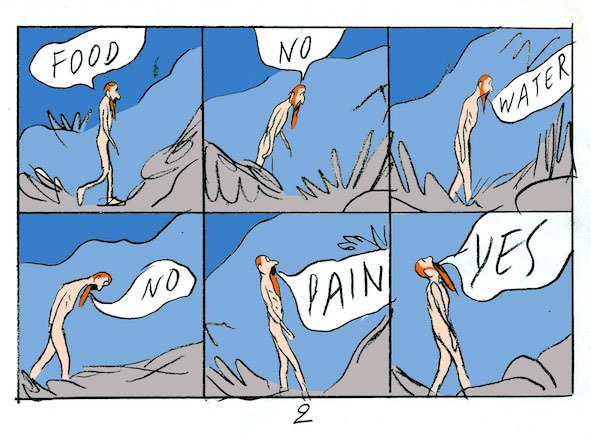
Schrauwen’s neanderthal characters speak in one- or two-word sentences, only ever describing their physical feelings and perceptions of their exterior environment, never any expression of emotion; the only exception is when the woman, on seeing the man’s erect penis, describes it as “love,” tying together the emotional and the biological. As characters, the neanderthals are completely flat and one-dimensional, vocalizing their metrics of existence — “cold,” “pain,” “food” — on a yes-no binary and operating completely without recognizable human depth beyond survival.
By all accounts, 29,000 Years of Bad Luck is a brief affair, not a story in the dramatic sense so much as a reenactment, a proof-of-concept that goes through the motions. To be sure, it’s an effective minicomic, but it is effective precisely because of that brevity, getting its point across concisely and without overstaying its welcome. Yet it takes on a greater poignancy when taking Schrauwen’s later works into account, especially what I have taken to referring to as his “Trilogy of the Self” — Arsène Schrauwen, Parallel Lives, and Sunday (all from Fantagraphics, 2015, 2019, and 2024 respectively). Last year, in writing on Jordan Crane, I made the distinction between the two prevalent strains of Anglophone alternative comics: the kneejerk camp of irredeemably distasteful dirtbags, such as Johnny Ryan or Joe Matt (stemming directly from Crumb), versus a more nuanced, largely neutral approach to the specifics of human emotion, more along the lines of Crane or Chris Ware. Schrauwen, for his part, does not belong strictly to one side or the other; he mixes the judgment of the former with the slower, more precise narrative structuring of the latter.
Let us consider Schrauwen’s fictionalized self. In the above works, Schrauwen’s protagonist is generally ignoble, capricious, and at least somewhat off-putting; he chases gratification but is never, in truth, gratified. These characterizations may be monotonous, but only because they are painfully, astonishingly consistent, so all-encompassing and elaborated (or belabored, as his detractors might put it) as to become almost ideological in nature; if they experience any downfall at all, it occurs precisely because of the unwavering nature of these traits. Whether in narration or just through blunt dialogue followed by pointedly-unsubtle action, all three books make sure that the reader understands the character and his emotional and behavioral mechanisms at every turn. There’s more than a note of David Foster Wallace in this characterization: ironic distancing coupled with absolute, unchanging constancy.
Having characterized the broad strokes of Schrauwen’s preferred type, we may look more closely at these protagonists’ identities: the titular Arsène Schrauwen is the cartoonist’s grandfather, while Thibault, protagonist of Sunday, is Schrauwen’s cousin; in the short stories that comprise Parallel Lives, the protagonist is usually Schrawen himself, or extensions of him (“Oly,” “Olver,” “Ooh-lee”), planted in sci-fi and futuristic scenarios. What Schrauwen does in practice, then, is take the characteristics that he ascribes to himself and, in essence, project them backwards and forwards in time as well as outwards in the present day — manufacturing empathy by grafting himself (for a comedically-embellished value of such, at least) onto those around him, thus creating, completely contra the theories of Boddice and his camp, an ‘absolute self’ that transcends momentary circumstance.
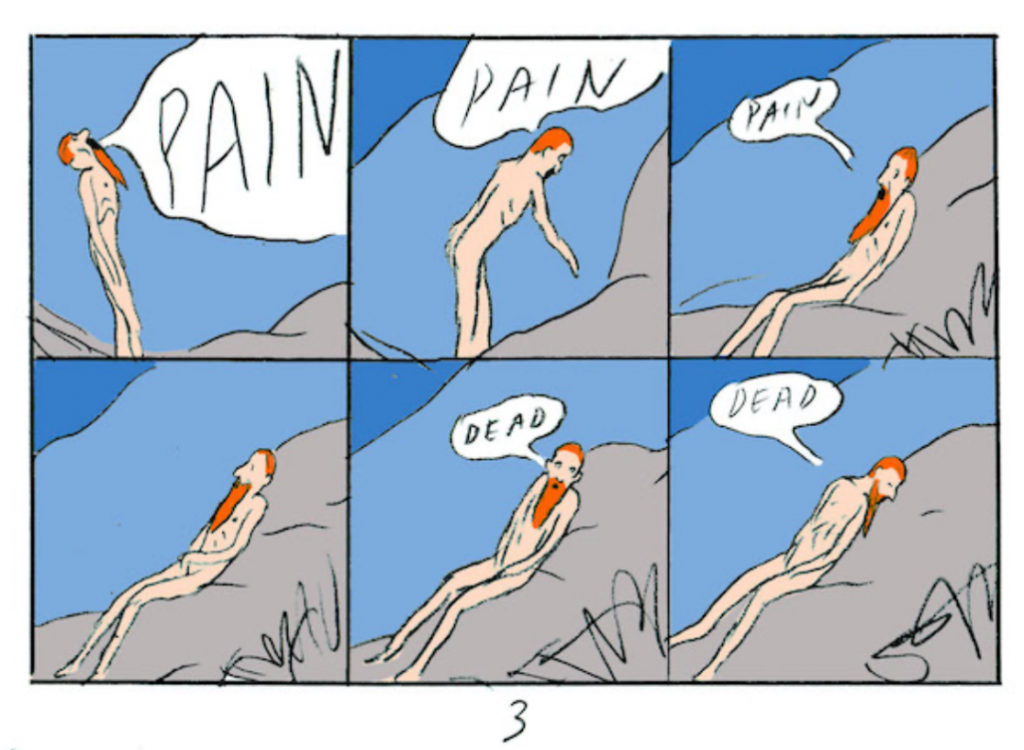
Thus, 29,000 Years of Bad Luck becomes interesting as it both contradicts and foreshadows this later endeavor. The crude verbalization can easily be explained away as the conventional portrayal of caveman-as-caricature, but, coming from Schrauwen, it feels like a loud expression of intent, a line in the sands of time distinguishing history from prehistory: history can be recognized as human, whereas prehistory scans more as half-hearted anthropomorphization, inscrutable and unknowable, a point so far that even the Schrauwen-self doesn’t reach it, at least not in tone and resulting ‘relatability.’
In the cartooning, too, the comic is an interesting contrast to Schrauwen’s latter-day works. Arsène Schrauwen, Parallel Lives, and Sunday are all dominated by a digital texture; even though the comics themselves are drawn traditionally with pencil (quite possibly a mechanical pencil, judging by the uniformity of his line-weight), more prevalent are the candy-hued gradients and, of course, the stiff font-based lettering. Disaffected modernity, nowadays, is baked into Schrauwen’s very material feel. 29,000 Years of Bad Luck, by contrast, feels much more immediate. The penwork is coarse and sparing, with shapes that feel like blunt, perfunctory communication, bringing to the fore the influence of Fort Thunder cartoonist CF; the colors are flat and blocky, with nary a gradient in sight. Most notably, the lettering is drawn with the same slapdash penhold, for once feeling like it exists on the same material plane as the cartooning itself. The consistency of Schrauwen’s visual perspective, meanwhile, harkens back to the comics of the early 20th century, drawing not from the cinema but from the stage: eye-level, never shifting up or down or closing in for a dramatic flare. Immediately, these formal choices make sense, mirroring the dawn of the art-form to depict the dawn of species.
At the same time, however, beyond the rudimentary style of communication, we may see patterns of behavior that feel far more in line. First, both times that the ‘family’ eats, it is the woman, not the man, who hunts the animal (“Strong,” she half-asks the first time the two meet, then, when she reaches to grab his scrawny arm, she simply observes, “No”); then, once the woman dies and the man is left with the toddler, he immediately tries to shirk his fatherly responsibility: “Dad,” the toddler exclaims, only for the man to respond “Dad no” and quickly run away. A revelation, then: to Schrauwen, personality is secondary, a mere post-hoc justification of our worst hardwired instincts.
A few months ago, I took a trip to Italy: to Rome, mostly, with a day-trip to Tivoli. I started the Tivoli trip at the Villa Adriana, which felt, more than anything, like a visit to the mind of Martin Vaughn-James; try as I may, I never do manage to make myself view ruins as more than just, well, ruins. Climbing up stairs, viewing still-more-or-less-whole sculptures, inspecting flooring tiles which still, in spite of everything, survive, two thousand years on: in point of fact, the place, on a deep level, was inaccessible to me, past the point of taking on life in imagination.
Not that I fared much better at its kontrapunkt, the more modern (and closely preserved and restored) Villa d’Este — despite its opulence and immediately-perceived beauty, the space remained detached. Despite my best efforts, I could not imagine walking its halls or its gardens at a time when Bernini, who designed the centerpiece of its many fountains, was still active, a celebrity rather than a historical figure. Infinitely more captivating to me were those indications of recency, like the graffiti of schoolchildren on field trips: the lives of Merli Anito (who visited on October 5th, 1941) or Gustin Kozina (August 15th, 1951) are closer to, if still separate from, my own.
What if our ancestors didn’t feel anything like we do? That’s quite possible, says Olivier Schrauwen. But we must not lose sight of the more important truth: that, feeling or no feeling, our ancestors were no nobler (that is, no less ignoble) than we are; that, feeling or no feeling, they were no more capable (that is, no less incapable) than we are. Most importantly, you can bet that they were no less pathetic than we are. Not a single bit. Feelings or no feelings, some things never change. Now ain’t that a comfort?
SOLRAD is made possible by the generous donations of readers like you. Support our Patreon campaign, or make a tax-deductible donation to our publisher, Fieldmouse Press, today.

Leave a Reply