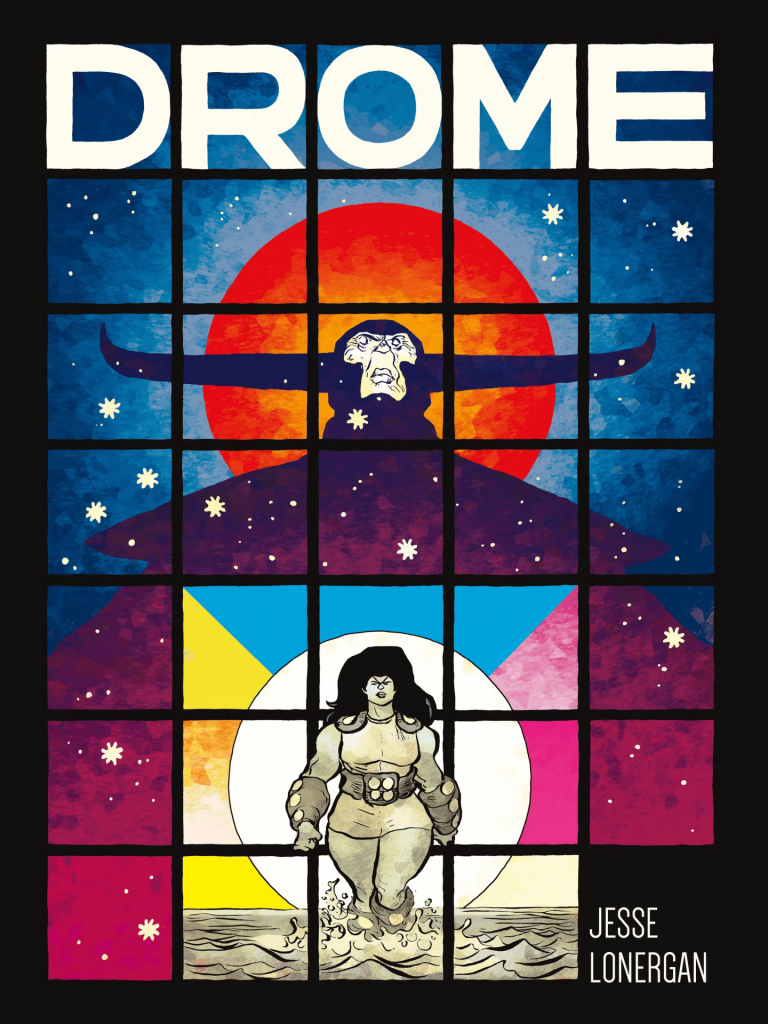
And Lonergan said, let there be CMYK, and there was CMYK.
Everything you need to know about Drome is right there, on the book’s very first page. Before you even reach the table of contents, Jesse Lonergan has revealed his hand. A blank page, save for four blocks of color: cyan, magenta, yellow, and black placed in a grid and separated by gutters. The cosmology of the comic book page, the atoms, electrons, and quarks of the medium, printed on the first page of a comic telling the origin, evolution, and fate of its fictional world.
What looks like a clever graphic design choice is, in fact, the book in miniature. Drome is a creation myth that performs its own thesis: a story about how a world gets made, woven from the material of comics-making itself. In Lonergan’s hands, the printed page becomes more than a vessel for that myth. It is the myth’s generative matter: black ink, white paper, gutters, grids, and color, transformed into gods, physics, and elemental forces.
Lonergan himself has described Form and Spirit, the book’s twin gods, as “black and paper… the present and the not present and the negative space and demarcation lines,” and the characters as “filling in CMY.” In other words, Drome does not simply use the printing process as a delivery system. It turns it into metaphysics.
The book is even divided into chapters that correspond to that cosmology: Blue, Red, Yellow, Form, and Spirit, with each chapter dedicated to one of the book’s central characters. The first three, the primary colors, become demigods, or elementals, in Lonergan’s universe: Blue, who brings language and reason to the world, Red, who introduces passion and love, and Yellow — destruction incarnate. The final two are celestial beings, the gods who create the world and govern its rules: Form is the black ink of creation. Spirit is the white page, the canvas the world is painted (or perhaps printed) on.
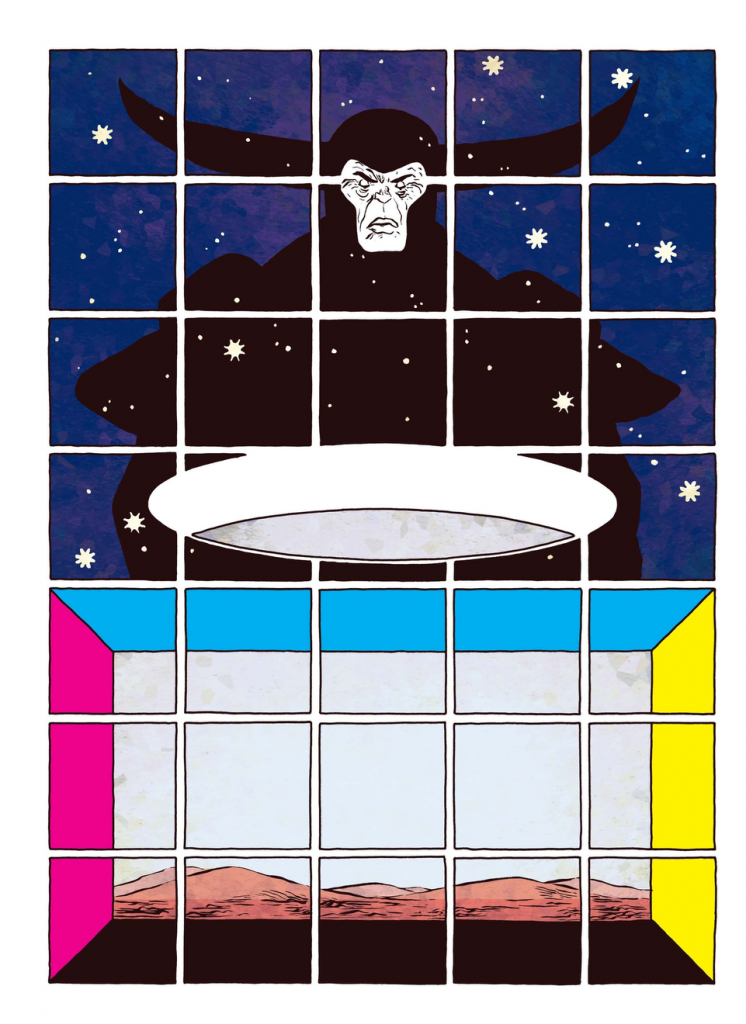
And if you still had any doubts about what Lonergan is doing here, the opening of the story instantly dismisses them. A single image is broken across a thirty-five panel grid. The massive, horned silhouette of the god Form looms against a starry sky. He is looking down into a hole in the fabric of reality, a clean, oval window into the new world. A world bound by cyan, magenta, yellow, and black.
Throughout the book, Lonergan restates and reinforces the idea that this is not just another fictional comic book world. We’re not in Kansas (or, for that matter, Metropolis) anymore. This is a new kind of world, one that can only exist as a comic. Creatures disrupt the narrative by literally shattering surrounding panels. Objects traverse the page, moving not only past gutters but through physical space. The medium is as much a part of the message as the narrative it presents.
One of the most effective examples of this occurs in a brief, quiet sequence. Blue dives into a river, surging through the water, existing for a moment in a space beyond the grid and gutters. But notice how Lonergan poses her, tilted upwards. Her body becomes a vector, pointing us not only across the page but through the page turn itself. Lonergan constantly breaks formal rules throughout Drome, but in this single instance, he also forces his readers to break theirs.
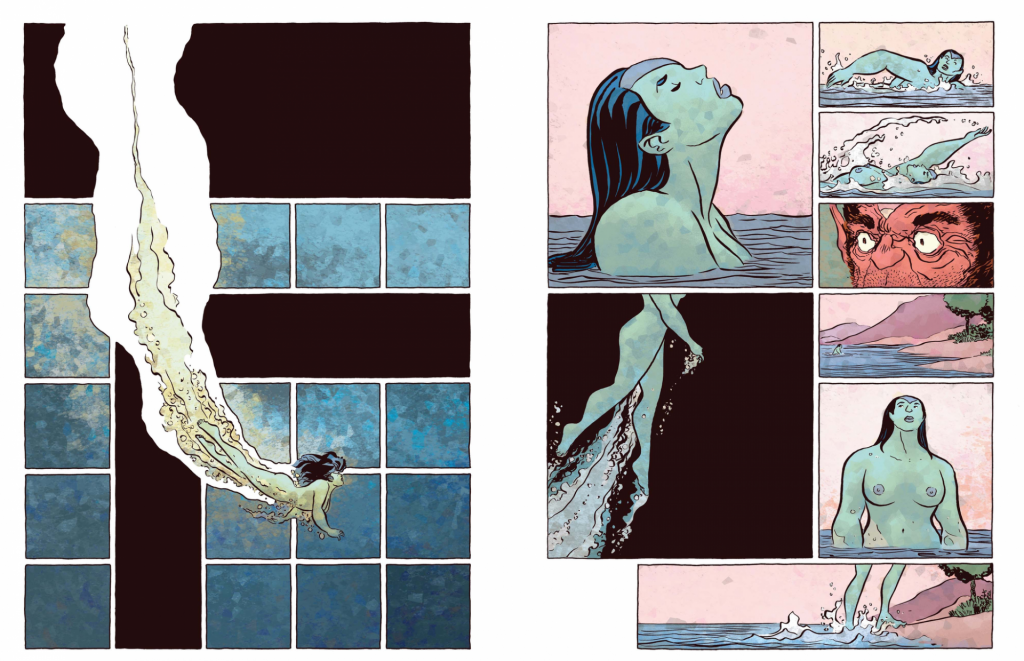
And he does it so masterfully that we have no choice. Our eyes automatically enter the next page in the lower left panel, arcing with Blue across page boundaries. We move through the physical space of the page (and more impressively, the page turn) in a way we are not used to. We interact with Lonergan’s world. We participate. And for a moment, we become a part of it.
The attentive reader will also notice the move Lonergan makes as Blue breaks the surface. Some might call this a cinematic transition, but it is actually inherent to sequential art. A film camera cannot convey the physical presence of a single body across multiple spaces, at least not in such elegant fashion. Here, Lonergan leans on our ingrained understanding of the language of comics. We see the two panels as a single, unbroken figure while simultaneously understanding the spatial and temporal separation between them. The gutter is both a formal boundary and a diegetic one. It functions as a clear break in the action, but also as the water’s surface. And, in doing so, it somewhat unintuitively merges two images that are separate in setting, time, and perspective into a single, flowing motion.
An even more attentive reader will notice the same idea mirrored in the final two panels.
Throughout the book, Lonergan continues testing the language of comics, offering his readers a new way to experience the page. And perhaps it’s no coincidence that it’s Spirit — the book’s celestial representation of that very same page — that gives the wild, murderous creatures of Drome’s world a new language: a way to recontextualize chaos into order, violence into civilization, and death into life.
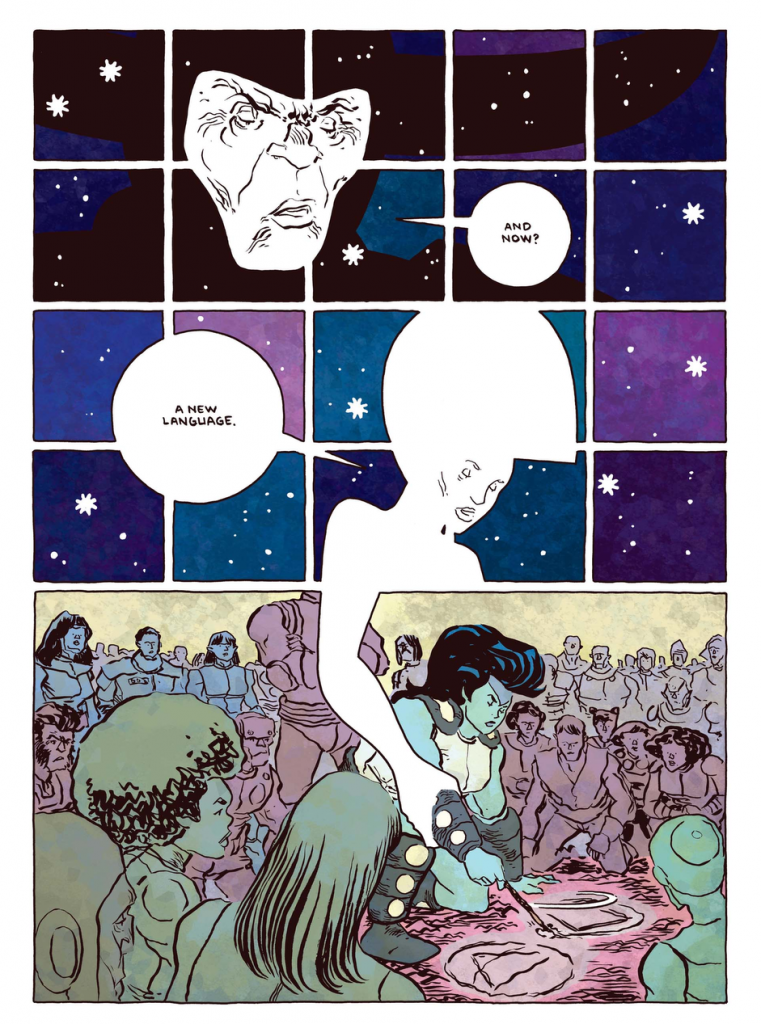
But Lonergan doesn’t just push against the boundaries of comic book vocabulary. He also breaks the constraints of its syntax. At times even literally.
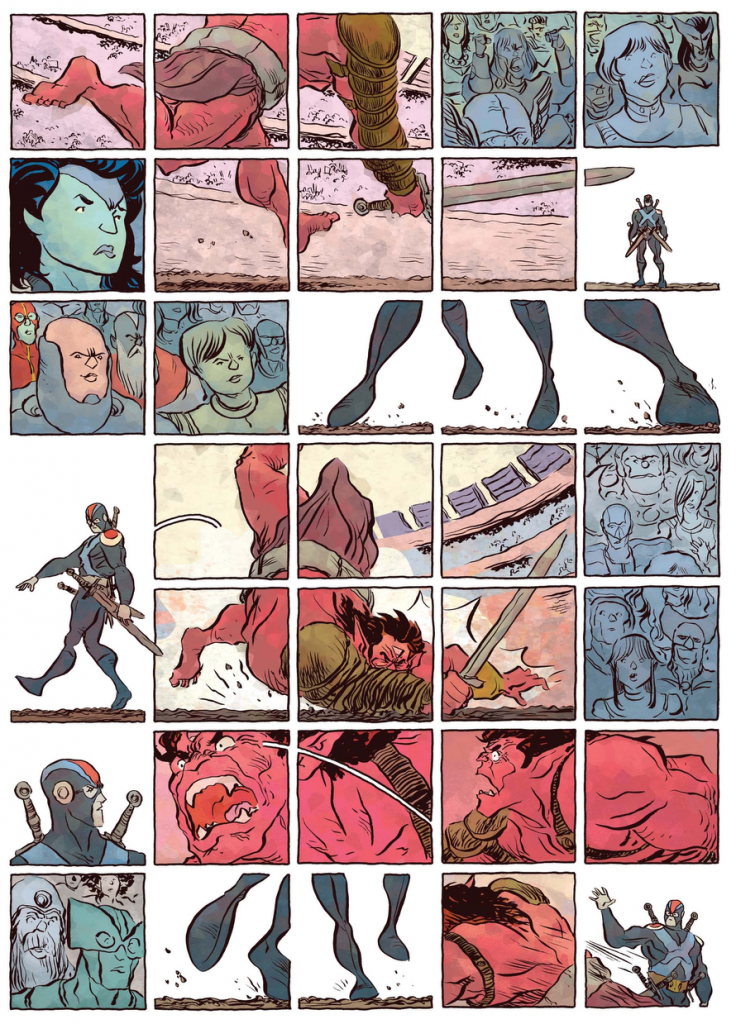
This feels like a continuation of Lonergan’s experimentation in Hedra, where dense paneling slows the reader down and forces closer attention to the page. In Drome, though, the grid is more than a pacing device. It shapes how the world is experienced. In the battle between Red and the Swordsman, for example, it defines how each character moves through the page’s architecture.
The Swordsman, a trained and agile fighter, is free of the grid’s boundaries. He slips between them with ease, dancing around the page unfettered. Red, on the other hand, is powerful, but also heavy and sluggish. He is trapped in the grid, unable to move as freely or as quickly as his opponent.
This dynamic culminates in the double-page spread at the heart of the fight. The Swordsman’s weapon doesn’t just break out of Red’s back. It breaks through the gutters and even across page boundaries. The Swordsman himself hovers above the grid. Only Red, wounded and near defeat, is placed within the grid’s constraints, boxed in by a web of gutters.
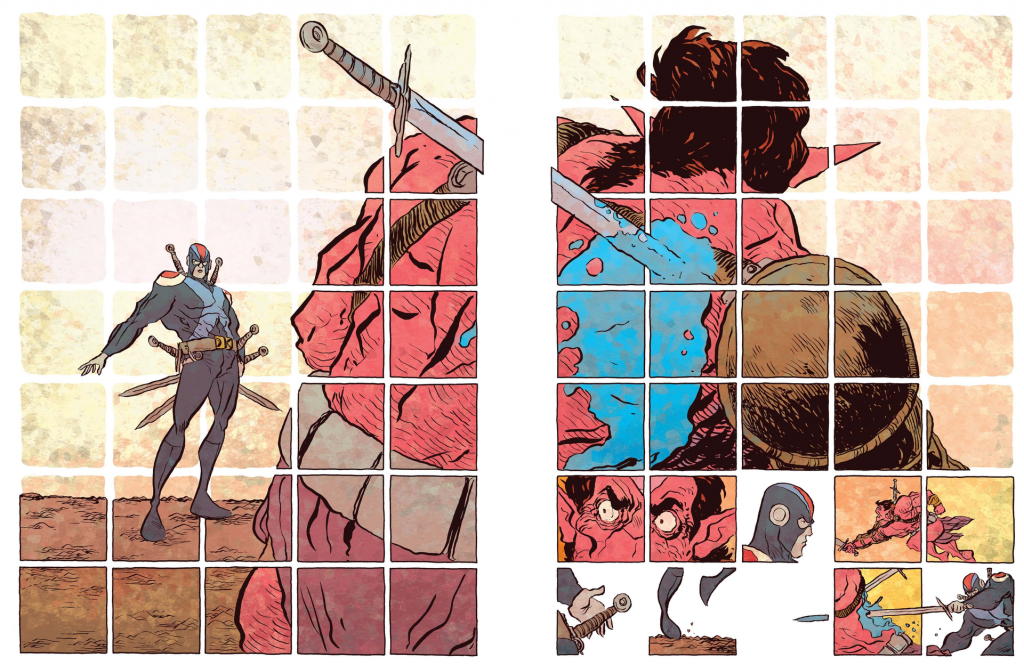
Comics theory has long treated the gutter as the charged space between images: the gap where readers connect one moment to the next. Lonergan challenges that idea. In Drome, gutters do not merely signify a move in time or space, a shift from one panel to the next. As we can see above, they often cut through a single continuous image, fragmenting one moment without fully breaking it. The effect is strange: we read the image both as a unified whole and as a sequence of parts.
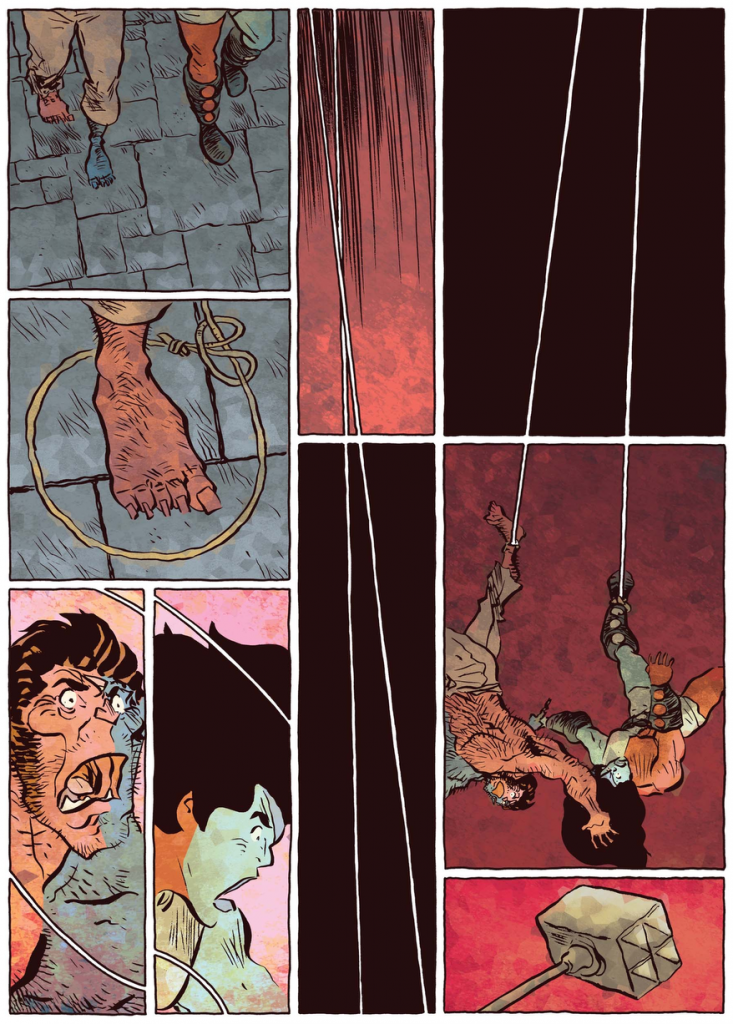
At times, Lonergan allows gutters to enter the fictional space, becoming forces inside the world itself. They often serve as movement lines, literalizing gesture and leading our eye across a page. But at key moments, they actually interact with the world and drive the story. The clearest examples are the birth of Blue, who is literally pulled into the world by gutters extending from Spirit’s fingertips, and the sequence when Blue and Red rush into a trap: the physical ropes of Drome’s world morph into gutters as they pull the heroes up by their feet.
Up to this point, Lonergan has invited the medium into the story: gutters become physical objects, the grid affects movement, panel borders represent water’s surface. But there is one culminating scene where Lonergan flips this relationship and invites the story into the medium. He moves beyond testing the formal language of comics and engages with the material vocabulary of print, turning comics production itself into the geography of his world.
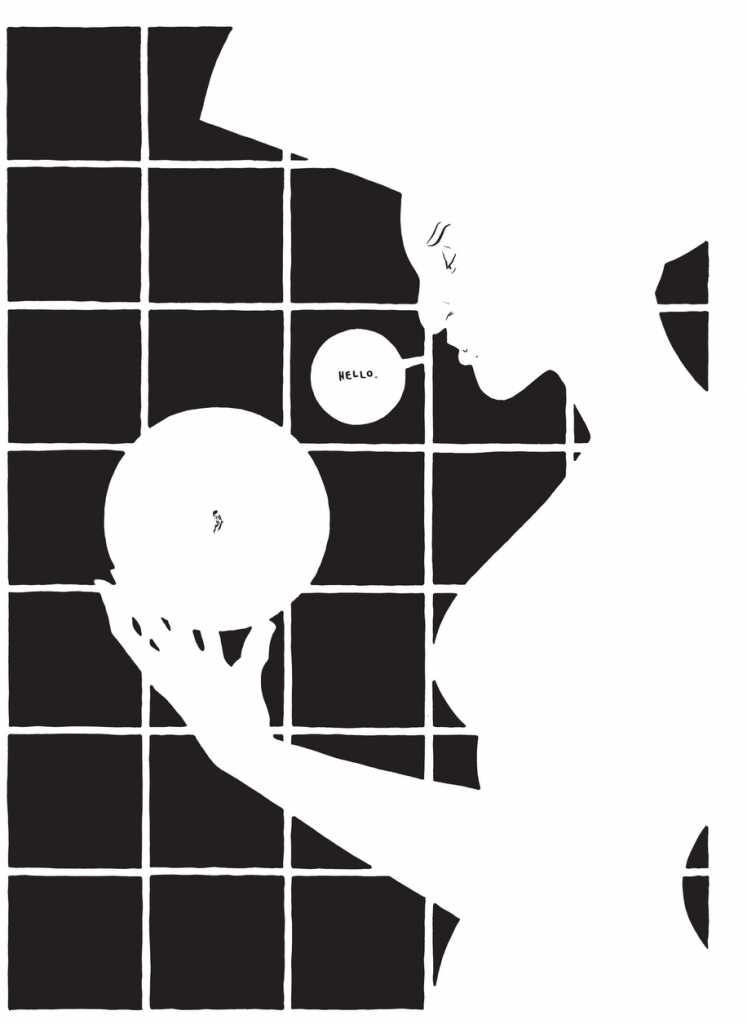
Blue ends her trip to the underworld by passing through what looks like a reverse printing process. The layered color of the comic-book world is stripped away until she is reduced to the duality at the core of the book: black on white.
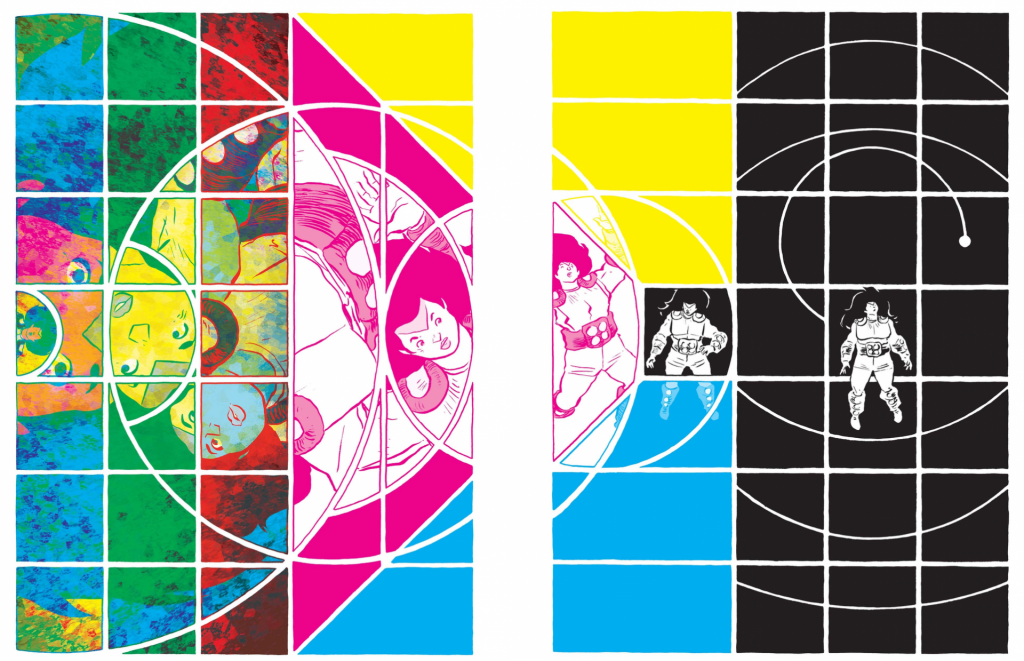
And in that primary form, she meets her creator. Spirit. The blank page. In this moment, Lonergan’s creation myth is no longer only about how a world is made. It is about the physical object that makes that world possible.
At its core, Drome is a book about language. Its world starts off with only the language of violence. Blue introduces the language of order and civilization. With Red, she explores the language of love. Yellow introduces (or perhaps reintroduces) the language of destruction. And it’s clear by now that, throughout the book, Lonergan is experimenting with the language of comics.
Which is why we can’t ignore that Drome is almost entirely a silent comic.
Across its three hundred and twelve pages of story, Drome uses roughly five hundred words. To put that into context, it averages out to less than two words per page. By any standard, that is astonishingly sparse. For Lonergan to tell a story that’s not only cohesive but also captivating, moving, and meaningful almost purely through visuals is more than an artistic flex. It’s a demonstration of the power and versatility of his own chosen language — the language of sequential art.
The four blocks of color on Drome’s first page are not preamble. They are the book. They are the cosmology of the printed page. They are the cosmology of Lonergan’s fictional world. They are the cosmology of Drome.
SOLRAD is made possible by the generous donations of readers like you. Support our Patreon campaign, or make a tax-deductible donation to our publisher, Fieldmouse Press, today.
Leave a Reply