
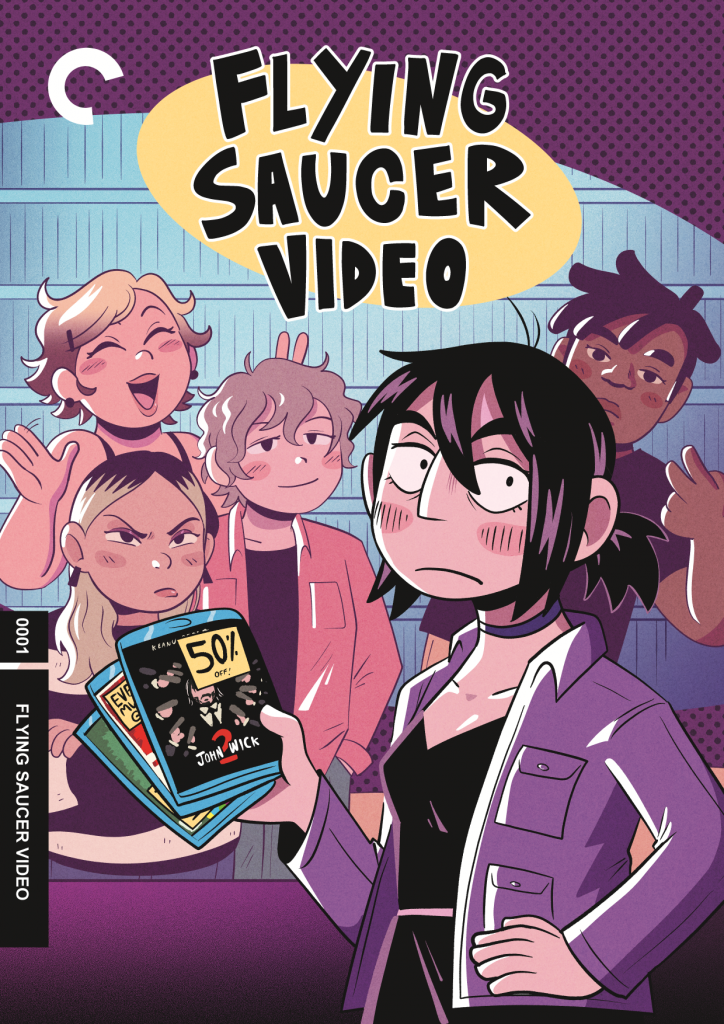
You know it’s not going to work out from the very first line. Panel one, page one of Cam Marshall’s Flying Saucer Video informs us that the titular DVD rental store shuttered its doors in 2020. This event – which occurs one year in the future from the actual start of the comic’s plot – contextualizes the bubbly, delightful world Marshall builds across the comic’s first arc. Across this opening run (what is referred to as “Disc One”), we are introduced to Frankie, our 24-year-old main character and the resident lazy clerk for Flying Saucer, along with a myriad of friends and crushes that make up her social circle. Like most 24-year-olds, Frankie feels pulled in a million different directions at once, especially when it comes to her love life. She entertains all-consuming crushes on every one of her coworkers, comprised of the beautiful Duncan, the deadpan Tyler, and the ambiguously heterosexual Tulip, each of whom tortures Frankie in ways both intentional and not. This web of rivalry, friendship, and attraction is thrown on its head by the introduction of Lucy, a stand-offish and enigmatic stranger who eventually blossoms into the comic’s main love interest.
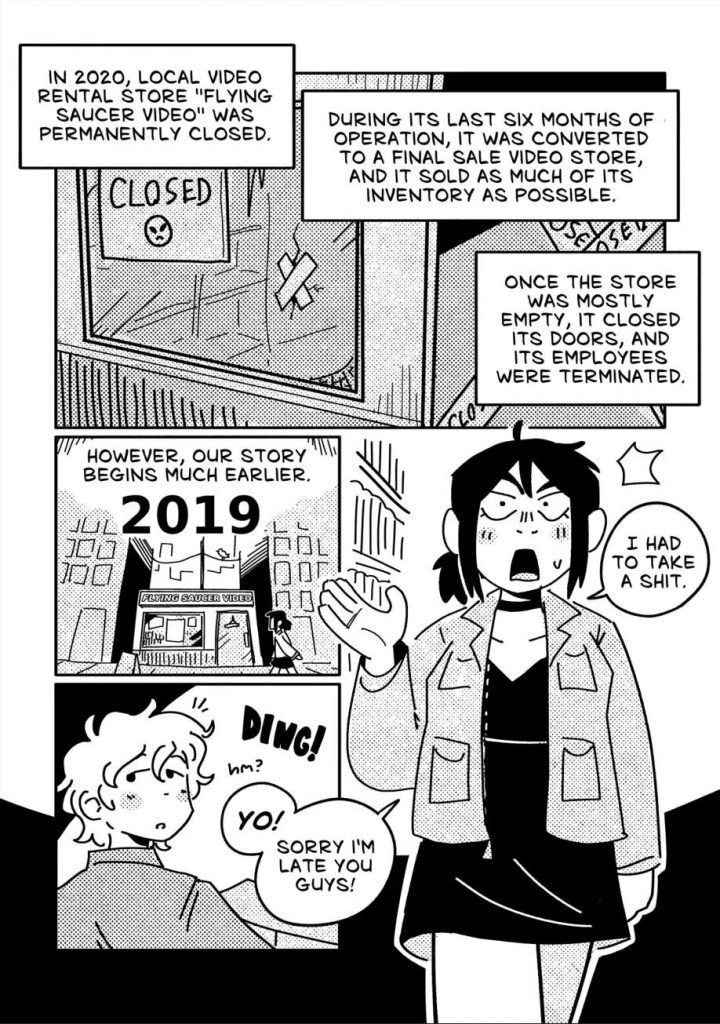
As the story develops, and the store’s imminent closure is made clear to Frankie, it becomes clear that a day job is not the only thing at stake for her. In an attempt to preserve this time in her life (and the various invaluable relationships that define it), she embarks on a project to preserve every DVD in the store on a digital archive. This goal, as admirable as it is futile, threatens to consume whatever remains of her connection to those around her.
This setup is great fodder for hijinks and drama alike, and, indeed, the comic is often both hysterical and surprising in its relatively light opening chapter. What elevates the story far past your typical slice-of-life romance, however, is that aforementioned contextualisation. The impending closure of the store lends every scene a grim portent, the reader always aware that, contrary to what the characters initially believe, we are reading about a bygone era. It’s worth noting that, while Marshall does not name it directly, the time period chosen inevitably evokes the spectre of the coronavirus pandemic. In this light, the delightful scenes of Frankie’s laidback life and petty personal foibles carry a bitter aftertaste.
This sense of dread is foregrounded by Marshall’s most audacious formal choice: third-person omniscient narration. Though the comic’s perspective remains firmly aligned with Frankie’s, Marshall often sees fit to expose us to various other characters’ personal monologues. Particularly memorable is Frankie and Duncan’s bus ride home, the narration informing us of the attraction both feel towards each other, but do not act on. As the comic continues, readers are increasingly aware of not just Frankie’s ambitions and anxieties, but those of her entire surrounding world.
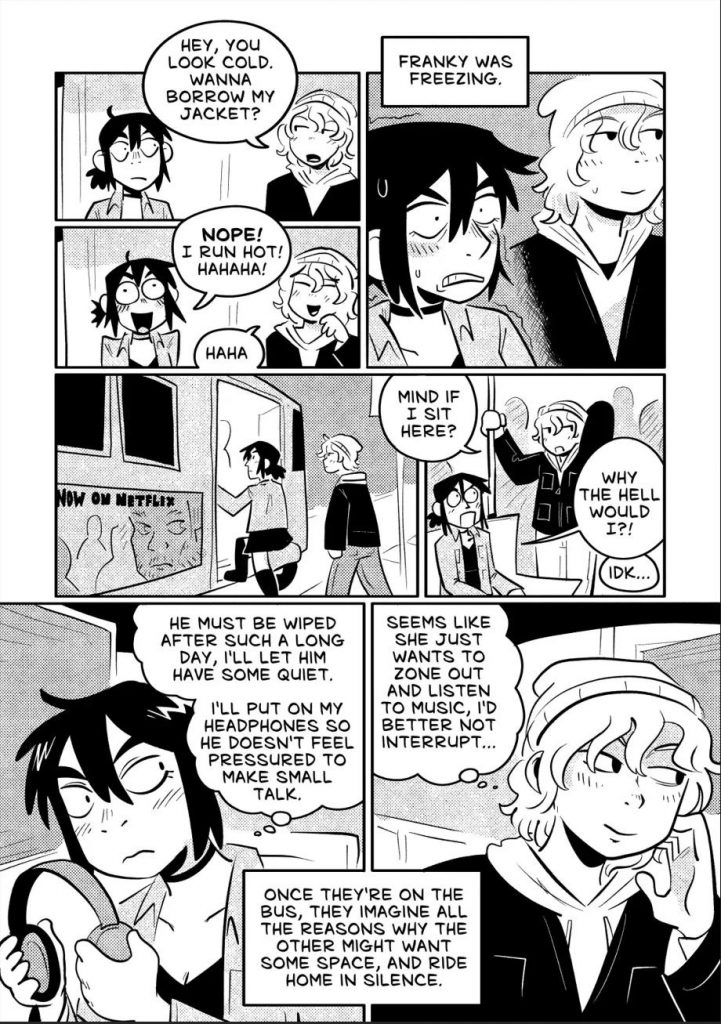
Conventional writing wisdom hazards against this approach, especially in a visually driven medium like comics. “Show don’t tell,” after all, and what is a better example of an author “telling” than a character verbosely informing us of everything that motivates their soul? Indeed, comics and animation are awash with characters seemingly gifted with their author’s omniscience, able to deliver perfectly calibrated and sensitively designed monologues to each other. This writing style, though popular and effective at communicating themes, renders much of modern drama and romance writing antiseptic, devoid of the invaluable texture of human failure. When was the last time anyone said exactly what they meant?
The genius of Marshall’s writing is its understanding of this failure. A character’s being able to articulate their ennui and desire to themselves does not prevent them from acting self-destructively for even a single second. Duncan pushes Frankie away, Frankie castigates herself for her attraction to Duncan, Lucy refuses to reciprocate Frankie’s desire, and each of these events is made all the more agonizing when we know how clearly they reflect these characters’ self-hatred. That dissonance between the characters’ wants and actions creates simmering tension on every page.
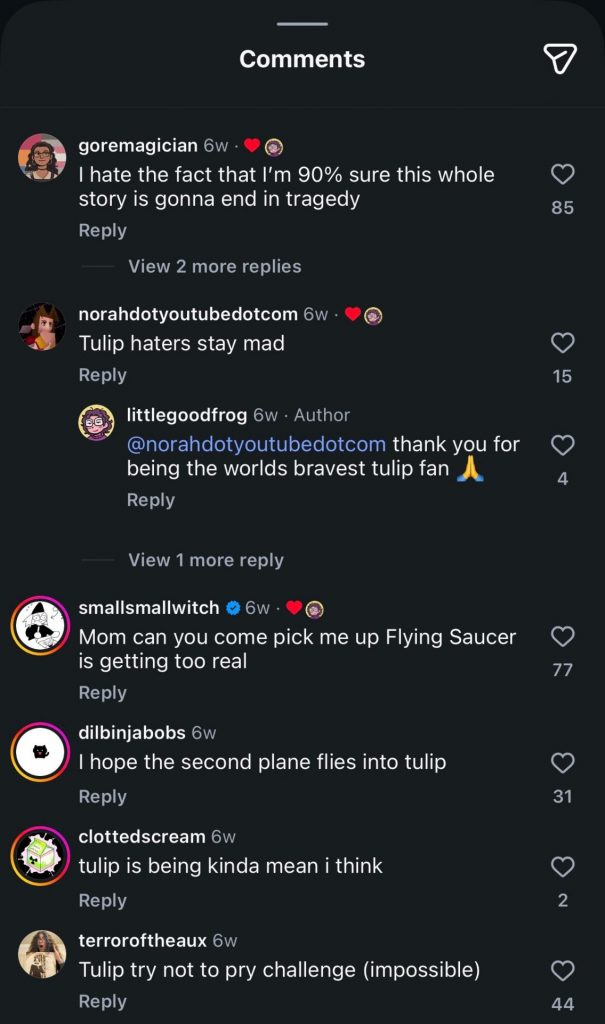
The current run of Flying Saucer Video offers the same pleasure as a slow-motion train crash (a phrase the comic uses directly) or a bird’s eye view of a 12-car pile-up. All parties involved seem bound towards a catastrophic collision, and you can only throw your hands up and hope no one is hurt too badly. If you’d like to see evidence of this narrative technique’s effect, scroll through any of the comment sections attached to the recent pages. Here you’ll find dedicated readers reacting to Tulip suggesting a “girl talk” or Duncan scooching slightly over on a couch like it’s the eclipse chapter of Berserk.
Marshall’s art style takes a few pages to find its footing, as is typical with serial comics, but it eventually establishes its identity in thick linework and bold black-and-white shape language. By the start of Disc Two, each new page is a screaming fastball served right across the plate. As any fan of shoujo, girls love, or more general romance comics will tell you, an understanding of theatrical staging is just as important as any drawing techniques. In a genre where the most heartstopping, stressful sequences usually feature two characters talking directly to each other, blocking out each panel’s view of the action to convey the internal feelings on display is a must. Flying Saucer sets itself apart from the pack by leaning into its heavy shadows and cramped framing. While the warm particle effects and steamy close-ups could be ripped straight out of Bloom Into You, more recent pages have established a noirish angularity that matches the story’s subliminal darkness.

While the comic’s environments are often rich in atmosphere (the aquarium date sequence is a stand out), the real strength of Marshall’s art is in the characters. Even at its most stylized, Marshall renders characters with a weight and presence that make them feel real. Facial expressions run the gamut from playful exaggeration to uncomfortable rawness, all hot tears and puffy cheeks. There is a love of the human form, evident especially in the romantic and erotic scenes. The character’s delicate body hair, beautifully sculpted fat, or sensitive lips are lovingly rendered and centered as the focus of each other’s gaze.
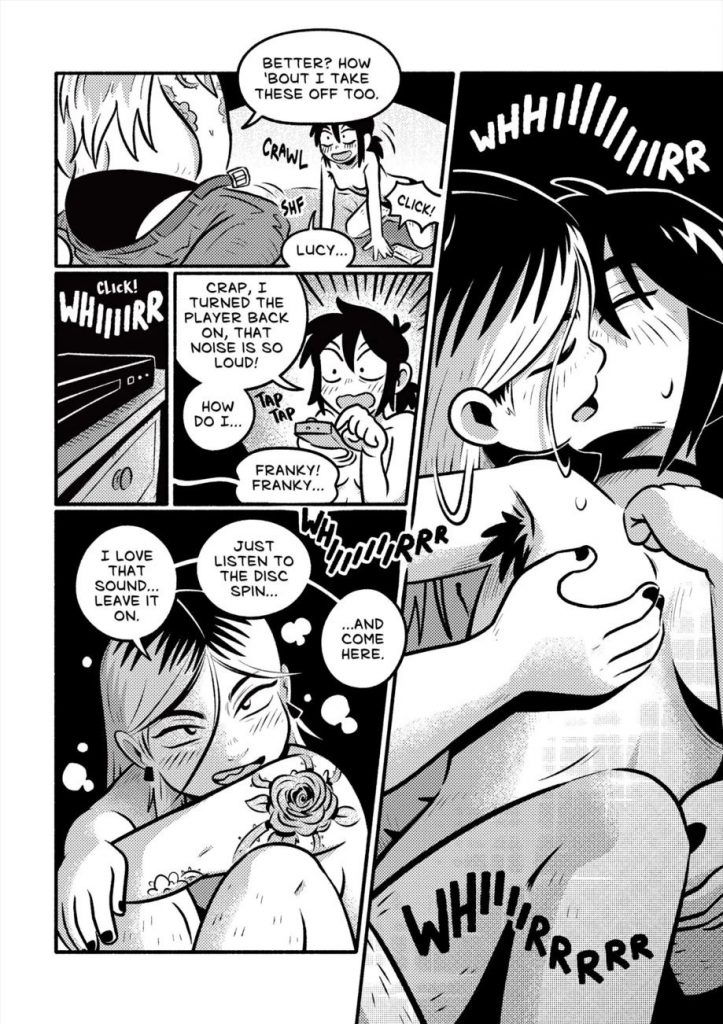
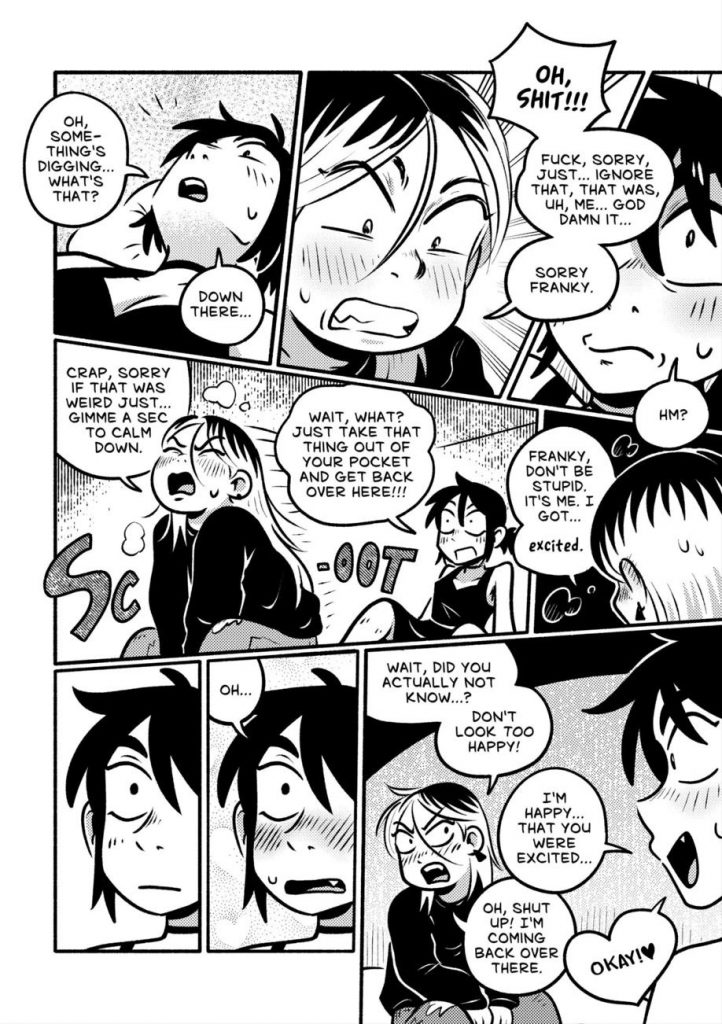
Cumulatively, these techniques reveal Marshall’s stated aim of rendering adult queer relationships that include the actual material realities of adult queer life. Readers are privy to these characters’ sex lives because who sleeps with whom (and how well they do it) is information that spills out into the rest of their relationships and behavior. People don’t just stop what they’re doing to have sex; they carry the rest of themselves into the bedroom, and the bedroom out into the rest of their lives. One of the most memorable scenes in Flying Saucer Video is when Frankie, during an intense make-out session, discovers that Lucy is transgender. The moment is silly and sexy, but reflects perhaps the most pressing and primal anxiety experienced by lesbians of every gender persuasion: the fear of your body being rejected by the person you trust most in the universe.
Flying Saucer Video’s characters feel real because of how fully rendered their own sense of self is and how catastrophically they fail to reflect it in their actions. Its world provides no guarantee of protection for this found community — in fact, it nearly assures its destruction. The crash seems inevitable because of how long ago the decisions that lead to it were made. Frankie, Lucy, and the rest of the cast are unaware of the strings that pull them, be it a worldwide pandemic or unresolved grievances. The price, as the comic repeatedly reminds us, may be the loss of the community as a whole, the loss of the greatest romance of Frankie’s life, or that fear most gripping to every young adult: perpetual stagnation, the loss of the ability to grow anything new. Still, with love so sweet and bodies so warm, even an inevitable end seems worth fighting against.
SOLRAD is made possible by the generous donations of readers like you. Support our Patreon campaign, or make a tax-deductible donation to our publisher, Fieldmouse Press, today.
Leave a Reply